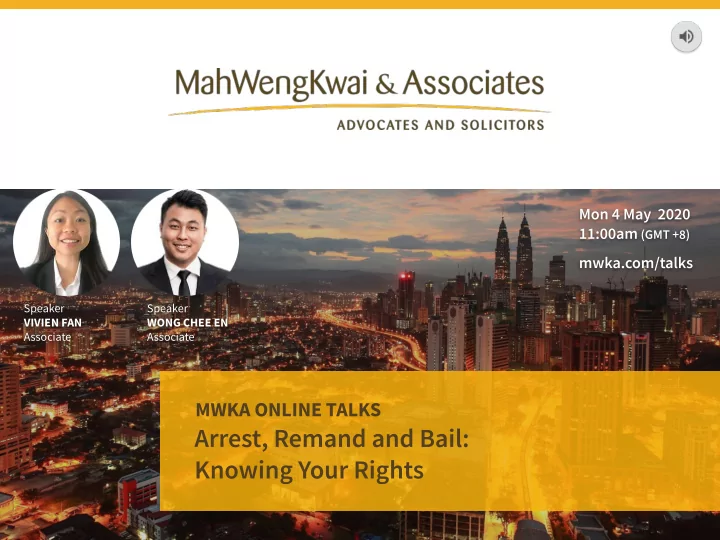
MWKA ONLINE TALKS 2 Speaker Speaker VIVIEN FAN WONG CHEE EN - - PowerPoint PPT Presentation

mwka online talks 2
SMART_READER_LITE
LIVE PREVIEW

MWKA ONLINE TALKS 2 Speaker Speaker VIVIEN FAN WONG CHEE EN - - PowerPoint PPT Presentation

Speaker Speaker VIVIEN FAN WONG CHEE EN Associate Associate MWKA ONLINE TALKS 2 Speaker Speaker VIVIEN FAN WONG CHEE EN Associate Associate MWKA ONLINE TALKS About Us Welcome to MahWengKwai & Associates! Trusted by


slide-1
SLIDE 1

MWKA ONLINE TALKS

Speaker VIVIEN FAN Associate Speaker WONG CHEE EN Associate
slide-2
SLIDE 2

2

slide-3
SLIDE 3

MWKA ONLINE TALKS

Speaker VIVIEN FAN Associate Speaker WONG CHEE EN Associate

slide-4
SLIDE 4

About Us

  • Welcome to MahWengKwai & Associates!
  • Trusted by small medium enterprises (SMEs),

family businesses and individuals.

  • Established in 1985 by Dato’ Mah Weng Kwai,

now a consultant with the firm.

  • Medium-sized law firm with 22 lawyers and 19 staff.

4

slide-5
SLIDE 5

Our Services

  • Full-service law firm with 4 Departments:

○ Corporate ○ Dispute Resolution ○ Employment ○ Individuals & Families

5

slide-6
SLIDE 6

Our Practice Groups

  • 5 Practice Groups:

○ ASEAN-China Desk ○ Construction ○ Foreign Direct Investment ○ Real Estate ○ Sports & eSports

6

slide-7
SLIDE 7

MWKA Online Talks

  • To share knowledge, raise awareness, encourage networking
  • For clients, potential clients, in-house counsel
  • Recent MWKA Online Talk:

○ 29.4.2020: Resolving Construction Disputes after the MCO

  • Upcoming MWKA Online Talk:

○ 4.5.2020: Debt Recovery during and after the MCO ○ 8.5.2020: Unfair & Constructive Dismissal Claims due to Pay Cuts, VSS & Retrenchment

7

slide-8
SLIDE 8

Vivien Fan

  • Associate in our Dispute Resolution and

Individuals & Families departments.

  • Bachelor of Laws (Honours) from Cardiff

University, Wales, UK

  • Called to the English Bar in July 2016
  • Admitted to the Malaysian Bar in 2017
  • Areas of practice include general litigation,

debt recovery, criminal, construction, land acquisitions, probate and administration of estates, contractual disputes and tenancy disputes.

8

slide-9
SLIDE 9

Wong Chee En

  • Associate in our Dispute Resolution and

Individuals & Families departments.

  • Bachelor of Laws (Honours) from University
  • f Leeds, Leeds, UK
  • Called to the English Bar in November 2018
  • Admitted to the Malaysian Bar in 2020
  • Areas of practice include general litigation,

construction, land disputes, land acquisition, corporate and commercial litigation, debt recovery, family law matters, criminal and Joint Management Body matters.

9

slide-10
SLIDE 10

Ask Questions on Slido

Please scan this QR Code to access Q&A and polling platform for this talk. Post the questions that you would like to ask. Upvote/Like the questions you like. Most liked / popular questions will be discussed and answered by the speaker(s) during the Q&A session. Or visit https://www.sli.do and enter #96019

slide-11
SLIDE 11

Talk Points

  • What amounts to an arrest? What are your rights?
  • What is remand? How long can you be detained?
  • What happens if you are stopped during MCO?
  • What happens when you are charged?
  • What is bail? How do you obtain bail?

11

slide-12
SLIDE 12
slide-13
SLIDE 13

What amounts to an arrest? What are your rights?

  • Article 5(1) of the Federal Constitution

Liberty of the person 5(1) No person shall be deprived of his life or personal liberty save in accordance with law.

13

slide-14
SLIDE 14

What amounts to an arrest? What are your rights?

  • What amounts to an arrest?

[Section 15(1) of the CPC & Common Law]

○ When the police officer informs you that he is

arresting you

○ When a police officer handcuffs, or restrains

your movement

  • Can the police use force to arrest you?

○ Yes, if you resist arrest

14

slide-15
SLIDE 15

What amounts to an arrest? What are your rights?

  • What do you need to know?

○ Whether the police officer has authority to arrest you ■ Ask for name and ID card ■ Red: Suspended ■ Blue: Rank of inspector and above ■ Yellow: Below rank of inspector ■ White: Police reserve ○ Your rights if you are being arrested.

[Article 5 of the Federal Constitution and Section 28A of CPC]

15

slide-16
SLIDE 16

What amounts to an arrest? What are your rights?

  • What do you need to know?

Your rights if you are being arrested.

[Article 5 of the Federal Constitution and Section 28A of the CPC]

  • 1. Right to be informed
  • 2. Right to communicate
  • 3. Right to consult and be defended
  • 4. To defer any questioning/recording of statement

until consultation

  • 5. Right to be released/brought to a Magistrate

after 24 hours

16

slide-17
SLIDE 17

What amounts to an arrest? What are your rights?

  • (1) Right to be informed

○ Must inform you the grounds of your arrest ASAP ○ Don’t have to if: ■ It is clear, e.g. getting caught in the act, or ■ Suspect makes it difficult to do so

17

slide-18
SLIDE 18

What amounts to an arrest? What are your rights?

  • (2) Right to communicate

○ To relative, friend, lawyer ○ Such right can be denied if:

[Section 28A(8) of CPC: authorised by officer not below rank

  • f Deputy Superintendent Police]

■ Police reasonably suspects that it will lead to:

  • Tampering of evidence
  • Accomplice avoiding arrest, or
  • Others’ safety

18

slide-19
SLIDE 19

What amounts to an arrest? What are your rights?

  • (3) Right to consult and be defended

○ A lawyer of the suspect’s choice ○ Police officer must provide reasonable facilities for the communication to take place

[Section 28A(7) of CPC]

  • (4) Right to defer any questioning/recording of

statement until such consultation take place

[Section 28A(6) of CPC]

19

slide-20
SLIDE 20

What amounts to an arrest? What are your rights?

  • (5) Rights during police interview

○ During questioning or recording of statement in an

interview by an Investigating Officer (IO) for investigation purposes if he thinks you have the information and knowledge of the case ○ Right to remain silent (if likely to expose you to a criminal offence) ○ Answers will be recorded in writing (i.e. the Section 112 Statement”) ○ Read to you, confirm accuracy and sign

20

slide-21
SLIDE 21

What amounts to an arrest? What are your rights?

cont.

  • (5) Rights during a police interview

○ If an IO calls you and tells you he wants to interview you, you should cooperate - time & place ○ If fail to comply, the IO may issue an order in writing ○ If disobey such order, Court can issue a warrant

  • f arrest

21

slide-22
SLIDE 22

What is remand? How long can you be detained?

  • How long can you be detained upon arrest?

○ Total of 24 hours only

  • What happens after 24 hours?

○ Suspect must be released, or ○ Police officer must bring suspect before a Magistrate and apply for a remand order to extend the detention period for further investigation

[Section 117 of CPC & Article 5(4) of the FC]

22

slide-23
SLIDE 23

What is remand? How long can you be detained?

  • How long can the detention period be extended?

○ The police officer can apply to the Magistrate twice.

  • 1. Offence punishable with imprisonment < than 14 years

[Section 117(2)(a) of the CPC]

○ 1st remand order : Not > 4 days ○ 2nd remand order : Not > 3 days

  • 2. Offence punishable with imprisonment > than 14 years

[Section 117(2)(b) of the CPC]

○ 1st remand order : Not > 7 days ○ 2nd remand order : Not > 7 days

23

slide-24
SLIDE 24

What is remand? How long can you be detained?

  • Exceptions?

○ Drug Dependants (Treatment and Rehabilitation) Act 1983 - 14 days ○ Immigration Act 1959/1963 - non-citizen to be remanded for 14 days

24

slide-25
SLIDE 25

What is remand? How long can you be detained?

  • Can you be represented during a remand

application? ○ Yes

  • What do we lawyers do?

○ Oppose the remand application, and submit why the suspect should not be detained any longer

25

slide-26
SLIDE 26

What is remand? How long can you be detained?

  • What happens at the end of the detention period?

○ The police officer must either: ■ Release the suspect if there is not enough evidence to charge the suspect in Court, or ■ Bring to the Court to be charged.

26

slide-27
SLIDE 27

What happens if you are stopped during MCO?

  • The Prevention and Control of Infectious Diseases

(Declaration of Infected Local Areas) Order 2020 = Movement Control Order (“MCO”) ○ Regulations were passed to prevent and control Covid-19 in areas declared as “infected local areas” ○ Restricts movement within Malaysia unless it falls within any of the exceptions

27

slide-28
SLIDE 28

What happens if you are stopped during MCO?

  • What happens if you breach the MCO, i.e. “flout

the regulations”? ○ An offence punishable with either: ■ Imprisonment of maximum 6 months, or ■ A fine of not more than RM1,000, or ■ Both

28

slide-29
SLIDE 29

What happens if you are stopped during MCO?

  • Case of PP v Chin Chee Wei

○ 2 accused were arrested and charged jointly by the Sungai Siput Magistrates’ Court for flouting the regulations during MCO ○ Found on a motorcycle carrying fish rods near a fishing pond at Sg Siput ○ Pleaded guilty, convicted and sentenced to 3 months’ imprisonment

29

slide-30
SLIDE 30

What happens if you are stopped during MCO?

  • Case of PP v Chin Chee Wei

○ The Taiping High Court Judge called for the records

  • f the Sg Siput Magistrates Court and defense

counsel applied for a review of the sentence passed ○ On 8.4.2020, the High Court Judge revised the sentence to compulsory attendance daily at the Perak Compulsory Attendance Centre and undertake compulsory work for 3 months (4 hours a day). A bond with one surety of RM500. ○ In the meantime, to report once a week, every Monday to IPD Sg Siput Utara Police Station

30

slide-31
SLIDE 31

What happens if you are stopped during MCO?

  • What happens if you are stopped by the police on

duty during MCO? ○ Name, address, where you are headed to ○ If you have flout the regulations, the police will ask you to meet at the nearest police station to interview you (take down your statements) ○ The police will release you on police bail, and fix another date for you to attend ○ The Prosecution will decide whether to prosecute you

31

slide-32
SLIDE 32

What happens if you are stopped during MCO?

  • Can the police arrest you for flouting the

Regulations? ○ Procedurally: No. ■ It is a non-seizable offence under the CPC. ■ Cannot arrest you without a warrant. ■ Discussion: Use of police powers to arrest under Section 186 of Penal Code: Voluntarily

  • bstructing a public servant in discharging his

duty

32

slide-33
SLIDE 33
slide-34
SLIDE 34

What happens when you are charged?

  • When you are brought to Court to be charged [Section 173 of

CPC]:

1. Charge containing the particulars of the offence will be read

  • ut in Court by the Court interpreter and explained to you

in language that you can understand 2. After reading the charge, you will be asked whether you understand the charge against you 3. Then you will be asked whether you want to plead guilty (mengaku salah) or plead not guilty (tidak mengaku salah) to the charge against you

34

slide-35
SLIDE 35

What happens when you are charged?

4. a) If plead guilty (mengaku salah), the Court interpreter will read out the maximum sentence of the offence that you are charged with, and confirm with you if you still want to plead guilty ○ If you still intend to plead guilty, Court interpreter will inform the Judge that you have pleaded guilty. The Judge will record your conviction and proceed to ask parties to submit on sentencing ○ Prosecution submit on what sentence should be imposed

35

slide-36
SLIDE 36

What happens when you are charged?

cont’d ○ You (or defence counsel) will submit and mitigate for a lower sentence. However it is the discretion of the Court to determine whether a lower sentence will be allowed ○ Examples of factors to mitigate for a lower sentence: i. criminal record (first time offender) ii. age iii. medical condition iv. Financial capabilities ○ After hearing both parties’ submission, the Judge will proceed to order the sentence against you

36

slide-37
SLIDE 37

What happens when you are charged?

4. b) If plead not guilty (tidak mengaku salah) or refuse to plead, the Court interpreter will inform the Judge and the Judge will record your not-guilty plea ○ Judge will fix a next Mention date to proceed to trial ○ You (or your defence counsel) will then ask for you to be released on bail pending the next Mention date ○ You (or your defence counsel) will submit on why you should be released on bail

37

slide-38
SLIDE 38

What happens when you are charged?

38

Court will ask the accused whether to plead guilty or not guilty

Plead Guilty Plead Not Guilty Claim trial Record conviction, proceed to sentencing

Brought to Court to be charged

Mitigation Apply for Bail Detained pending trial

slide-39
SLIDE 39

What is Bail?

  • “Bail, in simple language, means security taken from a

person to appear on a fixed date before a court. The meaning of the word ‘bail’ as ordinarily and commonly understood is to set free a person who is under arrest, detention or is under some kind of restraint by taking security for his appearance.” - Yusoff bin Mohamed v Public Prosecutor [1995] 3 MLJ 66

  • The Court may release you on certain conditions pending

your next Court appearance, usually depositing a a sum of money into Court (security/bail sum) and give an undertaking to ensure your subsequent Court attendance throughout the trial

39

slide-40
SLIDE 40

How do you obtain bail?

  • Are you entitled to bail?

○ Depends on the category of offence that you are charged with ○ 3 scenarios:

■ You are entitled to bail if charged with bailable

  • ffence. Court cannot deny you bail

■ Depends on the Court - if charged with non-bailable

  • ffence. Court will decide based on the seriousness
  • f the offence and facts of the case;

■ You are not entitled to bail if charged with unbailable offence

40

slide-41
SLIDE 41

How do you obtain bail? - Bailable offence

  • Bailable offences [Section 387 of CPC]:

○ A person charged under bailable offence shall be released on bail as of right. The Court cannot deny you bail ○ Usually less serious offences which carry lighter sentences - offences which carry imprisonment of less than 3 years and/or fine

41

slide-42
SLIDE 42

How do you obtain bail? Non-bailable

  • ffence
  • Non-bailable offences [Section 388 of CPC]:

○ The Court has the discretion to decide whether to grant you bail (Not as of right) for non-bailable offence ○ Usually more serious offences which carry heavier sentences - offences which carry imprisonment of more than 3 years, imprisonment for life or even punishable by death. Example of non-bailable offences: murder

42

slide-43
SLIDE 43

How do you obtain bail? Non-bailable

  • ffence
  • How does the Court decide whether to grant bail?

○ if the offence is punishable by death or life imprisonment, the Court will not grant bail if there are reasonable grounds to believe that you have committed the offence, unless if you are: ■ under age of 16; ■ a woman; or ■ ill ○ if the offence is not punishable by death or life imprisonment, the Court may decide to grant bail based

  • n several factors, for example: seriousness of offence,

danger of absconding, danger of repeated offence

43

slide-44
SLIDE 44

How do you obtain bail? Unbailable offence

  • Unbailable offences - offences which may involve provisions
  • ther than CPC

○ The Court cannot grant you bail at all ○ Examples of unbailable offences: ■

  • ffences relating to terrorism;

■ kidnapping offences under Kidnapping Act 1961; ■

  • ffences under section 3 of Firearms (Increased

Penalties) Act 1971

44

slide-45
SLIDE 45

How do you obtain bail?

  • As you are in detention in Court, you will be required to

contact someone to bail you out from being detained, usually your family member(s) or friend(s) (i.e. a bailor)

  • Who can be a bailor?

○ An adult (age must be above 18 years) ○ Malaysian citizen (for non-citizen, the person shall be subjected to certain conditions imposed by the Court) ○ For foreign accused, the bailor shall be a Malaysian citizen ○ Understand all the conditions imposed by the Court, and able to pay the bail sum fixed by the Court

45

slide-46
SLIDE 46

How do you obtain bail?

  • The responsibility of a bailor is to ensure your attendance in

Court on the dates fixed by the Court. If you fail to attend Court, the bailor will have to attend Court and explain the reason for your non-attendance. The bail sum deposited by the bailor will also be forfeited if you fail to attend your subsequent Court date

  • Apart from imposing a bail sum, the Court may also impose

further conditions to ensure your attendance in Court. Examples of other conditions: ○ Report to police station on a weekly basis ○ Not allowed to travel overseas (Surrender passport)

46

slide-47
SLIDE 47

How do you obtain bail?

  • Bail process:

a. Bail will be processed at the relevant Court registry; b. The bailor has to produce his NRIC, and his accounts or land title to be used as payment of bail sum; c. The Court will explain the conditions of the bail and the

  • accused. Both the bailor and the accused will then

execute the bail bond

47

slide-48
SLIDE 48

How do you obtain bail?

  • What happens if you breach the conditions of the bail

granted? ○ The Bailor will be summoned to Court to answer to the Judge ○ Bail sum may be forfeited ○ The Court will issue a warrant of arrest ○ The Court may revoke bail, or impose stricter/more conditions during your next appearance in Court

48

slide-49
SLIDE 49

Bail for committing an offence under the Regulations?

  • Are you entitled to bail for committing an offence under

the Regulations, i.e. “flouting the regulations under MCO”? ○ Yes, you are entitled. It is a bailable offence ○ But, can deny you bail if you are charged for committing an offence under Section 186 of Penal Code, i.e.

  • bstructing public officer from carrying out his duties

49

slide-50
SLIDE 50

Questions?

slide-51
SLIDE 51

Upcoming Talks

Date Topic Speakers 6 May 2020 (Wednesday) Debt Recovery during and after the MCO Gan Chong Chieh Wong Sue Ann 8 May 2020 (Friday) Unfair & Constructive Dismissal Claims Due To Pay Cuts, VSS and Retrenchment Diana Cheak John Chan

Sign up for more MWKA Online Talks at https://mahwengkwai.com/talks-signup/

slide-52
SLIDE 52

Complimentary Consultation

Schedule a complimentary 30 minute video-consultation with our lawyers by filling up the form at https://mahwengkwai.com/schedule-a-meeting/

slide-53
SLIDE 53

Thank you!

Notice: This presentation does not constitute legal advice and its contents should not be relied upon as such. The facts and circumstances of each and every case will differ and therefore will require specific legal advice. Feel free to contact us for complimentary legal consultation.