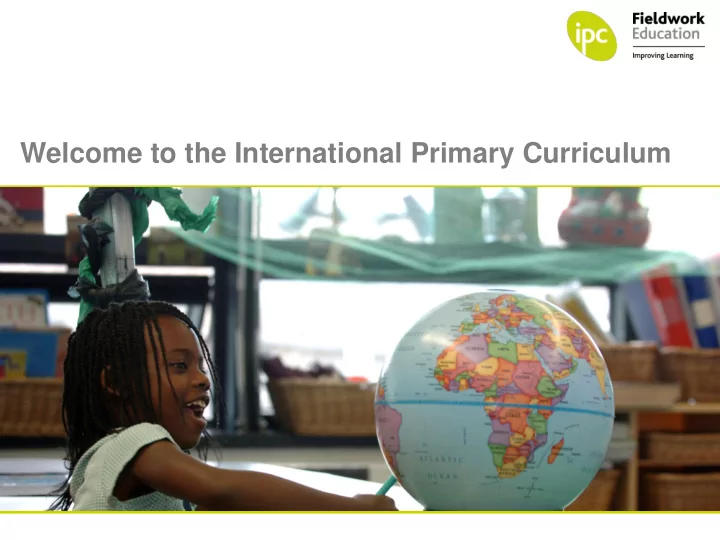
SLIDE 1
Welcome to the International Primary Curriculum
SLIDE 2 What is the IPC?
- A philosophy (what we believe)
- A pedagogy (an approach to teaching and
learning)
- A process (which honours how children learn best
in this age group) Our philosophy, pedagogy and process are aimed at improving children’s learning.
SLIDE 3 Fast facts
- Includes over 130 thematic units
- Taught in over 90 countries
- International schools
- UK state schools and academies
- Dutch national schools
- Special Education schools
- Shell schools
- British Schools of America
SLIDE 4
Milepost 1 (5-7 years) Milepost 2 (7-9 years) Milepost 3 (9-12 years)
- Assessment for Learning Programme
- Specialist Skills Programmes (Art, Music, PE, ICT &
Computing)
The Programmes
SLIDE 5
The IPC extends knowledge, skills and understanding, develops personal attributes and supports an international perspective in a way that responds to revised ideas about learning. Developing 21st Century Learners
SLIDE 6
Types of Learning
SLIDE 7
Academic Learning
The IPC Subject Learning Goals are the foundation on which the IPC was built. The learning goals cover the knowledge, skills and the understandings that children will develop. Knowledge Skills Understanding
What children will know What children will be able to do What children will understand
SLIDE 8
The IPC Personal Learning Goals underpin each unit – they represent the attributes that we believe children will find essential in the 21st Century. They help children to develop those qualities that will enable them to be at ease with the continually changing context of their lives. Enquiry Communication Thoughtfulness Adaptability Cooperation Resilience Respect Morality
Personal Learning
SLIDE 9 The IPC’s International Learning Goals help children begin the move towards an increasingly sophisticated national, international, global and intercultural perspective and develop a sense of ‘international mindedness’. Each unit has embedded within it, across the different subjects, learning-focused activities that help children start developing a global awareness and gain an increasing sense
- f themselves, their community and the world around them,
as well as inspiring positive action and engagement with global issues.
International Learning
SLIDE 10 Thematic Units
- Art
- Geography
- History
- ICT
- Language Arts
- Mathematics
- Science
- PE
- Technology
- Music
- Society
- International
Our units are organised around a theme, which helps children to see how subjects are both ‘independent’ and ‘interdependent’ enabling them to see ‘the big picture’ of their learning, make connections through and across different subjects, and talk about a theme from multiple perspectives.
SLIDE 11
The IPC Process of Learning
There is a distinct learning process with every IPC unit, providing a structured approach to make sure that children’s learning experiences are as stimulating and rigorous as possible.
SLIDE 12 Entry Point
- Wow factor!
- Motivation for learning – the hook
- Inspire learning through passion for
the theme
Chocolate unit – Milepost 2
Circus Unit – Milepost 1 The Magic Toymaker – Milepost 1 Investigators – Milepost 3
SLIDE 13 The Knowledge Harvest
- What do children already know?
- Helps to make connections with
previous learning
SLIDE 14 Explaining the Theme
- Gives children the ‘big picture’ of their learning
- Shared with parents at the start of a unit to help support the learning at
home
SLIDE 15
Researching and Recording
Each IPC unit has a research activity and a recording activity. Research activities always precede the recording activities. During research activities, children use a variety of methods and work in different group sizes to find out a range of information. During the recording activities, children interpret the learning they have researched and have the opportunity to demonstrate, share and explain their learning in different ways.
SLIDE 16 16
Exit Point – when the learner becomes the teacher!
Mission to Mars - Milepost 3 Pictures, Paintings and Photographs - Milepost 2
The exit point has two main purposes: to help children pull together their learning from the unit and to celebrate the learning that has taken place.
SLIDE 17 Assessment for Learning
It isn't enough to assume that children are learning. We need some way of measuring improvements in learning. Our programme supports teachers in assessing, and children in self-assessing, their progress with key skills from the IPC Learning Goals. It provides:
- specific skills assessment for Mileposts 1, 2 and 3
- a system that provides learning advice
- a rubric (success criteria) for teachers and children
- tracking through beginning, developing and
mastering
SLIDE 18
Beginning Developing Mastering
The child can make a simple map or plan with some identifiable features in pictorial form. The features are not in their correct relative positions. The child independently produces a map with three or more identifiable features in correct relative positions. Features may be shown as pictures or symbols. The child independently produces a map with most features in the correct position relative to one another. They use symbols rather than pictures to identify features and may include a simple key.
Sample Teacher Rubric
SLIDE 19
Sample Children’s Rubric
SLIDE 20 Peer Assessment
Children use the rubrics to self and peer assess, putting them in charge
SLIDE 21 How you can get involved!
- Look out for the parent information letter to find out about
the next IPC unit
- Supply resources from home and host country if available
- Join in with entry and exit points
- Talk to your children about their learning