Welcome Some of our work What we have learnt so far WHAT DO YOU - - PowerPoint PPT Presentation

welcome some of our work what we have learnt so far what
SMART_READER_LITE
LIVE PREVIEW

Welcome Some of our work What we have learnt so far WHAT DO YOU - - PowerPoint PPT Presentation

Welcome Some of our work What we have learnt so far WHAT DO YOU LOVE ABOUT HOOKY? The consensus seems to be that Hooky is a great place to live because it is off the beaten track and has a sense of self sufficiency , for example people like


slide-1
SLIDE 1

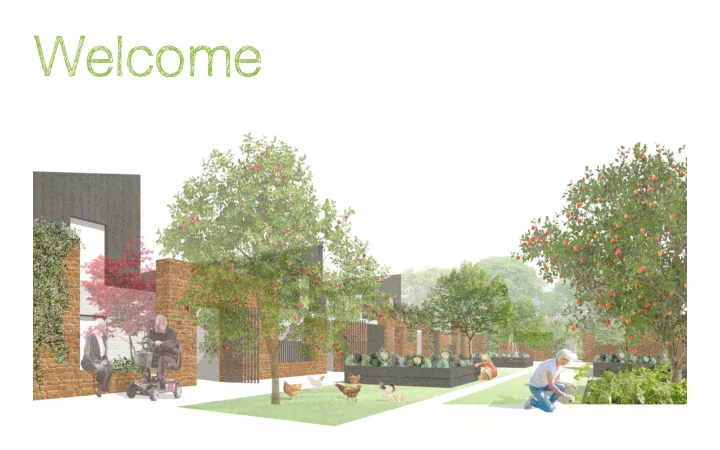
Welcome

slide-2
SLIDE 2

Some of our work

slide-3
SLIDE 3

What we have learnt so far

slide-4
SLIDE 4

WHAT DO YOU LOVE ABOUT HOOKY?

The consensus seems to be that Hooky is a great place to live because it is off the beaten track and has a sense of self sufficiency, for example people like the fact that it has its own independent shops and

  • pubs. People talk of the mix of people and

the lack of 2nd homes, that it is a vibrant village with its own life and industry. People seemed to value the range of meeting places and the ‘messy’ architecture.

slide-5
SLIDE 5

WHAT IS THE DREAM?

The most common dream was for the provision of shared facilities that would enrich home life, these included art studio space, laundrette, cafe, workspace and youth centres. People were also keen on the idea of shared garden space, but also on the idea

  • f private gardens, both/and rather

than one or the other. In terms the architecture itself, people were keen that it was not homogeneous, but that it was ‘modern’ and ‘visionary’. The other key concern was that any development allowed for a mix of age groups and backgrounds.

slide-6
SLIDE 6

HOW CAN I HELP?

People want to help largely by volunteering: by offering skills (or people they know who have skills); offering to engage with the community and help with communicating ideas etc; fundraising; researching other projects, documenting the process; joining the committee. Some people also responded by saying they could offer financial

  • support. And one respondent said

they could get a load of sheep wool for insulation!

slide-7
SLIDE 7

WHAT COULD POSSIBLY GO WRONG?

People are worried about allocation, maintenance, practical issues like flooding and services, the wackiness

  • r conservativeness of the design,

cost/affordability, the proximity of the sports and social club, the social mix of the people who live there and people pulling their weight etc. and that it might never happen because its all talk.

slide-8
SLIDE 8

Survey

Please rank each statement 1–8, 1 being the most important for you

slide-9
SLIDE 9

Hook Norton

A1

Village analysis

As a starting point we have looked at Hook Norton and tried to find inspiration for the design of a ‘mould-breaking’ community development. Hook Norton is a village with a tightly packed core where houses sit shoulder to shoulder. This creates fascinating street scapes with a web of cut-throughs and canyons of stone, all pierced with windows and topped with a jumble of roofs. These spaces and their qualities create interaction and street life not normally found in newer developments. The village also has a stunning centrepiece - the Brewery - which might provide a fascinating precedent for a new housing scheme. Standing tall in the countryside the brewery is a landmark for the village. The new development could complement this. Its courtyards and buildings have been adapted over 150 years, from stables to store, office, cafe, museum and visitor centre. Flexibility has allowed it to remain relevant to the community, a great exemplar for any new development in the village. We would seek to draw upon the very best of Hook Norton and re-imagine it for the 21st century, not by aping it, but by learning from it and re- imagining it to provide a template for future housing in Hook Norton and beyond.
slide-10
SLIDE 10

The Site

A D D I T I O N A L T R A F F I C

*

Oxford / Chipping Norton Countryside Views Brewery View SW Prevailing Winds Existing Wind breaker Pedestrian Movement 1m Level Change Potential Light Pollution Potential Overlooking SUNRISE SUNSET Opportunity for ofg-site parking

Site Opportunities and Constraints - Micro Site Opportunities and Constraints - Macro

A2 The proposed site is located in the middle of Hook Norton bounded by the 1930’s Bourne estate to the south and east, the new Bourne View housing estate to the north and the Sports and Social club to the west. The site has limited views at ground level although at first floor level there are longer views to the West over the Brewery to the newly planted wooded ridge beyond. We believe there is an opportunity to create a new landmark within the village roofscape when viewed from a far; a source of pride for the community. Currently overgrown, the site has limited links to the rest of the village but there are opportunities to create a strong connection from the heart of the village, through the site to both the Sports and Social Club and Bourne View. The current proposed main access route to the site through the Bourne View is, we believe, problematic. It is circuitous, through an existing residential area which lacks a hierarchy of roads and house scale that makes a poor impression for arrival at the proposed
  • housing. Furthermore there is the potential that the additional traffic
  • n the residential streets of Bourne View will further impact quality of
the street life in the estate. This route will also create additional traffic through the village centre for Chipping Norton and Oxford journeys. As an alternative we see a potential opportunity for access through the Sports and Social Club and the potential of locating all or part of the parking on that site too. This would allow for funds to improve the approach area, road and existing parking at the Sports and Social club. It would redirect any funds going to Taylor Wimpy and their legal team to benefiting an existing community facility. Allocating parking off site would allow for additional units generating more revenue that could be benefit SSC, HNH and the wider community. It could also have an additional benefit of increasing footfall for SSC, enlivening a key village asset, and create a more direct vehicular route to Chipping Norton and Oxford that bypasses the centre of the village. Adjacent to the site is a strip of garden which has been offered to the project which would increase the site of area. We believe that this additional land is a significant opportunity and have therefore designed our proposals including this area. The site is currently over grown and has an array of self seeded trees, bushed and plants. They appear to be of little value and significant removal, cutting back and replanting should be possible subject to a proper tree arboricultural survey and landscaping plan. The land is relatively flat with a gentle slope to the south. However, there is a significant level change, around 1m,
  • n the northern boundary and the proposed access road
from Bourne View. Accommodating this would have an impact on the parking layout, levels and take up valuable land. Furthermore the current location of the access road from Bourne View is in a poor position and would necessitate either, moving it or the wasteful use of prime development land at the north of the site for parking. There are areas of the southern end of the site that are not suitable for having the main living space on the first floor as it will impact on the privacy of the adjacent housing. In fact any construction in the area could have a negative impact
  • n the adjacent housing making the residents feel enclosed
and overlooked. There have been concerns raised about potential localised flooding on the site. We have assumed this occurs on the western edge of the site around the existing drainage ditch. This issue will require proper investigation and a robust drainage and flood strategy to be produced early in the scheme design phase but simple assumptions should suffice for the outline design stage. There is a potential issue of light pollution from the flood lights
  • f the SSC tennis courts and playing field. Careful consideration
during the design phase should negate any issues. The site has good solar access and with the right building form should allow for an extensive PV array on the roofs. There is also potential for the roof of the SSC to have a solar array and be connected to a micro-grid covering the Community led housing, SSC and beyond. Current Proposed Access Alternative Proposed Access Sports and Social Club Sports and Social Club Low Build Zone
slide-11
SLIDE 11

Sustainability

HOOK NORTON COMMUNITY HOUSING

Sensitive lighting Low VOC paints and materials No PVC formaldehyde MVHR fjltration Solar PV Micro grid expanded to other nearby residents District heating Ground air source CHP Biomass District heating to SSC/ neighbours Planting Bird boxes Low CO2 concrete Wood fjbre insulation Reclaimed recycled materials Sustainable timber focused construction MVHR Tripple Glazing Electric vehicle parking Allotments Green houses Orchard Shared chickens Delivery point for local food initiatives

  • less packaging

Onsite composting Community recycling point for non collected materials Well designed recycling space Overheating focus Air tightness Thermal modelling Thermal mass Imporved pedestrian links in village Bike/E-Bike storage Car pool Route around village Home working

Energy Bio- Diversity Embodied Energy Fabric First Approach Transport Food Waste Internal air quality

A3

Sustainability Strategy

The sustainability of this project is core to its success. It should be an exemplar pushing the boundaries in many aspects of this broad and complex area, and setting the bar for others to follow. The funding for the feasibility study has been granted because of its sustainable ambitions and we believe LCH, HNLC and CDC working with Charlie Luxton Design can provide a trail blazer of affordable, low carbon running, low embodied energy, biodiversity rich, community focused living. This diagram indicates some of the areas that we would explore and try to embody in the design as we take the project forward. For us sustainability is a wider consideration than low energy and green technologies, it is also about beauty, the quality of the design and flexibility, for it is only wonderful (and flexible) buildings that are enough to last generations and are therefore truly sustainable.
slide-12
SLIDE 12 B1

House type & site capacity

Option 1

Option 1 is for stand alone and semi-detached houses to allow for self build, self finish.
  • A simple approach for a first development to try and
ensure successful delivery.
  • 8 units 4 semi-detached, build by community for right sizes, 4
detached for young families with possibility of self-build elements
  • Requires relocation of existing access
  • Deals with level change to Bourne View with a straight sloped road
  • Density similar to the Bourne View estate for ease of planning
  • Focused parking to keep cars from dominating the site
  • Possibility of shared facility/community building
  • Main spine road to allow for simple district heating and service rates
  • Shared planting area
  • Self build could allow for younger members
  • f the community to build Sweat Equity.
  • Large gardens to allow for individual food growing and fruit trees.
  • New pedestrian access to Sports and Social

Option 2

Option 2 creates an 11 unit scheme that borrows heavily from the Alms house tradition and the density and inherent sustainability
  • f terrace housing.
  • Utilises existing access from Bourne View
  • Keeps parking to one area of the site but uses
prime development land for car parking
  • Communal Orchard and planting areas
  • Central shared public space
  • Scheme limited to two types of houses for efficiency and simplicity
  • Terraces are cheaper to build and easier to heat
  • Density allows for easy provision of district heating
  • Houses arranged for good solar access
  • New pedestrian access to Sports and Social with permeable boundary
for increased connection to village

Option 3

An ambitious idea that might draw on the Brewery for architectural inspiration as it seeks to create a new landmark for Hook Norton and a new focus for village
  • activity. High density provides more people with high quality accommodation.
This is more sustainable in terms of land use, volume to surface area ratio and allows for better-used shared facilities. Flexibility is at the core of the idea which is conceived as 7 near identical units that can be adapted over time to provide between 7 and 21 individual dwellings to meet the changing needs of the village. To better utilise the development land Option 3 proposes to shift the parking off the site onto underused/derelict land on the Sports and Social Club site. This also creates better connectivity to the rest of the village. At the heart of the arrangement is a new public space for the whole village with large areas for possible allotments, orchard, play space - whatever the community decides.
  • 7 main units that can be adapted for between 7 and 21 dwellings.
  • Car parking on adjacent SSC site with access for loading etc
via a shared space between houses.
  • Brewery is inspiration for massing, courtyards and flexible
robust structure. This approach has allowed the brewery buildings to be adapted and remain relevant for 150 years.
  • Density is efficient for construction and thermal performance.
  • Uses a repeating design to provide the structure and shell
  • f the buildings whilst leaving flexibility for occupation.
  • All units have high quality external space whatever the configuration through
roof terraces, rear and front yards or back gardens.
  • Large new public space for Hook Norton.
  • Elevated units would get great views over surrounding landscape.
  • Good solar access to allow for extensive PV arrays connected
to Micro-grid
  • Community building provides possibility of additional bedrooms for guests
and/or AirBnB income to help maintain communal areas.
  • Concept can be adapted to put parking on site if use of SSC
is not possible
  • The new structures have been pulled away from the adjacent properties to
reduce negative impact on the neighbours and allow for first floor living areas.
slide-13
SLIDE 13

Community Facilities

B2 Bookable Spare Room for Guests Communal Tool-Share / Making space Art and Crafts Space Shared Work Space Community Pool Space for fitness classes Space for group classes Communal Garden Shed Children’s disco Children’s & Adult Parties Community Cinema Social events & Activities for Teenagers & Young Adults Multifunction Laundrette + Cafe Opportunities to sell home-made goods Shared eCar Pool Community Bikes

By sharing communal facilities we have the

  • pportunity to make individual homes more spacious

Here are just a few ideas... what do you think?

slide-14
SLIDE 14

Flexible homes

Flexible Home Concept

Things change; people change, places change, the economy changes, our requirements for a home change. To remain relevant for several hundred years our buildings need to be able to change
  • too. This project is about meeting the long term changing needs of
an evolving community. Flexibility is the key. 7 individual units that share a layout and robust, thermally massive structure allows for the stairs, services and façades to remain but the interior space to be easily adapted and reconfigured during design/construction and then over time to provide between 7 and 21 homes. From accessible single story 1 bedroom homes with loft type apartments above to large 4/5 bedroom family homes, these homes can flex and evolve to suit the changing community that live there. 16 homes 21 homes 13 homes 14 homes 12 homes 7 homes B3

Considering the use

  • f communal facilities

such as bookable spare bedrooms, how many bedrooms do you need?

3 x 1-2 bed homes 1 x 1-2 bed home 1 x 3-4 bed home 1 x 2-3 bed home = 1-2 bed home = 2-3 bed home = 3-4 bed home
slide-15
SLIDE 15

Tenure & Ownership

B4

What do you think?

Please add your comments to this board on Post-it notes

slide-16
SLIDE 16

Allocation

B5

What do you think?

Please add your comments to this board on Post-it notes