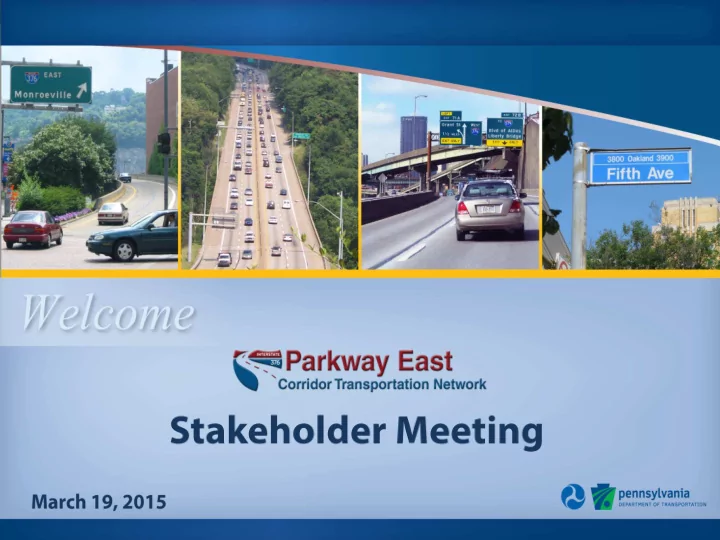
SLIDE 1
Welcome Project Team Parsons Brinckerhoff Darryl Phillips, - - PowerPoint PPT Presentation
Welcome Project Team Parsons Brinckerhoff Darryl Phillips, P.E., PTOE David Cooper, P.E. McCormick Taylor Jennifer Threats Betsy Zang Carrie Hill Todays Meeting Progress to Date Needs Analysis
SLIDE 2
SLIDE 3
Project Team
- Parsons Brinckerhoff
– Darryl Phillips, P.E., PTOE – David Cooper, P.E.
- McCormick Taylor
– Jennifer Threats – Betsy Zang – Carrie Hill
SLIDE 4
Today’s Meeting
- Progress to Date
- Needs Analysis
- Measures of Effectiveness
- Improvement Concepts
- Next Steps
SLIDE 5
Project Approach
Completed to Date:
- Public Input
- Traffic Data Collection
- Traffic Modeling and
Analysis
- Needs Analysis
- Developing Improvement
Concepts
SLIDE 6
Public Input
Nearly 2,200 completed surveys and shared over 17,000 interests and concerns
Survey Visitors: 2,797 Completed Surveys: 2,179
- Stakeholder Interviews
- Public Meetings
- Website
- Online survey
SLIDE 7
- What We Heard
Survey & Stakeholder I-376 Common Themes
SLIDE 8
Technical Studies
Traffic Studies:
- Traffic counts
– Aerial photography – Origin-destination counts – Turning movement counts – ATR counts
- Safety and Geometric studies
- Alternate routes
- Alternate modes
SLIDE 9
Technical Studies
Capacity Analysis:
- Document Parkway congestion
- Measure level-of-service on arterial roadways
SLIDE 10
Technical Studies
Network Model:
- Models alternate routes
- Calibrated to field data
- Separate AM and PM models
- Forecasts future conditions
SLIDE 11
Technical Studies
Network Simulation:
SLIDE 12
Needs Analysis
Purpose and Need
- Conducted in accordance with PennDOT
Publication 319
- Developed based upon:
– Technical analysis – Public comment
- Basis of evaluation of alternatives
SLIDE 13
Needs Analysis
Purpose: To improve traffic flow, improve safety, and improve multimodal travel options in the Parkway East Corridor Transportation Network, located in Allegheny County, Pennsylvania, which consists of the Parkway East (I-376) from the Fort Pitt Bridge to the Pennsylvania Turnpike/US 22 interchange, and also includes parallel and intersecting arterial roadways.
SLIDE 14
Needs Analysis
Needs:
- The Parkway East is congested
- Alternate routes are congested
- Crash rates are above average
- Parkway East does not meet existing design
criteria
- Parkway East travel times are unreliable
- Multimodal transportation options are limited
SLIDE 15
MOEs
Measures of Effectiveness:
- Ways to measure how
improvements meet the goals of the project
- Evaluation of Cost, Benefits,
and Constraints
SLIDE 16
MOEs
Initial Screening:
- Qualitative
- Rank each MOE from 1-10
- Weight MOEs based on importance
- Identify fatal flaws
- Consider potential benefit-cost ratio
- Determine options to advance
SLIDE 17
Improvement Concepts
Improvement Concepts:
- Initial list of 100 based upon technical
evaluation and public input
- Screening to reduce number
- Some projects programmed
- Opportunities for early action
SLIDE 18
Improvement Concepts
Already Programmed:
- Queue detection on Glenwood ramp
- Glenwood off-ramp deceleration lane
- Second/Bates/Hot Metal signal retiming
- Bates Street Improvements
- Improve bottleneck on Route 28 at Highland
Park Bridge
SLIDE 19
Improvement Concepts
Review of Improvement Options:
- Six stations
- Conceptual at this stage
- Detailed analysis will follow
- Things we should know
- Anything we’ve missed
- Comment sheets
SLIDE 20
Project Approach
Next Steps:
- Preliminary screening
- Stakeholder email update
- Detailed Analysis
- Stakeholder Meeting #2
- Public Meeting
- Identify Potential Projects
- Implementation
SLIDE 21
Group Discussion Questions and Discussion
SLIDE 22