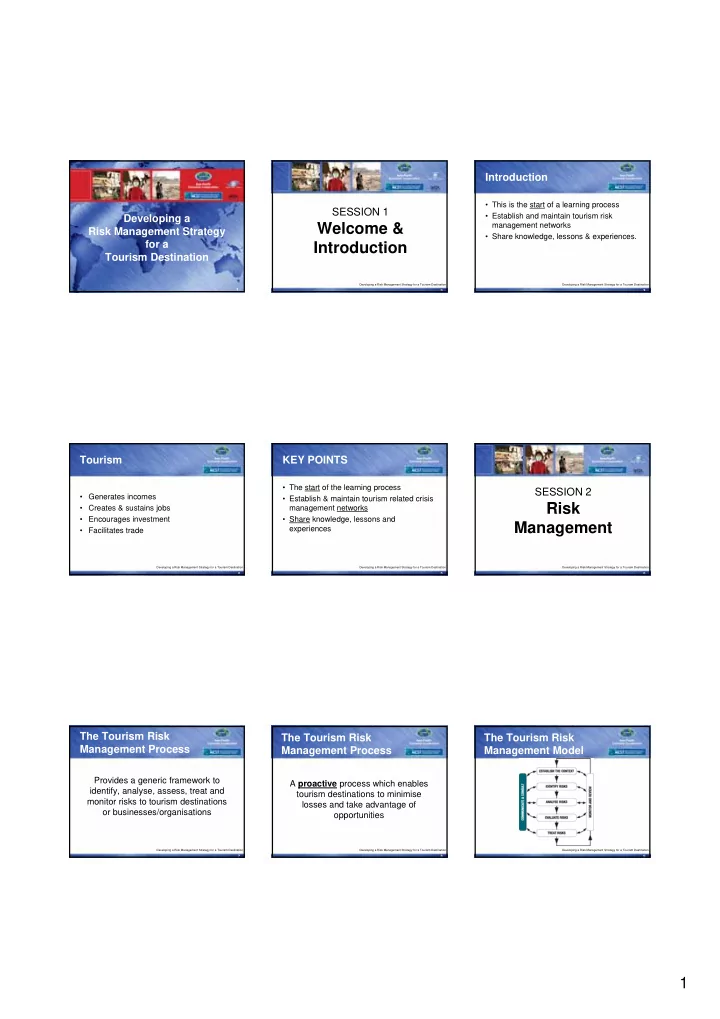
Welcome & management networks Risk Management Strategy Share - - PDF document

welcome
SMART_READER_LITE
LIVE PREVIEW

Welcome & management networks Risk Management Strategy Share - - PDF document

Introduction This is the start of a learning process SESSION 1 Establish and maintain tourism risk Developing a Welcome & management networks Risk Management Strategy Share knowledge, lessons & experiences. for a


slide-1
SLIDE 1

1

1

Developing a Risk Management Strategy for a Tourism Destination

Developing a Risk Management Strategy for a Tourism Destination

2

SESSION 1

Welcome & Introduction

Developing a Risk Management Strategy for a Tourism Destination

3

Introduction

  • This is the start of a learning process
  • Establish and maintain tourism risk

management networks

  • Share knowledge, lessons & experiences.

Developing a Risk Management Strategy for a Tourism Destination

4

Tourism

  • Generates incomes
  • Creates & sustains jobs
  • Encourages investment
  • Facilitates trade

Developing a Risk Management Strategy for a Tourism Destination

5

KEY POINTS

  • The start of the learning process
  • Establish & maintain tourism related crisis

management networks

  • Share knowledge, lessons and

experiences

Developing a Risk Management Strategy for a Tourism Destination

6

SESSION 2

Risk Management

Developing a Risk Management Strategy for a Tourism Destination

7

Provides a generic framework to identify, analyse, assess, treat and monitor risks to tourism destinations

  • r businesses/organisations

The Tourism Risk Management Process

Developing a Risk Management Strategy for a Tourism Destination

8

A proactive process which enables tourism destinations to minimise losses and take advantage of

  • pportunities

The Tourism Risk Management Process

Developing a Risk Management Strategy for a Tourism Destination

9

The Tourism Risk Management Model

slide-2
SLIDE 2

2

Developing a Risk Management Strategy for a Tourism Destination

10

A serious disruption to community life which threatens or causes death or injury in that community and/or damage to property which is beyond the day-to-day capacity of the prescribed statutory authorities and which requires special mobilisation and

  • rganisation of resources other than those

normally available to those authorities.

Disaster

Developing a Risk Management Strategy for a Tourism Destination

11

Crisis

Any situation that has the potential to affect long-term confidence in an

  • rganisation or a product, or which may

interfere with its ability to continue

  • perating normally

Developing a Risk Management Strategy for a Tourism Destination

12

Crises for a tourism destination may arise from: Internal (organisational) sources External (community) sources

Developing a Risk Management Strategy for a Tourism Destination

13

FOR EXAMPLE

Hurricane Katrina and the Bali Bombings Affected confidence in tourism and interfered with its ability to continue normal

  • perations

So these community disasters produced CRISES for tourism destinations to address

Developing a Risk Management Strategy for a Tourism Destination

14

Community Disaster Visitor numbers fall Loss of confidence by visitors CRISIS for tourism destinations

Developing a Risk Management Strategy for a Tourism Destination

15

KEY POINTS

  • Tourism risk management is an important

process for destinations

  • Crises and disasters are different things
  • Community disasters can cause crises for

tourism destinations

Developing a Risk Management Strategy for a Tourism Destination

16

SESSION 3

Prevention & Mitigation

Developing a Risk Management Strategy for a Tourism Destination

17

SWOT

Provides a STRUCTURE to identify a destination’s internal strengths & weaknesses and external opportunities & threats

Strengths, Weaknesses, Opportunities, Threats

Developing a Risk Management Strategy for a Tourism Destination

18

SWOT should focus upon:

  • Strengths – resources and support

available for crisis

  • Weaknesses – which will affect your

destination’s ability to cope with crisis

  • Opportunities – to enlist support for

tourism

  • Threats – risks to the destination and

tourism

slide-3
SLIDE 3

3

Developing a Risk Management Strategy for a Tourism Destination

19

Occupational Health and Safety

  • Identify OH&S requirements consistent

with national laws which will protect visitors

  • Advise operators on plans and

procedures

Developing a Risk Management Strategy for a Tourism Destination

20

Common elements of OH&S:

  • Employers & employees liable for their actions
  • Penalties for non-compliance
  • Requirement for a safe workplace
  • Provision of adequate facilities
  • Safe access & egress
  • Absence of risk in plant & substances
  • Emergency procedures
  • Training and testing regimes
  • Information in different language

Developing a Risk Management Strategy for a Tourism Destination

21

Emergency Plans (SOPs):

  • Evacuation
  • Fire
  • Bomb threat
  • Civil disorder
  • Armed intruder
  • Hazardous materials
  • Gas leak
  • Building collapse
  • Medical emergency
  • External emergencies

Developing a Risk Management Strategy for a Tourism Destination

22

Which agencies can advise you…..?

Identify & comply with national requirements

Developing a Risk Management Strategy for a Tourism Destination

23

A multi-agency approach to tourism is fundamental to its viability

An integrated approach to tourism health and safety is your aim

Developing a Risk Management Strategy for a Tourism Destination

24

KEY POINTS

  • A SWOT analysis is a valuable tool
  • Destinations should identify national

OH&S requirements to protect visitors

  • Emergency plans are essential for tourism

facilities

  • Develop multi-agency partnerships

Developing a Risk Management Strategy for a Tourism Destination

25

SESSION 4

Preparedness

Developing a Risk Management Strategy for a Tourism Destination

26

Tourism Crisis Preparedness

Development of plans & program, systems & procedure, training & testing to ensure that when crises do occur, resources are used to best effect to reduce the effects of the crisis

Developing a Risk Management Strategy for a Tourism Destination

27

Preparedness includes:

Establishment of networks and liaison with government and community agencies. You need a multi-agency, integrated approach to ensure the viability of tourism operations.

slide-4
SLIDE 4

4

Developing a Risk Management Strategy for a Tourism Destination

28

Preparedness:

Those you will need to cooperate with during a crisis – those who can provide support and assistance Networks and liaison with government and community agencies…

Developing a Risk Management Strategy for a Tourism Destination

29

  • Representatives of your tourism operators
  • Government and community agencies

An integrated, multi-skilled committee….

Tourism Crisis Planning Committee

Developing a Risk Management Strategy for a Tourism Destination

30

The tourism crisis planning committee will base its plans on the sources of risk (hazards) identified in the tourism risk management process

Developing a Risk Management Strategy for a Tourism Destination

31

Tourism planning committee responsibilities:

– Plans & procedures – Allocation of roles & responsibilities – Training needs & programs – Exercises – Monitoring, evaluation and amendment

Developing a Risk Management Strategy for a Tourism Destination

32

So….?

No two crises will ever be the same…..each one will present different problems needing different solutions

Developing a Risk Management Strategy for a Tourism Destination

33

You need a GENERIC tourism crisis management plan

One plan to apply to all crises…..

Developing a Risk Management Strategy for a Tourism Destination

34

A best practice crisis plan is a starting point Managing a crisis needs knowledge, skill and flexibility to adapt to the needs of the situation

Developing a Risk Management Strategy for a Tourism Destination

35

A tourism crisis management plan should:

  • Describe activation procedures
  • Allocate roles & responsibilities
  • Identify control & coordination
  • Include standard procedures
  • Identify information requirements
  • Establish communication methods
  • Describe PR & media arrangements

Developing a Risk Management Strategy for a Tourism Destination

36

Tourism crisis management arrangements should ensure:

– Safety of all persons within, at or visiting a destination – Minimal disruption to tourism operations – Compliance with laws & regulations

slide-5
SLIDE 5

5

Developing a Risk Management Strategy for a Tourism Destination

37

‘What if’ questions….

  • What if….happened here…..what would it

mean to us?

  • What are the implications for tourism and

the behaviour of travellers?

  • What must we do to protect our tourism

destination and to restore confidence?

Developing a Risk Management Strategy for a Tourism Destination

38

Training and exercising (testing) is fundamental to a high level

  • f preparedness.

Crises require staff to carry out unfamiliar tasks in a stressful environment, so they need training and to PRACTISE.

Developing a Risk Management Strategy for a Tourism Destination

39

The fundamental purpose of training & exercising is to improve your destination’s capacity to respond efficiently and effectively to crisis

Developing a Risk Management Strategy for a Tourism Destination

40

Tourism crisis management exercises can:

– Reveal planning weaknesses – Expose resource gaps – Clarify roles & responsibilities – Improve performance – Build confidence – Develop proficiency – Test plans systems & procedures – Foster cooperation between agencies

Developing a Risk Management Strategy for a Tourism Destination

41

Importantly

Exercises provide the

  • pportunity for personnel to work

together and to develop an effective working relationship

Developing a Risk Management Strategy for a Tourism Destination

42

  • Discussion exercises

– Present a situation and problems to be discussed

  • Functional exercises

– Test a crisis management centre and decision- making

Two forms of exercises:

Developing a Risk Management Strategy for a Tourism Destination

43

  • What would we do if it happened here?
  • What would be the implications for our

destination?

  • How would it affect potential visitors?
  • What problems would we face?
  • How would media & PR be managed?
  • Do we need additional training, equipment, etc?
  • How would it affect us if it happened near by?

Informal exercises

problems which occur at other destinations….

Developing a Risk Management Strategy for a Tourism Destination

44

Planning continues during tourism crisis response & recovery. SHORT-TERM TACTICAL PLANS and LONGER-TERM STRATEGIC PLANS (24 – 48 hours)

Crisis planning is an

  • ngoing PROCESS

Developing a Risk Management Strategy for a Tourism Destination

45

KEY POINTS

  • Preparedness includes plans, training & testing
  • Networks & liaison with Government and

community agencies

  • Need a tourism crisis planning committee
  • Develop generic tourism crisis response &

recovery plans

  • Training & exercising is essential
  • Conduct multi-agency exercises
  • Use informal exercises regularly
  • Crisis planning is an on-going process
slide-6
SLIDE 6

6

Developing a Risk Management Strategy for a Tourism Destination

46

SESSION 5

Response

Developing a Risk Management Strategy for a Tourism Destination

47

Tourism crisis response includes actions leading up to and immediately after the impact of a crisis to: minimise its effects and manage the consequences

Developing a Risk Management Strategy for a Tourism Destination

48

In a disaster, disaster management agencies are responsible for lives and property

Tasks depend upon nature and extent of the crisis

Developing a Risk Management Strategy for a Tourism Destination

49

  • Maintain visitors’ confidence:

– Don’t neglect normal services – Least disruption possible

Tourism destination personnel may be part of an integrated multi-agency response to disasters

Developing a Risk Management Strategy for a Tourism Destination

50

The key to effective response is trained, experienced, flexible personnel

Developing a Risk Management Strategy for a Tourism Destination

51

  • How has it affected:

– People – visitors & staff – Facilities – Infrastructure – Tourism operations

Initial information needs:

Developing a Risk Management Strategy for a Tourism Destination

52

  • For decision-making purposes:

– Effects upon visitors – Damage to property & infrastructure – Disruption to services – Consequences for tourism – Resources needed

Specific Information needs:

Developing a Risk Management Strategy for a Tourism Destination

53

  • Responsible for:

– Briefing & management of staff – Processing operational information collecting, collating & evaluation, making decisions – Planning

Tourism crisis management team:

Developing a Risk Management Strategy for a Tourism Destination

54

Keep a record of all actions taken and decisions You may need to justify your actions later…..

slide-7
SLIDE 7

7

Developing a Risk Management Strategy for a Tourism Destination

55

Main work area - space, lighting, low sound level Media briefing room

  • Conference room
  • Foyer/access control area
  • Retreat/quiet room
  • Rest and recreation area
  • Tea and coffee making facilities
  • Furniture & equipment
  • Tourism Crisis

Management Centre

Checklist:

Developing a Risk Management Strategy for a Tourism Destination

56

You need a crisis management TEAM One person can’t do it all alone…..

Developing a Risk Management Strategy for a Tourism Destination

57

In tourism crisis response operations information is a tool which allows people to make timely, critical decisions.

Developing a Risk Management Strategy for a Tourism Destination

58

  • Must be:

– Collected and recorded – Collated – Evaluated – Decided upon – Disseminated – Monitored

Operational information

Developing a Risk Management Strategy for a Tourism Destination

59

  • What does this mean to us?
  • What must we do as a result of this to

protect visitors?

Core Questions:

Developing a Risk Management Strategy for a Tourism Destination

60

Information has to be put together (collated), checked and assessed (evaluated) to establish relevance and reliability and to identify gaps. Then it can be used for decision-making purposes…..

Developing a Risk Management Strategy for a Tourism Destination

61

This is what we know….. now, what do we have to do about it?

Developing a Risk Management Strategy for a Tourism Destination

62

Decisions then have to be disseminated via the media to those who need to know:

– Visitors – Government agencies – Community agencies – General public

Developing a Risk Management Strategy for a Tourism Destination

63

  • Identification of visitor’ needs
  • Priorities for restoration
  • Resources & budgets
  • Business issues
  • Media management
  • PR issues
  • Consultation with government and community
  • Alternate sites of operation

Business Continuity Issues

slide-8
SLIDE 8

8

Developing a Risk Management Strategy for a Tourism Destination

64

KEY POINTS

  • Response tasks depend upon the nature

and extent of a crisis

  • Most important objective is maintaining

visitors’ confidence

Developing a Risk Management Strategy for a Tourism Destination

65

SESSION 6

Recovery

Developing a Risk Management Strategy for a Tourism Destination

66

  • How has affected our destination?
  • What must we do to return business

to normal?

Establish what’s left:

Developing a Risk Management Strategy for a Tourism Destination

67

  • Residual effects on tourism
  • Damage
  • Causes of service disruption
  • Consequences for tourism and the

community

  • Resources needed

You will need information on:

Developing a Risk Management Strategy for a Tourism Destination

68

  • Setting objectives
  • Identifying priorities
  • Identifying needs and assistance
  • Communicating with tourism operators
  • Liaising with government and community

agencies

  • Briefing media & agencies
  • Monitoring restoration of services
  • Planning
  • Decision-making

Tourism crisis recovery management tasks include:

Developing a Risk Management Strategy for a Tourism Destination

69

MONITOR AND EVALUATE COMMUNITY PERCEPTIONS OF THE CRISIS

Developing a Risk Management Strategy for a Tourism Destination

70

Community support is essential to restore tourism Government and community agencies should be part of the recovery team

Developing a Risk Management Strategy for a Tourism Destination

71

Lessons should be shared so that all tourism destinations can benefit…..

Debriefings

Developing a Risk Management Strategy for a Tourism Destination

72

To gain the information necessary to improve plans, procedures, systems and training of personnel…..

Purpose of debriefing:

slide-9
SLIDE 9

9

Developing a Risk Management Strategy for a Tourism Destination

73 What happened ?

  • Type of incident

What did we do?

  • Sequence of actions by personnel

Was that what we planned?

  • Reasons planned systems & procedures weren’t followed or

appropriate. How can we do better?

  • Can our plans be improved
  • Do we need different or more training
  • Do we need improved liaison with Government and community

agencies

  • As our media management effective
  • Did we identify & meet visitors’ needs
  • Do we need better communications
  • Do we need a different tourism crisis management system
  • Was our tourism risk management process effective?

Aide-memoire

Developing a Risk Management Strategy for a Tourism Destination

74

  • After the debrief the planning committee

should:

– Analyse findings – Identify planning, training & operational needs – Identify timelines – Allocate responsibilities – Revise the tourism crisis management plan – Organise training – Test & evaluate revised plans & procedures

Identify lessons and act upon them….

Maximising the benefits

Developing a Risk Management Strategy for a Tourism Destination

75

How can we share the lessons with

  • ther tourism destinations?

Developing a Risk Management Strategy for a Tourism Destination

76

Send debriefing reports Guest speakers at conferences Observers at crisis exercises Newsletter dedicated to tourism crisis management Workshops, etc.

Developing a Risk Management Strategy for a Tourism Destination

77

KEY POINTS

  • Need information on how the crisis has

affected the destination

  • Community perceptions should be

monitored

  • Debriefing is essential to identify lessons
  • Share lessons with other destinations

Developing a Risk Management Strategy for a Tourism Destination

78

SESSION 7

Media & Communications

Developing a Risk Management Strategy for a Tourism Destination

79

Why is the media interested?

Disasters are usually:

– Spectacular – Action Orientated – Focused on human suffering or courage or both

From a media perspective they are:

– Relatively easy to cover – Guaranteed to attract an audience and sell newspapers etc

Developing a Risk Management Strategy for a Tourism Destination

80

Principles

  • The media will always be there!
  • The media should be managed

rather than controlled

  • Cooperation with the media is better

than confrontation

  • The media is a vital communication

medium

Developing a Risk Management Strategy for a Tourism Destination

81

Stages of media reporting of disasters

Stage 1

  • Nature and extent of crisis or disaster

Stage 2

  • Heroes and hardships

Stage 3

  • Scape-goating and fault finding - who’s

to blame?

slide-10
SLIDE 10

10

Developing a Risk Management Strategy for a Tourism Destination

82

Crisis Management of Media and Communication

The goal is to have visitors returning to the destination as quickly as possible after a crisis

Developing a Risk Management Strategy for a Tourism Destination

83

  • Designate a spokesperson
  • Establish media & communications section
  • Communicate regularly with the media
  • Pay attention to local media
  • 1. BEFORE A CRISIS

Preparing for the worst

Developing a Risk Management Strategy for a Tourism Destination

84

  • 2. DURING A CRISIS

Minimising Damage in a Crisis

  • Be honest and transparent
  • Don’t impose a news blackout
  • Establish a media centre
  • Act fast
  • Remember the victims
  • Avoid speculation
  • Put the crisis into context
  • Challenge untrue media statements

Developing a Risk Management Strategy for a Tourism Destination

85

DURING A CRISIS (cont.) Minimising Damage in a Crisis

  • Highlight positive aspects
  • Place information on destination website
  • Network with other media liaison officers
  • Seek increases in promotional budgets
  • Establish hotline
  • Monitor safety & security
  • Coordinate with agencies for media access
  • Communicate to staff

Developing a Risk Management Strategy for a Tourism Destination

86

  • Be proactive in communications
  • Increase trips for journalists
  • Remember anniversaries
  • Create news outlet on destination website
  • Increase trips for tour operators
  • 3. FOLLOWING A CRISIS

Restoring Visitor Confidence

Developing a Risk Management Strategy for a Tourism Destination

87

What other measures can you implement to restore the confidence of visitors in your destination? Which other agencies can assist?

Developing a Risk Management Strategy for a Tourism Destination

88

KEY POINTS

  • Work cooperatively with the media
  • Anticipate media focus & needs during

crises

  • Develop media & communication

strategies for before, during and after a crisis

Developing a Risk Management Strategy for a Tourism Destination

89

KEY POINTS FOR THE WORKSHOP

  • Tourism is vital to the economic viability of

all countries

  • Tourism risk management is an on-going

process

  • Share information & experiences in

tourism crisis management

  • Tourism operators share the responsibility

for the safety of visitors

90

Developing a Risk Management Strategy for a Tourism Destination