Welcome Cooling Our Communities: Reducing Heat Through the Built - - PowerPoint PPT Presentation

welcome cooling our communities reducing heat through the
SMART_READER_LITE
LIVE PREVIEW

Welcome Cooling Our Communities: Reducing Heat Through the Built - - PowerPoint PPT Presentation

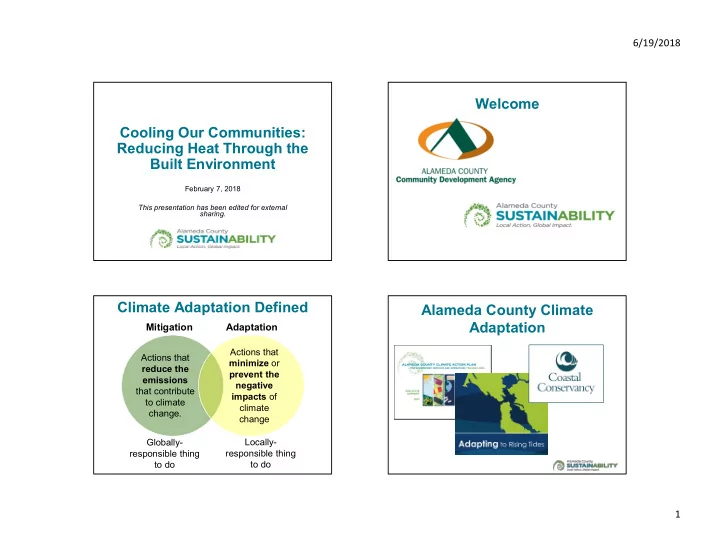
6/19/2018 Welcome Cooling Our Communities: Reducing Heat Through the Built Environment February 7, 2018 This presentation has been edited for external sharing. Climate Adaptation Defined Alameda County Climate Adaptation Mitigation

slide-1
SLIDE 1

6/19/2018 1

Cooling Our Communities: Reducing Heat Through the Built Environment

February 7, 2018 This presentation has been edited for external sharing.

Welcome Climate Adaptation Defined

Adaptation Mitigation

Actions that reduce the emissions that contribute to climate change. Actions that minimize or prevent the negative impacts of climate change Globally- responsible thing to do Locally- responsible thing to do

Alameda County Climate Adaptation

slide-2
SLIDE 2

6/19/2018 2

Agencies Already Taking Action

Climate-smart agriculture Responding to vegetative fires Mosquito-borne disease tracking Salt ponds as buffer to flooding Emergency preparedness training

Goals for This Morning

  • To familiarize attendees with how projected

increases in temperature will impact health and infrastructure, and how the built environment contributes to heat risk.

  • To explore cooling strategies for the built

environment to mitigate the impacts of increased heat in Alameda County’s unincorporated areas.

  • To inform planning policies.

Goals for this Morning

  • Strategies developed will inform, as

appropriate: ▫ The Community Climate Action Plan, ▫ Relevant sections of Specific Plans, ▫ Amendments to General Plan as mandated by SB 1000, ▫ Residential Design Standards and Guidelines, and ▫ Discretionary guidance in the permitting process.

Agenda

9:00am-1:00pm Refreshments Provided

  • Heat, Climate, and the Built Environment

Presentations

  • Case Study: Sacramento County
  • Breakout Group Activity
  • Report Out & Next Steps
slide-3
SLIDE 3

6/19/2018 3

CLIMATE IMPACTS Range of Implications

Increased Temperatures Sea Level Rise Extreme Storms Wildfires

Range of Implications

Increased Temperatures Sea-Level Rise Wildfires Extreme Storms

Increased Temperatures

Climate change will cause increases in average temperatures across the County.

slide-4
SLIDE 4

6/19/2018 4

Increased Temperatures The Impacts Can Already Be Felt HEAT AND HEALTH Whose Health is Impacted?

Children People with Disabilities Elderly People living alone Low Income Communities of Color

slide-5
SLIDE 5

6/19/2018 5

What Factors Contribute?

  • Unemployment
  • People living in poverty
  • Households without a

vehicle

  • Ozone
  • Households without AC
  • Households with limited

English

  • No Tree Canopy
  • Impervious Surfaces

Example: How Does Heat Affect Health?

Children (≤ 5) are especially vulnerable to heat:

  • Adjust less quickly to

heat

  • More susceptible to

changes in air pollutants (hot environments favor formation)

  • Less likely to seek help

What Factors Contribute?

  • Unemployment
  • People living in

poverty

  • Households without

a vehicle

  • Ozone
  • Households without AC
  • Households with

limited English

  • No Tree Canopy
  • Impervious Surfaces
slide-6
SLIDE 6

6/19/2018 6

Composite Vulnerability HEAT AND THE BUILT ENVIRONMENT When You Hear Heat Island You May Think of This… When in Reality, Heat Islands Also Appear Here…

Ashland, CA

slide-7
SLIDE 7

6/19/2018 7

When in Reality, Heat Islands Also Appear Here…

Castro Valley, CA

Defining a Heat Island

Urban and suburban built environment factors trap heat, making daytime temperatures 1-6 F⁰ hotter and nighttime temperatures up to 22 F⁰ hotter than rural areas Two Scenarios

Defining a Heat Island

Dark Roofing Light Roofing

Defining a Heat Island

Dark Pavement Light Pavement

slide-8
SLIDE 8

6/19/2018 8

Defining a Heat Island

No Shade Tree Shade

+Improved Air Quality

Built Environment Factors Contributing to Heat Islands

Building Density Design & Materials Vegetation Roofing Pavements

Impervious Surfaces No Tree Cover

slide-9
SLIDE 9

6/19/2018 9

Using the Built Environment to Cool Communities

Factors that mitigate against heat island effect, and cool down communities: Cool Roofs Vegetation & Tree Cover Cool Pavements

Cool Roofs

Benefits:

  • Improved indoor

comfort in non-a/c houses

  • Reduced local air

temperatures

  • Reduced energy costs

Challenges:

  • Can be more

expensive

  • Potential heat loss in

winter

Los Angeles, CA

Cool/Pervious Pavements

Benefits:

  • Reduced heat-related

illness

  • Decreased street

lighting cost

  • Increased storm-water

management Challenges:

  • More expensive
  • Newer technology

Evanston, IL

Increased Vegetation/Tree Cover

Benefits:

  • Reduced energy

costs

  • Reduced air pollution
  • Reduced UV

exposure

Davis, CA

Challenges:

  • Maintenance costs &
  • wnership
  • Tree Placement
  • Initial Infrastructure
slide-10
SLIDE 10

6/19/2018 10

Co-Benefits to Cooling Strategies

Many of these cooling strategies have other planning benefits.

Visual Amenity Housing Density Neighborhood character Walkability & Safety Energy Costs Charleston, SC

Envisioning the Future Built Environment

The built environment is a large complex network of public and private land.

Discussion

CASE STUDY: SACRAMENTO COUNTY

slide-11
SLIDE 11

6/19/2018 11

Office of Planning and Environmental Review February 7, 2018 John T. Lundgren, lundgrenj@saccounty.net

Cooling our Community

Integrated Strategies for Success

Here, There, Everywhere

42 February 7, 2018

Office of Planning and Environmental Review

  • The need to cool is not new
  • Strategies already exist
  • Motivations have changed
  • Take stock of what you have
  • Integrate your strategies

Sacramento County’s Strategies

43 February 7, 2018

Office of Planning and Environmental Review

  • Ordinance - Native Oaks
  • General Plan – Tree Canopy
  • Zoning Code - Dev. Stds.
  • LHMP
  • Landscape Architect
  • SB 1000 / EJ Element
  • Climate Action Plan
  • Smart Growth Streets
  • Complete Streets
  • Design Guidelines

Core Strategy: Shade

44 February 7, 2018

Office of Planning and Environmental Review

  • Enhance existing requirements
  • More than just parking lots
  • Identify co-benefits
  • Utilize Multiple Approaches
  • Discretionary: CEQA Mitigation

(e.g. canopy replacement)

  • Ministerial: Dev. Stds.

(e.g. Zoning Code 50% @15 Yrs.)

  • Voluntary/Partnerships

(e.g. Sac Tree, Utilities)

slide-12
SLIDE 12

6/19/2018 12

Horizontal (Time) Integration

45 February 7, 2018

Office of Planning and Environmental Review

  • Pre-Application

Review !

  • CEQA Review !!
  • Design Review !!!
  • Approval !!!!?
  • Maintenance ??
  • Enforcement ???

It’s Good Business – Don’t Get Political

46 February 7, 2018

Office of Planning and Environmental Review

  • Be politically aware

but apolitical

  • Develop a champion

with broad appeal

  • Educate don’t

indoctrinate

  • Don’t catastrophize

Challenges

47 February 7, 2018

Office of Planning and Environmental Review

  • State Mandates
  • Special Interests
  • Lingering Effects
  • Silos
  • Budget
  • Polarization

Duty of a Public Servant

48 February 7, 2018

Office of Planning and Environmental Review

  • Whine in private
  • Use EAP
  • Focus on (ALL) the

people we serve

  • Consider alternative

viewpoints

  • Treat others as they

want to be treated

slide-13
SLIDE 13

6/19/2018 13

Q & A

49 February 7, 2018

Office of Planning and Environmental Review

Visioning the Future

Thinking 50 years in the future… with no limitations

  • r constraints…

If cooling strategies were implemented, what is one change you might see in the built environment?

Break

Breakout Groups

❸ Vegetation & Landscaping ❹ Transformative Built Environments

Thinking big, incorporating co- benefits

❶ Building Materials

Roofing, etc.

❷ Pavement & Hard Surfaces

slide-14
SLIDE 14

6/19/2018 14

Breakout Groups

  • Don’t be concerned

about committing resources

  • Don’t limit yourself to

your role or expertise

  • Think outside the box!

Tips

  • Work with new faces
  • Build on what we’ve

heard, but add your new thinking

Breakout Groups

Instructions

  • Choose a group
  • Brainstorm as many ideas as you can
  • Select one “straightforward” idea and one

“creative” idea to flesh out

  • Answer questions on the worksheet
  • Select a “reporter”
  • Write up 2 ideas on flipchart

Breakout Groups

❸ Vegetation & Landscaping ❹ Transformative Built Environments

Thinking big, incorporating co- benefits

❶ Building Materials

Roofing, etc.

❷ Pavement & Hard Surfaces

Break

slide-15
SLIDE 15

6/19/2018 15

Report Outs

Post-Its: Support & Suggest

Favorite feasible idea ROSE THORN BUD Good idea with key obstacles Idea with potential

Post-Its: Support & Suggest

Favorite feasible idea (suggest first step) ROSE THORN BUD Good idea with key obstacles (suggest what to consider) Idea with potential (suggest how to develop further)

Discussion

slide-16
SLIDE 16

6/19/2018 16

What Will Happen Next

  • Consideration
  • Integration
  • Additional ideas

Next Steps

Adaptation Across the County… and Beyond Resources

Georgetown Climate Center’s Adaptation Clearinghouse Governor’s Office of Planning and Research Adaptation Clearinghouse US EPA’s Heat Island Compendium of Strategies

slide-17
SLIDE 17

6/19/2018 17

Reflection Thank You! Photo & Image Credit

  • People with Disabilities: Mike Ashley, Noun

Project (Slide 18)

  • Low Income Communities of Color: Gerald

Wildmoser, Noun Project (Slide 18)

  • People Living Alone: Seona Kim, Noun Project

(Slide 18)

  • Children: Gilad Fried, Noun Project (Slide 18)
  • Elderly: Marie Van den Broeck, Noun Project

(Slide 18)

  • Vulnerability Maps (Children, Composite,

Impervious Surfaces, Tree Cover): Courtesy of Matt Beyers, Alameda County Public Health Department (Slides 21, 22, 23, 36, 37)

  • Vulnerability Table: Courtesy of Matt Beyers,

Alameda County Public Health Department (Slides 24, 25, 35)

  • Vegetation: Blaise Sewell, Noun Project (Slide

34) In order of appearance in presentation. Photos not listed are labeled for reuse without attribution.

  • Roofing: Luke Patrick, Noun Project (Slide 34)
  • Pavements: Viktor Fedyuk (Tim P), Noun Project

(Slide 34)

  • Design & Materials: zidney, Noun Project (Slide

34)

  • Building Density: Laurene Smith, Noun Project

(Slide 34)

  • Los Angeles Cool Roof: Climate Resolve (Slide

39)

  • Evanston Pervious Paving: Bill Smith,

EvanstonNow.com, Newstory (2015) (Slide 40)

  • Davis Parking Lot: Arbor Day Foundation,

Alliance for Community Trees (2014) (Slide 41)

  • Charleston Sustainable Living Community: Chrys
  • Rynearson. Oak Tree Preserve (2012) (Slide 42)
  • Transformative Built Environment: Coalition for a

Livable Sudbury (Slide 43)