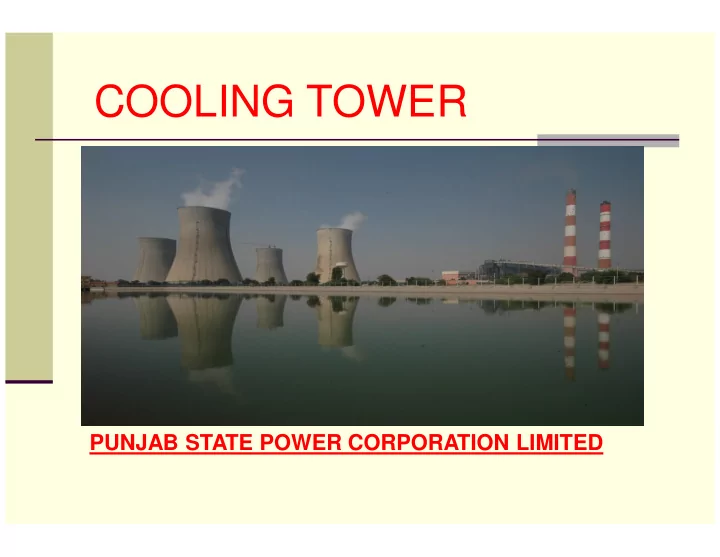
COOLING TOWER PUNJAB STATE POWER CORPORATION LIMITED Introduction - - PowerPoint PPT Presentation
COOLING TOWER PUNJAB STATE POWER CORPORATION LIMITED Introduction Cooling towers are commonly used to remove excess heat that is generated & represent a relatively inexpensive and dependable means of removing low-grade heat from cooling
Introduction
Cooling towers are commonly used to remove
excess heat that is generated & represent a relatively inexpensive and dependable means of removing low-grade heat from cooling water.
Cooling towers make use of evaporation whereby
some of the water is evaporated into a moving air stream and subsequently discharged into the atmosphere in the form of vapours.
Classification of Cooling water
Classification by build Classification based on heat transfer method Classification based on Air draft Classification based on Air flow pattern
but I will limit my talk to a Air draft (Natural Draft) Cooling Tower
Factors governing operation of Cooling water
The dry-bulb and wet-bulb temperatures of the air The temperature of warm water The area of contact between air and hot water The contact time between the air and the water The air pressure drop The desired temperature of the cooled water
Natural Draft Tower
The natural draft or hyperbolic cooling tower makes use of the difference in temperature between the ambient air and the hotter air inside the tower. As hot air moves upwards through the tower (because hot air rises), fresh cool air is driven into the tower through an air inlet provided at the bottom.
Components of Cooling Tower
Structural Components
1. Cold water basin 2. Tower Framework 3. Water distribution System 4. Fill 5. Drift Eliminator 6. Casing / Shell Structure 7. Louvers
Materials of Components of Cooling Tower
Tower Material
1. Frame & Casing – Concrete & Steel 2. Fill - PVC/Polyproplene 3. Nozzles
- PVC/Polyproplene
Tower Problems
Scale deposit Fouling due to presence of silt ,dirt ,sand etc. Microbiological growth due to presence of
microoganisms , Algae, fungi
Corrosion of steel parts
Operation Considerations
Water make-up
To compensate the water loss due to :
- 1. Evaporation ,
- 2. Drift (water entrained in discharge vapor),
estimated to be About 0.2% of water supply
- 3. Blow down (water released to discard solids).
Cooling Tower parameters
Sr. No. Design Parameter CT- Stage I CT – Stage II 1. Total design capacity 33000cum / Hr. 36500 m3/hr 2. Height of top of tower above sill 120 m 104.625 m 3.
- do- at throat
36.93 m 49.856 4.
- do- at top
42.67 m 51.856 5 Dry Bulb Temp. 35.1 35.05 6 Design wet bulb Temp 28.5 28.25 7 Cold Water outlet Temp 32.5 33 8 Hot water Inlet Temp 42.5 41.1
9
PVC Fill
Size 1600x600x300 in two layers; munters type C-10-19 double folded edge on one side and with black UV Stabilization , 0.25 mm thick and having a flute size of 19mm
1220x1830 of varying depths of 915mm,1120mm &1525 mm of Paharpur M67 make
10
Basin Depth
2.8 m
2.0-2.30 m
Cooling Water Analysis
Sr. No. Design Parameter Design Actual 1 Ph 7.5-8.00 8.4 2 Turbidity & Suspended solids
- 100 ppm
6 – 7 50-60 ppm 3 Total dissolved solids 200-500 ppm 350-500 ppm 4 Ca-hardness as CaCo3 140 ppm 150-200 ppm 5 M -alkanity as CaCo3 140 ppm 104-120 ppm 6 Chlorides as Cl 40 ppm 40-70 ppm 7 Sulphates as SO4 140 ppm 125 – 180 ppm 8 Silica as Sio2 4 ppm 3.3 – 7.0 ppm
Improving Energy Efficiency of Cooling Towers
1. Clearances around cooling towers needs to be adequate to ensure uninterrupted air intake or exhaust.
- 2. Use right type of nozzles that do not clog & spray in a
more uniform water pattern. Square spray nozzles are clog free as compared to spray type nozzles.
- 3. Increase contact surface and contact time between air
and water may be with the use of PVC Film Type fills by replacing splash bars.
- 4. Clean distribution nozzles regularly.
- 5. Optimize the blow down flow rate, taking into account
the cycles of concentration (COC)limit.
Improving Energy Efficiency of Cooling Towers
- 6. Keep the cooling water temperature to a minimum level by
(a) segregating high heat loads like furnaces, air compressors, DG sets and (b) isolating cooling towers from sensitive applications like A/C plants, condensers of captive power plant etc. 7. Monitor approach, effectiveness and cooling capacity to continuously optimize the cooling tower performance Seasonal variations be taken into consideration.
- 8. Monitor liquid to gas ratio and cooling water flow rates and
amend these depending on the design values and seasonal
- variations. For example: increase water loads during summer
and times when approach is high and increase air flow during monsoon times and when approach is low.
Improving Energy Efficiency of Cooling Towers
- 9. Increase COC improvement for water savings. The use
- f water treatment chemicals, pretreatment such as
softening & pH adjustment , and other techniques can affect the acceptable range of cycles of concentration.
- 10. Check cooling water pumps regularly to maximize
their efficiency.
Some Problems & its remedy for Cooling Towers
Drift/carry-over of water outside the unit
- 1. Uneven operation of spray nozzles
2 Blockage of the fills 3 Defective or displaced droplet eliminators 4 Excessive circulating water flow may be due to too high pumping head) 1 Adjust & clean the nozzle 2 Eliminate any dirt on the top of the fill or with suitable chemical pretreatment 3 Replace or realign the eliminators 4 Adjust the water flow-rate by means of the regulating valves. Check damage to the fill Lack of cooling and hence increase in temperatures owing to increased temperature range 1 Water flow below the design value 2 Irregular airflow or lack of air 3 Recycling of humid discharge air 4 Intake of hot air from other sources 5 Blocked spray nozzles (or even blocked water pipes) 6 Scaling of joints 7 Scaling of the fill pack 1 Regulated the flow by means of the valves 2 Ensure adequate clearance around cooling towers 3 Check the air descent velocity 4 Install deflectors 5 Clean the nozzles and/or the Tubes 6 Wash or replace the item 7 Clean or replace the material (washing with inhibited aqueous sulphuric acid is possible but long, complex and expensive)
Problems Encountered at GHTP
Concrete Shell
Patches of dampness on external surface of RCC shell.
Minor cracks on staircase beams & columns.
Holes & Patches in the inside of shell Water distribution Pipes
Silt Deposit in the distribution pipes
Exposure of Concrete surface of Supports
Deposit of Scale / Corrosion of MS pipe surface PVC Fills
Green algae found on fills
Fills are almost choked with scale deposit mainly consisting of CaCo3 & sio2 & other organic matter.
water at operating COC is scaling in nature.
Pre chemical treatment / dozing be adopted to prevent organic growth. PVC Nozzles
Chocking of nozzles due to the presence of silt, clay, sand & scale deposits.
Nozzles are cleaned as a matter of routine in every shut down
Presence of algae, fungi & bacteria are causing biological fouling in Nozzles
Strainers & chemical treatment can be used to prevent biological fouling.