Welcome, attendees! Your microphone is muted on entry into the event - - PowerPoint PPT Presentation

welcome attendees
SMART_READER_LITE
LIVE PREVIEW

Welcome, attendees! Your microphone is muted on entry into the event - - PowerPoint PPT Presentation

Welcome, attendees! Your microphone is muted on entry into the event to avoid background noise/feedback. You wont be able to unmute yourself. To reduce video bandwidth, your camera will remain off. The chat feature is turned off for


slide-1
SLIDE 1

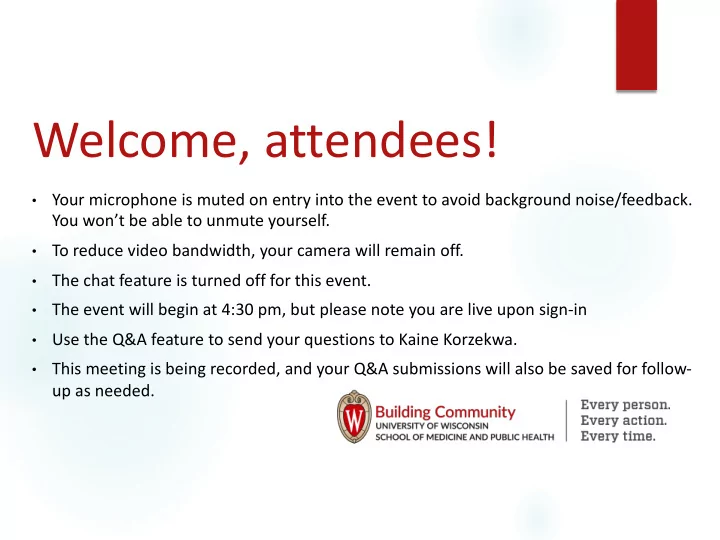
Welcome, attendees!

  • Your microphone is muted on entry into the event to avoid background noise/feedback.

You won’t be able to unmute yourself.

  • To reduce video bandwidth, your camera will remain off.
  • The chat feature is turned off for this event.
  • The event will begin at 4:30 pm, but please note you are live upon sign-in
  • Use the Q&A feature to send your questions to Kaine Korzekwa.
  • This meeting is being recorded, and your Q&A submissions will also be saved for follow-

up as needed.

slide-2
SLIDE 2

University of Wisconsin School of Medicine and Public Health Summer Faculty & Staff Town Hall

Robert N. Golden, MD

Robert Turell Professor in Medical Leadership Dean, School of Medicine and Public Health Vice Chancellor for Medical Affairs University of Wisconsin–Madison

slide-3
SLIDE 3
  • Welcome
  • Administrative Updates
  • Panel Discussion on Anti-Racism: Taking Action in SMPH
  • Town Hall
  • Closing Remarks
  • Adjournment

Agenda

slide-4
SLIDE 4

University of Wisconsin-Madison Campus Reopening Plan

Jonathan L. Temte, MD/PhD Associate Dean for Public Health and Community Engagement School of Medicine and Public Health

slide-5
SLIDE 5

SARS-CoV-2 by the numbers

(as of June 22, 2020)

Cases

  • Global

8,986,016

  • United States

2,281,903

  • Wisconsin

24,819

  • Dane County

1,141

Deaths

468,907 119,997 744 32

We are in this for the long haul…

slide-6
SLIDE 6

Phasing

– Identify categories of on-site, non-essential functions not currently being performed. – Group activities into phases based on their transmission risk and the program and campus impact of not resuming them. – Recommend any campus services necessary to support the resumption

  • f additional on-site functions.

Public Health Protocols

– Identify necessary public health precautions needed for each phase.

Case Response Protocols

– Outline campus protocol in the event of a presumed positive COVID-19 case of an employee working in an on-site, non-essential function. – Outline how the protocol changes if a case is confirmed positive.

Guidelines for Reopening Campus Operations

slide-7
SLIDE 7

Supporting Operations Key Functions

slide-8
SLIDE 8

Phase 1: Low Transmissibility and High Modification

slide-9
SLIDE 9

Phase 2: Medium Transmissibility and Medium Modification

slide-10
SLIDE 10

Phase 3: High Transmissibility and Medium Modification

slide-11
SLIDE 11

Indeterminate: High Transmissibility and Low Modification

slide-12
SLIDE 12

Public health protocols and associated practices to reduce the risk of COVID-19 transmission

slide-13
SLIDE 13

Public health protocols and associated practices to reduce the risk of COVID-19 transmission

slide-14
SLIDE 14

https://smartrestart.wisc.edu/ Released 6/17/2020

slide-15
SLIDE 15

On Campus SARS-CoV-2 Surveillance

  • situational awareness -
  • Development of ~100 cohorts of 10 individuals

– Representing schools, divisions, buildings etc. – Faculty, staff, graduate assistants (~24,000)

  • SMPH = 5,400 (~26 cohorts)
  • Weekly specimen self-collection

– Nasal swab (or saliva sample) – Workplace drop-off point on same day each week

  • On-campus testing by RT-PCR
  • Notification if PCR(+)
  • Weekly Analytics for incidence of SARS-CoV-2
slide-16
SLIDE 16

Moderator: Angela Byars-Winston, PhD Department of Medicine How Can We Break the Bias Habit? Molly Carnes, MD, MS (Medicine) Experiences with and Observations of Racism in SMPH Amy Zelenski, PhD and Bennett Vogelman, MD (Medicine) Resources for the Process of Eradicating Racism and Anti-Blackness Karin Silet (Division of Diversity, Equity & Educational Achievement

Panel Discussion on Anti-Racism: Taking Action in SMPH

slide-17
SLIDE 17

We must all break our bias habits to successfully combat anti-blackness

Presentation to SMPH Town Hall June 22, 2020

slide-18
SLIDE 18
  • 1. We all know cultural stereotypes even if we consciously

disavow bias against any group

  • 2. Just knowing stereotypes creates bias habits that distort

perceptions of objective information

  • 3. Bias habits can be broken but it takes more than good

intentions

St Stereotyp ypes s underlie overt anti-bl blackne ness ss an and comp mplic licit it unin inten entio ional al an anti-bl blackne ness ss

slide-19
SLIDE 19

Knowing common stereotypes creates bias habits even if we don’t believe them

1Carli et al. 2016, Eagly & Sczesny 2009, Bem 1974; 2Ghavami & Peplau 2013.

Men1 Women1 White2 Asian2 Black2 Latino2

  • Strong
  • Decisive
  • Stubborn
  • Competitive
  • Ambitious
  • Risk-taking
  • Assertive
  • Logical
  • Authoritative
  • Independent
  • Caring
  • Nurturing
  • Family-
  • riented
  • Emotional
  • Supportive
  • Sympathetic
  • Nice
  • Helpful
  • Dependent
  • Poor
  • Illegal

immigrant

  • Uneducated
  • Family-
  • riented
  • Lazy
  • Unintelligent
  • Loud
  • Gangsters
  • High status
  • Rich
  • Intelligent
  • Arrogant
  • Privileged
  • Blonde
  • Racist
  • All-

American

  • Ignorant
  • Intelligent
  • Bad drivers
  • Good at

math

  • Nerdy
  • Shy
  • Skinny
  • Educated
  • Quiet
  • Passive
  • Ghetto or

unrefined

  • Criminal
  • Athletic
  • Loud
  • Gangsters
  • Poor
  • Unintelligent
  • Uneducated
  • Lazy
slide-20
SLIDE 20

Bias habits fill in stereotypes and distort the perception of objective data

  • Patient satisfaction scores in a large HMO were significantly

more negative for physicians of color than White physicians with the same objective quality metrics Hekman et al., 2010

  • Text analysis of 6000 MSPEs from 134 med schools to 16

residencies found White students more likely to be described as “intelligent” and Black students as “competent” controlling for USMLE scores Ross et al., PLOS ONE 2017

  • White medical students up to 6 times more likely than Black

students to be selected for AOA after controlling for multiple academic factors Boatright et al., JAMA Intern Med 2017; Wijesekera et al., Acad

Med 2018

slide-21
SLIDE 21

Systematic review of 19 studies:

  • Discrimination included:
  • Facing greater scrutiny,
  • Being held to higher standards,
  • Having their competence questioned,
  • Needing to justify their credentials, and
  • Being mistaken for maintenance, housekeeping or food service

workers in the workplace

  • Black physicians face the most discrimination (59-71% vs.

20-27% Latinx, 31-50% Asians, 6-29% of white physicians)

  • Experiencing discrimination had adverse health outcomes

and employment outcomes including job turnover

Filet, Alvarez & Carnes, Discrimination toward physicians of color: A systematic

  • review. JNMA, 2020

Ph Physi sicians ns of color face workpl place di disc scrimina nati tion

slide-22
SLIDE 22

Physicians of color at UW Health face similar indignities

  • WISELI’s Study of Faculty Worklife surveyed all

SMPH faculty, all tracks in 2016

  • Faculty of color significantly less likely to feel

respected by patients than White faculty

slide-23
SLIDE 23

1 2 3 4 5

How often are you treated with respect by patients?

Women Men Faculty of color Majority Faculty LGBT Non-LGBT Faculty with disability

*

Response choices: Not at all, 2=A little, 3=Somewhat, 4=Very, 5=Extremely. Survey response rate = 58%. * p<.05. FOC N=83. White N=630. FOC mean=4.47 (.62); White mean=4.63 (.56). FOC=all American Indian/Alaskan Native, Black/African American, Native Hawaiian or Other Pacific Islander, and Asians who are US Citizens.

slide-24
SLIDE 24

Patients score the only Black physician in three departments consistently lower than colleagues on “cleanliness of the clinic”

  • All physicians are working in

the same clinic and exam rooms

  • Due to a concerted effort

from dept chairs UW Health has stopped sending these monthly evaluations

slide-25
SLIDE 25

Cleanliness is part of a deep-seated negative stereotype about Blacks

  • The Flexner Report (1910) which laid the groundwork for

training of U.S. physicians recommended:

  • Black physicians should be trained but only to care for Black

patients, primarily to prevent Whites from being exposed to “a potential source of infection and contagion”

  • Jim Crow laws segregating Black and White Americans

were justified under the false pretenses of cleanliness and disease prevention

  • Joe Biden said Barack Obama was: “the first mainstream

African-American who is articulate and bright and clean”

Flexner A. Medical Education in the United States and Canada, 1910, p.180 Biden, J. February 9, 2007

slide-26
SLIDE 26

Bias habits distort perception of objective data

  • Patients’ lower clinic cleanliness rating for Black doctors

is typical of how stereotypes distort perceptions

  • Patients “see” a dirtier clinic when they have a Black

doctor

  • Knowing the cause of this bias relieves blame but not

responsibility

  • Changing the culture of an organization requires

changing the attitudes and behaviors of members of the

  • rganization – i.e., breaking bias habits
slide-27
SLIDE 27

Breaking the bias habit takes more than good intentions

Changing any habit is a multistep process:

  • Awareness
  • Motivation
  • Self-efficacy
  • Positive outcome expectations
  • Deliberate practice

e.g. Bandura, 1977, 1991; Devine, et al., 2000, 2005; Plant & Devine, 2008; Ericsson, et al., 1993; Prochaska & DiClemente, 1983, 1994

slide-28
SLIDE 28

92 depts. at UW-Madison

2,290 faculty

46 experimental 1,137 faculty

Attendance/dept 31% ± 21 Overall 310 = 26%

46 control 1,153 faculty Baseline, 3 d & 3 months Survey response: 587 (52%) Baseline, 3 d & 3 months Survey response: 567(49%)

Cluster randomized trial of bias habit-reducing workshop

Carnes et al. Acad Med 90 (2): 221-230, 2015

slide-29
SLIDE 29

Targeting individual faculty had long term institutional impact

INDIVIDUAL BEHAVIORS: Increased motivation, self- efficacy, and action DEPARTMENT CLIMATE: Improved feelings of fit, feeling valued, raising personal issues INSTITUTIONAL OUTCOMES: Gender parity and more ethnic/racial diversity among new hires, greater retention of male faculty

slide-30
SLIDE 30

2 strategies to practice to break your own bias habits

  • Growth mindset messages: e.g., “with hard work I can
  • vercome the influence of stereotypes on my judgment and

decision-making” (Carr et al., 2012)

  • Perspective-taking: The active contemplation of another’s

perceptions and experiences (e.g. Todd et al., 2011)

slide-31
SLIDE 31

Resources for the Eradication of Racism and Anti-Blackness

Karin Silet, MA Director, Student SEED Programs Division of Diversity, Equity and Educational Achievement Associate Lecturer, Department of Counseling Psychology University of Wisconsin-Madison

slide-32
SLIDE 32

St Steps t to b

  • becom
  • ming An

Anti-Ra Racist

(Adapted from Anti-Racist Resource Guide)

  • Awareness
  • Shift away from understanding racism at the individual level to seeing it’s full complexity and how it lives at the interpersonal,

institituional and systemic levels

  • In order to see group power relations, we must re-learn our history and our place within it.
  • We must stop overlooking our own complicity in creating environments in which black lives are not treated as equal.
  • Our choice is not between being racist/not racist but between racist/anti-racist
  • Are we supporting policies that yield and create racial equity? Anti-racist
  • Are we supporting policies that do not yield and create racial equity? Then we are being racist
  • Education
  • https://diversity.wisc.edu/resources-for-white-allies/
  • Self-Examination
  • Health Equity & Social Justice (S&APHM480)
  • Leadership Institute
  • Community Action
  • Elevate the intellectual and emotional contributions and scholarship of black colleagues, students and thought leaders
  • Center racism as a public health crisis in our curriculum
  • Conduct an equity audit and re-evaluate medical guidelines and institutional protocols to pinpoint “how is racism operating

here” and to implement solutions

  • Equity Scorecard
  • Leverage our positions of leadership and spheres of influence to normalize and encourage work in anti-racism.
slide-33
SLIDE 33

Im Impact of

  • f H

HESJ on J on St Students

  • “By learning about ourselves and how our thoughts and views have

been formed, we were able to relate better to others and understand why others may have differing viewpoints. It helped me to see the humanity in all other people, something no other course in my curriculum could’ve done.”

  • “As a future health care provider, the identities I hold and my

exposure to other identities will impact my care, and that I can use my privilege to advocate for others. Because of this class, I more consciously question the impact my actions may have on others and the role I play in systems.”

slide-34
SLIDE 34
slide-35
SLIDE 35
slide-36
SLIDE 36

Open for Questions, Comments, and Discussion

Use the Q&A feature on the bottom right of your screen to send your questions to Kaine Korzekwa.

Town Hall