Week 9 March 20, 22 - - PDF document

week 9 march 20 22
SMART_READER_LITE
LIVE PREVIEW

Week 9 March 20, 22 - - PDF document

Week 9 March 20, 22 !


slide-1
SLIDE 1

1

!

  • Week 9 – March 20, 22
  • "#$%

"#$%

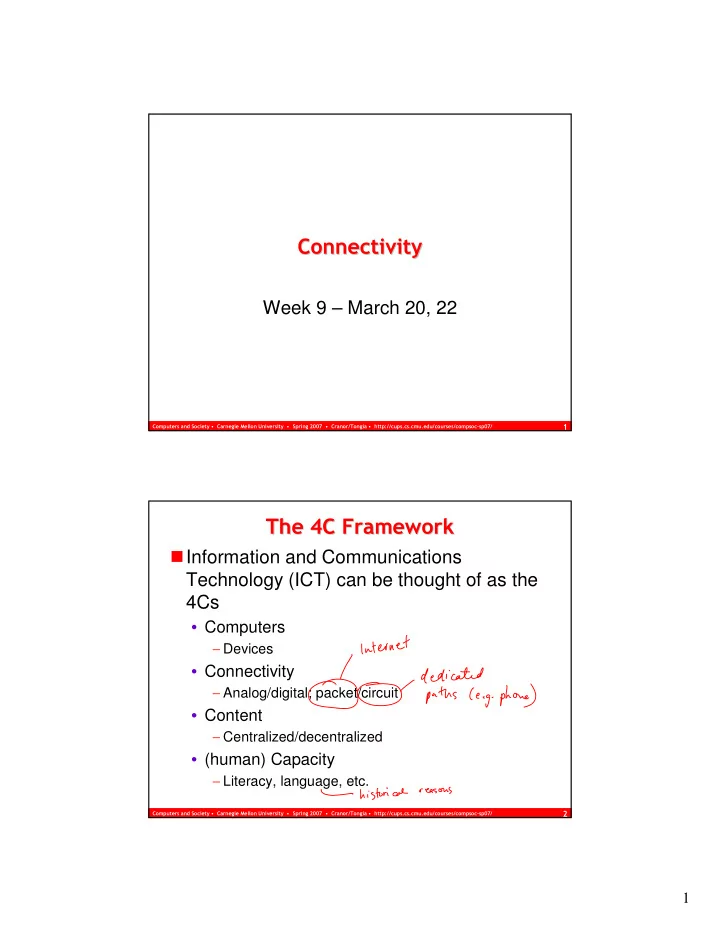
Information and Communications Technology (ICT) can be thought of as the 4Cs

  • Computers

− Devices

  • Connectivity

− Analog/digital; packet/circuit

  • Content

− Centralized/decentralized

  • (human) Capacity

− Literacy, language, etc.

slide-2
SLIDE 2

2

&

'( '(

Is it fast enough? Is it cheap enough? If not, is that a big deal? Are there distribution issues? What is the role of government and policy?

"

)(* )(*

Why is this misleading?

slide-3
SLIDE 3

3

+

,()( ,()(

Why could such information be misleading?

  • *.,()(

*.,()(

Issues of speeds or price are not shown

slide-4
SLIDE 4

4

  • /0123

/01234 4) )

(retail) Bandwidth Providers often chase the so- termed “Triple Play”

  • Voice

− Lots of $, still

  • Video

− Very high subscription rates in the US, approaching 90% − Different designs are possible

– Shared (e.g., broadcast) – Switched (e.g., Joost, YouTube, Pay-per-View)

  • Data

Mobility is another HUGE market What about secure (low-bandwidth connections)?

  • Home alarms
  • Smart Homes (“Home of the Future”)

5

0..)0.. 0..)0..

Voice

  • Fixed

− 23 $/month, 1 month/1923 min. → ~ 3,100 p$/bit

  • LD

− $0.10/minute → 26,000 p$/bit

– Incl. International charges (FCC numbers)

Web (broadband user)

− 35 $/month, 2 hours per day usage, 30 kbps average usage → ~ 5,400 p$/bit

TV (cable/satellite, excl. PPV)

− 225 $/year/person, 2.58 persons/household, 850 hours/year watched → ~ 36 p$/bit − A good fraction of their revenues comes from advertising − BUT, we don’t know what demand will look from 5 years from now, or, say, under 100 Mbps conditions p$ = picodollars = 10-12

2002 or 2003 US Statistical Abstract Average Numbers except in Italics

slide-5
SLIDE 5

5

6

.7 .7

Hardware / Installation Marketing / Advertising O&M Uplinking (transit fees) Technical CRM

!

  • "
  • !

1 1 )$8 )$8

$/Mbps transit Statistical Multiplexing (oversubscription) Mbps uplinked Number of users sharing a link Rated Bandwidth $/month cost per user to ISP for uplinking

slide-6
SLIDE 6

6

!!

* *9 9

!

:. :.

Ancient History

  • Marathon

− Ran 40 km in 490 BC to deliver a message of victory (and then died)

  • Smoke, fire, optical, and acoustic signals

− Water signals also allow the message to be stored (linked to fire/smoke signals)

Use of electricity gave rise to “instantaneousness”

slide-7
SLIDE 7

7

!&

:. :.

1800s:

  • Telegraph

– Patented by Samuel Morse – Idea came to him in 1832 on during a visit to Italy – Patented in 1838 – First line opened in 1844 between Washington High Court and Baltimore – “What Hath God Wrought?” – Improvements – Two way communications, single battery, etc. – TransAtlantic line continuously operating from 1866

  • Pony Express came about in 1860
  • Transcontinental railroad completed in 1869

!"

:. :. ;< ;<

  • Telephone

− Bell patented the telephone on February 14, 1876, beating Elisa Gray by 2 hours! − Bell recognized the commercial potential of his device

– Tried to sell the patent to Western Telegraph for $100,000, who refused – “What shall we do with a toy like that?” – Few years later, they offered Bell $25,000,000 (he refused) – Established Bell Telephone Company – Delivered and installed 50,000 telephones within the first three years – Became the world's largest telephone company: AT&T

− Almon Strowger, an undertaker, invented the exchange in 1889

slide-8
SLIDE 8

8

!+

. .

Digital world deals with bits

# $ $ % % # #&

  • !'
  • (

) ) * ) +# ) $#, ) - ) ) $! ) & ) + ) ., ) /( $ ) 0$ ) 12 ) / ) )

!-

3/. 3/.

Sampling – How often you “take in” data

  • Nyquist Sampling Theorem: Minimum rate of 2x the

highest frequency needed

− E.g., CDs sample at 44.1 kHz

Claude Shannon’s seminal work in 1948 led to Information theory

  • Statistical properties of message, averaged out over

the whole message--without regard to content

  • Tells us channel capacity (signal to noise ratio)

− 2^x = M (x = number of bits, M = of messages) − Thus, log(2) M = x (now, x is a measure of “entropy”)

slide-9
SLIDE 9

9

!

  • 4

4/. /.

Relates error-free transmission capacity C, given a bandwidth W (hertz) and signal to noise ratio (S/N) C = W log2 * (1 + S/N) Only provides theoretical limits to transmission capabilities

  • Does not tell us how to encode

!5

/*=)7 /*=)7

http://www.dslprime.com/pix/cbrrates.jpg

slide-10
SLIDE 10

10

!6

)(> )(>9 9 ? ?@ @A A

Different technologies are available

  • Cable
  • DSL
  • Fiber
  • Wireless

− Fixed − Mobile − Satellite

  • Powerline

They differ in

  • Reach
  • Speeds
  • Costs
  • Regulation (?)
  • (:(#(B;:#<

(:(#(B;:#<

Headend Home Drop Loop Node Feeder (Fiber) Active FROM BROADCAST SOURCES

Source: Marvin Sirbu

slide-11
SLIDE 11

11

!

>:(#(B >:(#(B

Headend Home Drop Loop Node Feeder (Fiber) Active HDT PSTN ATM NETWORK Coaxial Termination Unit FROM BROADCAST SOURCES

Source: Marvin Sirbu

>)@3C03 >)@3C03

O/E O/E Video Video Head End Head End

O/E O/E

fiber node fiber node

Tap Tap

T T

2 2-

  • way amplifier

way amplifier

  • ptoelectronics
  • ptoelectronics

O/E O/E

Internet Internet Backbone Backbone

IAP IAP

Cable Modem Cable Modem

CMTS CMTS

T T

PC PC

10 10 BaseT BaseT set top set top T T

Source: Stagg Newman

Frequency

Spectral Use

50M U P T V 900M T V T V T V 750M D O W N

slide-12
SLIDE 12

12

&

0@.C.. 0@.C..

ADSL Modem Splitter Telephone PC DSLAM Voice Switch Data Switch

Subscriber Premises Central Office Data carried above 4KHz voice frequencies This simplification ignores the use of remote terminals and digital loop carrier (DLC)

Source: Marvin Sirbu

#(D( #(D(

Fiber Optic Feeder Plant Distribution Plant: ADSL Inter-Office Trunking Local Access Network Drop Plant Manhole Central Office Central Office RDU RDU

Source: Marvin Sirbu

  • Can go all the way to the home (FTTH)
  • Fiber can easily provide Gigabit speeds
slide-13
SLIDE 13

13

+

=0@ =0@ >0@ >0@

!

  • )7=

)7=

slide-14
SLIDE 14

14

  • 1,,

1,,

Landlines have stagnated or diminished in the US In much of the world, mobiles are 5-10x landlines

  • E.g., Africa has about 10% mobile phone penetration
  • Why?

There is a generational gap as well…. Telephony is more established Data varies in service

  • Mobile
  • Portable / nomadic
  • Fixed

5

:.17 :.17

1894 Marconi sends signal 2 miles

  • Preceded by Bose and Tesla

1910 First song transmitted from Metropolitan Opera in New York 1917 AM transmission of speech 1920 First public radio broadcast in Germany 1928 FM transmission of speech (higher quality)

slide-15
SLIDE 15

15

6

11 11

3λ 4 ! 3 !12 λ 3! 3(

&

  • Wavelength

Wavelength Frequency Energy (Angstroms) (centimeters) (Hz) (eV) Radio > 109 > 10 < 3 x 10⁹ < 10-5 Microwave 109 - 106 10 - 0.01 3 x 10⁹ - 3 x 10¹² 10-5 - 0.01 Infrared 106 - 7000 0.01 - 7 x 10⁻⁵ 3 x 10¹² - 4.3 x 10¹⁴ 0.01 - 2 Visible 7000 - 4000 7 x 10⁻⁵ - 4 x 10-

5

4.3 x 10¹⁴ - 7.5 x 10¹⁴ 2 - 3 Ultraviolet 4000 - 10 4 x 10⁻⁵ - 10-7 7.5 x 10¹⁴ - 3 x 10¹⁷ 3 - 103 X-Rays 10 - 0.1 10-7 - 10-9 3 x 10¹⁷ - 3 x 10¹⁹ 103 - 105 Gamma Rays < 0.1 < 10-9 > 3 x 10¹⁹ > 105 Region

slide-16
SLIDE 16

16

&!

  • &

*. *.

Heavily controlled

  • Military uses
  • Licensed use

Source of licensing fees Is a public good; everywhere yet not limitless Should it be a property (auctioned off?) or a shared resource? Many forms are appropriate for point to multipoint (including broadcast) Encoding is key for capacity in practice – bits per hertz

  • Theory is bounded by Shannon’s Theorem
slide-17
SLIDE 17

17

&&

$1 $19 9

What prevents us from more wireless broadband?

  • Spectrum
  • Reach

− Related to power levels − Line of Sight

  • Costs
  • Evolving standards and technologies

− WiFi

– Mesh, MIMO, etc.

− WiMax

– Fixed and Mobile

− 3G, 4G, etc.

&"

#B1> #B1>E E / /

Base station

  • Point to Multipoint

Receivers

  • Rooftop
  • Indoors
  • Mobile/Portable

Shared bandwidth depends on technology

  • 25-40 Mbps downstream (might be)
  • 15-25 Mbps upstream
  • Spectrum matters

− Unlicensed (UNI – 5 GHz) − Licensed (e.g., MMDS - 2.5 GHz)

slide-18
SLIDE 18

18

&+

0#B1> 0#B1> )*3 )*3

Small Business

Wireless Modem Unit Ethernet LAN Transceiver/ Antenna VoIP Adapter Adapter Transceiver/ Antenna Wireless Modem Unit

Fiber Backhaul To Distribution Hub

Transmitter Receiver Channel Combiner

Wireless Modem Termination System

Router/ ATM switch Other MMDS channels Tower and Antenna (Base Station Outdoor Unit) Base Station Indoor Unit

Sprint and MCI have purchased

extensive MMDS licenses and will roll out in 40-60 markets over the next year.

Source: Marvin Sirbu &-

#B1 #B1

Typically, requires clear Line of Sight (LOS)

  • Except in small

radius

  • This requires costly

site visit to install antenna, run wiring to computer

Newer alternatives emerging (non-LOS)

Source: Sprint (Hybrid Networks) (antenna/transceiver only)

slide-19
SLIDE 19

19

&

)3F )3F

A single tower can cover up to 20 mile radius

  • Depends on terrain

As subscribers increase, may need additional base stations/cells for frequency reuse

"#$%&' ()*

&5

1/* 1/*

There are several thousand Wireless ISPs (WISPs) in the U.S.

  • Easy because of light touch regulation

− Spectrum − Antennae

Majority of WISPs use souped up wireless LAN technology

  • Normal WLAN coverage ~ few hundred feet
  • With directional antennas, coverage can reach

several miles

slide-20
SLIDE 20

20

&6

1D$% 1D$%

Popular for many city networks

  • Philadelphia, San Francisco, etc.

Major advantage

  • Issues of backhaul

Challenge

  • Shared throughput

Business model questions

  • Free vs. subsidized vs. at cost

Q: Can one share connectivity?

  • Open Access Points (mesh or non-mesh)?

"

>.@7 >.@71@>D 1@>D

Source: Cisco

slide-21
SLIDE 21

21

"!

/ /1# 1# . .? ?@ @A A 8 8 What’s the speed? What’s the reach? What’s the cost? What else do I need?

  • Backhaul
  • Management
  • Access Control

"

:$$ :$$? ? A A 1# 1#8 8

Access control vs. Encryption

  • WEP
  • WPA
  • Access Control – MAC Layer

Choose to run networks as open

  • Why or why not?
  • Default settings are “non-secure” – why?
  • Calif. is enacting legislation to limit open access

points People have been arrested/charge for “stealing WiFi”

slide-22
SLIDE 22

22

"&

. .

Community networks Municipal Networks (public) Sharing networks

  • Fon, Free
  • Would these be legal in the US?

""

  • 3.

3.

  • Based on Tongia (2003)

Connecting to global network Regulatory fees (e.g., spectrum); Marketing; Promotional equipment (e.g., CPE); Line conditioning / Testing; Installation CRM; Billing; Maintenance Common equipment; CPE Enormous variance across nations; depends on rated speeds / oversubscription Uplinking Costs Installation can be a bottleneck One-time Costs “cheap labor” Operating Costs Is there physical media available? Cost of capital? Hardware

slide-23
SLIDE 23

23

"+

7*> 7*>

  • ISP licensing fees
  • Spectrum
  • Rights of Way charges
  • Import Duties
  • User Taxes and Surcharges
  • Uplinking and interconnection

restrictions

  • Limits on applications and

services

  • Limits on sharing connectivity
  • Lack of clarity / consistency on

“affiliate transactions”

  • Low density of target users
  • Design without scalability or

upgrading possibilities

  • Proprietary or National-only

standards

  • High costs of regulatory

compliance

  • Higher failure rates and/or

maintenance

  • High costs of capital

(In no particular order)

"-

'..> '..>

  • Generalization is nigh impossible
  • Case to case variation

− Location − Carrier − Country − Technology

  • Data unavailability

Larger components often include

  • Licensing
  • Technology and design choice

− Legacy systems

  • Other infrastructure (power, security, etc.) [is it an add-on?]
slide-24
SLIDE 24

24

"

3 34 4& &

(@;&,<

(@;&,<

Recently went to Etisalat for $2.9B + 6% revenue share Technology estimated at

  • nly ~$1B

$0 $50 $100 $150 $200 $250 $300 6% 8% 10% 12% 14% 16% 18% 20% Discount Rate Annual Cost

2.5 5 7.5 10 12.5 15 Millions of Subscribers

Source: Tongia (2006)

"5

1*8 1*8

US regulator is the Federal Communications Commission (FCC)

Charge from Congress: “Ensure that the American people have available, at reasonable costs and without discrimination, rapid, efficient, Nation- and world-wide communication services; whether by radio, television, wire, satellite, or cable” – FCC Website

History

  • Succeed Federal Radio Commission in 1934
  • Federal Radio Commission (based on Radio Act of

1927) superceded Radio Act of 1912

− That one was made in response to the Titanic – all ships must have open and monitored radio channels

slide-25
SLIDE 25

25

"6

#G #G

All non-governmental use of radio All international communications originating or terminating in the US All interstate telecommunications (whether wired

  • r wireless)

What about Cable TV? Regulations initially separated Information Service from Telecommunications Services

  • Different regulations

+

0$ 0$? ?C CA A 78 78

Could new technologies make “ownership”

  • f spectrum obsolete?
  • UltraWideBand

− Really lower power

  • Cognitive Radios

− Can adapt their transmissions as per ambient conditions

– Change band, power level, modulation, etc.

Reality: Most existing spectrum is empty or underused!

slide-26
SLIDE 26

26

+!

/ /

Standards

  • Backwards compatibility

Metrics

  • How to measure size, number of users, etc?

− Important because of inter-player payments

Digital Communications

  • Broadcast industries

− TV − Radio

Mobile communications

  • Rush for “3G”

“Convergence”

+

/ /

Internet (more later) Security

  • Encryption
  • Privacy

Policy

  • Convergence
  • Open Access

Market Power

  • Not easy to define – at what Layer?

Globalization

  • “Winner Takes All”
slide-27
SLIDE 27

27

+&

)(*/ )(*/

Unanswered questions

  • Is there a “natural monopoly” in broadband?

− Very low marginal costs in telecom

  • How can one support competition over broadband

infrastructure?

  • Who should build broadband networks?

− Public/Private − Market/Regulated

  • How do we define and pay for “Universal Service?

Thinking of layers or boundaries becomes important

  • Wholesale vs. retail
  • Physical vs. logical
  • Content vs. carriage