
SLIDE 1
1
CL1 2007/08
Lecture 15: The Internet and the Web
CL1 2007/08
Alphabet Soup
– MAC (ethernet address e.g. 00-00-6c-4f-3d-1a) » Differentiates between machines on one ethernet segment) – UDP (datagram) – TCP (transport – gives you a reliable connection) – IP (end-to-end addressing e.g. 129.215.200.7) – HTTP (Web) – SMTP (mail) – SSL (secure socket layer) » Supports creation of Virtual Private Networks (VPNs) – secure tunnels through Internet – And many others
CL1 2007/08
OSI 7 layer networking model
- 7: Application layer e.g. terminal emulation, file transfer
- 6: Presentation layer (encryption, compression etc. )
- 5: Session layer manages connections between applications
- 4: Transport layer is responsible for ensuring correct end-to-end
delivery
- 3: Network layer finds routes for packets and transmits them to
next node
- 2: Link layer breaks packets into frames and sends them;
handles point-to-point issues e.g. error recovery, flow control
- 1: Physical layer sends bits
- TCP/IP model is rather different
- Both cases, each layer makes assumptions about layer below
CL1 2007/08
Put it all together - home
- Internet connection
– Dial-up – Cable – DSL (ADSL) over phone network
- Connection point
– Dial-up, cable or DSL modem
- Attach to PC or switch/router
CL1 2007/08
Switches and hubs
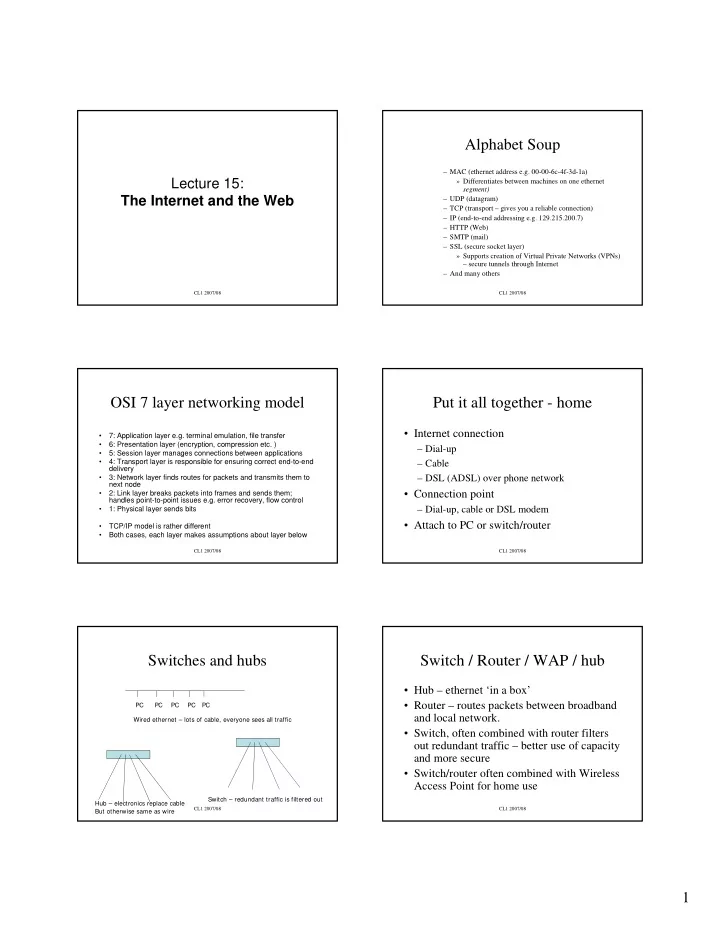
PC PC PC PC PC Wired ethernet – lots of cable, everyone sees all traffic Hub – electronics replace cable But otherwise same as wire Switch – redundant traffic is filtered out
CL1 2007/08
Switch / Router / WAP / hub
- Hub – ethernet ‘in a box’
- Router – routes packets between broadband
and local network.
- Switch, often combined with router filters
- ut redundant traffic – better use of capacity
and more secure
- Switch/router often combined with Wireless