Webinar: State of the Off-grid Appliance Market 2019 September 24 th - - PowerPoint PPT Presentation

webinar state of the off grid appliance market 2019
SMART_READER_LITE
LIVE PREVIEW

Webinar: State of the Off-grid Appliance Market 2019 September 24 th - - PowerPoint PPT Presentation

Webinar: State of the Off-grid Appliance Market 2019 September 24 th , 2019 The 2016 Global LEAP State of the Off-Grid Appliance Market Report was the first ever snapshot of off-grid appliances 2016 conclusions and insights Off-grid


slide-1
SLIDE 1

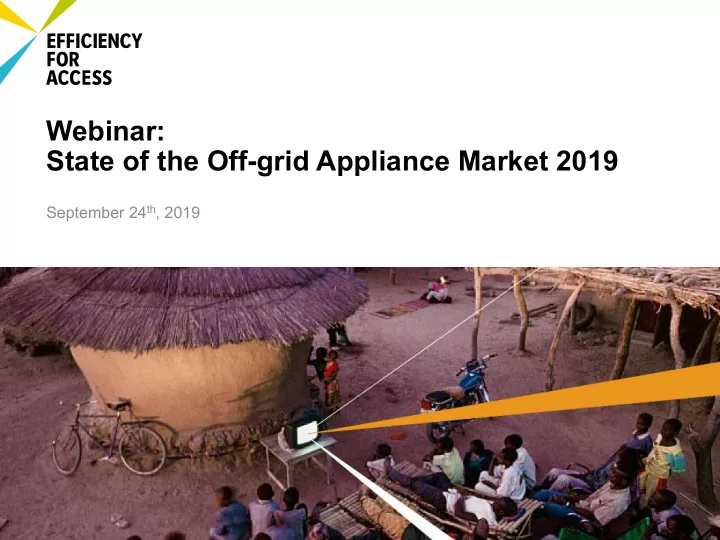
Webinar: State of the Off-grid Appliance Market 2019

September 24th, 2019

slide-2
SLIDE 2

2

The 2016 Global LEAP State of the Off-Grid Appliance Market Report was the first ever snapshot of off-grid appliances

  • Off-grid appliances hold significant promise for improving socio-economic
  • utcomes; but it is critical to think beyond lighting and cooking
  • Early movers are beginning to provide proof points for the potential of this

market; but continued product innovation, quality improvements, financing efforts, and supply chain development are crucial to realizing this potential

  • Governments, donors, and private investors alike have a critical role to play to

strengthen this market and realize its social impact potential

2016 conclusions and insights 2016 2017 2018 2019

State of the Off-Grid Appliance Market Report Launch Results-Based Financing (RBF) for Appliances Launch Equip Data Tool Launch LEIA Programme Launch GOGLA Sales Data Collection Expanded to Include Appliances

Launch of EforA R&D Fund for Appliances

Efficiency for Access Relaunch RBF Program Expanded to Solar Water Pumps Global LEAP Competition for Solar Water Pumps and Refrigerators Global LEAP Competition for Fans, Refrigerators, and TVs Second State of the Off-Grid Appliance Report Launch

slide-3
SLIDE 3

3

The 2019 report seeks to continue to build the fact base of the off- grid appliance market, and chart potential pathways to growth

OBJECTIVE Elevate and accelerate investment and action in the off- grid appliance space by putting forward an analysis of where the market is today and what is needed to move it forward AUDIENCE Industry players (manufacturers, distributors, and finance providers) in the off-grid appliance market Policymakers, donors, investors SCOPE Appliances: Household appliances, with a deep focus on TVs, fans, and refrigerators Geographic: Focus on representative markets in Africa and South Asia, including India, Myanmar, Kenya, Uganda, Ethiopia, Nigeria, Cote d’Ivoire, and Sierra Leone

slide-4
SLIDE 4

4 Source: IFC, Lighting Global Off-Grid Appliance training, 2018

The report focuses on off-grid appliances for the household - both generic off-grid and off-grid appropriate appliances

AFFORDABILITY

slide-5
SLIDE 5

5

Off-grid appliances are a critical catalyst for energy access – allowing people to enjoy the full benefits of electrification and, in turn helping drive demand for off-grid and mini-grid connections Overall appliance penetration remains low, significant untapped demand. Rural appliance penetration (grid and off-grid) across Sub-Saharan Africa – 17% TVs, 6% refrigerators, 6-8% fans. Market uptake of off-grid appliances has continued to grow, driven by technology advances, increased market entrants (especially with DESCO/PAYGO distribution), and competition – rough estimate of 5-10 million off-grid TVs, refrigerators, fan in market, but only small share branded Rapid off-grid market growth – 30-80% y-on-y, very wide range of estimate due to gaps in data Product development toes the line between efficiency and affordability, as scale of production increases it is hoped that more efficiency can be achieved at a lower production cost. While smaller appliances such as fans and to a certain extent televisions are demanded for household use, the suitability of larger more expensive and energy consuming appliances such as refrigerators may be more suited to small business productive use at this stage in the market Affordability remains a key constraint to market growth. Given the high upfront cost of off-grid appliances, and low incomes of target customers, there is a need for creative ways to increase affordability and access: smart subsidies, public funding, consumer financing More innovation and competition is needed to move the space forward. Government and donors can do more to support the sector and chart a sharper growth trajectory – in particular by integrating off-grid appliances into national electrification plans, supporting policies (e.g., taxes/tariffs), and investment into quality standards

The 2019 report takes a deeper look at the market sizing, how the market has evolved since 2016, and what is needed for it to grow further

slide-6
SLIDE 6

6 Source: CLASP

By providing access to electricity services, appliances support a number of SDGs – especially for marginalized communities

slide-7
SLIDE 7

7

This presentation will provide a short snapshot of the forthcoming report

SIZE OF THE OPPORTUNITY PRODUCT & TECHNOLOGY TRENDS CONSUMER INSIGHTS SUPPLY MARKET DYNAMICS & BUSINESS MODELS CONDITIONS FOR MARKET GROWTH PATH FORWARD

slide-8
SLIDE 8

8 Source: IEA World Energy Outlook, country grid quality surveys (e.g., Afrobarometer),, WB Lighting Global Market Trends Report, WB Mini-Grids Report (2019), Dalberg analysis

Globally, 475 million households are off-grid or have weak-grid connections, but uptake of off-grid solar and mini-grids is growing

SIZE OF OPPORTUNITY

Estimated number of off- and weak- grid households (Millions of Households, 2018) Large off-grid and weak-grid populations that are continuing to grow

  • Of

475 million

  • ff-grid

and weak-grid households, 90% in South Asia and SSA

  • Weak grid (225 million) almost as big as
  • ff-grid (250 million)
  • Off-grid and weak-grid market will remain

large over next decade, particularly in SSA as grid extension lags population growth .. off-grid appliance opportunity growing with off-grid and mini-grid growth

  • 73 million HHs, 360 million people, with off-

grid solar by EOY 2018, with SHS segment growing at >60% y-on-y

  • 10 million HHs connected to mini-grids

(mostly in Asia); WB projects 100-120 million households (500 million people) on mini-grids by 2030

South Asia Sub-Saharan Africa

The large and growing off-grid and weak- grid populations are the foundation of and primary engine for the growth of off-grid appliance demand

slide-9
SLIDE 9

9 Source: DHS, MICS, LSMS, National Energy Survey data across Africa (2012-2019); CGDEV mobile appliance demand survey (2018); desk research; Dalberg analysis

Low levels of appliance use in Sub-Saharan Africa and South Asia relative to higher income countries; immense latent demand

Appliance ownership rates in Africa and South Asia (% of HHs with appliance) Number of appliances per households – Africa vs. South Asia vs. High Income

SIZE OF OPPORTUNITY

High levels of unmet household demand for energy and appliances

  • HH energy consumption in US and Europe is 5-10 times greater than for avg. India HH, 10-20 times greater than for

Nigeria HH, and 20-200 times greater than rural Africa HH

  • Japan with 1/10 the people of SSA region, has 25% more refrigerators (47 million vs. 35 million for SSA) and TVs

(105 million vs. ~80 mil for SSA)

  • Across 10 SSA countries, 28% of off-grid households (18-35%) intend to purchase a television and 14% (6-24%

range) have interest in purchasing a refrigerator upon gaining access to electricity

India 78% 30% SSA 66% 35% 17% 12-18% Television Refrigerator Fan 69% 16% 54% 6-8% 17% 6% Total penetration (%) Rural penetration (%) India (rural) Developed world (US, UK, Spain, Korea, Japan) 2-5 3-10 Sub-Saharan Africa (rural) 12-40

slide-10
SLIDE 10

10 Source: Dalberg analysis

The high up-front cost of off-grid appliances limits the market size if only cash sales are considered

Estimated market size of off-grid appliances, globally, based with cash sales and with financing, 2018 (Bn USD)

0.9 0.8 1.3 6.8 4.4 0.0 TVs Fans Refrigerators Without financing With financing

SIZE OF OPPORTUNITY

Without financing: Full cost of appliance paid with 2 months saving With financing: 28-month repayment period, a 10% down payment and a 70% mark-up for servicing and financing

slide-11
SLIDE 11

11 Addressable market: Includes all households that can afford an appliance with financing (2 months of saving, 10% down payment, 28 months repayment, 70% mark-up for financing) Obtainable market: Accounts for access to financing (mobile money or financial inclusion) and rural access (World Bank Rural Access Index)

Up to 50% of off- and weak-grid households can afford off-grid appliances with financing, but the obtainable market is smaller

475 232 39 Total

  • btainable

market Off-grid and bad grid households Total addressable market

  • 92%

Households in the fan market (Mn) 475 221 36 Off-grid and bad grid households Total addressable market Total

  • btainable

market 92% Households in the TV market (Mn) 475 68 11 Off-grid and bad grid households Total addressable market Total

  • btainable

market

  • 98%

Households in the fridge market (Mn)

Households fan market 2018 (Mn) Households TV market 2018 (Mn) Households fridge market 2018 (Mn)

SIZE OF OPPORTUNITY

slide-12
SLIDE 12

12 Source: Dalberg analysis

The obtainable market size in South Asia and sub-Saharan Africa is 12.6 billion USD

Obtainable households for off-grid appliances, by region, 2018 (Mn)

6.4 28.7 8.7 23.9 3.5 6.4 South Asia sub-Saharan Africa

Refrigerators Fans TVs

Obtainable households for off-grid appliances, by region, 2018 (Bn USD)

SIZE OF OPPORTUNITY

The following assumptions were used to reach a representative and obtainable market size: 1. Consumer financing (10% up-front payment, 28 months financing, accounting for up to 70% mark-up due to financing and after-care service) 2. Financial inclusion (% of population with mobile money or access to a bank account) 3. Accessibility (World Bank Roads Index)

1.5 2.4 1.7 4.4 0.9 sub-Saharan Africa 0.3 7.7 South Asia 3.5

Refrigerators Fans TVs

slide-13
SLIDE 13

13 Source: Dalberg market sizing model, 2019

Looking ahead to 2030, the off-grid appliance market could reach 25.3 billion USD as higher value appliances come onto the market

SIZE OF OPPORTUNITY

6.8 8.2 9.5 4.4 8.7 14.3 1.5

2030

1.4 18.3

2018 2025

12.5 25.3 1.3

Fans TVs Refrigerators

Cumulative market potential (USD Bn)

The most important growth drivers accounted for:

  • Population growth
  • Increase in income levels
  • Lower product costs
  • Improved financial and mobile infrastructure

Cumulative market potential (HHs Mn)

39 44 48 36 47 57 11 23 41

2018 2025 2030

slide-14
SLIDE 14

14 Source: Dalberg analysis

Countries are developing in different ways, based on their grid penetration, access to finance, and policy support

SIZE OF OPPORTUNITY

Country Market potential (Mn USD, 2030) Financial inclusion (mobile money / account ownership)* Government Support (Favorability) India 9387 80% Explicit VAT exemption on SHS Kenya 264 73% VAT exemption on SHS, but mixed application Nigeria 929 40% Reduced VAT on SHS Myanmar 221 26% VAT exemption on SHS Côte d’Ivoire 127 34% Reduced VAT on SHS Uganda 39 51% Explicit VAT exemption on SHS Ethiopia 234 35% VAT exemption on SHS, but mixed application Sierra Leone 10 20% Duty waivers on SHS, but limited success

Early categorization of some of the off-grid appliance markets indicates

  • Ready for scale: Larger potential market, more mature solar sector, high and growing A2F,

strong government support

  • High potential markets: Large potential market, nascent A2F, growing but unconsolidated

government support

  • Nascent markets: Medium market size, accelerating A2F, unconsolidated government support
slide-15
SLIDE 15

15 Source: Dalberg Analysis, GOGLA H2 2018 Data

While data is incomplete, it is clear that the off-grid appliance sector is already substantial and growing, driven by televisions and fans

3 2 2 5 10 3 4 8 7 9 5 1 1 1 3 3 6 2 2

5 10 15 20 25

1 1 1

H1 2016

1

H2 2016 H1 2017

6

1

H2 2017 H1 2018 H2 2018

9 12 13 19 23 +33% per 6 month

11-20 Wp 100+ Wp 21-49 Wp 50-100 Wp 3-4 lights, phone charging, radio, fan 3-4 lights, phone charging, radio, fan, TV Medium capacity with extended capabilities High capacity with extended capabilities

Growth in newly installed global SHS capacity, by SHS size (MW installed) Growing off-grid appliance sales

  • We estimate aggregate off-grid TV, refrigerator,

fan penetration of 5-10 million units globally

  • Vast majority are generic (non-branded) products

(70-90%), most sold in Asia to date, particularly Bangladesh

  • Based on GOGLA H2 2018 data, which is highly

incomplete: 175,000 fans, 147,000 televisions (50% in Kenya), and 5,900 refrigerators

  • 30-80% growth in sales (compare with 33% per 6

month or 80% y-on-y growth for 50Wp+)

  • 25-85% of PAYGO today sold bundled with off-

grid appliance

H2 of 2018 was the first time GOGLA collected appliance sales data, this data set is expected to grow over time to provide the industry with more trends and insights

SUPPLY MARKET TRENDS

slide-16
SLIDE 16

16 Source: Interviews with experts, manufacturers, and distributors, 2019; Dalberg analysis

The supply side for off-grid appliances shows varying levels of integration and partnerships are required to drive sales

OEMs Branded manufacturers Vertically integrated DESCOs Distribution focused DESCOs Importers/ Wholesalers Local distributors / retailers Specialist Financiers

Production/ assembly Sales / Distribution After sales services Design

Upstream Downstream

Primary actors in the off-grid appliances value chain

SUPPLY MARKET TRENDS

slide-17
SLIDE 17

17 Source: Stakeholder interviews; “Global LEAP solar TV RBF: Baseline in East Africa,” Acumen, 2018

Consumer financing models have been a major driver of uptake by reducing affordability constraints for off-grid households

PAYGO MFI Alternative financing

Financing unlocks the up-front affordability barrier that prevent customers from purchasing off-grid appliances. In East Africa, 99% of survey respondents purchased their off-grid television on credit The three most common forms of financing for off-grid appliances are: DESCOs are leading efforts to add appliances to their PAYGO

  • fferings. This can increase demand for the system as a whole,

however it can increase their financing portfolio risk profile. In areas where mobile money has low penetration MFIs are providing financing for off-grid appliances. This is prevalent in India, and is being tested in more nascent countries like Myanmar. Local distributors have tested alternative models of financing such as rent to own financing, or installment payments, often in partnership with finance providers.

Financing is only one of the factors that will enable uptake of off-grid appliances

SUPPLY MARKET TRENDS

slide-18
SLIDE 18

18

There is a portfolio of appliances both on the market and at the horizon of innovation

PRODUCT & TECHNOLOGY

Source: Dalberg analysis; CLASP, GLOBAL LEAP SOLAR TV RBF: BASELINE IN EAST AFRICA, 2019

Solar Lanterns HOUSEHOLD INCOME ENERGY DEMAND ENERGY STACK OF OFF-GRID APPROPRIATE HOUSEHOLD APPLIANCES FOR BOP CUSTOMERS Mobile chargers Fans Radios Televisions Refrigerators Irons / sewing machines Electric cookers EMERGING APPLIANCES MATURING APPLIANCES HORIZON APPLIANCES

slide-19
SLIDE 19

19 Source: Dalberg Analysis, GOGLA H2 2018 Data

There is rapid evolution in off-grid appliance energy efficiency ratings, costs, and product diversity

Fan and TV energy efficiency over time based on Global Leap Awards data Increasingly diverse product eco-system with product variety, improved efficiencies, and falling product prices for some categories

  • Number of off-grid appliance enterprise

and products growing quickly – 3-5 branded manufacturers for each product in 2013 grew to 11 TV, 8 TV, 7 off-grid fan quality product mfg by 2017 in Global LEAP across dozens of products

  • Efficiency rising (45% improvement in TV

efficiency from 2014-2017), but very big disparity between average

  • ff-grid

appliance and best in class (1.5-3x)

  • Still big potential for efficiency improved,

e.g., 50% for average TV with improved insulation, materials, motors

  • Prices falling (23% decline in TV prices

from 2015 to 2018, will be 30%+ by 2023)

PRODUCT & TECHNOLOGY

slide-20
SLIDE 20

20

  • Content. Entertainment and access to information are primary purchase drivers for
  • ff-grid televisions, manufacturers and distributors are looking for ways to enable

access to more content – both in the hardware and through partnerships

  • Luminance. Due to televisions in off-grid areas often being the primary source of

light and therefore used in areas without other sources of light, manufacturers have found that screens can be dimmer and therefore more efficient

  • Durability. Televisions in off-grid environments are often moved around a house,

therefore product designers are looking for ways to make the television more durable and portable, especially for appliances bought on 2+ years credit

Source: Stakeholder interviews

Future technology trends for fans and televisions are moving beyond affordability, however for refrigerators it remains the key challenge

PRODUCT & TECHNOLOGY

Blade design. Blade design has the potential to have significant impact on efficiency, however there is less R&D invested in this field

  • BLDC. BLDCs are recognized to be one of the most significant technologies that can

improve a fan’s efficiency however despite efforts they remain relatively expensive for the price point at which an off-grid fan is attractive for a customer Phase Change Materials. PCM is used by some manufacturers in their off-grid refrigerators to help thermal management when power is intermittent or unavailable, however the materials tend to have higher energy efficiency Controllability. Manufacturers are working to improve controllability

  • f

the refrigerator’s temperature, to allow the product to remain cool when other off-grid appliances are drawing on solar home system power Smart inverters. Inverters that make refrigerators dual use (for off-grid and weak- grid) are currently being tested for the market

slide-21
SLIDE 21

21 Source: LEIA; Acumen Lean Data, 2018, Television Baseline report

2018 Household Use Appliance Demand & Impact

Consumer demand is not driven by impact potential, as increasingly diverse and affordable products are available

Almost 60% of the respondents bought the refrigerator to improve their business and attract more customers. Only 2% use them purely for convenience Comfort is frequently cited as being the most important purchase driver for fans Entertainment, news, and sports are the top three purchase drivers for a television in East Africa

CONSUMER INSIGHTS

slide-22
SLIDE 22

22 Source: Dalberg analysis

There are a number of conditions, beyond policy, that are important in the enabling environment to support market growth

CONDITIONS FOR GROWTH

Financial incentives Access to finance for consumers, suppliers, and distributors is crucial for enabling both the demand and supply of off-grid appliances. This can be supported with grants, concessional financing, and RBF programs. Policy The supply of energy access has historically been a government led initiative, however they have not always engaged on promoting the demand of energy through appliances. This is particularly relevant as countries expand their electrification using off-grid technologies. Consumer Awareness Given the early stage of the industry, there is low consumer awareness of solar technology and off-grid appliances as an alternative to the grid and conventional appliances. Independent surveys have shown that customers are likely to purchase from people they know, indicating a potential route to increase awareness. Innovative Distribution The diversification of players in the market, and other innovative means of distribution, ensures locally relevant distribution mechanisms. Partnerships will continue to be important to ensure distribution of appliances reaches those consumers who can most benefit from appliances.

slide-23
SLIDE 23

23

Policy: Governments should increasingly recognize the importance of driving energy demand through off-grid appliances as part of electrification initiatives, and could implement corresponding policies around taxes and, as the market matures, quality assurance Finance: More dedicated financing for

  • ff-grid

appliances should be made available—with an emphasis on customer-tailored solutions Knowledge sharing: More research on consumer habits should continue to be collected and disseminated across the industry to inform product design and business models, while more information should also be shared with customers to increase their awareness of off-grid appliances Market Stakeholders: Global on-grid conventional appliance players should be encouraged to enter the

  • ff-grid

market, potentially through public-private partnerships Technology: An ongoing focus should be placed on improving the efficiency of off- grid appliances to be able to reduce panel array and energy storage requirements, as well as increasing product durability, quality, and the availability of aftercare services

There are diverse levers needed to ensure the off-grid appliance market reaches its potential and has maximum impact

PATHWAYS TO GROWTH

slide-24
SLIDE 24

24

A number of levers, by a variety of actors, can be used to improve affordability of off-grid appliances and drive market growth

Industry Donors Government

  • Increased economies of scale in production and

distribution

  • Technological advances
  • Subsidy (to customer or distributor)
  • Results based financing schemes
  • Tax exemptions
  • Inclusion of off-grid appliances in electrification strategy

PATHWAYS TO GROWTH

slide-25
SLIDE 25

Questions? Comments? michael.tsan@dalberg.com jcorry@clasp.ngo

slide-26
SLIDE 26