WebEx Instructions 3 2 1 1. When logging in, please include a - - PowerPoint PPT Presentation

webex instructions 3 2 1
SMART_READER_LITE
LIVE PREVIEW

WebEx Instructions 3 2 1 1. When logging in, please include a - - PowerPoint PPT Presentation

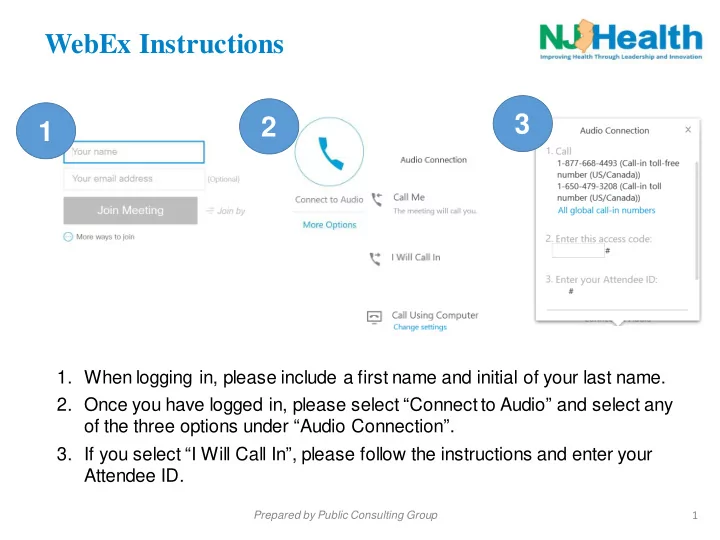
WebEx Instructions 3 2 1 1. When logging in, please include a first name and initial of your last name. 2. Once you have logged in, please select Connect to Audio and select any of the three options under Audio Connection. 3. If


slide-1
SLIDE 1

WebEx Instructions

1

Prepared by Public Consulting Group

1 2 3

  • 1. When logging in, please include a first name and initial of your last name.
  • 2. Once you have logged in, please select “Connect to Audio” and select any
  • f the three options under “Audio Connection”.
  • 3. If you select “I Will Call In”, please follow the instructions and enter your

Attendee ID.

slide-2
SLIDE 2

2

Prepared by Public Consulting Group

Ask questions in two ways: 1. Submit questions through the chat.

If the chat box does not automatically appear

  • n the screen’s right panel, hover over the

bottom of your screen and click the chat bubble icon, circled in red.

2. ‘Raise your hand’ to ask a question through your audio connection.

Once we see your hand raised, we will call

  • n you and unmute your line.

Please introduce yourself and let us know what organization you are from.

Q & A

Email njdsrip@pcgus.com with any additional questions.

slide-3
SLIDE 3

3

Prepared by Public Consulting Group

How did you celebrate the 4th of July holiday?

  • a. Attended a Cookout with Family & Friends
  • b. Watched a Parade or Fireworks Show
  • c. Enjoyed a Beach Day
  • d. Traveled Out of Town
  • e. Other? Type it in the chat!

Warm Up Poll

slide-4
SLIDE 4

NJ DSRIP July 2019 Webinar

July 11, 2019

Prepared by Public Consulting Group

Today’s Speakers: Meghan Cox, PCG Office of Healthcare Financing Robin Ford, MS Executive Director Michael D. Conca, MSPH Health Care Consultant Alison Shippy, MPH

slide-5
SLIDE 5

Today’s Objectives

5

By the end of today’s webinar, participants should be able to:

  • Share key highlights from the June In-Person Learning

Collaborative

  • Discuss opportunity to present on future webinars
  • Identify latest performance data available in dashboard
  • Locate and review the DSRIP 38 Recording
  • Interpret the changes to DY7 Attribution and follow the

appropriate next steps

Prepared by Public Consulting Group

slide-6
SLIDE 6

Proposed Agenda

6

  • 1. June 26th In-Person Learning Collaborative Highlights
  • 2. Call for Presentations & Upcoming Dates
  • 3. Dashboard Update – DY6 Appeals Adjustments
  • 4. DSRIP 38 Recording
  • 5. DY7 Attribution Updates & Next Steps
  • 6. Q&A
  • 7. Evaluation

Prepared by Public Consulting Group

slide-7
SLIDE 7

June 26th In-Person Learning Collaborative Highlights

slide-8
SLIDE 8

6/26 In-Person LC Highlights

8

Prepared by Public Consulting Group

slide-9
SLIDE 9

6/26 LC Successor Plan Update

9

Prepared by Public Consulting Group

Q1

Will the attribution model be redesigned in the Successor Program? Is this a way to have concurrent attribution?

A1

The State is planning to have a new attribution model in the Successor

  • Program. The new model is

currently under development.

Will the attribution model be redesigned in the Successor Program? Is this a way to have concurrent attribution?

Will payment be available to extend reporting partners?

A2

The Successor Program is planning to have provisions that address extending payment to Network Partners.

Q2

Do we know where the funding will be going through? State v. MCO

A3

The plan is that funding will go out through the MCOs.

Q3 A4

The package of quality measures currently under consideration for the Successor Program has been refined and tailored for the specific focus areas of the new program - behavioral health and maternal health. There will likely be fewer quality measures in the new program compared to the number of measures included in current DSRIP.

Q4

Since we are starting "new" DSRIP in July 2020 - will it be a 6 month reporting period, a 1 year reporting period (mid year) or 18 months to catch up to the calendar year cycle?

Q5 A5

The State is currently seeking guidance from CMS on this issue. Can a successor program have only 10 focused high impact measures instead of 68 currently?
slide-10
SLIDE 10

6/26 LC Successor Plan Timeline

10

Prepared by Public Consulting Group

slide-11
SLIDE 11

Upcoming Dates & Call for Presentations!

slide-12
SLIDE 12

Upcoming Dates

12

Prepared by Public Consulting Group

Upcoming Webinars

  • Tuesday, August 13th at 3pm
  • Thursday, September 19th at 10am*
  • Tuesday, October 8th at 3pm
  • Thursday, November 14th at 10am
  • Tuesday, December 10th at 3pm

*Note that this webinar does not follow the typical webinar schedule due to the September 2019 In- Person Learning Collaborative

Save the Date!

The next In-Person Learning Collaborative is Tuesday, September 10th in Princeton, NJ!

slide-13
SLIDE 13

Call for Presentations!

13

Prepared by Public Consulting Group

What to Expect

  • Order of topics to be based on presentation interest.
  • Presentations may range from 5-15 minutes.
  • Depending on interest, presentations may be single hospital or panel.
  • DSRIP Team will assist you to craft and prepare presentation.
  • Content can be based on reporting practices or improvement strategies.
  • Share hard work, best practices, and successes with your DSRIP colleagues!

Measure Name DSRIP # Heart Failure Admission Rate 45 COPD Admission Rate 32 Ambulatory Care – Emergency Department Visits 8 Percentage of Live Births Weighing Less Than 2,500 grams 67

slide-14
SLIDE 14

Dashboard Updates

DY6 appeals adjustments live

slide-15
SLIDE 15

Dashboard Updates

DY6 Appeal Results

  • Only 3 performance result changes occurred after appeals process.
  • Some substantiated appeals impacted hospitals’ DY6 Stage 3 results.
  • All eligible hospitals will have a UPP payment adjustment due to changes in the

amount available in the UPP Remainder Pool. DSRIP Dashboard Updates

  • Performance changes from substantiated appeals updated in dashboard on 7/10.
  • Includes small changes to DY6 Stage 3
  • Updates to UPP Payments for eligible hospitals

DSRIP Dashboard Resources 1. Dashboard Tutorials: https://dsrip.nj.gov/dashboard.html 2. Dashboard Instructions Page: Defines data contained in Dashboard – always review!

Prepared by Public Consulting Group

slide-16
SLIDE 16

DSRIP 38 Recording

Now Available!

slide-17
SLIDE 17

DSRIP 38 Recording

  • Now available on the NJ DSRIP Learning Collaborative webpage:

https://dsrip.nj.gov/lc.html

  • Reviews the current measure specification for DSRIP 38 – Engagement of

Alcohol and Other Drug Treatment

  • Overview of key changes from Databook v4.1 to align with NCQA 2019
  • Detailed review of the measure logic, including examples of numerator

compliance and non-compliance

  • These specifications are reflected in Databook v5.1
  • This recording is a companion to the February 2019 DSRIP webinar
  • Please email NJDSRIP@pcgus.comwith questions regarding this recording and

measure specification

Prepared by Public Consulting Group

slide-18
SLIDE 18

DY7 Attribution Updates & Next Steps

slide-19
SLIDE 19

DY7 Attribution

Prepared by Public Consulting Group

  • Hospitals were notified on July 1st of an update to patient attribution rosters to

account for changes in three hospital Medicaid IDs

  • Updated patient attribution rosters are available on the New Jersey DSRIP SFTP
  • For most DSRIP hospitals the change in attribution was less than 1% with most

patients remaining the same

  • To ensure that performance measures are accurately calculated, DY7 results need to

be calculated using these updated attribution rosters

  • In order to update EHR/Chart based measures, DSRIP providers need to review

these updated rosters and update and re-submit their DY7 Standard Reporting Workbooks (SRW) and Measure Validation Templates (MVT) by July 26th

slide-20
SLIDE 20

DY7 Attribution Methodology Refresher

Prepared by Public Consulting Group

  • The attribution algorithm matches individuals to providers based on a hierarchical process

that looks at claims over the last two years. The latest year is weighted 70%, the earlier year 30%. The model then categorizes claims in the groups listed below:

  • A minimum threshold 10% of utilization per category is required to be attributed to a category
  • For example: if a patient has received 10% of their total visits within Category 1, the

patient will be assigned based on those visits. If the threshold is not met, the model cascades through the hierarchy to the category where the 10% threshold is met.

  • The patient is then assigned to a provider based on a plurality (simple majority) of their visits

within the category.

  • In the case of a tie, the patient is attributed to the provider it has the most recent visits with.

1. Hospital-based clinic 2. ED Hospital 3. Reporting Partner 4. All other non-participating provider types

slide-21
SLIDE 21

DY7 Attribution Changes

Prepared by Public Consulting Group

Based on the nature of the attribution algorithm, when the Medicaid IDs were updated all claims were re-evaluated and more patients were attributed to these

  • hospitals. However, this also impacts other hospitals as it can shift where

patients had the majority of their visits. This caused the following changes program wide:

  • 0.78%
  • f patients are newly attributed to DSRIP providers
  • 0.23%

patients switched attributed DSRIP provider

  • 0.14%

patients are no longer attributed to DSRIP providers

slide-22
SLIDE 22

DY7 Attribution: Reconciling Attribution Lists

Prepared by Public Consulting Group

  • In order to identify the change in its patient attribution hospitals should compare

the attribution roster they received in February with the new attribution roster.

  • Medicaid Patients: can be identified using the Original Medicaid ID field
  • Charity Care Patients: can be identified using the Original Medicaid ID field

as well as birth date and gender

Individuals on the new roster that were not on the old roster are newly attributed patients and should be added where appropriate in the calculation of chart-based measures Individuals on the old roster that are not on the new roster are no longer attributed to your facility and should be removed from chart- based measures

New Patients Lost Patients

slide-23
SLIDE 23

DY7 Attribution: Next Steps

Prepared by Public Consulting Group

  • 1. Providers need to reconcile their attribution lists; adding newly attributed

members and removing those no longer attributed

  • 2. Providers need to review all chart-based measures in their SRWs and MVTs

Next Steps

Updated SRWs and MVTs must be uploaded to the NJ DSRIP SFTP by July 26, 2019

  • Where members are no longer attributed remove them and if appropriate

replace them with another member from the sample

  • Providers need to review their newly attributed members and assess if

they should be included in any chart-based measures

slide-24
SLIDE 24

Q & A

24

Prepared by Public Consulting Group

slide-25
SLIDE 25

25

Prepared by Public Consulting Group

Ask questions in two ways: 1. Submit questions through the chat.

If the chat box does not automatically appear

  • n the screen’s right panel, hover over the

bottom of your screen and click the chat bubble icon, circled in red.

2. ‘Raise your hand’ to ask a question through your audio connection.

Once we see your hand raised, we will call

  • n you and unmute your line.

Please introduce yourself and let us know what organization you are from.

Q & A

Email njdsrip@pcgus.com with any additional questions.

slide-26
SLIDE 26

Evaluation

26

  • Please answer the following evaluation questions

1. How would you rate this activity? 5 = Excellent; 1 = Very Poor 2. Did you feel that this webinar’s objectives were met?

  • Share key highlights from the June In-Person Learning Collaborative
  • Discuss opportunity to present on future webinars
  • Identify latest performance data available in dashboard
  • Locate and review the DSRIP 38 Recording
  • Interpret the changes to DY7 Attribution and follow the appropriate next steps

3. Please provide suggestions on how to improve this educational session.

Prepared by Public Consulting Group