Web Mining Mining content Simple rank is confused by rank sinks, - - PowerPoint PPT Presentation

web mining
SMART_READER_LITE
LIVE PREVIEW

Web Mining Mining content Simple rank is confused by rank sinks, - - PowerPoint PPT Presentation

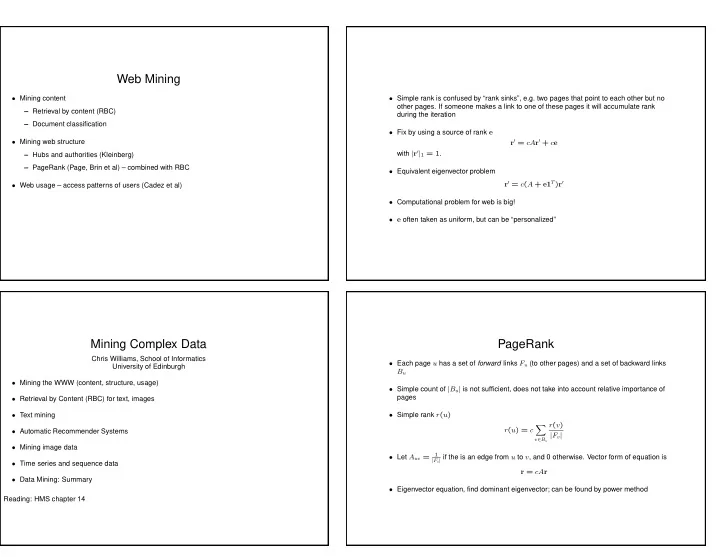
Web Mining Mining content Simple rank is confused by rank sinks, e.g. two pages that point to each other but no other pages. If someone makes a link to one of these pages it will accumulate rank Retrieval by content (RBC) during


slide-1
SLIDE 1

Mining Complex Data

Chris Williams, School of Informatics University of Edinburgh

  • Mining the WWW (content, structure, usage)
  • Retrieval by Content (RBC) for text, images
  • Text mining
  • Automatic Recommender Systems
  • Mining image data
  • Time series and sequence data
  • Data Mining: Summary

Reading: HMS chapter 14

Web Mining

  • Mining content

– Retrieval by content (RBC) – Document classification

  • Mining web structure

– Hubs and authorities (Kleinberg) – PageRank (Page, Brin et al) – combined with RBC

  • Web usage – access patterns of users (Cadez et al)

PageRank

  • Each page u has a set of forward links Fu (to other pages) and a set of backward links

Bu

  • Simple count of |Bu| is not sufficient, does not take into account relative importance of

pages

  • Simple rank r(u)

r(u) = c

  • v∈Bu

r(v) |Fv|

  • Let Auv =

1 |Fu| if the is an edge from u to v, and 0 otherwise. Vector form of equation is

r = cAr

  • Eigenvector equation, find dominant eigenvector; can be found by power method
  • Simple rank is confused by “rank sinks”, e.g. two pages that point to each other but no
  • ther pages. If someone makes a link to one of these pages it will accumulate rank

during the iteration

  • Fix by using a source of rank e

r′ = cAr′ + ce with |r′|1 = 1.

  • Equivalent eigenvector problem

r′ = c(A + e1T)r′

  • Computational problem for web is big!
  • e often taken as uniform, but can be “personalized”
slide-2
SLIDE 2

Retrieval by Content (RBC)

  • Documents: any segment of structured text
  • Terms: words, word pairs, phrases
  • Represent each document by which terms it contains
  • Use TF-IDF weighting (Salton and Buckley, 1988)
  • Term frequency

fij = countij maxl countlj where countij is the number of occurrences of term i in document j

  • Inverse document frequency

id fi = log n ni where N is the total number of documents, ni is the number that contain term i wij = fijid fi

  • wj is vector of wij’s for document j
  • Measure similarity between document and query using cosine distance

sim(dj, q) = wj · q √wj · wj√q · q

  • q has 1’s for terms in the query, 0’s elsewhere
  • Evaluation in terms of precision and recall
  • Latent Semantic Indexing (LSI): measure similarity in low-dimensional space found by

PCA on document-term matrix

Relevance Feedback

  • If user knew all relevant documents R and irrelevant documents NR, ideal query is

qopt = 1 |R|

  • j∈R

wj − 1 |NR|

  • j∈NR

wj

  • Rocchio’s algorithm: adjust by labelling a small set of returned documents as R′, NR′

qnew = αqcurrent + β |R′|

  • j∈R′

wj − γ |NR′|

  • j∈NR′

wj

  • Parameters α, β, γ chosen heuristically

Text Data Mining

  • Can’t wait for complete natural language understanding solution, mapping from text to

semantics!

  • Some example applications

– Classify newswire stories, email messages – Predict if pre-assigned key phrases apply to a given document – Rank candidate key phrases based on features (e.g. frequency, closeness to start of document) – Information retrieval – Labelling information in text, e.g. names in documents – Probabilistic parsing of bibliographic references

slide-3
SLIDE 3

Automatic Recommender Systems

  • Collaborative filtering: how can knowledge of what other people liked/disliked help you

make your choice?

  • Example domains: movies, groceries
  • Data is sparse like/dislike data for each person
  • Empirical Analysis of Predictive Algorithms for Collaborative Filtering (Breese,

Heckerman and Kadie, 1998) compared – Memory-based methods (correlation, vector similarity) – Cluster models – Bayes Net models

  • Found that Bayes Nets and correlation methods worked best

Mining Image Data

  • As with text, can’t wait for full AI solution to image understanding problem
  • Example problems

– Classification of regions/objects (e.g. astronomy) – Retrieval

  • Example retrieval system QBIC (IBM), Query by Image Content
  • Measure similarity using

– Global colour vector – Colour histogram – 3-d Texture feature vector – 20-d Shape feature for objects

Time Series and Sequences

  • Time series but also other sequences, e.g. DNA, proteins
  • Predictive time-series modelling (e.g. financial, environmental modelling)
  • Similarity search in sequences (define similarity!)
  • Finding frequent episodes (in a window of length lwin) from sequences.

Uses APRIORI-style algorithm

Paper Presentations

  • Further examples of data mining of complex data will be found in the

student paper presentations

slide-4
SLIDE 4

Datamining and KDD

Cleaning and Integration Selection and Transformation Data Mining Patterns Evaluation and Presentation Data warehouse Databases Flat files Knowledge

KDD: Knowledge Dis- covery in Databases Figure from Han and Kamber

Data Mining Tasks

  • Visualizing and Exploring Data (incl Association Rules)
  • Data Preprocessing
  • Descriptive Modelling
  • Predictive Modelling: Classification and Regression

What is data mining?

Data mining is the analysis of (often large) observational data sets to find unsuspected relationships and to summarize the data in novel ways that are both understandable and useful to the data owner. Hand, Mannila, Smyth We are drowning in information, but starving for knowledge John Naisbett [Data mining is the] extraction of interesting (non-trivial, implicit, previously unknown and potentially useful) information or patterns from data in large databases. Han

Some Issues in Data Mining

  • Mining methodology and user interaction

– e.g. Incorporation of background knowledge – e.g. Handling noise and incomplete data

  • Performance and scalability
  • Diversity of data types

– Handling relational and complex types of data – Mining information from heterogeneous databases and WWW

  • Applications, social impacts