What is Web Mining? The use of data mining techniques to - - PDF document

what is web mining
SMART_READER_LITE
LIVE PREVIEW

What is Web Mining? The use of data mining techniques to - - PDF document

What is Web Mining? The use of data mining techniques to automatically RECOMMENDATION MODELS discover and extract information from Web documents and services (Etzioni, 1996) FOR WEB USERS Web mining research integrate research from several


slide-1
SLIDE 1

1

1

RECOMMENDATION MODELS FOR WEB USERS

  • Dr. Şule Gündüz Öğüdücü

sgunduz@itu.edu.tr

2

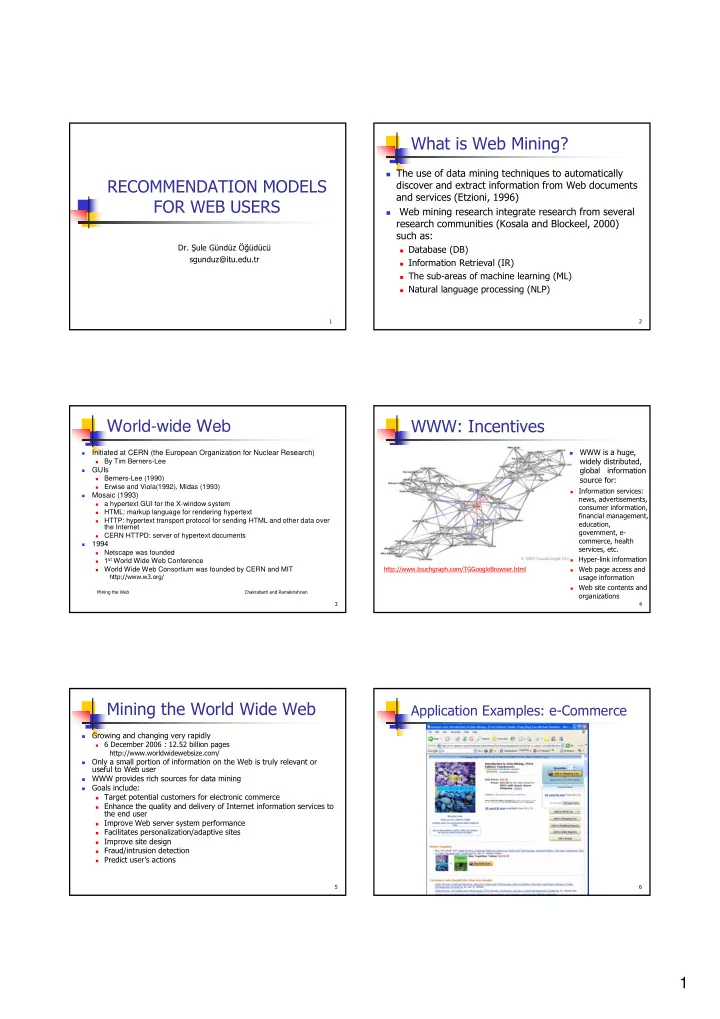
What is Web Mining?

The use of data mining techniques to automatically

discover and extract information from Web documents and services (Etzioni, 1996)

  • Web mining research integrate research from several

research communities (Kosala and Blockeel, 2000) such as:

Database (DB) Information Retrieval (IR) The sub-areas of machine learning (ML) Natural language processing (NLP) 3

World-wide Web

  • Initiated at CERN (the European Organization for Nuclear Research)
  • By Tim Berners-Lee
  • GUIs
  • Berners-Lee (1990)
  • Erwise and Viola(1992), Midas (1993)
  • Mosaic (1993)
  • a hypertext GUI for the X-window system
  • HTML: markup language for rendering hypertext
  • HTTP: hypertext transport protocol for sending HTML and other data over

the Internet

  • CERN HTTPD: server of hypertext documents
  • 1994
  • Netscape was founded
  • 1st World Wide Web Conference
  • World Wide Web Consortium was founded by CERN and MIT

http://www.w3.org/

Mining the Web Chakrabarti and Ramakrishnan

4

WWW: Incentives

http://www.touchgraph.com/TGGoogleBrowser.html

  • WWW is a huge,

widely distributed, global information source for:

  • Information services:

news, advertisements, consumer information, financial management, education, government, e- commerce, health services, etc.

  • Hyper-link information
  • Web page access and

usage information

  • Web site contents and
  • rganizations

5

Mining the World Wide Web

  • Growing and changing very rapidly

6 December 2006 : 12.52 billion pages

http://www.worldwidewebsize.com/

  • Only a small portion of information on the Web is truly relevant or

useful to Web user

  • WWW provides rich sources for data mining
  • Goals include:

Target potential customers for electronic commerce Enhance the quality and delivery of Internet information services to

the end user

Improve Web server system performance Facilitates personalization/adaptive sites Improve site design Fraud/intrusion detection Predict user’s actions

6

Application Examples: e-Commerce

slide-2
SLIDE 2

2

7

Challenges on WWW Interactions

Searching for usage patterns, Web structures,

regularities and dynamics of Web contents

Finding relevant information

99% of info of no interest to 99% of people

Creating knowledge from information available

Limited query interface based on keyword – oriented

search

Personalization of the information

Limited customization to individual users 8

Web Mining Taxonomy

Web Structure Mining Web Content Mining Web Usage Mining Web Mining

9

Web Usage Mining

Web usage mining also known as Web log mining

The application of data mining techniques to discover

usage patterns from the secondary data derived from the interactions of users while surfing the Web

Information scent

Information: Food WWW: Forest User: Animal Understanding the behavior of an animal that looks for food in the forest

10

Terms in Web Usage Mining

User: A single individual who is accessing files from

  • ne or more Web servers through a browser.

Page file: The file that is served through a HTTP

protocol to a user.

Page: The set of page files that contribute to a single

display in a Web browser constitutes a Web page.

Click stream: The sequence of pages followed by a

user.

Server session (visit): A set of pages that a user

requested from a single Web server during her single visit to the Web site.

11

Methodology

Usage Patterns Recommendation Set Data Collection Preparation Cleaning Pattern Extraction Recommendation

Offline Process Online Process

  • Server level collection
  • Client level collection
  • Proxy level collection
  • User Identification
  • Session Identification
  • Calculation of visiting

page time

  • Cleaning
  • Statistical analysis
  • Association rules
  • Clustering
  • Classification
  • Sequential pattern

Data collection Data preparation and cleaning Pattern extraction Recommendation

12

Recommendation Process

The right information is

delivered to the right people at the right time.

Recommender System User Representation Set of items:

  • Movies
  • Books
  • CDs
  • Web documents

: : Subset of items:

  • Movies
  • Books
  • CDs
  • Web documents

: :

Input Output

slide-3
SLIDE 3

3

13

What information can be included in User Representation?

The order of visited Web pages The visiting page time The content of the visited Web page The change of user behavior over time The difference in usage and behavior from

different geographic areas

User profile

14

Data Collection

Server level collection Client level collection Proxy level collection

Web server Proxy server Client Client

15

Web Server Log File Entries

Size Status Method/ URL Timestamp User ID IP Address 16

Use of Log Files

Questions

Who is visiting the Web site? What is the path users take through the Web

pages?

How much time users spend on each page? Where and when visitors are leaving the Web

site?

17

Data Preprocessing (1)

Data cleaning

Remove log entries with filename suffixes such as gif,

jpeg, GIF, JPEG, jpg, JPG

Remove the page requests made by the automated

agents and spider programs

Remove the log entries that have a status code of 400

and 500 series

Normalize the URLs: Determine URLs that correspond to

the same Web page

Data integration

Merge data from multiple server logs Integrate semantics (meta-data) Integrate registration data 18

Data Preprocessing (2)

Data transformation

User identification

Users with the same client IP are identical

Session idendification

A new session is created when a new IP address is

encountered or if the visiting page time exceeds 30 minutes for the same IP-address

Data reduction

sampling dimensionality reduction

slide-4
SLIDE 4

4

19

Discovery of Usage Patterns

Pattern Discovery is the key component of the Web

mining, which converges the algorithms and techniques from data mining, machine learning, statistics and pattern recognition etc research categories

Separate subsections:

Statistical analysis Association rules Clustering Classification Sequential pattern 20

Statistical Analysis

  • Different kinds of statistical analysis (frequency, median, mean,

etc.) of the session file, one can extract statistical information such as:

The most frequently accessed pages Average view time of a page Average length of a path through a site

  • Application:

Improving the system performance Enhancing the security of the system Providing support for marketing decisions

  • Examples:

PageGather (Perkowitz et al., 1998) Discovering of user profiles (Larsen et al., 2001)

21

Association Rules

Sets of pages that are accessed together with a

support value exceeding some specified threshold

Application:

Finding related pages that are accessed

together regardless of the order

Examples:

Web caching and prefetching (Yang et al.,

2001)

22

Clustering

A technique to group together objects with the

similar characteristics

Clustering of sessions Clustering of Web pages Clustering of users

Application: Facilitate the development and execution of

future marketing strategies

Examples:

Clustering of user sessions (Gunduz et al., 2003) Clustering of individuals with mixture of Markov

models (Sarukkai, 2000)

23

Classification

The technique to map data item into one of

several predefined classes

Application

Developing a usage profile belonging to a

particular class or category

Examples:

WebLogMiner (Zaiane et al., 1998) 24

Sequential Pattern

Discovers frequent subsequences as patterns Applications:

The analysis of customer purchase behavior Optimization of Web site structure

Examples:

WUM (Spiliopoulou and Faulstich, 1998) Longest Repeated Subsequence (Pitkow and

Pirolli, 1999)

slide-5
SLIDE 5

5

25

Online Module: Recommendation

The discovered patterns are used by the online

component of the model to provide dynamic recommendations to users based on their current navigational activity

The produced recommendation set is added to

the last requested page as a set of links before the page is sent to the client browser

26

Probabilistic models of browsing behavior

Useful to build models that describe the

browsing behavior of users

Can generate insight into how we use Web Provide mechanism for making predictions Can help in pre-fetching and personalization

27

Markov models for page prediction

General approach is to use a finite-state Markov chain

Each state can be a specific Web page or a category of

Web pages

If only interested in the order of visits (and not in time),

each new request can be modeled as a transition of states

Issues

Self-transition Time-independence 28

Markov models for page prediction

For simplicity, consider order-dependent, time-independent

finite-state Markov chain with M states

Let s be a sequence of observed states of length L. e.g. s =

ABBCAABBCCBBAA with three states A, B and C. st is state at position t (1<=t<=L). In general,

Under a first-order Markov assumption, we have This provides a simple generative model to produce sequential

data ∏

= −

=

L t t t

s s s P s P s P

2 1 1 1

) ,..., | ( ) ( ) (

= −

=

L t t t

s s P s P s P

2 1 1

) | ( ) ( ) ( 29

Markov models for page prediction

  • If we denote Tij = P(st = j|st-1 = i), we can define a M x M transition

matrix

  • Properties

Strong first-order assumption Simple way to capture sequential dependence

  • If each page is a state and if W pages, O(W2), W can be of the
  • rder 105 to 106 for a CS dept. of a university
  • To alleviate, we can cluster W pages into M clusters, each assigned

a state in the Markov model

  • Clustering can be done manually, based on directory structure on

the Web server, or automatic clustering using clustering techniques

30

Tij = P(st = j|st-1 = i) now represent the probability

that an individual user’s next request will be from category j, given they were in category i

We can add E, an end-state to the model E.g. for three categories with end state: - E denotes the end of a sequence, and start of a new

sequence

⎟ ⎟ ⎟ ⎟ ⎟ ⎠ ⎞ ⎜ ⎜ ⎜ ⎜ ⎜ ⎝ ⎛ = ) | 3 ( ) | 2 ( ) | 1 ( ) 3 | ( ) 3 | 3 ( ) 3 | 2 ( ) 3 | 1 ( ) 2 | ( ) 2 | 3 ( ) 2 | 2 ( ) 2 | 1 ( ) 1 | ( _) 1 | 3 ( ) 1 | 2 ( ) 1 | 1 ( E P E P E P E P P P P E P P P P E P P P P T

Markov models for page prediction

slide-6
SLIDE 6

6

31

Markov models for page prediction

First-order Markov model assumes that the next state

is based only on the current state

Limitations

Doesn’t consider ‘long-term memory’

We can try to capture more memory with kth-order

Markov chain

Limitations

Inordinate amount of training data O(Mk+1)

) ,.., | ( ) ,.., | (

1 1 1 k t t t t t

s s s P s s s P

− − −

=

32

Fitting Markov models to observed page- request data

Assume that we collected data in the form of N

sessions from server-side logs, where ith session si, 1<= i <= N, consists of a sequence of Li page requests, categorized into M – 1 states and terminating in E. Therefore, data D = {s1, …, sN}

Let denote the set of parameters of the Markov

model, consists of M2 -1 entries in T

Let denote the estimated probability of transitioning

from state i to j.

ij

θ

θ θ

33

Fitting Markov models to observed page-request data

The likelihood function would be This assumes conditional independence of sessions. Under Markov assumptions, likelihood is where nij is the number of times we see a transition from state i

to state j in the observed data D. ∏

=

= =

N i i

s P D P L

1

) | ( ) | ( ) ( θ θ θ

M j i L

ij

n ij

≤ ≤ =∏ , 1 , ) (

θ

θ

34

Fitting Markov models to observed page- request data

For convenience, we use log-likelihood We can maximize the expression by taking partial

derivatives wrt each parameter and incorporating the constraint (via Lagrange multipliers) that the sum of transition probabilities out of any state must sum to

  • ne

The maximum likelihood (ML) solution is

= =

ij ij ij

n L l θ θ θ log ) ( log ) (

=

j ij

1 θ

i ij ML ij

n n =

θ

35

Bayesian parameter estimation for Markov models

In practice, M is large (~102-103), we end up estimating M2

probabilities

D may contain potentially millions of sequences, so some nij = 0 Better way would be to incorporate prior knowledge – prior

probability distribution and then maximize , the posterior distribution on given the data (rather than )

Prior distribution reflects our prior belief about the parameter

set

The posterior reflects our posterior belief in the parameter set

now informed by the data D

) | ( θ D P ) (θ P ) | ( D P θ

θ

36

Bayesian parameter estimation for Markov models

For Markov transition matrices, it is common to put a distribution

  • n each row of T and assume that each of these priors are

independent where

Consider the set of parameters for the ith row in T, a useful prior

distribution on these parameters is the Dirichlet distribution defined as

where , and C is a normalizing constant

=

i iM i

P P }) ,..., ({ ) (

1

θ θ θ

=

j ij

1 θ

= −

= =

M j q ij q iM i

ij i

C D P

1 ) 1 ( 1

}) ,..., ({

θ

α α

θ θ

= >

j ij ij

q q 1 , , α

slide-7
SLIDE 7

7

37

Bayesian parameter estimation for Markov models

The MP posterior parameter estimates are If nij = 0 for some transition (i, j) then instead of

having a parameter estimate of 0 (ML), we will have allowing prior knowledge to be incorporated

If nij > 0, we get a smooth combination of the data-

driven information (nij) and the prior

α α

θ

+ + =

i ij ij MP ij

n q n

) /( α α +

i ij

n q

38

Bayesian parameter estimation for Markov models

One simple way to set prior parameter is

Consider alpha as the effective sample size Partition the states into two sets, set 1 containing all

states directly linked to state i and the remaining in set 2

Assign uniform probability e/K to all states in set 2 (all

set 2 states are equally likely)

The remaining (1-e) can be either uniformly assigned

among set 1 elements or weighted by some measure

Prior probabilities in and out of E can be set based on

  • ur prior knowledge of how likely we think a user is to

exit the site from a particular state

39

Predicting page requests with Markov models

Many flavors of Markov models proposed for next

page and future page prediction

Useful in pre-fetching, caching and personalization of

Web page

For a typical website, the number of pages is large –

Clustering is useful in this case

First-order Markov models are found to be inferior to

  • ther types of Markov models

kth-order is an obvious extension

Limitation: O(Mk+1) parameters (combinatorial

explosion)

40

Predicting page requests with Markov models

Deshpande and Karypis (2001) propose schemes to

prune kth-order Markov state space

Provide systematic but modest improvements

Another way is to use empirical smoothing techniques

that combine different models from order 1 to order k (Chen and Goodman 1996)

Cadez et al. (2003) and Sen and Hansen (2003)

propose mixtures of Markov chains, where we replace the first-order Markov chain:

) | ( ) ,..., | (

1 1 1 − −

=

t t t t

s s P s s s P

41

Predicting page requests with Markov models

with a mixture of first-order Markov chains

where c is a discrete-value hidden variable taking K values Sumk

P(c = k) = 1and P(st | st-1, c = k) is the transition matrix for the kth mixture component

One interpretation of this is user behavior consists of K different

navigation behaviors described by the K Markov chains

Cadez et al. use this model to cluster sequences of page

requests into K groups, parameters are learned using the EM algorithm

) ( ) , | ( ) ,..., | (

1 1 1 1

k c P k c s s P s s s P

K k t t t t

= = = ∑

= − −

42

Predicting page requests with Markov models

Consider the problem of predicting the next state, given some

number of states t

Let s[1,t] = {s1,…, st} denote the sequence of t states The predictive distribution for a mixture of K Markov models is

  • The last line is obtained if we assume conditioned on component c = k,

the next state st+1 depends only on st

= + +

= =

K k t t t t

s k c s P s s P

1 ] , 1 [ 1 ] , 1 [ 1

) | , ( ) | (

= +

= = =

K k t t t

s k c P k c s s P

1 ] , 1 [ ] , 1 [ 1

) | ( ) , | (

= +

= = =

K k t t t

s k c P k c s s P

1 ] , 1 [ 1

) | ( ) , | (

slide-8
SLIDE 8

8

43

Predicting page requests with Markov models

Weight based on observed history is

where

Intuitively, these membership weights ‘evolve’ as we

see more data from the user

In practice,

Sequences are short Not realistic to assume that observed data is generated

by a mixture of K first-order Markov chains

Still, mixture model is a useful approximation

K k j c P j c s P k c P k c s P s k c P

j t t t

≤ ≤ = = = = = =

1 , ) ( ) | ( ) ( ) | ( ) | (

] , 1 [ ] , 1 [ ] , 1 [

= −

= = = =

L t t t t

k c s s P k c s P k c s P

2 1 ] , 1 [

) , | ( ) | 1 ( ) | ( 44

Predicting page requests with Markov models

K can be chosen by evaluating the out-of-sample

predictive performance based on

Accuracy of prediction Log probability score Entropy

Other variations of Markov models

Sen and Hansen 2003 Position-dependent Markov models (Anderson et al.

2001, 2002)

Zukerman et al. 1999 45

Collaborative Filtering

Method

Correlation between the item contents (such as

term frequency inverse document frequency and weighting)

Correlation between user’s interests (such as

votes and trails)

Results are captured in a generally sparse matrix

(users x items)

Problems

Sparsity Cold-start 46

Examples of Collaborative Filtering

Customer X

Buys Falcon CD Buys Stret Dogs CD

Customer Y

Searchs for Falcon Street Dogs is

recommended

47

Examples of Collaborative Filtering

48

Examples of Collaborative Filtering

slide-9
SLIDE 9

9

49

Examples of Collaborative Filtering

50 51

Networks & Recommendation

Word-of-Mouth

Needs little explicit advertising Products are recommended to friends, family,

co-workers, etc.

This is the primary form of advertising behind

the growth of Google

52

Email Product Recommendation

Hotmail

Very little direct advertising in the beginning Launched in July 1996

20,000 subscribers after a month 100,000 subscribers after 3 months 1,000,000 subscribers after 6 months 12,000,000 subscribers after 18 months By April 2002 Hotmail had 110 million subscribers

53

Email Product Recommendation

What was Hotmail’s primary form of

advertising?

Small link to the sign up page at the bottom of

every email sent by a subscriber

‘Spreading Activation’ Implicit recommendation

54

Spreading Activation

Network effects

Even if a small number of people who receive

the message subscribe (~0.1%), the service will spread rapidly

This can be contrasted with the current

practice of SPAM

SPAM is not sent by friends, family, co-workers No implicit recommendation SPAM is often viewed as not providing a good

service

slide-10
SLIDE 10

10

55

Page Prediction

  • Click-straem Tree Model (Gunduz et. al. 2003)

Pair-wise similarities of user sessions are calculated

the order of pages the distance between identical pages the time spent on these pages

A graph is constructed

Vertices: User sessions Edges: Pair-wise similarities

A graph-based clustering approach is applied Each cluster is then represented by a click-stream tree whose

nodes are pages of user sessions of that cluster

When a request is received from an active user, a recommendation

set consisting of three different pages that the user has not yet visited, is produced using the best matching user session

56

Problems

Evaluation of recommender systems Poor data Lack of data Privacy control

57

References

http://ibook.ics.uci.edu/slides.html http://www-users.cs.umn.edu/~kumar/dmbook/

  • O. Etzioni. The world wide web: Quagmire or gold
  • mine. Communications of the ACM, 39(11):65-68,

1996.

  • R. Kosala and H. Blockeel. Web Mining Research: A
  • summary. SIGKDD Explorations, 2(1):1-15, 2000
  • L. Page, S. Brin, R. Motwani, T. Winograd, The

PageRank Citation Ranking: Bringing Order to the

  • Web. In Proc. of the 7th Intenational World Widw Web

Conference, 161-172, 1998

58

References

  • L. V.S. Lakshmanan, F. Sadri, and I. N. Subramanian. A

Declarative Language for Querying and Restructing the World Wide web. Post-ICDE IEEE Workshop on Research Issues in Data Engineering (RIDE-NDS'96). New Orleans, February 1996.

  • G. O. Arocena and A. O. Mendelzon. WebOQL: Restructuring

Documents, Databases and Webs. In Proc. ICDE'98, 1998

  • M. Perkowitz and O. Etzioni, Adaptive Web Sites: Automatically

Synthesizing Web Pages. In Proc. of Fifteenth National Conference on Artificial Intelligence, 1998

  • J. Larsen, L. K.Hansen, A. Szymkowiak, T. Christiansen and T.

Kolenda, Webmining: Learning from the World Wide Web. Computational Statistics and Data Analysis, 2001

  • Q. Yang, H. H. Zhang and I. T. Yi Li, Mining web logs for

prediction models in WWW caching and prefetching. Knowledge Discovery and Data Mining, 473-478, 2001

59

References

  • Y. Yan, M. Jacobsen and H. G. Molina and U. Dayal, From User Access

Patterns to Dynamic Hypertext Linking. In Proc. 5th Int. World Wide Web Conference, 1007-1014, 1996 C. Shahabi, A. Zarkesh, J. Adibi and

  • V. Shah, Knowledge Discovery from Users Web-Page Navigation. In
  • Proc. 7th Int. Workshop on Research Issues in Data Engineering, 20-29,

1997

  • R. R. Sarukkai, Link Prediction and Path Analysis Using Markov Chains.

In Proc. 9th Int. World Wide Web Conference, 377-386, 2000.

  • O. R. Zaiane, M. Xin and J. Han, Discovering Web Access Patterns and

ternds by applying OLAP and data mining technology on Web logs. Advances in Digital Libraries, 19-29, 1998

  • M. Spiliopoulou and L. C. Faulstich, WUM: A Tool for Web Utilization

Analysis, extended version of Proc. EDBT Workshop WebDB'98, 184- 203, 1998

60

References

  • J.Pitkow and P.Pirolli, Mining Longest Repeating Subsequences to

Predict World Wide Web Surfing. In Proc. USENIX Symp. on Internet Technologies and Systems (USITS'99), 1999.

  • B. Mobasher and H. Dai and T. Luo and M. Nakagawa, Discovery
  • f Aggregate Usage Profiles for Web Personalization. In roc.

International {WEBKDD} Workshop -- Web Mining for E- Commerce: Challenges and Opportunities, 2000.

  • B. Mobasher and H. Dai and T. Luo and M. Nakagawa, Effective

Personalization Based on Association Rule Discovery from Web Usage Data. In Proc. 3rd ACM Workhop on Web Information and Data Management, 2001.