Web-Ice and Labelit: Tools for Convenient Diffraction Analysis at - - PowerPoint PPT Presentation

web ice and labelit tools for convenient diffraction
SMART_READER_LITE
LIVE PREVIEW

Web-Ice and Labelit: Tools for Convenient Diffraction Analysis at - - PowerPoint PPT Presentation

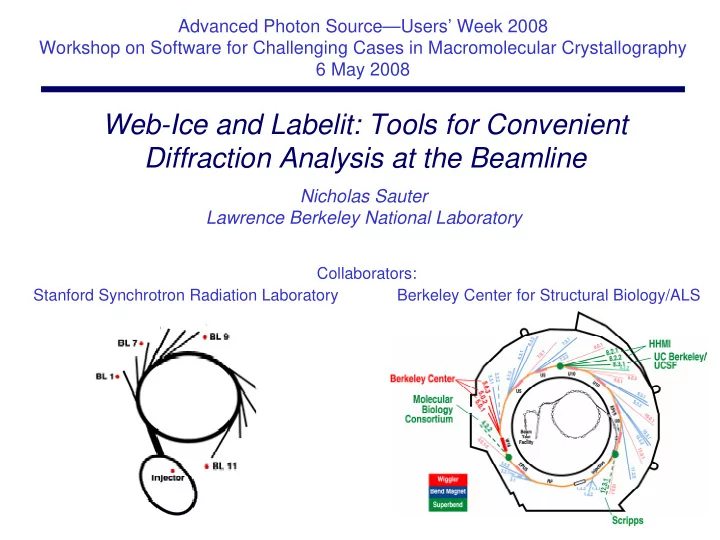
Advanced Photon SourceUsers Week 2008 Workshop on Software for Challenging Cases in Macromolecular Crystallography 6 May 2008 Web-Ice and Labelit: Tools for Convenient Diffraction Analysis at the Beamline Nicholas Sauter Lawrence


slide-1
SLIDE 1

Web-Ice and Labelit: Tools for Convenient Diffraction Analysis at the Beamline

Advanced Photon Source—Users’ Week 2008 Workshop on Software for Challenging Cases in Macromolecular Crystallography 6 May 2008 Nicholas Sauter Lawrence Berkeley National Laboratory

Collaborators: Stanford Synchrotron Radiation Laboratory Berkeley Center for Structural Biology/ALS

slide-2
SLIDE 2

Sector 5 ALS Automounter

Gripper

  • ALS-style puck: 112 Crystal Samples
  • Beamline Operating System (BOS) control
  • Liquid Nitrogen Autofill

Quantum 315 X-ray Detector

Dewar

Micro- scope Gonio- meter

Present Goals:

  • Screen for best crystal growth

conditions

  • Select the highest-quality

samples from a batch

  • Discovery of drug leads and

protein-ligand complexes

  • Enable multi-crystal dataset

acquisition

  • Perform initial characterization

with minimal radiation dose

Eventual Goals Later…

Cryo Stream

Also:

  • Single-run data collection
slide-3
SLIDE 3

First task—crystal screening: preliminary characterization of X-ray diffraction quality

  • Identify crystal lattice and

cell dimensions

  • Good fit between model and
  • bservation (r.m.s.d.)
  • Diffraction to high resolution
  • Minimal crystal disorder

(mosaicity)

  • Minimal diffraction artifacts

(ice rings)

The challenge is to perform this analysis reliably in a high- throughput automated setting!

slide-4
SLIDE 4

Screening results can be viewed both locally &

  • ver the Web González et al.(2008) J Appl Cryst 41:176

DISTL: the selection of candidate Bragg spots. Zhang et al.(2006) J Appl Cryst 39:112 LABELIT: characterization of the lattice. Sauter et al.(2004) J Appl Cryst 37:399 Blu-Ice / BOS: graphical beamline interface --- or --- Web-Ice: Web-viewer

Collect 2 oscillation frames 90° apart MOSFLM / BEST / RADDOSE 1 min LABELIT ~25 sec DISTL ~5 sec

slide-5
SLIDE 5

Heuristic score Q = 1 – (.7*e– 4/resolution) – (1.5*rmsResidual) – (.02*mosaicity)

Second task—selecting the best crystal and deciding on data collection strategy

BEST (Popov & Bourenkov, 2003): optimization of exposure time, Δφ, and distance so as to maximize the signal-to-noise (I/σ) in the dataset with a given radiation dose. RADDOSE (Murray et al, 2005): predict the absorbed radiation dose that limits the useful lifetime of the crystal sample. Beamline-specific and experiment-specific calibration

slide-6
SLIDE 6

Details of the “View Strategy” Implementation

  • Calculate strategy in

the correct Laue group

  • Initiate data collection
  • Process data after

autoindexing (at the command line)

slide-7
SLIDE 7

Web-Ice goals: scalability, extendability, portability Main site: http://smb.slac.stanford.edu/research/developments/webice Developers’ wiki: https://smb.slac.stanford.edu/wikipub Basic idea: the beamline crystallographer logs in to unix account with user name & password. Command-line scripts are run to process the data: The output files are in the user’s home directory, which is cross-mounted on all unix systems at the beamline.

run_mosflm run_labelit run_distl

The Web-Ice architecture offers the opportunity (through collaboration) to extend beamline efficiency and ultimately improve the science.

run_best

slide-8
SLIDE 8

Autoindexing gives the reduced cell, but can only guess at the Bravais lattice

Hexagonal Rhombohedral Reduced cell Monoclinic C-centered Triclinic Monoclinic C-centered Monoclinic C-centered

slide-9
SLIDE 9

Collaborative Goals to Extend Beamline Science

  • Early detection of the Laue group with labelit.rsymop / POINTLESS
  • Phenix.xtriage; detection of twinning
  • Real-time monitoring of radiation damage or heavy-atom signal
  • Fully automated data collection with multi-wavelength protocol
  • Combination of multiple crystals to form complete dataset

Web-ice is not so much an application as it is a computing architecture on which to hang different applications. Already-implemented features include beamline control & beamline video.

slide-10
SLIDE 10

Impersonation Daemon (C++ application running as root) Is this ticket valid? If yes, change process

  • wnership to user &

execute job

Under the hood: Systems computing on a handshake

run_mosflm run_labelit run_distl

Step 1. Getting a ticket

User

Authentication Server (Java webapp running on Apache Tomcat) Global server keeps track

  • f all user

login sessions https:// “give me a ticket” …here’s my password Pluggable Authentication Modules (PAM) Unix login LDAP here’s your ticket Other LDAP modules Implemented by John Taylor & Scott Classen

Step 2. Using a ticket

User

https://execute job …here’s my ticket Secure sockets As many servers in the cluster as needed to process the data

slide-11
SLIDE 11

Impersonation Daemon

High throughput automatic signaling

run_mosflm run_labelit run_distl

Local User

Web-Ice Crystal Analysis Webapp

Remote User

Blu-Ice or BOS: Graphical Data Collection Interface Web-Ice Front Page (SSRL or ALS code) Signal each time a new image is collected ticket ticket ticket Manual data processing

slide-12
SLIDE 12

Managing the Sample List: Different Choices at SSRL and ALS

Local User

Web-Ice Sample Information List Server

Remote User

Blu-Ice

  • r

BOS Web-Ice Front Page SSRL

  • r

ALS Excel spreadsheet Beamline database Standard http protocol

slide-13
SLIDE 13

Software demo: SIL server Image server & color markup AJAX client

slide-14
SLIDE 14

A Historical Note on Automatic Processing

  • LABELIT represented a new software approach to

autoindexing

– The initial approach of writing shell scripts to wrap existing software was changed early in development (2003), as legacy software relied too heavily on human input to make choices – Basic well-known algorithms had to be re-examined (cell reduction; Fourier-based autoindexing) – Use of the Python language to rapidly prototype new approaches was indispensable – A core library of C++ crystallography algorithms (cctbx; Grosse- Kunstleve et al. 2002, J Appl Cryst 35: 126) was exposed at the Python scripting level with Boost.Python bindings

  • Achieving automation has been an enormous challenge

– There are additional challenges related to instrumentation, record- keeping, and communication – Physical properties of macromolecular diffraction patterns are very diverse; the simplest algorithms are inadequate for outlying cases

slide-15
SLIDE 15

Very Large Unit Cells: Tightly Packed Diffraction Spots

  • 621Å cubic cell (virus crystal) leads to

barely-separated diffraction spots

  • Results from the indexing algorithm

are degraded when two bright spots are categorized as a single spot at the average position

  • Special fix:

– Find the brightest spots (Blue) – Find the best-fit ellipse – Find each spot’s nearest neighbor (Univ. Maryland ANN) – Plot all nearest-neighbor vectors on top of each other – Vector-clusters are probable reciprocal cell vectors – Throw out the large “blobs” longer than the probable reciprocal cell lengths – Special allowance made to accept spots with very little baseline separation; balanced against need for sufficient background

slide-16
SLIDE 16

Pseudocentering: systematically weak Bragg spots

  • The true symmetry is P21 with two

protein molecules per asymmetric unit, related by a non-crystallographic translation.

  • The NCS translation is ½ the cell length,

approximating an additional symmetry

  • perator, giving rise to alternating weak

spots (Hauptman & Karle, 1953).

  • If weak spots are ignored, the symmetry

is C-centered orthorhombic with one protein molecule per asymmetric unit.

  • Automatic indexing relies on picking the

brightest spots, so it is easy to pick the

  • C cell by chance.
  • Lowering the spot-picking threshhold to

find the weak spots is counterproductive.

slide-17
SLIDE 17

Construction of the Sublattice: Cell Doubling

Basis vectors Strong reflections Patterson peak 2a, b, c h = 2n ½, 0, 0 a, b, c hkl 0, 0, 0 a, b, 2c l = 2n 0, 0, ½ a, 2b, c k = 2n 0, ½, 0 2a, b+a, c+a h + k + l = 2n ½, ½, ½ 2a, b+a, c h + k = 2n ½, ½, 0 2a, b, c+a h + l = 2n ½, 0, ½ a, 2b, c+b k + l = 2n 0, ½, ½ Basis vectors Strong reflections Patterson peak

a c b

slide-18
SLIDE 18

Evidence for Cell Doubling in the Raw Data

Doubled a-axis Doubled c-axis Doubled b-axis Pseudo body-centered Pseudo C-face centered Pseudo B-face centered Pseudo A-face centered

*

Original Cell

slide-19
SLIDE 19

Filtering out decoy signals

Should the lattice be reindexed by imposing pseudo A-centering …

  • r …

pseudo-body centering?

slide-20
SLIDE 20

Statistical outlier rejection

100 200 300 400 500

1 3 5 7 9 11 13 15 17 19

20 40 60 80 100 120 140

1 2 3 4 5 6 7 8 9 10 11 12 13 14 15 16 17 18 19 20 21 22 23 24 25 26 27 28 29

Distribution of peak-heights for the pseudo body-centered coset

Peak height of candidate spot

Distribution of peak-heights for the pseudo A-centered coset

Peak height of candidate spot

Exponential Distribution Gaussian Distribution

Outlier

slide-21
SLIDE 21

More decoy signals to filter out

Inadequate mosaicity model Mismatched or non-Bragg-like profile

slide-22
SLIDE 22

In Summary

  • There is still work to be done so that the most challenging cases can

be processed automatically; these cases include samples with large unit cells (viruses), and crystals with pseudo-symmetry.

  • While screening has been automated, the longer term goal of

automated dataset collection is only beginning to be addressed.

  • Web-Ice has been successfully ported from SSRL to BCSB, and will be

the focus of continued efforts at real-time data analysis, to enable better high-throughput data collection.

slide-23
SLIDE 23

Acknowledgements

Advanced Photon Source—Users’ Week 2008 Workshop on Software for Challenging Cases in Macromolecular Crystallography 6 May 2008 Nicholas Sauter Billy Poon Ralf Grosse-Kunstleve Paul Adams Peter Zwart John Taylor Yun Zhou Ana González Mike Soltis Penjit (Boom) Moorhead Jinhu Song Ken Sharp Scott McPhillips

Computational Crystallography Initiative at Lawrence Berkeley National Lab Berkeley Center for Structural Biology at the Advanced Light Source Stanford Synchrotron Radiation Lab