We the People.. The Failings of the Articles of Confederation and - - PowerPoint PPT Presentation

we the people
SMART_READER_LITE
LIVE PREVIEW

We the People.. The Failings of the Articles of Confederation and - - PowerPoint PPT Presentation

We the People.. The Failings of the Articles of Confederation and the Solutions of the Constitutional Convention Unit Two- BD Sorting Out the Problems: Article One * Two plans are put forth to address the issue of representation James


slide-1
SLIDE 1

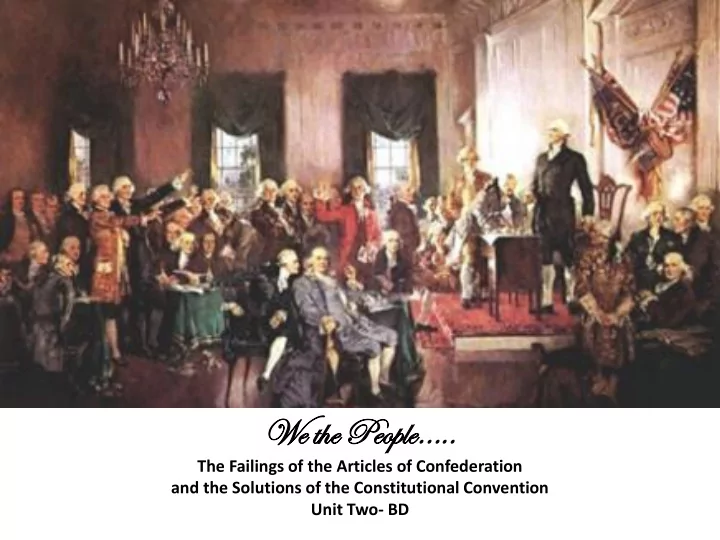
We the People…..

The Failings of the Articles of Confederation and the Solutions of the Constitutional Convention Unit Two- BD
slide-2
SLIDE 2

Sorting Out the Problems: Article One * Two plans are put forth to address the issue of representation

  • James Madison proposes THE VIRGINIA PLAN:
  • This states that Congress will have two houses
  • A lower house based on population
  • An upper house elected by, and from, the members of the lower house
  • William Patterson proposes THE NEW JERSEY PLAN:
  • This basically leaves Congress the way it was under the Articles of

Confederation, where each state was equally represented, except for;

  • Congress could set taxes and enforce their collection
  • National laws would take precedence over state laws
slide-3
SLIDE 3

Sorting Out the Problems: Article One * Two plans are put forth to address the issue of representation

  • By the end of the debate, Roger Sherman of Connecticut proposes what has

come to be known as the GREAT COMPROMISE, which says that:

  • Congress, the legislative body responsible for making laws, will consist of two

houses:

  • The House of Representatives, elected by the people, based on population, (one

representative for every 30,000 people,) elected every two years, and presided

  • ver by a Speaker of the House; and
  • The Senate, elected by the people, and consisting of two members from each

state, elected every six years, and presided over by the Vice President of the United States.

slide-4
SLIDE 4

Article One * Two plans are put forth to address the issue of representation

  • The issue of who would be counted was particularly important, and caused

much heated debate

  • Southern states wanted to count their slaves in the count of their population
  • Northern states did not want this to be allowed
  • A compromise was reached, known as the 3/5th’s COMPROMISE, wherein each

slave and indentured servant would be counted as 3/5th’s of a person, and Indians would not be counted

  • Congress was also given the power to approve direct taxes on the people based
  • n population
slide-5
SLIDE 5

Article One: Qualifications * A Representative

  • Must be 25 years of age
  • Must have been a U.S. citizen for at least 7 years
  • Must be a resident of the state in which they are elected from

* A Senator

  • Must be 30 years of age
  • Must have been a U.S. citizen for at least 9 years
  • Must be a resident of the state in which they are elected from
slide-6
SLIDE 6

Article One: The Powers of Congress * THE ELASTIC CLAUSE

  • “To make all laws which shall be necessary and proper for carrying into

execution the foregoing powers, and all other powers vested by this Constitution in the government of the United States, or in any department or

  • fficer thereof.”
  • For example, the Constitution says nothing about health care, but yet Congress

passed a law stating that mandatory universal health care must be provided by the government, because they felt it was necessary and proper to providing for the general welfare of the people

  • Another example, the Constitution says nothing about electronic piracy, but yet

the Congress has passed laws protecting the rights of artists and media companies to the works they produce, because they felt it necessary to insure justice

slide-7
SLIDE 7

Article One: The Powers of Congress * IMPEACHMENT

  • When a high ranking government official is accused of “high crimes and

misdemeanors” the House of Representatives will determine if there is enough evidence to find him guilty, and if so, will impeach the official

  • Once impeached, the Senate will conduct a trial, with witnesses, a defense, and

presided over by the Chief Justice of the United States Supreme Court

  • 2/3’rds (Two-Thirds) of all Senators must vote guilty in order for the impeached

person to be removed from office

  • Only three Presidents in U.S. history have been impeached (Andrew Johnson,

Richard Nixon and Bill Clinton.) None have been found guilty in the Senate

slide-8
SLIDE 8

Article One: The Powers of Congress * APPROVAL OF PRESIDENTIAL APPOINTMENTS

  • The Senate approves, with a majority vote, such appointments to offices as:
  • Cabinet Members
  • Ambassadors
  • Supreme Court Justices
slide-9
SLIDE 9

* APPROVE TREATIES Article One: The Powers of Congress

  • 2/3rd’s (Two-Thirds) of all Senators must vote to approve a treaty in order for it

to take effect

slide-10
SLIDE 10

Article One: The Powers of Congress * OTHER ENUMERATED POWERS

  • To coin money
  • To declare war
  • Create taxes
  • Regulate Commerce
  • Borrow Money
  • Create and Fund an Army and a Navy
slide-11
SLIDE 11

Article One: The Powers of Congress * POWERS LEFT TO THE STATES

  • Anything not listed in the Constitution as a power of Congress is left to the states to

decide how to exercise

  • HOWEVER, A FEDERAL LAW ALWAYS BEATS A STATE LAW!
  • States are left with some powers under our system of government. The

division of powers between the national government and the individual state governments is called Federalism

  • Powers shared by both the national (federal) and state governments are called

Concurrent Powers