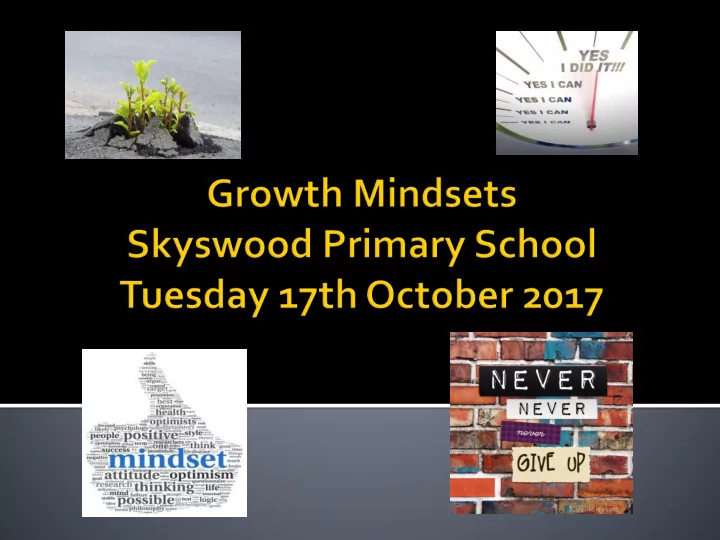
We now understand more about ourselves as learners than ever - - PowerPoint PPT Presentation

we now understand more about ourselves as learners than
SMART_READER_LITE
LIVE PREVIEW

We now understand more about ourselves as learners than ever - - PowerPoint PPT Presentation

We now understand more about ourselves as learners than ever before. With a fixed mindset we believe that there are things that we simply cannot learn to do. With a growth mindset we understand that the most powerful


slide-1
SLIDE 1
slide-2
SLIDE 2

 We now understand more about ourselves as learners

than ever before.

 With a ‘fixed mindset’ we believe that there are things

that we simply cannot learn to do.

 With a ‘growth mindset’ we understand that the most

powerful learning can come from addressing our ‘mistakes.’ We enjoy the challenge of coming out of

  • ur comfort zones and develop resilience when things

don’t automatically go to plan.

slide-3
SLIDE 3

Positive self-belief is vital if we are to reach our true potential..

The language that we use is essential.

High quality feedback has a significant impact.

Appropriate ‘pitch’ of learning will challenge and motivate our children.

Emphasis must be given to building resilience and developing skills of self-evaluation.

An open ended, investigative approach to learning supports a growth mindset culture.

An understanding of how our brain works can help to embed a growth mindset.

slide-4
SLIDE 4

Skyswood Primary & Nursery School Improvement Plan 2017/18 To embed a growth mindset culture of learning throughout the school

‘We cannot fully succeed without learning that it’s okay to fail.’

slide-5
SLIDE 5

Schools can embed practices that support a growth mindset approach, but to create a growth mindset culture then all stakeholders need to be on board. Parental attitudes are critical.

slide-6
SLIDE 6

Children as Teachers

We retain 5 to 10% of what we see or hear, as opposed to 90% of what we teach!

Talk Partners Encourages engagement of ALL Chilli Challenge Encourages children to take

  • wnership of their own learning

Investigative, enquiry-based curriculum Motivates children and encourages deeper thinking.

slide-7
SLIDE 7

The brain is like a muscle that can be developed and grow in strength.

Our brain does not grow from making mistakes as if by magic , it is how we respond to our mistakes that is critical in order to develop a growth mindset.

https://www.youtube.com/watch?v=ELpfYCZa87g

slide-8
SLIDE 8
slide-9
SLIDE 9

https://www.youtube.com/watch?v=2zrtHt3bBmQ

slide-10
SLIDE 10
slide-11
SLIDE 11

Those kids with a ‘fixed mindset’

  • Research shows more girls have a fixed mindset

than boys in maths

  • ‘Higher ability’ pupils often have a fixed mindset;

having always received praise for being ‘smart’, they won’t take on further challenges for fear of losing that ‘smart’ label

  • ‘Lower ability’ pupils with a fixed mindset

perceive themselves as ‘not smart’ and only ever capable of tackling ‘easy’ tasks

  • These kids see ‘failure’ as something to be

avoided, so stay firmly in their comfort zone

slide-12
SLIDE 12

Praise

You got them all right, fantastic! You have a real talent for this; you’re a natural! Well done! You are very clever to remember all those facts. Wow! Great drawing! What an artist!

slide-13
SLIDE 13

The Language that we use really matters!

When similar children were given fixed mindset praise (“you did that really well; you are so clever at doing puzzles!”) or growth mindset praise (“you did that really well; you must have tried really hard!”) it dramatically reduced or improved their ability to progress

  • nto harder puzzles.
slide-14
SLIDE 14
slide-15
SLIDE 15

Growth Mindset Praise

It was great how you tried lots of different strategies to get the answers. You must have put a lot of time and effort into this work. Good job! You stuck at this really well and didn’t give up. Super effort! Look at how much better your second attempt was – well done!

slide-16
SLIDE 16

The best kind of praise...

  • is sincere
  • is well-deserved
  • is relevant
  • is linked to process (learning), rather than
  • utcome (achievement)
  • is consistent
  • is supported through wider reflection and

evaluation

slide-17
SLIDE 17

“The surest path to high self-esteem is to be successful at something one perceived would be difficult! Each time we steal a student’s struggle, we steal the opportunity for them to build self-confidence. They must learn to do difficult things to feel good about themselves.” Sylvia Rimm

slide-18
SLIDE 18