We acknowledge we are hosted on the lands of the Mississaugas of the - - PowerPoint PPT Presentation

we acknowledge we are hosted on the lands of the
SMART_READER_LITE
LIVE PREVIEW

We acknowledge we are hosted on the lands of the Mississaugas of the - - PowerPoint PPT Presentation

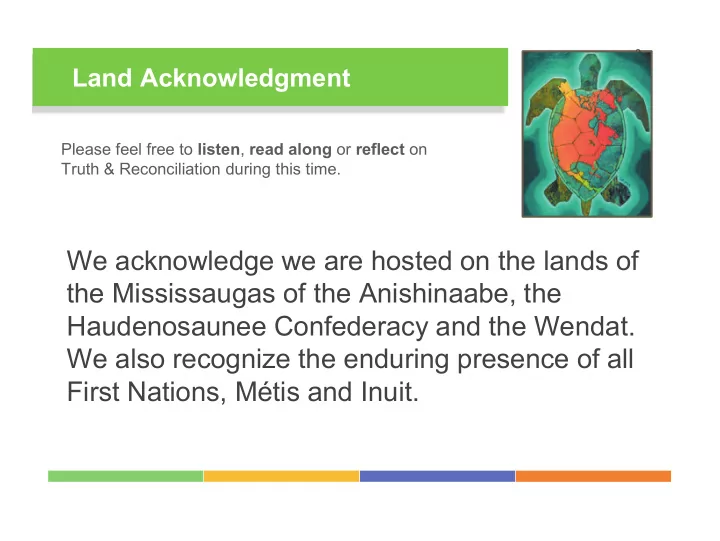
2 Land Acknowledgment Please feel free to listen , read along or reflect on Truth & Reconciliation during this time. We acknowledge we are hosted on the lands of the Mississaugas of the Anishinaabe, the Haudenosaunee Confederacy and the


slide-1
SLIDE 1

We acknowledge we are hosted on the lands of the Mississaugas of the Anishinaabe, the Haudenosaunee Confederacy and the Wendat. We also recognize the enduring presence of all First Nations, Métis and Inuit.

Land Acknowledgment

Please feel free to listen, read along or reflect on Truth & Reconciliation during this time.

2

slide-2
SLIDE 2

Delayed Start and Staggered Entry

  • Based on the advice of Toronto Public Health and with permission from the

Ministry of Education, the first day of school has been delayed, and our schools will now begin the new school year with a staggered entry.

  • School starts on Tuesday, September 15, 2020 and grades will be staggered

to begin over the first week to safely reintroduce smaller numbers of students on each day into the building and give everyone a chance to get used to the new routines.

  • As plans are finalized, your Principal(s) will be in touch as to when your

child(ren) will start.

6

slide-3
SLIDE 3

Registration Process

  • The registration process will be open for one week:

Opening: Wednesday, August 26, 2020 Closing: Saturday, August 29, 2020

  • Prior to the registration process, parents and adult students will be

informed of the upcoming registration process and directed to the TDSB’s website for information about September and materials to support the completion of the registration. (e.g., translations, explanations of the elementary and secondary school day, public health protocols, etc.)

  • Follow up with families who have not responded to online

registration will be through the local school by school administrative staff prior to September 15

7

slide-4
SLIDE 4

Registration Process

8

  • We are asking parents/families to let us know what model they plan to have their

children participate in for September.

  • Parents will continue to have the option for their children to participate in fully

remote learning rather than the in-person model in both elementary and secondary.

  • Is there an option to switch between regular school day or remote learning?

Elementary students: opportunity at a natural break Secondary students: opportunity between each quadmester

  • If a change is required in between these periods, exceptions may be made on a

case by case basis with time built in to transition into a classroom or remote cohort.

slide-5
SLIDE 5

Key Health and Safety Measures

Ensuring the health and safety of students and staff is our

  • priority. Following

guidance from Toronto Public Health, a number of key measures will be implemented to help stop the spread of COVID-19, including: physical distancing, hand hygiene, respiratory etiquette, and screening for symptoms.

10

slide-6
SLIDE 6

Health and Safety

Arrival and Departure All staff/students to self assess prior to leaving home Consider staggered entry/exit times Establish parent pick up/drop off protocols All staff/students screened prior to entry Limit visitors to schools to essential visitors

11

slide-7
SLIDE 7

Health and Safety

12

Facilities

  • Cleaning: Caretakers will perform routine cleaning of general

facilities through the day and will conduct enhanced cleaning

  • f high touch surfaces twice per day. Shared items will be used

minimally and cleaned between users.

  • Air Flow: Mechanical HVAC system settings will be adjusted to

increase the amount of fresh air and windows will be opened, where possible, to increase natural ventilation.

slide-8
SLIDE 8

Health & Safety: Screening Practices

  • All students and staff must

undergo screening for symptoms

  • f COVID-19 at home prior to

leaving for school/work

  • Upon arrival at the school, all

individuals entering the building will complete an entry screening

  • Anyone with COVID-19

symptoms will be directed to return home Screening for COVID-19 Symptoms Suspected Case of COVID-19

13

  • Anyone with symptoms should get

tested

  • If symptoms appear during the

school day, students should be isolated and picked up, staff sent home

  • Ill students kept in a designated

isolation room until picked up

  • The room will be disinfected after

pick up

  • Track student and staff

absenteeism

  • Toronto Public Health conduct

contact tracing

slide-9
SLIDE 9

Additional Details from Ministry Guidelines

14

Masks & PPE

  • Students in Grades K to 12 will be required to wear non-medical or cloth masks/face

coverings indoors, including in hallways and in classrooms. Outdoor times can be

  • pportunities to provide student breaks from wearing masks within their cohorts.
  • Students may wear their own non-medical masks, and non-medical masks will also be

made available. Reasonable exceptions on the requirement to wear masks will apply.

  • School-based staff who are regularly in close contact with students will be provided with

all appropriate personal protective equipment (PPE). Cohorting

  • Direct and indirect contacts in schools for elementary students should be limited to

approximately 50 and for secondary students should be limited to approximately 100.

slide-10
SLIDE 10

Transportation Considerations

  • Full return to school for elementary students will require the increase of

utilization of bus capacity beyond one student per seat and operating closer to capacity

  • Retention of drivers by bus operators will be based on pre-existing conditions,

age and other factors

  • Mandatory face coverings for Kindergarten to 21 years old
  • Seating plan for all students - siblings and students in the same class can sit

together

  • Active Safe Travel (AST) encouraged and walking maps provided

15

slide-11
SLIDE 11

Elementary Model: Class Sizes

17

Class Caps JK/SK Grades 1 to 3 Grade 4 to 8 Remote 29 20 35 Impacted Schools 15 20 20 Non-impact Schools 26 20 27 Averages Regular Program French Immersion Extende Late Spec Ed Jk/SK Grade 1 to 3 Grade 4 to 8 Jk/SK Grade 1 to 3 Grade 4 to 8 Grades 4-8 Grades 4 to 8 Gifted Remote 28.9 20.0 34.9 28.5 19.8 34.7 34.8 34.3 25.0 Impacted Schools 13.3 18.1 18.3 11.9 18.2 17.5 17.0

  • 18.3

Non-impact Schools 21.6 18.1 24.1 20.2 18.0 23.5 22.1 21.6 21.6 Total System 19.5 18.1 22.8 18.8 18.0 22.9 21.5 21.6 20.6

slide-12
SLIDE 12

Elementary -- Full Return with Full ClassSize

Elementary: Regular School Day – Current Ministry of Education Model

  • Full Day Return, 5 Days per week

(Inclusive of Special Education and French Immersion and Extended French programs)

  • 300 minutes of instruction per day within a Regular School Day
  • Regular Class Size, with the students grouped (cohorted) together (including recess

and lunch)

  • An elementary student will be cohorted with their classmates and their

homeroom teacher, one teacher and one DECE in kindergarten, with limited contact with other subject specific teachers for classes such as Core French, the arts and physical education.

  • Expect changes in the timing of recesses, lunches, and bathroom breaks as they

are staggered to support cohorting.

  • Enhanced Health & Safety Protocols in place

18

slide-13
SLIDE 13

Elementary: Learning and Instruction

Elementary -- Full Return with Full ClassSize

  • Schools have their teacher allocations and will create tentative timetables and class

placements

  • classroom teacher responsible for covering the Overall Expectations of the

Ontario curriculum in all subjects (prep subjects excluded)

  • Cohort movement will be limited by rotary of subject-specialist teachers going

into the classroom (following TPH guidelines)

  • Prep Delivery:
  • Teacher prep delivered throughout the day by Subject-Specialist teachers
  • Specialized teachers (e.g. Core French teachers) will be able to go into

classrooms to provide the full breadth of programming for students

  • Educators will maintain an online learning platform (Google Classroom or

Brightspace) so all students in the class have access

19

slide-14
SLIDE 14

Provisions will be made so students are able to leave their classrooms to receive additional support and maintain limited groupings (Ministry of Education Guide to Reopening Ontario’s Schools, p3) Itinerant educators will have a schedule assigned to them to minimize moving from school to school, and will support both remotely and in person following physical distancing and cohorting guidelines i.e. ESL Itinerants/Itinerant Music Instructors (IMI) may be assigned to

  • ne of their schools as a home base and support additional schools

remotely.

20

Elementary -- Full Return with Full ClassSize

Elementary: Supports

slide-15
SLIDE 15

Elementary: Kindergarten

21

Kindergarten educators will follow the Ontario Kindergarten Program, 2016 The program should continue to be play- and inquiry-based as per the curriculum/program document The educator team of DECE and teacher (OCT) should continue to plan independent, small and large group learning experiences for children to play and inquire while maintaining health protocols All learning opportunities begin from a place of creating belonging for the children, along with building a community of learners Classroom cleaning protocols will need to be in place for shared learning materials

Elementary -- Full Return with Full ClassSize

slide-16
SLIDE 16

Elementary – Virtual Learning

22

Elementary: Virtual Learning Option

  • Some families may opt for a fully virtual learning option
  • Transition in and out of virtual option will be made at specific times during the school year

Structure of Day

  • Daily attendance will be taken
  • 300 minutes of learning opportunities (synchronous and asynchronous)
  • Large Group Instruction 40-50% of the day (dependent on grade level)
  • Guided Instruction (small group), Live, Interactive Synchronous Check & Connect (small

group or individual)

  • Independent asynchronous work available in Brightspace
  • Instruction will be delivered by more than one educator (i.e. “virtual cohort homeroom”

teacher, DECE for Kindergarten where applicable, and prep subject teachers) Focus of Curriculum

  • Based on the Overall Expectations of the Ontario Curriculum and Kindergarten Program
  • Units of Study should be interdisciplinary
  • All learning opportunities begin by creating a sense of belonging for the students
  • Small group learning to build on students demonstrating their learning through play and

inquiry (Early Years), literacy and numeracy, and other curriculum areas

slide-17
SLIDE 17

Elementary – Virtual Learning

Kindergarten Grades 1-3 Grades 4-6 Grades 7-8 Whole Group Instruction 2-3 sessions per day for short periods

  • f time

4 sessions per day 4 sessions per day 4 sessions per day Guided Instruction and Independent Work 2 sessions per day 2 sessions per day 3 sessions per day 3 sessions per day Synchronous (live virtual) Check & Connect 2 sessions per day 2 sessions per day 1 sessions per day 1 sessions per day

Expectations by Grade

23

slide-18
SLIDE 18

Elementary – Virtual Learning

PPM164 Requirements

Division Grade Level of Students Daily Minimum Synchronous Learning Time Requirement* Elementary Kindergarten 180 minutes Grades 1 to 3 225 minutes Grades 4 to 8 225 minutes

24

slide-19
SLIDE 19

Guidelines for Subject Delivery

The appropriate modifications and adaptations will be made in order to continue to deliver curriculum in ways that take the necessary health & safety measures into consideration.

  • Cooperative Education
  • French
  • Health and Physical Education
  • Library
  • Mathematics
  • Science/STEM
  • Tech Education
  • The Arts (Music, Drama, Dance, Visual Arts)

25

slide-20
SLIDE 20

Additional Learning and Instruction Considerations

Classroom Setup

  • Desks will be set up to adhere to physical distancing in rows and facing forward

Lunch & Recess

  • Lunch and recess will be staggered to allow for physical distancing
  • Students will eat in classrooms & should not share food

Field Trips & Assemblies

  • Schools will not plan field trips or assemblies until further notice

School Clubs & Extra-curricular Activities

  • Schools can offer clubs and extra-curricular activities if physical distancing is

possible and equipment and spaces are cleaned and disinfected between each use. Organized Sports

  • Suspended until we receive further direction from the sports/recreation provincial
  • rganizations

26

slide-21
SLIDE 21

Special Education-Regular Class

Elementary students with special education needs in regular class will continue to be supported as per their IEP. Classroom teachers and special education teachers (e.g., Resource teachers, HSP teachers) will collaborate by co-planning and co-teaching to support students on IEPs (face to face and/or remotely)

  • Regular Class with Indirect Support - students with this designation will continue to

receive indirect support from special education teacher through their classroom teacher (face-to-face and/or remotely)

  • Regular Class with Resource Assistance - students with this designation will continue

to receive direct support individually or in small groups within the regular class from a special education teacher; if student has elected remote learning, support will be provided remotely

  • Regular Class with Withdrawal Assistance - students with this designation will

continue to receive direct support outside of the classroom for less than 50% of the school day from a special education teacher (face to face and/or remotely). Withdrawal support can continue while maintaining safe practices such as wearing a mask and keeping the group small

  • Students who are in a Regular Class with an IEP IPRC’d or non IPRC’d will have access to

daily attendance

35

slide-22
SLIDE 22

Special Education Elementary ISP

Elementary ISP classes are capped at 6-16 students (excluding Gifted) depending on the ISP program

  • Elementary students in ISP classes will come to school daily and be considered

their own cohort; this includes Congregated Sites and all ISP classes in regular K-8 schools (including Elementary Gifted classes which are capped at 25 students)

  • There are a total of 6 congregated elementary sites where students will be

able to attend daily; those schools include: Beverley School, Lucy McCormick Senior School*, Park Lane Public School*, Seneca School, Sunny View Junior and Senior Public School, and William J McCordic *schools that have secondary aged students and follow an elementary school model

36

slide-23
SLIDE 23

Special Education-Remote Learning

Structure:

  • Daily attendance will be taken; 300 minutes of learning opportunities

(synchronous and asynchronous)

  • Synchronous learning (e.g., Whole Group Instruction; Guided Instruction -

small group or individual; Check & Connect -small group or individual); Asynchronous independent work available in Google Classroom/Brightspace

  • Parents/guardians will receive a timetable

Digital and Non-Digital:

  • Students will continue to access their SEA devices and equipment; should the

family choose remote learning non-digital, the teacher will continue to program for the student based on IEP strengths and needs; the school will arrange for family access of non-digital resources Regular Class:

  • Students with special education needs in regular class with resource

assistance or withdrawal assistance who elect remote learning will have a teacher assigned (from current school or other) to support their learning

41

slide-24
SLIDE 24

Special Education-Remote Learning

ISP Class: Students with special education needs in an ISP who elect remote learning, will have a teacher (from current school or other) to support remote learning; schools will work in collaboration with ES to ensure teachers assigned to remote learning have Spec Ed Qualification Learning Focus: Learning will be based on the Overall Expectations of the Ontario Curriculum, Kindergarten Program and/or Alternative Curriculum Schools will follow the Individual Education Plan (IEP) requirements. Teachers will work collaboratively with families and the IEP team to ensure the IEP reflects learning goals, updates, assessment and evaluation that reflects the remote learning environment The Classroom teacher will program for the student based on IEP learning goals

42

slide-25
SLIDE 25

Special Education PPE

PPE

  • Initial PPE will be provided by the Board for all students and staff and

delivered to schools prior to school opening

  • School Administrators can order PPE through the TDSB Distribution Centre

based on the needs of the staff (surgical masks, gloves, gowns, face shields, etc.,) and students (non surgical masks or face coverings) in their ISP classes

  • The TDSB Distribution Centre has been given a list of Congregated Sites and

schools with ISP classes to flag as priority schools due to the unique circumstances they support; PPE is managed through Occupational Health and Safety

  • Exceptions will be made for students with special education needs if required

43

slide-26
SLIDE 26

Special Education Transportation

Students with SEN will begin September 15th; busses will be running at full capacity with a seating plan for all students; windows are recommended to be

  • pen. Masks are expected for all bus riders and there will be enhanced cleaning
  • f all buses, including wiping down all high touch surfaces between runs.

Siblings and students in the same class can sit together Elementary:

  • Bussing for students in Elementary will have pick up and drop off times that

reflect full day school learning times Secondary:

  • Bussing for students in DD ISP will have pick up and drop off times that reflect

full day learning

  • Bussing for students in an ISP class (capped at 6-16 students) who are

integrated in courses will have pick up and drop off times as per the alternate secondary model; typically these ISPs would include MID, LD, ASD, DHH and PD

44

slide-27
SLIDE 27

Supporting Students with Special Education Needs

  • Individual Education Plan (IEP): Schools will follow the requirements to provide students with their

IEPs in collaboration with the IEP team and parents/guardians. Changes in the school environments and/or remote learning needs will be considered when creating and updating the IEPs

  • In School Team (IST) Meetings, School Support Team (SST), IPRC and SEPRC meetings will

continue either face to face and/or remotely using an AODA platform. Professional Support Services and other members of the team will be included as usual (e.g. SW, psych, special education inclusion consultant) to be in attendance

  • Itinerant Staff: Regional Support Services (e.g. Autism Services (ASD) Team Referrals, Behaviour

Regional Services (BRS) Team Referrals, Itinerant Blind & Low Vision (BLV) and Deaf & Hard of Hearing (DHH) will continue to support both remotely and in person following physical distancing guidelines and a Tiered Approach based on a student’s IEP

  • PR699: Ongoing support and training will be provided in Non-Violent Crisis Intervention (NVCPI)

and personal protective equipment (PPE) will be provided; Safety Plans will also continue on a needs basis

  • Special Equipment Amount (SEA): Students will continue to access SEA equipment/assistive

technology and staff will continue to be supported with SEA equipment training to enhance student access to learning

45
slide-28
SLIDE 28

71 4 6