Wave model of the Schroedinger operator on semiaxis (the limit point - - PDF document

wave model of the schroedinger operator on semiaxis the
SMART_READER_LITE
LIVE PREVIEW

Wave model of the Schroedinger operator on semiaxis (the limit point - - PDF document

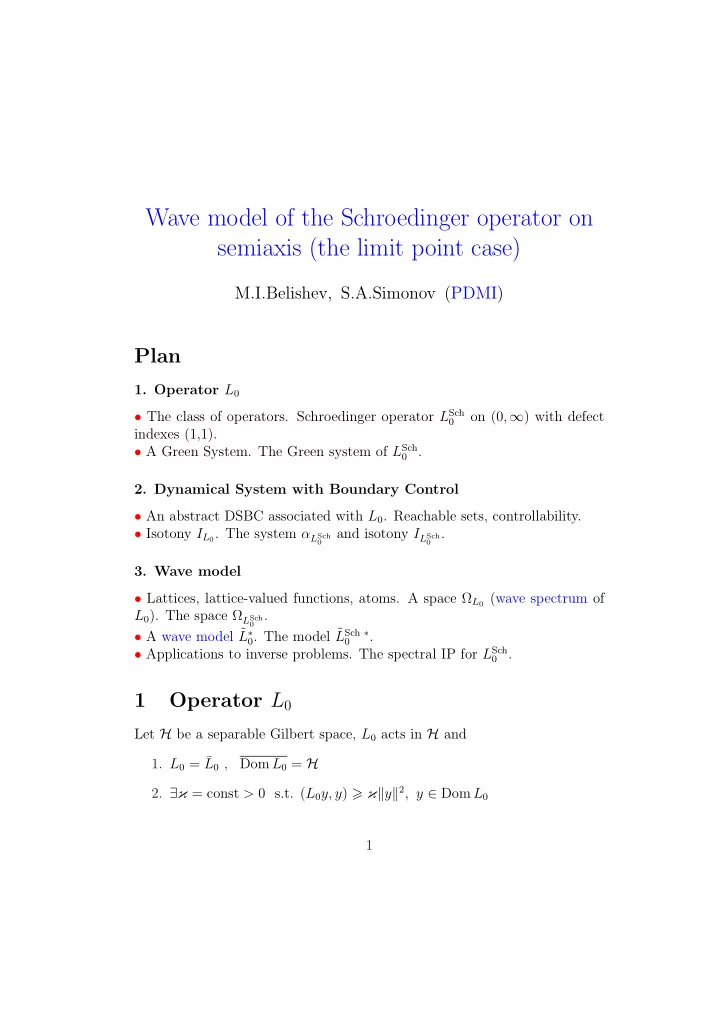
Wave model of the Schroedinger operator on semiaxis (the limit point case) M.I.Belishev, S.A.Simonov (PDMI) Plan 1. Operator L 0 The class of operators. Schroedinger operator L Sch on (0 , ) with defect 0 indexes (1,1). A Green


slide-1
SLIDE 1

Wave model of the Schroedinger operator on semiaxis (the limit point case)

M.I.Belishev, S.A.Simonov (PDMI)

Plan

  • 1. Operator L0
  • The class of operators. Schroedinger operator LSch
  • n (0, ∞) with defect

indexes (1,1).

  • A Green System. The Green system of LSch

0 .

  • 2. Dynamical System with Boundary Control
  • An abstract DSBC associated with L0. Reachable sets, controllability.
  • Isotony IL0. The system αLSch

and isotony ILSch

0 .

  • 3. Wave model
  • Lattices, lattice-valued functions, atoms. A space ΩL0 (wave spectrum of

L0). The space ΩLSch

0 .

  • A wave model ˜

L∗

  • 0. The model ˜

LSch ∗ .

  • Applications to inverse problems. The spectral IP for LSch

0 .

1 Operator L0

Let H be a separable Gilbert space, L0 acts in H and

  • 1. L0 = ¯

L0 , Dom L0 = H

  • 2. ∃κ = const > 0 s.t. (L0y, y) κy2, y ∈ Dom L0

1

slide-2
SLIDE 2

2

  • 3. 1 n±(L0) = dim Ker L∗

0 ∞ .

Let L be the Friedichs extension of L0: L0 ⊂ L ⊂ L∗

0;

L∗ = L; (Ly, y) κy2, y ∈ Dom L . ========================================= Notation: R+ := (0, ∞), ¯ R+ := [0, ∞). Let H = L2(R+) and L0 = LSch

0 ,

LSch

0 y := −y′′ + qy ,

Dom LSch =

  • y ∈ H ∩ H2

loc(¯

R+) | y(0) = y′(0) = 0; −y′′ + qy ∈ H

  • ,

where q = q(x) is a real-valued function (potential) provided (1) q ∈ Cloc ¯ R+

  • (2)

n±(LSch

0 ) = 1 (the limit point case)

(3) (LSch

0 y, y) κy2, y ∈ Dom LSch

. In such a case, the problem −φ′′ + qφ = 0 , x > 0 ; φ(0) = 1 , φ ∈ L2(R+) has a unique solution φ(x); (LSch

0 )∗y := −y′′ + qy ,

Dom (LSch

0 )∗ =

  • y ∈ H ∩ H2

loc(¯

R+) | − y′′ + qy ∈ H

  • ,

Ker (LSch

0 )∗ = {cφ | c ∈ C};

the Friedrichs extension of LSch is LSchy := −y′′ + qy , Dom LSch =

  • y ∈ H ∩ H2

loc(¯

R+) | y(0) = 0; −y′′ + qy ∈ H

  • .

=========================================

slide-3
SLIDE 3

3 Green system Let H B be the Hilbert spaces, A : H → H and Γi : H → B (i = 1, 2) the

  • perators provided:

Dom A = H, Dom Γi ⊃ Dom A, Ran Γ1 ∨ Ran Γ2 = B. The collection G = {H, B; A, Γ1, Γ2} is a Green system if (Au, v)H − (u, Av)H = (Γ1u, Γ2v)B − (Γ2u, Γ1v)B for u, v ∈ Dom A. H is an inner space, B is a boundary values space, A is a basic operator, Γ1,2 are the boundary operators. System GL0 Operator L0 determines a Green system in a canonical way. Put K := Ker L∗

0 ,

Γ1 := L−1L∗

0 − I ,

Γ2 := PKL∗

0 ,

where PK projects in H onto K Proposition 1. The collection GL0 := {H, K; L∗

0, Γ1, Γ2} is a Green system.

========================================= Let L0 = LSch

0 , H = L2(R+), K = {cφ | c ∈ C};

Γ1y = − y(0)φ , Γ2y = y′(0) − y(0)φ′(0) η′(0)

  • φ ,

where η := (LSch)−1φ. Then GLSch := {H, K; (LSch

0 )∗, Γ1, Γ2} is the canonical

Green system associated with LSch

0 .

=========================================

2 Dynamical System with Boundary Control

System αL0 The Green system GL0 determines a DSBC αL0 of the form utt + L∗

0u = 0,

t > 0, u|t=0 = ut|t=0 = 0 in H Γ1u = h , t 0,

slide-4
SLIDE 4

4 where h = h(t) is a boundary control (a K-valued function of the time), u = uh(t) is a solution (wave, an H-valued function of the time). For a smooth enough class M ∋ h, uh is classical. Proposition 2. For an h ∈ M, one has uh(t) = −h(t) + t L− 1

2 sin

  • (t − s)L

1 2

  • htt(s) ds ,

t 0 , (2.1) where L is the Friedrichs extension of L0. ========================================= For L0 = LSch

0 , system αLSch

is utt − uxx + qu = 0, x > 0, t > 0, u|t=0 = ut|t=0 = 0, x 0, u|x=0 = f , t 0 . For M := {f ∈ C∞[0, ∞) | supp f ⊂ (0, ∞)}, the solution uf is classical. ========================================= Controllability For the DSBC αL0, the set UT

L0 := {uh(T) | h ∈ M}

is called reachable (at the moment t = T); UL0 :=

  • T>0

UT

L0

is a total reachable set. System αL0 is controllable, if UL0 = H . Proposition 3. System αL0 is controllable iff L0 is a completely nonself- adjoint operator (i.e., L0 induces a self-adjoint part in no subspace of H). ========================================= For L0 = LSch

0 , one has

UT

LSch

= {y ∈ C∞(¯ R+) | supp y ⊂ [0, T]} , ULSch = L2(R+) = H , so that αLSch is controllable. =========================================

slide-5
SLIDE 5

5 Isotony Introduce a dynamical system βL0: vtt + Lv = g , t > 0, v|t=0 = vt|t=0 = 0 , where g = g(t) is an H-valued function. For a smooth enough g, the solution v = vg(t) is vg(t) = t L− 1

2 sin

  • (t − s)L

1 2

  • g(s) ds ,

t 0 holds. Fix a subspace G ⊂ H; let g be a G-valued function. A set Vt

G :=

  • vg(t) | g ∈ Lloc

2 ([0, ∞); G)

  • is a reachable set of system βL0.

Proposition 4. If G ⊂ G′ and t t′ then Vt

G ⊂ Vt′ G′.

Let L(H) be the lattice of subspaces of H with the standard operations A ∨ B = {a + b | a ∈ A, b ∈ B} , A ∧ B = A ∩ B, A⊥ = H ⊖ A , the partial order ⊆, the least and greatest elements {0} and H, and the relevant topology. A family of maps I = {It}t0, It : L(H) → L(H) is said to be an isotony if I0 := id and G ⊂ G′, t t′ implies ItG ⊂ It′G′ , i.e., I respects the natural order on L(H) × [0, T). By Proposition 4, the family I0

L0 := id ;

It

L0G := Vt G ,

t > 0 is the isotony determined by L0. ========================================= For E ⊂ ¯ R+, let Et := {x ∈ ¯ R+ | dist (x, E) := inf

e∈E|x − e| < t} ,

t > 0 (a metric neighborhood). Denote ∆a,b := [a, b] ⊂ ¯ R+ and L2(∆a,b) := {y ∈ L2(R+) | supp y ⊂ [a, b]} .

slide-6
SLIDE 6

6 Proposition 5. For any 0 a < b ∞, the relation It

LSch

0 L2(∆a,b) = L2(∆t

a,b) ,

t > 0 holds. =========================================

3 Wave model

Lattices Let LL0 ⊂ L(H) be a minimal (sub)lattice s.t. U

T L0 ⊂ LL0 , T 0

and It

L0LL0 ⊂ LL0 , t 0

(i.e., LL0 is invariant w.r.t. the isotony IL0). The space of the growing LL0-valued functions FIL0 ([0, ∞); LL0) :=

  • F(·) | F(t) = It

L0A, t 0 , A ∈ LL0

  • is a lattice w.r.t. the point-wise operations, order, and topology.

Wave spectrum

  • Reminder. P is a partially ordered set, 0 is the least element. An a ∈ P is

an atom (minimal element) if 0 = p a implies p = a . Let At P be the set of atoms in P. Basic definition. The set ΩL0 := At FIL0 ([0, ∞); LL0) endowed with a relevant topology is a wave spectrum of operator L0. Each ω = ω(·) ∈ ΩL0 is a growing LL0-valued function of t. So, the path is L0 ⇒ GL0 ⇒ αL0, UT

L0 ⇒ IL0 ⇒ LL0 ⇒ FIL0 ([0, ∞); LL0) ⇒ ΩL0 .

slide-7
SLIDE 7

7 ========================================= Theorem 1. For L0 = LSch

0 , there is a bijection

ΩLSch ∋ ω ↔ x ∈ ¯ R+ and each atom is of the form ω = ωx(t) = L2

  • {x}t

, t 0 . Endowing the wave spectrum with the proper metrizable topology, one gets ΩLSch

isom

= ¯ R+ . ========================================= The model Goal: the image map H ∋ y

Y

→ ˜ y, where ˜ y = ˜ y(·) is a ”function” on ΩL0. Fix ω ∈ ΩL0; let P t

ω be the projection in H onto ω(t). For u, v ∈ H, a

relation u

ω

= v ⇔

  • ∃ t0 = t0(ω, u, v) s.t. P t

ωu = P t ωv for all t < t0

  • is an equivalence.
  • The equivalence class [y]ω is a germ of y ∈ H at the atom ω ∈ ΩL0.
  • The linear space

Gω := {[y]ω | y ∈ H} is a germ space.

  • The space

˜ H :=

  • ω∈ΩL0

Gω is an image space.

  • The image map is

Y : H → ˜ H , ˜ y(ω) := [y]ω, ω ∈ ΩL0 .

  • The wave model of L∗

0 is

  • L∗

0 : ˜

H → ˜ H,

  • L∗

0 := Y L∗ 0Y −1 .

slide-8
SLIDE 8

8 ========================================= Let y ∈ H = L2(R+). Take an e = cφ ∈ Ker (LSch

0 )∗ and fix an ω ∈ ΩL0.

Identify ΩLSch ≡ ¯ R+ (by Theorem 1) and ˜ y(ω) ≡ lim

t→0

(P t

ωy, e)

(P t

ωe, e) ,

ω ∈ ¯ R+ . Then ˜ H ≡ L2, µ(R+) with dµ =

dω e2(ω).

Theorem 2. The representation (LSch

0 )∗˜

y

  • (ω) = − ˜

y′′(ω) + p(ω) ˜ y′(ω) + Q(ω)˜ y(ω) , ω > 0 is valid with p := −2 e′(ω) e(ω) , Q := q(ω) − e′′(ω) e(ω) . Application to IP Inverse Data: the spectral function, Weyl function, dynamical response operator, etc. Then ID ⇒ copy ULSch

0 U ∗ ⇒ wave model

(LSch

0 )∗ ⇒ p, Q ⇒ q .

=========================================

References

[1] M.I.Belishev. A unitary invariant of a semi-bounded operator in recon- struction of manifolds. Journal of Operator Theory, Volume 69 (2013), Issue 2, 299-326. [2] M.I.Belishev and M.N.Demchenko. Dynamical system with boundary control associated with a symmetric semibounded operator. Journal of Mathematical Sciences, October 2013, Volume 194, Issue 1, pp 8-20. DOI: 10.1007/s10958-013-1501-8. [3] A.N.Kochubei. Extensions of symmetric operators and symmetric binary

  • relations. Math. Notes, 17(1): 25–28, 1975.

[4] V.Ryzhov. A General Boundary Value Problem and its Weyl Function. Opuscula Math., 27 (2007), no. 2, 305–331.