The Quantum Program in One Dimension - So Far Solve the Schroedinger - - PowerPoint PPT Presentation

the quantum program in one dimension so far
SMART_READER_LITE
LIVE PREVIEW

The Quantum Program in One Dimension - So Far Solve the Schroedinger - - PowerPoint PPT Presentation

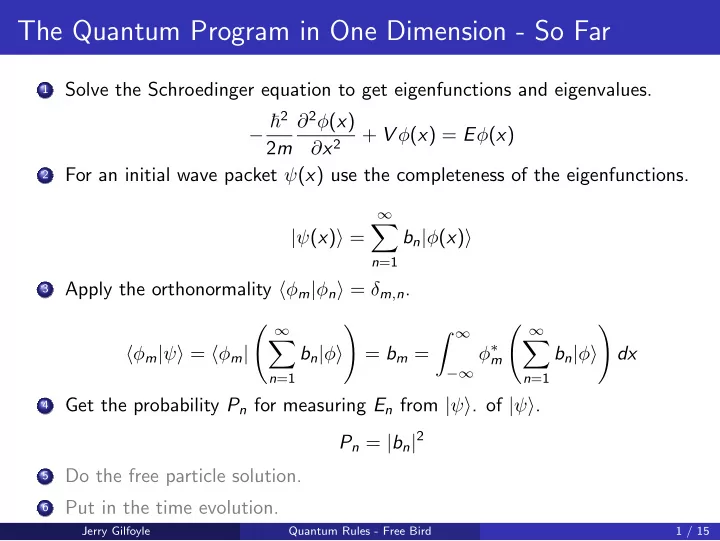
The Quantum Program in One Dimension - So Far Solve the Schroedinger equation to get eigenfunctions and eigenvalues. 1 2 2 ( x ) + V ( x ) = E ( x ) x 2 2 m For an initial wave packet ( x ) use the completeness of the


slide-1
SLIDE 1

The Quantum Program in One Dimension - So Far

1

Solve the Schroedinger equation to get eigenfunctions and eigenvalues. − 2 2m ∂2φ(x) ∂x2 + V φ(x) = Eφ(x)

2

For an initial wave packet ψ(x) use the completeness of the eigenfunctions. |ψ(x) =

  • n=1

bn|φ(x)

3

Apply the orthonormality φm|φn = δm,n. φm|ψ = φm| ∞

  • n=1

bn|φ

  • = bm =

−∞

φ∗

m

  • n=1

bn|φ

  • dx

4

Get the probability Pn for measuring En from |ψ. of |ψ. Pn = |bn|2

5

Do the free particle solution.

6

Put in the time evolution.

Jerry Gilfoyle Quantum Rules - Free Bird 1 / 15

slide-2
SLIDE 2

The Free Particle Problem

Consider a free particle (V = 0) which has an initial wave packet that is described by a gaussian function. |Ψ(x, 0) = 1 (2πσ2)1/4 e−x2/4σ2 What is the spectrum of momenta that form this wave packet? How wide is that distribution?

  • 4
  • 2

2 4 0.0 0.1 0.2 0.3 0.4 0.5 x |ψ

2

The Initial Gaussian Wave

Jerry Gilfoyle Quantum Rules - Free Bird 2 / 15

slide-3
SLIDE 3

red - x=2.0 green - x=0.5 blue - x=0.2

  • 20
  • 10

10 20

  • 0.5

0.0 0.5 1.0 1.5 2.0 Δk Sin(Δk x)/Δk

Jerry Gilfoyle Quantum Rules - Free Bird 3 / 15

slide-4
SLIDE 4

Jerry Gilfoyle Quantum Rules - Free Bird 4 / 15

slide-5
SLIDE 5

∆kmax

−∆kmax

lim

x→∞

sin(∆k x) ∆k d(∆k) x ∆kmax Integral 0.01 10000 3.12445 1.0 10000 3.14178 2.0 10000 3.14151 4.0 10000 3.14158 10.0 10000 3.14161 100.0 10000 3.14159 1000.0 10000 3.14159 10000.0 10000 3.14159 100000.0 10000 3.14159 Jerry Gilfoyle Quantum Rules - Free Bird 4 / 15

slide-6
SLIDE 6

The Dirac Delta Function

∆kmax

−∆kmax

lim

x→∞

sin(∆k x) ∆k d(∆k) x ∆kmax Integral 0.01 10000 3.12445 1.0 10000 3.14178 2.0 10000 3.14151 4.0 10000 3.14158 10.0 10000 3.14161 100.0 10000 3.14159 1000.0 10000 3.14159 10000.0 10000 3.14159 100000.0 10000 3.14159 Jerry Gilfoyle Quantum Rules - Free Bird 5 / 15

slide-7
SLIDE 7

Dirac Delta Function Demonstration

Use straight line for b(k) Dirac δ representation

  • 30
  • 20
  • 10

10 20 30

  • 0.2

0.0 0.2 0.4 0.6 0.8 1.0 1.2 Δk Input Functions

Product of input functions

  • 30
  • 20
  • 10

10 20 30

  • 0.2

0.0 0.2 0.4 0.6 Δk Output Function

∆kmax

−∆kmax

2b(k) lim

x→∞

sin(∆k x) ∆k d(∆k) = 2b(k′) ∆kmax

−∆kmax

lim

x→∞

sin(∆k x) ∆k d(∆k) 2b(k = 0) = 1.0 x on l.h.s. ∆kmax l.h.s r.h.s 0.01 1000 3.31670 3.14159 1.0 1000 3.14047 3.14159 2.0 1000 3.14196 3.14159 10.0 1000 3.14178 3.14159 100.0 1000 3.14161 3.14159 1000.0 1000 3.14159 3.14159 10000.0 1000 3.14159 3.14159 100000.0 1000 3.14159 3.14159

Jerry Gilfoyle Quantum Rules - Free Bird 6 / 15

slide-8
SLIDE 8

Comparison of Bound and Free Particles

Particle in a Box The potential V =0 0 < x < a =∞

  • therwise

Eigenfunctions and eigenval- ues |φn =

  • 2

a sin nπx a

  • En = n2 2π2

2ma2 Superposition |ψ =

  • n=1

bn|φn φm|φn = δm,n Getting the coefficients bn = φn|ψ Pn = |bn|2 Free Particle The potential V = 0 Eigenfunctions and eigenvalues |φ(k) = 1 √ 2π e±ikx E = 2k2 2m Superposition |ψ = ∞

−∞

b(k)φ(k)dk φ(k′)|φ(k) =δ(k − k′) Getting the coefficients b(k) = φ(k)|ψ P(k)dk = |b(k)|2dk

Jerry Gilfoyle Quantum Rules - Free Bird 7 / 15

slide-9
SLIDE 9

The Free Particle Problem

Consider a free particle (V = 0) which has an initial wave packet that is described by a gaussian function. |Ψ(x, 0) = 1 (2πσ2)1/4 e−x2/4σ2 What is the spectrum of momenta that form this wave packet? How wide is that distribution?

  • 4
  • 2

2 4 0.0 0.1 0.2 0.3 0.4 0.5 x |ψ

2

The Initial Gaussian Wave

Jerry Gilfoyle Quantum Rules - Free Bird 8 / 15

slide-10
SLIDE 10

From The Homework (3.10)

In the solution to 3.10 (∆x)2 = x2 − x2 and x2 = a2 + x2 and x2 = x2 so (∆x)2 = a2 + x2

0 − x2 0 = a2

Jerry Gilfoyle Quantum Rules - Free Bird 9 / 15

slide-11
SLIDE 11

From The Homework (3.10)

Blue: σ=0.6 Green: σ=1.2 Red: σ=2.4 x0=0 

f(x)ⅆx=1

  • 10
  • 5

5 10 0.0 0.1 0.2 0.3 0.4 0.5 x f(x) Effect of Changing σ on Gaussian Shape

Jerry Gilfoyle Quantum Rules - Free Bird 10 / 15

slide-12
SLIDE 12

Initial Wave Packet and the Spectral Distribution

  • 4
  • 2

2 4 0.0 0.1 0.2 0.3 0.4 0.5 x |ψ

2

The Initial Gaussian Wave

  • 4
  • 2

2 4 0.0 0.2 0.4 0.6 0.8 k (inverse length) b (k)

2

Spectral Distribution

Jerry Gilfoyle Quantum Rules - Free Bird 11 / 15

slide-13
SLIDE 13

Probabilities of Different Final States

a = 1.0 Å x0 = 0.3 Å x1 = 0.5 Å 500 1000 1500 2000 2500 3000 0.0 0.1 0.2 0.3 0.4 Energy (eV) Probability Rectangular Wave in a Square Well

Jerry Gilfoyle Quantum Rules - Free Bird 12 / 15

slide-14
SLIDE 14

Spectral Distribution for One-Dimensional Nuclear Fusion

50 100 150 200 0.0 0.1 0.2 0.3 0.4 0.5 0.6 En (units of E1) |bn

2

Nuclear Fusion

Jerry Gilfoyle Quantum Rules - Free Bird 13 / 15

slide-15
SLIDE 15

Spectral Distribution for One-Dimensional Nuclear Fusion

200 400 600 800 1000 0.0 0.1 0.2 0.3 0.4 0.5 0.6 En (units of E1) |bn

2

Nuclear Fusion

Jerry Gilfoyle Quantum Rules - Free Bird 14 / 15

slide-16
SLIDE 16

Spectral Distribution for One-Dimensional Nuclear Fusion

Only non-zero values bn=0 for n even, except n=8 200 400 600 800 1000 10-5 10-4 0.001 0.010 0.100 1 En (units of E1) |bn

2

Nuclear Fusion

Jerry Gilfoyle Quantum Rules - Free Bird 15 / 15