wastes and waste derived products case studies V I K T R I A F E I - - PowerPoint PPT Presentation

wastes and waste derived products
SMART_READER_LITE
LIVE PREVIEW

wastes and waste derived products case studies V I K T R I A F E I - - PowerPoint PPT Presentation

Improvement of degraded soil by wastes and waste derived products case studies V I K T R I A F E I G L * , O R S O L Y A K L E B E R C Z * , V A U J A C Z K I * , E M E S E V A S Z I T A * , M N I K A M O L N R * , N I K O L E T


slide-1
SLIDE 1

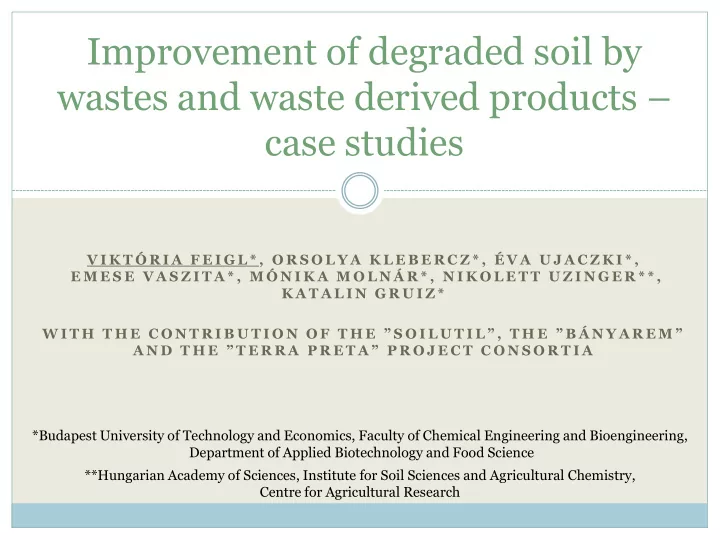
V I K T Ó R I A F E I G L * , O R S O L Y A K L E B E R C Z * , É V A U J A C Z K I * , E M E S E V A S Z I T A * , M Ó N I K A M O L N Á R * , N I K O L E T T U Z I N G E R * * , K A T A L I N G R U I Z * W I T H T H E C O N T R I B U T I O N O F T H E ” S O I L U T I L ” , T H E ” B Á N Y A R E M ” A N D T H E ” T E R R A P R E T A ” P R O J E C T C O N S O R T I A

Improvement of degraded soil by wastes and waste derived products – case studies

*Budapest University of Technology and Economics, Faculty of Chemical Engineering and Bioengineering, Department of Applied Biotechnology and Food Science **Hungarian Academy of Sciences, Institute for Soil Sciences and Agricultural Chemistry, Centre for Agricultural Research

slide-2
SLIDE 2

Evaluation of wastes and their application for soil based on their risks and benefits

Hazard of waste and the risk of its application Value of the wastes and benefit

  • f their

utilization Values and benefits  Nutrient and organic matter content, pH  New, improved soil  Re-use of waste  Green areas: aesthetic, climatic, ecological Hazards and risks  Toxic substance content  Radioactivity  Patogenes  Natural dilution  Land use  Frequency of application  Untreated degraded land

slide-3
SLIDE 3

Case studies: wastes for soil improvement

 No. 1. Remediation of mine waste with fly ash and

  • ther amendments

 No. 2. Remediation of metal contaminated soil with

fly ash

 No. 3. Revegetation and rehabilitation: creation of a

fertile topsoil layer from fly ash and organic wastes

 No. 4. Soil substitute from red mud  No. 5. Acidic sandy soil improvement with biochar

slide-4
SLIDE 4

Case study No 1.

 Site: Gyöngyösoroszi mining

site

 Problem: acidic (pH=2.8),

Cd, Zn, Pb and As containing mine waste on the surface for 40 years

 Solution: combined chemical

and phytostabilisation

 Amendments:

fly ash, lime, iron grit

 Plants:

grass mixture, broom corn, sudan grass

Environ- mental effect Nagyvölgyi creek Mine waste dump

Metal ore mine waste to be treated

Chemical stabiliser Chemical stabiliser

Combined chemical and pytostabilisation Fly ash

Fly ash + lime treatment Untreated plot

Field experiment

slide-5
SLIDE 5

Effect of chemical stabilisation

Grass: 0.16 mg/kg Cd (HQC=1 mg/kg)** 58 mg/kg Zn (HQC=100 mg/kg)**

* B contamination level for underground water, 6/2009 (IV. 14.) KvVM-EüM-FVM joint decree ** Hungarian quality criteria for food and fodder, 44/2003. (IV.26.) FVM and 17/1999. (VI. 16.) EüM decree

Untreated mine waste

Mine waste treated with fly ash and lime Leachate:

Cd: 441 µg/l (HQC: 5 µg/l)* → 0.12 µg/l Zn: 89 079 µg/l (HQC: 200 µg/l)* → 29.3 µg/l

(Untreated mine waste, 2007 → Fly ash+lime+iron, 2009)

slide-6
SLIDE 6

Case study No 2.

 Site: Gyöngyösoroszi

mining site

 Problem: agricultural soil

contaminated with Cd and Zn by flooding

 Solution: combined

chemical and phytostabilisation

 Amendment:

fly ash

 Plant: grass mixture,

broom corn, sudan grass, maize

3D Contour Plot (distribution of the zinc in the hobby garden)

2000 1500 1000 500 (ppm) 10 20 30 40 50 60 Widht (m) 2 4 6 8 10 12 14 16 18 Distance from

Cd: 3.00 mg/kg Zn: 348 mg/kg Cd: 0.902 mg/kg Zn: 104 mg/kg

Flooding in Gyöngyösoroszi Mine waste in the Toka-creek

Direction Toka-creek

Sudan grass on untreated (left) and fly ash treated (right) soil

slide-7
SLIDE 7

Case study No. 3.

 Site: .A.S.A. Hungary Ltd.

municipal landfill site at Gyál

 Problem: steep ringwall

with no vegetation – bad aesthetic view, erosion

 Solution: in situ waste

mixing

 Amendment:

fly ash; wood ash; raw, digested and composted sewage sludge

 Plant: grass mixture

Barren ringwall

  • f the municipal landfill

Eroded ringwall

slide-8
SLIDE 8

Long term effect of waste treatment (2.5 years)

 One-time treatment, but improvement from year to year  Improvement in texture, nutrient-availability,

biological activity

 No toxic effect  Best option: organic+inorganic amendment together

Fertilizer Inorganic Organic Organic+ inorganic

Grass on the organic + inorganic waste amended plot Field experiment

slide-9
SLIDE 9

Case study No. 4.

 Site: .A.S.A. Hungary Ltd.

municipal landfill site at Gyál

 Problem: cheap and fertile

cover material needed

 Solution: soil substitute

from waste

 Wastes:

 subsoil (construction waste)  red mud (Ajka)  red mud contaminated soil

(removed after Ajka accident)

 compost, green waste, saw dust

 Plant: grass mixture

Best combinations:

  • subsoil + 2% Ajka red mud

+ 10% green waste or compost

  • subsoil + 20% red mud contaminated soil

Soil substitute with ideal water balance, available nutrient and organic matter content, active microflora, no toxic effect Experimental plots Plants grown

  • n the waste

mixtures

slide-10
SLIDE 10

Case study No. 5.

 Site: Nyírlúgos,

agricultural land

 Problem: acidic (pH=4.5)

sandy (85 w/w% sand) soil

 Solution: biochar

amendment

 Biochar from waste:

 Grain husks  Paper fibre sludge  Pyrolysis: 500 °C, 20 min

 Plant: maize

Best options:

  • 1% biochar
  • 0.5% biochar + microbial soil inoculant

Improved plant growth & productivity, higher pH, available K and P, water holding capacity, more active microflora & soil as habitat Experimental field plots Biochar Maize in pot experiments

slide-11
SLIDE 11

Wastes are solution for degraded land!

Thank you for your attention!

E-mail: vfeigl@mail.bme.hu, mmolnar@mail.bme.hu More info: www.enfo.hu

The experiments were carried out in the frame of the BÁNYAREM (GVOP 3.1.1-2004-05-0261/3.0), the MOKKA (NKFP-020-05 ) and the SOILUTIL (TECH_09-A4-2009-0129) Hungarian R&D projects, the TERRA PRETA (HU09-0029-A1-2013) Norway Grants project