SLIDE 1
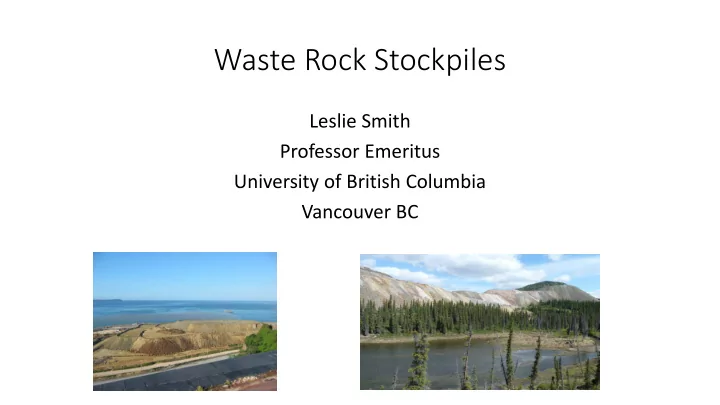
Waste Rock Stockpiles
Leslie Smith Professor Emeritus University of British Columbia Vancouver BC
SLIDE 2 Outline for this Discussion
- 1. General discussion of processes that influence potential for
water quality impacts from waste rock
- 2. Options for waste rock management
- 3. Waste rock stockpiles in northern Canada – unique
features
SLIDE 3 Waste Rock Management
Leslie Smith Professor Emeritis University of British Columbia Vancouver BC
Rainfall Evaporation Infiltration to Groundwater Toe seepage Chemistry Air Flow
SLIDE 4
Toe seepage with impaired water quality
Waste rock has a wide range in particle sizes: clay to large boulders Chemistry, Hydrology, Air Circulation
SLIDE 5 Chemistry
- Sulphide content within waste rock pile, chemical reaction rates
- Presence of minerals within pile that can neutralize acidic water
- If reactive, time to onset of poor quality drainage (few months to
many decades)
- Oxygen consumption and replacement
- Solutes that are mobile at neutral pH
Processes are well understood – challenges relate to site specific data interpretation and extrapolating lab tests and small scale field data to full-scale waste rock piles
SLIDE 6 Test cells to gain insight to chemistry in field conditions
Constructed in 1995 – British Columbia
2017
SLIDE 7
Test piles to gain insight to chemistry in field conditions
Island in Tropics – South Pacific
SLIDE 8 Hydrology
- Infiltration of water into the waste rock pile
- Wet-up of the waste rock pile during / following construction
- Drainage of water out of the bottom of the pile
- LS rule of thumb estimates for downward rate of water flow in waste
rock is 1 – 10 m/year Principal challenge relates to estimating how much of the water that infiltrates a pile contacts how much surface area of reactive minerals in the waste rock pile
SLIDE 9 Air Circulation Within Waste Rock Piles
- Density differences between warm air and cold air
- Changes in barometric pressure (weather patterns)
- Wind-driven pressure differences
Oxygen re-supply: Controlled by bulk permeability of the pile
SLIDE 10
Porosity and Permeability Measurement in a Large-Scale Permeameter
4 m x 4 m x 2 m high
SLIDE 11 Waste Rock Management
- Waste rock segregation to separate non-acid generating rock from
acid generating rock (“Designing for Closure”)
- Where protection of water quality requires additional measures:
- Submergence of waste rock in water (low oxygen)
- Reduce oxygen transfer into the interior of the waste rock pile
- Limit infiltration of water through the waste rock pile
- Commit to long-term seepage collection and water treatment before
release (perpetual care)
SLIDE 12
Waste Rock Management (Place Rock in Pit)
Saskatchewan South Carolina
SLIDE 13
Engineered soil covers to reduce infiltration of water
Closed gold mine in Nevada - 2004
SLIDE 14
Engineered soil covers to reduce entry of oxygen
Test pile in northern Ontario 2017
SLIDE 16 August 2005
Permafrost
Rainfall Evaporation
SLIDE 17
Diavik August 2005 Pods of biotite schist in a large mass of granite
SLIDE 18
Ten-Year Record of Infiltration Estimates for Rainfall at Diavik Test Piles Each year is unique: long-term data is important
SLIDE 19
Snow hydrology is as important as rainfall in understanding infiltration of water to waste rock
SLIDE 20 2004 - 2017
UBC U Waterloo U Alberta Carleton U Diavik Diamond Mine INAP, MEND
L Collette 2017
SLIDE 21
Construction of the Covered Test Pile at Diavik
Placing Till Layer Placing Upper Waste Rock Layer
2006
SLIDE 22
Covered Test Pile – View in 2015
No Outflow from the Base of the Covered Pile Since 2014
SLIDE 24 Computer simulation
thermal and hydrologic evolution
Covered Test Pile
L Collette 2017
SLIDE 25 Ice accumulation within open voids of a waste rock pile
2015
Blocky ice Ice-filled pores in sand
SLIDE 26 Monitoring Data
- Thermistors for recording temperature profiles with depth
- Weather station data to estimate infiltration – can be checked
with lysimeters which are designed to measure infiltration through the surface of a waste rock pile
- Seepage monitoring (quantity, quality), if possible
- Water content in active zone of waste rock pile
SLIDE 27 Effects of Climate Change
- What is the predicted extent of warming in the various regions of
northern Canada?
- What is the predicted change in the amount of infiltration, if any?
- What is the internal temperature response within a waste rock pile?
Computer simulations based on sound conceptual models and reliable parameter values Long-term monitoring programs and checking predictions