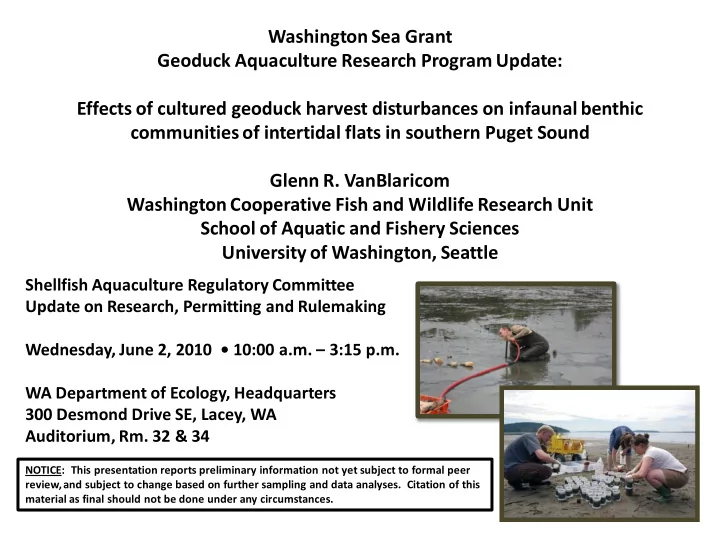
Washington Sea Grant Geoduck Aquaculture Research Program Update: - - PowerPoint PPT Presentation

washington sea grant geoduck aquaculture research program
SMART_READER_LITE
LIVE PREVIEW

Washington Sea Grant Geoduck Aquaculture Research Program Update: - - PowerPoint PPT Presentation

Washington Sea Grant Geoduck Aquaculture Research Program Update: Effects of cultured geoduck harvest disturbances on infaunal benthic communities of intertidal flats in southern Puget Sound Glenn R. VanBlaricom Washington Cooperative Fish and


slide-1
SLIDE 1

Washington Sea Grant Geoduck Aquaculture Research Program Update: Effects of cultured geoduck harvest disturbances on infaunal benthic communities of intertidal flats in southern Puget Sound Glenn R. VanBlaricom Washington Cooperative Fish and Wildlife Research Unit School of Aquatic and Fishery Sciences University of Washington, Seattle

Shellfish Aquaculture Regulatory Committee Update on Research, Permitting and Rulemaking Wednesday, June 2, 2010 • 10:00 a.m. – 3:15 p.m. WA Department of Ecology, Headquarters 300 Desmond Drive SE, Lacey, WA Auditorium, Rm. 32 & 34

NOTICE: This presentation reports preliminary information not yet subject to formal peer review, and subject to change based on further sampling and data analyses. Citation of this material as final should not be done under any circumstances.

slide-2
SLIDE 2

Project objectives and foci:

Measurement of effects of five categories of disturbance, all associated with geoduck aquaculture activities, on the benthic infauna

  • f intertidal sand habitats in the Puget Sound

region: 1) Predator exclusion structure placement; 2) Predator exclusion structure presence; 3) Predator exclusion structure removal; 4) Enhanced geoduck densities in cultured areas; 5) Harvest of geoducks from cultured areas.

G VanBlaricom (all)

NOTICE: This presentation reports preliminary information not yet subject to formal peer review, and subject to change based on further sampling and data analyses. Citation of this material as final should not be done under any circumstances.

slide-3
SLIDE 3

General characteristics of the benthic infauna

1) Live on or in sediments; 2) Mostly invertebrates, but may include vertebrates; 3) Highly diverse; 4) Dominant groups are usually crustaceans, polychaete worms, and small bivalves; 5) Often abundant (commonly > 10,000 individuals per m2); 6) Generally quite small (body lengths < 1 cm); 7) Our project is focusing on “macroinfauna” (Animals retained on a 0.5 mm sieve).

J Cordell J Zekely C & L Raabe J Cordell C & L Raabe

NOTICE: This presentation reports preliminary information not yet subject to formal peer review, and subject to change based on further sampling and data analyses. Citation of this material as final should not be done under any circumstances.

slide-4
SLIDE 4

Study site locations for evaluation of harvest effects

Manke Foss Chelsea/Wang NOTICE: This presentation reports preliminary information not yet subject to formal peer review, and subject to change based on further sampling and data analyses. Citation of this material as final should not be done under any circumstances.

slide-5
SLIDE 5

Study Site Layout

~2500 m2 50 m

≥100 m

Water Upland Sampling distribution, treatment plot

Treatment Control Core samples Excavations

Not to scale

NOTICE: This presentation reports preliminary information not yet subject to formal peer review, and subject to change based

  • n further sampling and data analyses. Citation of this material as final should not be done under any circumstances.
slide-6
SLIDE 6

NOTICE: This presentation reports preliminary information not yet subject to formal peer review, and subject to change based on further sampling and data analyses. Citation of this material as final should not be done under any circumstances.

slide-7
SLIDE 7

Results

  • Secondary Model

– Species composition ~ Harvest State: Treatment

Df SumsOfSqs MeanSqs F.Model R2 Pr(>F)

STATE 2.00000 0.72731 0.36365 2.54090 0.2138 0.0005 *** TREAT 1.00000 0.49717 0.49717 3.47381 0.1461 0.0001 *** STATE:TREAT 2.00000 0.17428 0.08714 0.60886 0.0512 0.9386 Residuals 14.00000 2.00368 0.14312 0.5889 Total 19.00000 3.40244 1.0000

  • Signif. codes: 0 ‘***’ 0.001 ‘**’ 0.01 ‘*’ 0.05 ‘.’ 0.1 ‘ ’ 1

NOTICE: This presentation reports preliminary information not yet subject to formal peer review, and subject to change based on further sampling and data analyses. Citation of this material as final should not be done under any circumstances.

slide-8
SLIDE 8

NOTICE: This presentation reports preliminary information not yet subject to formal peer review, and subject to change based on further sampling and data analyses. Citation of this material as final should not be done under any circumstances.

slide-9
SLIDE 9

10000 20000 30000 40000 50000 60000 70000 80000 90000 100000 6/20/08 7/31/08 8/27/08 10/16/08 11/15/08 12/14/08 1/8/09 2/7/09 4/29/09 5/25/09

Density per m2 Date

Average Abundance of All Organisms

Reference Treatment 1 to 3 9 to 11 49 to 51 NOTICE: This presentation reports preliminary information not yet subject to formal peer review, and subject to change based on further sampling and data analyses. Citation of this material as final should not be done under any circumstances.

Date:

slide-10
SLIDE 10

5 10 15 20 25 30 35

Number of Taxa Date

Total Taxa Richness by Month

Reference Treatment NOTICE: This presentation reports preliminary information not yet subject to formal peer review, and subject to change based on further sampling and data analyses. Citation of this material as final should not be done under any circumstances.

slide-11
SLIDE 11

500 1000 1500 2000 2500 3000 3500 4000 Jun-08 Jul-08 Aug-08 Oct-08 Nov-08 Dec-08 Jan-09 Feb-09 Apr-09 May-09

Organisms per m2 Date

Polychaete Worms: Glyceridae

Reference Treatment

NOTICE: This presentation reports preliminary information not yet subject to formal peer review, and subject to change based on further sampling and data analyses. Citation of this material as final should not be done under any circumstances.

slide-12
SLIDE 12

1000 2000 3000 4000 5000 6000 7000 Jun-08 Jul-08 Aug-08 Oct-08 Nov-08 Dec-08 Jan-09 Feb-09 Apr-09 May-09

Organisms per m2 Date

Polychaete Worms: Goniadidae

Reference Treatment

NOTICE: This presentation reports preliminary information not yet subject to formal peer review, and subject to change based on further sampling and data analyses. Citation

  • f this material as final should not be

done under any circumstances.

slide-13
SLIDE 13

5000 10000 15000 20000 25000 Jun-08 Jul-08 Aug-08 Oct-08 Nov-08 Dec-08 Jan-09 Feb-09 Apr-09 May-09

Organisms per m2 Date

Polychaete Worms: Hesionidae - Ophidromus

Reference Treatment

NOTICE: This presentation reports preliminary information not yet subject to formal peer review, and subject to change based on further sampling and data analyses. Citation of this material as final should not be done under any circumstances.

slide-14
SLIDE 14

200 400 600 800 1000 1200 1400 1600 1800 2000 Jun-08 Jul-08 Aug-08 Oct-08 Nov-08 Dec-08 Jan-09 Feb-09 Apr-09 May-09

Organisms per m2 Date

Polychaete Worms: Spionidae

Reference Treatment

NOTICE: This presentation reports preliminary information not yet subject to formal peer review, and subject to change based on further sampling and data analyses. Citation of this material as final should not be done under any circumstances.

slide-15
SLIDE 15

1000 2000 3000 4000 5000 6000 7000 Jun-08 Jul-08 Aug-08 Oct-08 Nov-08 Dec-08 Jan-09 Feb-09 Apr-09 May-09

Organisms per m2 Date

Polychaete Worms: Capitellidae

Reference Treatment

NOTICE: This presentation reports preliminary information not yet subject to formal peer review, and subject to change based on further sampling and data analyses. Citation of this material as final should not be done under any circumstances.

slide-16
SLIDE 16

1000 2000 3000 4000 5000 6000 7000 8000 9000 Jun-08 Jul-08 Aug-08 Oct-08 Nov-08 Dec-08 Jan-09 Feb-09 Apr-09 May-09

Organisms per m2 Date

Oligochaete Worms

Reference Treatment

NOTICE: This presentation reports preliminary information not yet subject to formal peer review, and subject to change based on further sampling and data analyses. Citation

  • f this material as final should not be

done under any circumstances.

slide-17
SLIDE 17

5000 10000 15000 20000 25000 30000 Jun-08 Jul-08 Aug-08 Oct-08 Nov-08 Dec-08 Jan-09 Feb-09 Apr-09 May-09

Organisms per m2 Date

Amphipod Crustaceans: Corophium group (important prey for juvenile salmonids)

Reference Treatment

NOTICE: This presentation reports preliminary information not yet subject to formal peer review, and subject to change based on further sampling and data analyses. Citation of this material as final should not be done under any circumstances.

slide-18
SLIDE 18

200 400 600 800 1000 1200 1400 Jun-08 Jul-08 Aug-08 Oct-08 Nov-08 Dec-08 Jan-09 Feb-09 Apr-09 May-09

Organisms per m2 Date

Cumacean Crustaceans: Cumella vulgaris

Reference Treatment

NOTICE: This presentation reports preliminary information not yet subject to formal peer review, and subject to change based on further sampling and data analyses. Citation of this material as final should not be done under any circumstances.

slide-19
SLIDE 19

50 100 150 200 250 300 350 400 450 500 Jun-08 Jul-08 Aug-08 Oct-08 Nov-08 Dec-08 Jan-09 Feb-09 Apr-09 May-09

Organisms per m2 Date

Sea Cucumber

Reference Treatment

NOTICE: This presentation reports preliminary information not yet subject to formal peer review, and subject to change based on further sampling and data analyses. Citation of this material as final should not be done under any circumstances.

slide-20
SLIDE 20

200 400 600 800 1000 1200 1400 1600 1800 2000 Jun-08 Jul-08 Aug-08 Oct-08 Nov-08 Dec-08 Jan-09 Feb-09 Apr-09 May-09

Organisms per m2 Date

Sand Dollar

Reference Treatment

NOTICE: This presentation reports preliminary information not yet subject to formal peer review, and subject to change based on further sampling and data analyses. Citation

  • f this material as final should not be

done under any circumstances.

slide-21
SLIDE 21

200 400 600 800 1000 1200 1400 1600 Jun-08 Jul-08 Aug-08 Oct-08 Nov-08 Dec-08 Jan-09 Feb-09 Apr-09 May-09

Organisms per m2 Date

Small Clams: Rochefortia

Reference Treatment

NOTICE: This presentation reports preliminary information not yet subject to formal peer review, and subject to change based on further sampling and data analyses. Citation of this material as final should not be done under any circumstances.

slide-22
SLIDE 22

Conclusions to date:

  • Time of year, plot category, and harvest timeline all explain significant portions of variance

in infaunal communities proximate to geoduck aquaculture operations;

  • Individual species can be found that display patterns relating to single explanatory

variables (as listed immediately above), or to combinations of more than one variable;

  • For some species, simple presence of adult geoducks at high density may have as much

impact on density as disturbances associated with harvest of cultured geoducks;

  • A spillover effect from harvested plots into adjacent unharvested grounds is apparent in

the data. The spillover is detectable to at least 50 m from edges of plot margins, and persists for ~6 months;

  • Our data do not provide any evidence to date of permanent damage or disruption to

infaunal communities in the study area as a consequence of geoduck aquaculture activities;

  • Additional analyses from samples collected at two other study areas will be helpful in

evaluating the generality of our conclusions to date from the Foss study area.

NOTICE: This presentation reports preliminary information not yet subject to formal peer review, and subject to change based on further sampling and data analyses. Citation of this material as final should not be done under any circumstances.

slide-23
SLIDE 23

Our research team:

  • David Armstrong
  • Jeff Cordell
  • Brittany Cummings
  • Megan Dethier
  • Tim Essington
  • Aaron Galloway
  • Mariko Langness
  • Sean McDonald
  • Jenny Price
  • Paul Stevick
  • Jason Toft
  • Glenn VanBlaricom

NOTICE: This presentation reports preliminary information not yet subject to formal peer review, and subject to change based on further sampling and data

  • analyses. Citation of this material as final should not be

done under any circumstances.