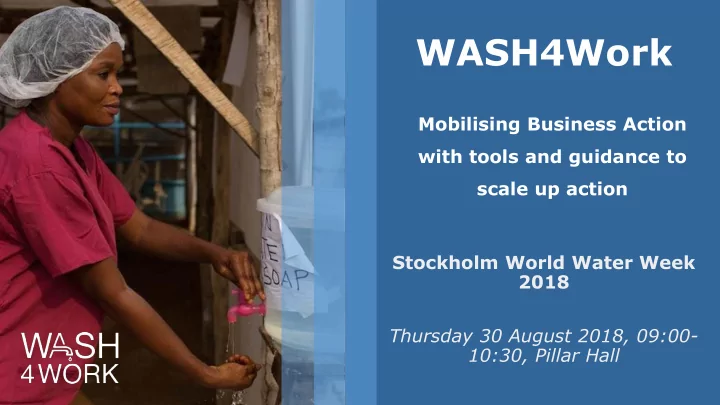
SLIDE 1
Mobilising Business Action with tools and guidance to scale up action
WASH4Work
Stockholm World Water Week 2018 Thursday 30 August 2018, 09:00- 10:30, Pillar Hall
SLIDE 2
Introduction and Overview
WASH4Work
Guy Hutton
Senior Adviser, UNICEF Chair of WASH4Work
SLIDE 3
WASH4Work Responds to Global Commitments to WASH for Everyone, Everywhere
8.8 Protect labour rights and promote safe and secure working environments for all workers, including migrant workers, in particular women migrants, and those in precarious employment 6.1 By 2030, achieve universal and equitable access to safe and affordable drinking water for all 6.2 By 2030, achieve access to adequate and equitable sanitation and hygiene for all and end open defecation
SLIDE 4
Challenges in Scaling Up WASH in the Workplace
SLIDE 5
WASH4Work Has Three Main Areas of Intervention 1.WASH in the Workplace to meet workers’ health, safety, comfort and dignity needs 2.WASH across Supply Chains to ensure deep and broad impact 3.WASH in the Community, providing goods & services and ensuring no negative impact of business operations Water Stewardship is fundamental to incorporate
SLIDE 6 WASH4WORK Progress & Plans to Scale-Up
2016 2017 2018
WASH4WORK Initiated, Secretariat, Partners, Steering Committee WASH in the Workplace packages and guidance materials
2019
¼ly SC meetings and annual partnership meeting www.wash4work.org launched with W4W materials Events such as Stockholm, WWF and HLPF Business case – review, publication, guideline Supply chains and voluntary standards report Increasing uptake (companies, governments)
SLIDE 7
WASH4Work Has Five Main Work Streams 1.Strengthening the “Business Case” for WASH in the workplace 2.Providing clear “WASH standards” for different business categories, and a link with broader Water Stewardship 3.“Government Engagement” for a conducive policy and regulatory environment and advocacy/technical support 4.Active “Company Outreach” to achieve greater update of materials and implement 5.Strong “Communication & Advocacy” for various key stakeholders and new companies
SLIDE 8
SLIDE 9
Thank You
http://www.wash4work.org
Guy Hutton, Chair ghutton@unicef.org Mai-Lan Ha, Secretariat mlha@pacinst.org
SLIDE 10
Mobilising Business Action with tools and guidance to scale up action
WASH4Work
Stockholm World Water Week 2018 Thursday 30 August 2018, 09:00- 10:30, Pillar Hall
SLIDE 11 Strengthening the Business Case for WASH
WaterAid/ Laura Summerton
Ruth Romer – Private Sector Advisor WaterAid 30/08/2018
SLIDE 12 Context: our shared global challenge
- Business is part of the solution to our global WASH crisis
- Progressive companies have shifted their perspective,
although a clear business case and a return on investment is compelling
- At a global level, economic case for WASH exists (WHO, 2012)
US$1 invested in sanitation = $5.5 benefit US$ 1 invested in water supply = $2 return
- At company level ROI is largely anecdotal. Quantitative $
evidence is missing and could help scale-up action
1 – WHO & UNICEF Joint Monitoring Programme, 2017
SLIDE 13 Quantifying business benefits: an opportunity
A new guide – ‘Strengthening the business case for WASH: how to measure value for your business’
- We need a more robust evidence base to build a stronger
business case for investment in WASH
- The practical guide has been championed by WaterAid’s
business partners Diageo, Gap Inc. and Unilever, and endorsed by WASH4Work
- The guide will help provide evidence of the benefits and
financial value of WASH interventions
SLIDE 14
SLIDE 15 The guide
- Purpose: to address the knowledge and data gaps on
the ROI for WASH and generate a clearer business case
- Who is it for: Progressive / ‘advanced’ companies; those
wanting to make the internal case and/or demonstrate leadership
- Assumptions: WASH identified as a priority issue;
WASH intervention already designed; ROI for WASH is
- ne factor in investment decision making; and
competency in data collection
- Outcome: ‘For every $ spent, how many $s are
generated/lost?’
SLIDE 16 Overview of the contents of the guide
Six steps main steps to measuring the business value of WASH A ‘hypothetical’ case study throughout to illustrate each
Where possible, it includes real company examples It also includes appendices with:
- Example impact pathways
- A list of potential indicators for each impact
- Worked examples for the key impacts we have identified
- References section with key resources for further information
- n WASH, M&E and measuring social return on investment
SLIDE 17
Test it, learn from it and share your results with us
corporate@wateraid.org
SLIDE 18 Thank you
WaterAid/Ernest Randriarimalala
SLIDE 19
Mobilising Business Action with tools and guidance to scale up action
WASH4Work
Stockholm World Water Week 2018 Thursday 30 August 2018, 09:00- 10:30, Pillar Hall
SLIDE 20
SLIDE 21
Mobilising Business Action with tools and guidance to scale up action
WASH4Work
Stockholm World Water Week 2018 Thursday 30 August 2018, 09:00- 10:30, Pillar Hall
SLIDE 22
SLIDE 23
Mobilising Business Action with tools and guidance to scale up action
WASH4Work
Stockholm World Water Week 2018 Thursday 30 August 2018, 09:00- 10:30, Pillar Hall
SLIDE 24 Deeper diver into the guide – facilitated session
- Hypothetical cases – factory and field scenario
- Triggers for discussion
- Focus on step 2
- Pre-developed impact pathways
- Facilitated 20 min discussion
- Immerse yourself in the scenario
- Discuss what types of benefits may result?
- How would you measure those benefits?
- What data do you need?
SLIDE 25 Factory
Reduced worker absence Cost of installing facilities Maintenance costs Improved supply chain resilience Menstrual health and hygiene programme Improved worker productivity Increased knowledge and awareness of health and hygiene practices Improved labour relations Improved supplier – lead company relations Improved licence to operate More efficient supply chain management Better reputation and brand value Improved stakeholder relations Training costs Other costs Improved sense
dignity Menstrual hygiene facilities Reduced input costs
INPUTS OUTPUTS IMPACTS BENEFITS TO PEOPLE – EMPLOYEES & COMMUNITY BENEFITS TO SUPPLIER BENEFITS IN SUPPLY CHAIN BENEFITS TO LEAD COMPANY
SLIDE 26 Field
Reduced school absence Reduced worker absence
INPUTS OUTPUTS IMPACTS BENEFITS TO PEOPLE – EMPLOYEES & COMMUNITY BENEFITS TO SUPPLIER BENEFITS IN SUPPLY CHAIN BENEFITS TO LEAD COMPANY
Cost of infrastructure Operating and maintenance costs Reduced input costs Improved supply chain resilience Installed water systems and potable water points Improved worker productivity Improved supplier – lead company relations Improved licence to operate More efficient supply chain management Better reputation and brand value Improved stakeholder relations with local government and other stakeholders Pipe extension Increased understanding of issues in their supply chain Other costs Reduced time to fetch water Increased water availability Better reputation in communities Better reputation in communities Increased volume of output Increased resilience
SLIDE 27
SLIDE 28
Mobilising Business Action with tools and guidance to scale up action
WASH4Work
Stockholm World Water Week 2018 Thursday 30 August 2018, 09:00- 10:30, Pillar Hall