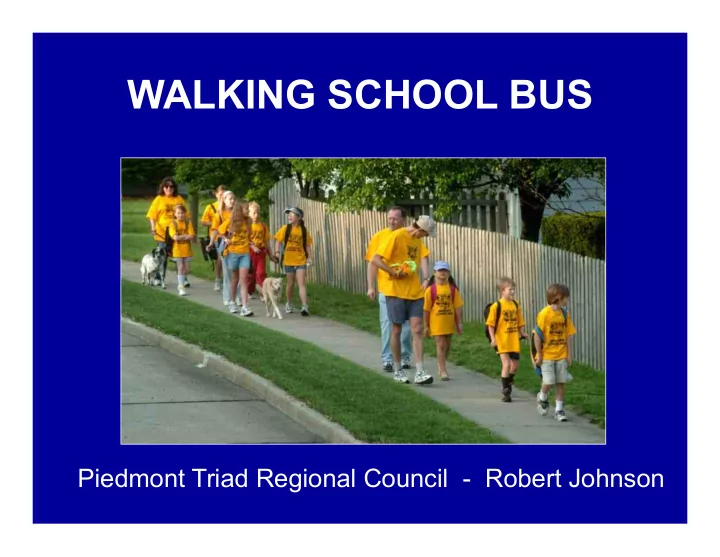
SLIDE 1
Piedmont Triad Regional Council - Robert Johnson
WALKING SCHOOL BUS
SLIDE 2 The PedNet Coalition
- Formed in April, 2000
- 7,000+ supporters in Columbia
- Mission: The Mission of the PedNet
Coalition of Columbia, MO is to encourage active travel such as walking, bicycling, and rolling a wheelchair, and to promote the creation of a safe and attractive network of paths, trails and multi-modal streets that provides health, environmental, quality-of-life, and economic benefits to the community.
- Tactics: Advocacy, policy change,
and programming
- Information: www.pednet.org
SLIDE 3
In 1969, about 50% of American children walked to school In 2001, ... just 15%.
SLIDE 4 Consequences
- 1. Health
- 2. Bussing Costs
- 3. Traffic Congestion
SLIDE 5
SLIDE 6 Bussing Costs
- 14.7 billion annual costs
- ~5% of average school budget
SLIDE 7 Traffic
- As walking to school has declined 50!15%,
private automobile travel has increased
- As much as 20% of rush hour traffic
- Traffic Danger (self fulfilling prophecy)
SLIDE 8 Individual barriers to walking and bicycling to school
62%
30%
19%
12% (CDC, 2005)
SLIDE 9
Walking School Bus
SLIDE 10
- 1. Staging Post Walking School Bus
- 2. Safe Routes to Bus Stops
- 3. Remote Drop Off Location
Variations
SLIDE 11
- 2003-present: Walk-to-School Days
- Spring, 2005: Pilot WSB program
(4 routes, 30 children, parent-led)
- Spring, 2006: Formal WSB program
(12 routes, 120 children, volunteer-led)
- Spring, 2010: WSB at 11 schools
(40 routes, 450 children, 120 volunteers)
Evolution of PedNet’s Program
SLIDE 12 What People Should Know
- Paid WSB Coordinator
- School Based Liaisons
SLIDE 13
register families
coordinate volunteers
WSB routes
Responsibilities of Coordinator
SLIDE 14
Walking School Bus Coordinator (All Programs) Single Bus Leader Single Bus Leader Single Bus Leader Single Bus Leader Single Bus Leader
SLIDE 15
when WSB arrives
parents etc
- Day to day volunteer
- 3-5 hours per week
Responsibilities of School Based Liaison
SLIDE 16
Walking School Bus Coordinator (All Programs) Liaison Liaison Liaison Liaison Liaison 5 Bus Leaders 40 families 5 Bus Leaders 40 families 5 Bus Leaders 40 families 5 Bus Leaders 40 families 5 Bus Leaders 40 families Communications (weather, volunteers, students)
SLIDE 17
Walking School Bus Coordinator (All Programs) Communications (weather, volunteers, students)
SLIDE 18
Walking School Bus Workshop
SLIDE 19 Community Specific Workshop
Workshop in the community beginning a WSB program
Public Health Official Law Enforcement Administration from District Level Administration from Elementary Level Traffic Engineer Walking School Bus Coordinator
representative from a key community group.
crucial organization is “bought in” to the WSB program.
conversations and planning to take place during workshop.
SLIDE 20
9:00 am: Welcome and Introductions 9:30 am: Safe Routes to School Concepts 10:00 am: Everything You Need to Know to Start Your Own WSB Program 12:00 pm: Lunch 1:00 pm: Neighborhood Walkability Audit 2:00 pm: Interactive Route-Planning Exercise 3:30 pm: Final Review/Q&A 4:00 pm: Close
Typical Workshop Agenda
SLIDE 21
Every Attendee Receives a Student Manual In both hard copy and electronic format
SLIDE 22
SLIDE 23 Technical Assistance
Each Workshop includes up to 6-hours of technical assistance
- Ongoing technical assistance from our
WSB staff in Columbia
- Available to answer questions that arise
anytime during the first year of their WSB program
SLIDE 24
- Up to 15 participants
- Each participant receives training manual (hardcopy
and electronic)
- Includes ongoing technical assistance
- Assistance in knowing who to invite
- Should budget $5,000 in grant application for
training, mentoring and technical assistance.
Workshop Recap
SLIDE 25
Robert Johnson, Director of Consulting 573-289-6479, robert@pednet.org Ian Thomas, Executive Director 573-239-7916, Ian@pednet.org
Questions and Answers