W43A: shaping the envelope of an AGB with a collimated jet Hiroshi - - PowerPoint PPT Presentation

w43a shaping the envelope of an agb with a collimated jet
SMART_READER_LITE
LIVE PREVIEW

W43A: shaping the envelope of an AGB with a collimated jet Hiroshi - - PowerPoint PPT Presentation

W43A: shaping the envelope of an AGB with a collimated jet Hiroshi Imai Confidential (Kagoshima University) Jun-ichi Nakashima (Ural Federal University) Gabor Orosz (University of Tasmania) Bosco Yung Nicolaus Copernicus Astronomical


slide-1
SLIDE 1

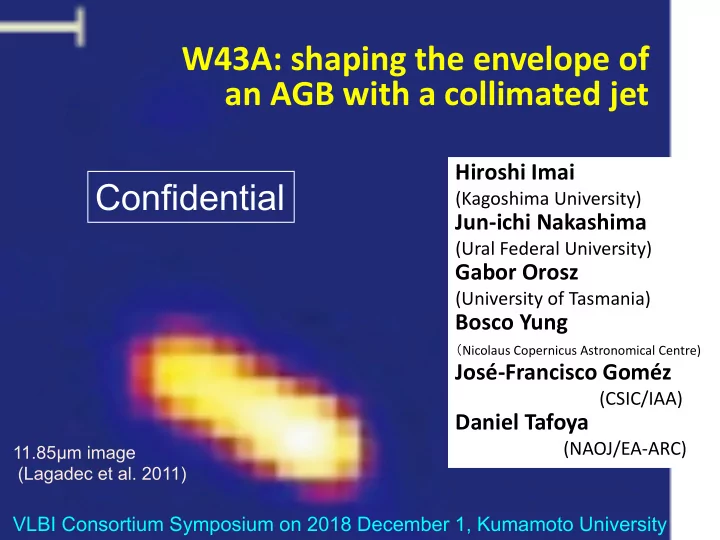
11.85μm image (Lagadec et al. 2011)

VLBI Consortium Symposium on 2018 December 1, Kumamoto University

W43A: shaping the envelope of an AGB with a collimated jet

Hiroshi Imai

(Kagoshima University)

Jun-ichi Nakashima

(Ural Federal University)

Gabor Orosz

(University of Tasmania)

Bosco Yung

(Nicolaus Copernicus Astronomical Centre)

José-Francisco Goméz

(CSIC/IAA)

Daniel Tafoya

(NAOJ/EA-ARC)

Confidential

slide-2
SLIDE 2

Transition phase from AGB to post-AGB star, from spherical symmetric to asymmetric circumstellar envelope

✦ When / how is a water fountain launched? ✦ Which kind of star becomes a host of a water fountain? Egg Nebula (post-AGB star) ⓒ NASA Betelgeuse (Mira variable) ⓒ NASA W43A (OH/IR star, water fountain) Deguchi et al. 2007

slide-3
SLIDE 3

Water fountain: highly-collimated stellar molecular jet traced by H2O maser emission

  • Vexp (H2O) (>100 km/s) >> Vexp (OH) (10ー30 km/s)
  • Very short dynamical time scale (?): <100 years
  • Very high mass loss rate (?): dM/dt>10-5Msunyr-1

H2O and OH masers in W43A (Imai et al. 2002)

SPITZER/GLIMPSE image around W43A (Deguchi et al. 2007) 11.85μm image (Lagadec et al. 2011)

slide-4
SLIDE 4

The origins of the jets: double stars or single star?

  • true and whole

morpho-kinematical structures of stellar jets in CO emission

  • evolution of the

structures

  • mass loss rates of

the jets

W43A

(Imai et al. 2008)

  • H2O: jet
  • 1612 MHz OH:

envelope

  • SiO: torus
  • Central stellar system probably

unresolved even with ALMA Cycle-6 beam (~20 mas)

  • Central torus was marginally resolved

with ALMA Cycle-4 beam (~40 mas)

slide-5
SLIDE 5

What seen in 12CO J=2à1 emission

  • Intermediate velocity

components

– Along the major axis of a MIR cavity

– Consistent with low-velocity components of H2O masers

11.85μm image (Lagadec et al. 2011)

Confidential

slide-6
SLIDE 6

Evolution of the W43A jet

slide-7
SLIDE 7

Previous precessing jet model

  • Precession period ~55 years
  • Precession angle amplitude ~5°
  • Gas bullets with ballistic motions from the central star and

interactions with ambient envelope

Imai et al. 2002, 2005

slide-8
SLIDE 8

Wrong precessing jet model by Imai et al. (2002)

Chong et al. (2015)

slide-9
SLIDE 9

A new model of H2O maser excitation region

(Chong et al. 2015)

  • Bipolar cavity formed by past jet ejection
  • New interaction of newly ejected jet

at the cavity wall

  • Periodic pattern of maser region

produced by discontinuous ejection of jet or envelope

11.8 μm emission from a bipolar cavity of W43A (Lagadec et al. 2011)

slide-10
SLIDE 10

Ballistic bow shock model

  • Formalization (Ostriker 2001)
  • Simulations (Lee et al. 2001)

steady v.s pulsed jets

  • Application to water fountain jet to

explain directions of maser motions and thickness of maser distribution

(Orosz et al. 2017 in prep.)

Steady jet Pulsed jet

Jet with a large opening angle

slide-11
SLIDE 11

Fast, decelerating, small-precessing jet model

Tafoya et al. (in preparation)

Fastest components close to the central system

IRAS 16342-3814

slide-12
SLIDE 12

Anticorrelation between CO and dust continuum emission regions

Confidential

slide-13
SLIDE 13

Periodic outbursts of the jet

Ejection period: P=5—7 years

Confidential

slide-14
SLIDE 14

Tracing the co-evolution of a collimated stellar jet and equatorial torus/flow

  • First outburst in W43A

~60 years ago

  • Interaction event between a

compact stellar object and a torus followed by a jet on a short time scale

  • Binary system scenario may

produce the interaction event and explain (multiple) discrete mass ejection.

  • The interaction event may
  • ccur in AGB phase.

Statistical study is necessary. Mapping the whole envelope/ torus is crucial.

Data point of W43A has been just determined.

W43A

slide-15
SLIDE 15

Future perspectives

FLASHING

Finest Legacy Acquisitions of SiO and H2O masers Ignitions by Nobeyama Generation

  • Episodic outbursts
  • Periodicity
  • Evolution
  • devolution

First observations on 2018 December 1 Simultaneous observations of SiO and H2O masers with new quasi-optics derived by HINOTORI

(Hybrid Installation Project in Nobeyama, Triple-band Oriented)