W hether it is a sales seminar deliv- and storytelling expert at - - PDF document

w
SMART_READER_LITE
LIVE PREVIEW

W hether it is a sales seminar deliv- and storytelling expert at - - PDF document

HOW TO Multiple Speakers, One Message How to prepare a cohesive group presentation. BY CHRISTINE CLAPP, DTM W hether it is a sales seminar deliv- and storytelling expert at Duarte, Inc. However, group presentations often ered on a large


slide-1
SLIDE 1

TOASTMASTER | NOVEMBER 2015 27

27 WHERE LEADERS ARE MADE

HOW TO

Multiple Speakers, One Message

How to prepare a cohesive group presentation.

BY CHRISTINE CLAPP, DTM

W

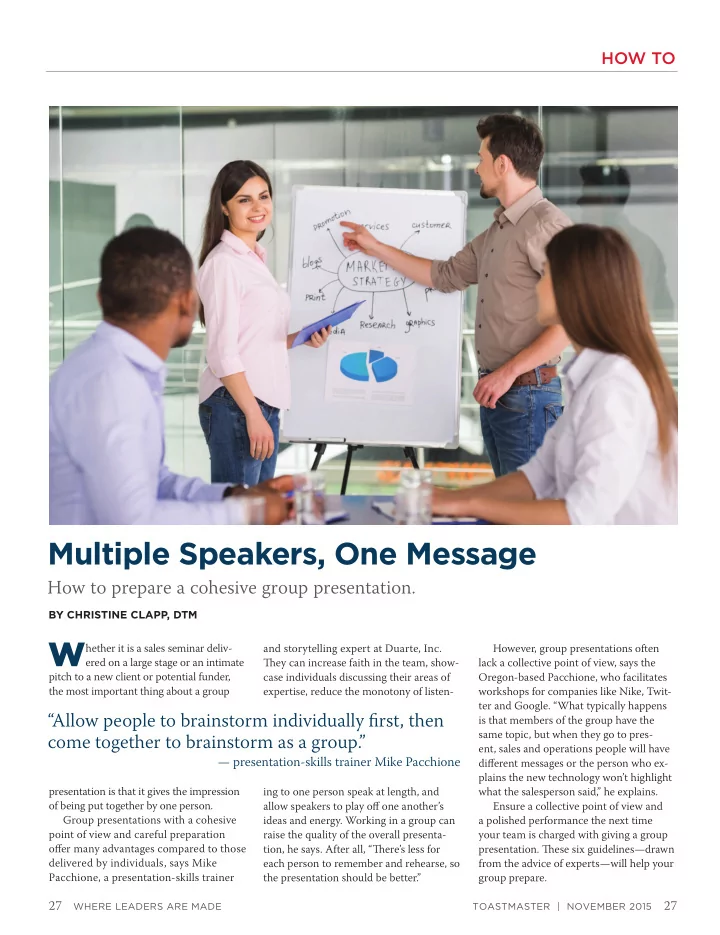
hether it is a sales seminar deliv- ered on a large stage or an intimate pitch to a new client or potential funder, the most important thing about a group presentation is that it gives the impression

  • f being put together by one person.

Group presentations with a cohesive point of view and careful preparation

  • ffer many advantages compared to those

delivered by individuals, says Mike Pacchione, a presentation-skills trainer and storytelling expert at Duarte, Inc. Tiey can increase faith in the team, show- case individuals discussing their areas of expertise, reduce the monotony of listen- ing to one person speak at length, and allow speakers to play off one another’s ideas and energy. Working in a group can raise the quality of the overall presenta- tion, he says. After all, “Tiere’s less for each person to remember and rehearse, so the presentation should be better.” However, group presentations often lack a collective point of view, says the Oregon-based Pacchione, who facilitates workshops for companies like Nike, Twit- ter and Google. “What typically happens is that members of the group have the same topic, but when they go to pres- ent, sales and operations people will have different messages or the person who ex- plains the new technology won’t highlight what the salesperson said,” he explains. Ensure a collective point of view and a polished performance the next time your team is charged with giving a group

  • presentation. Tiese six guidelines—drawn

from the advice of experts—will help your group prepare.

“Allow people to brainstorm individually first, then come together to brainstorm as a group.”

— presentation-skills trainer Mike Pacchione

slide-2
SLIDE 2

28 WHERE LEADERS ARE MADE

Once the whole group agrees on the gen- eral outline of the entire presentation, assign each portion to the speaker who can deliver it knowledgeably and enthusiastically. Tien let each presenter work independently to develop an outline for his or her part. “Tie group has to agree on the direction and the

  • utline, not the details,

” says Trivers. Make sure speakers know how long their part of the presentation should run before they go off to work independently. Tiough timing for specific sections can be refined as the presentation develops, it’s important that speakers have general guidelines early on, so they don’t prepare too much or too little material.

4

Craft cohesive visuals The person or team responsible for visu- al aids should curate and maintain a master document of slides and handouts of leave- behind materials. It’s best when the visual- aid contributions from different presenters are consistent—both in the amount and the formatting of material. Allot about a week to refine and finalize visuals and another week for a print shop to print handouts. “One of the biggest challenges with groups is they spend way more time with creating slides than with practicing,” warns

  • Trivers. She thinks groups should only

spend about 20 percent of their prepara- tion time working on slides, so they don’t get bogged down in minutia.

5

Rehearse effectively About two weeks before the presenta- tion, the group should do a rough run- through, sitting down with the visual aids and talking through the presentation. This helps to identify gaps or redundancies in the presentation; to allow presenters to plan references to material discussed by

  • ther team members; and to craft smooth

transitions between speakers. Just as important, it provides an opportunity to check on speaking times. All too often, speakers go longer than they anticipate and must streamline their material. Trivers recommends that group members practice a great deal individually before prac- ticing as a team. “You don’t want speakers to practice with the group; it’s a huge waste of

  • time. Speakers need to get fluent first—hav-

ing a coach, a colleague or a spouse will help. ”

HOW TO

1

Start earlier For a make-or-break presentation, a single speaker needs at least a month to prepare. Working in a group of presenters extends this timeline, because it takes longer to schedule planning meetings, make decisions and conduct rehearsals. Aim to start prepar- ing one to three months in advance. Because “people want to debate every last decision, ” says Pacchione, groups often take way too long to prepare presentations. His suggestion: “Allow people to brainstorm individually first, then come together to brainstorm as a group. ” Making it a more democratic activity often increases buy-in and cuts down on decision-making time.

2

Have a point person Identify one person to serve as the project manager. He or she might be a leader in the group—a respected member

  • f the organization—who is not speaking

in the presentation. Or your point person could be a presentation-skills consultant who brings an outside perspective to the team; it may be easier for team members to respond to suggestions from a consul- tant rather than from within the group or

  • rganization. Whoever it is, this person is

responsible for developing a timeline for the group’s major milestones (like creating an outline, coordinating visual aids and holding the first rehearsals) and keeping the team on schedule.

3

Develop a perspective and a detailed outline To present a collective point of view, your group needs to develop an outline for the entire project. Susan Trivers is a business- growth coach who has consulted with more than 4,000 people in 450 companies on how to present to win audiences. She recom- mends starting an outline by asking what the ultimate goal of the presentation is. “Know your call to action. Don’t start from the beginning and hope to get to the end,” she advises. “It’s much harder to get to the end when you’re crafting a presenta- tion with five people.” Choose one person to open and close the presentation based on whoever is most comfortable.

“One of the biggest challenges with groups is they spend way more time with creating slides than with practicing.”

— business coach Susan Trivers

slide-3
SLIDE 3

TOASTMASTER | NOVEMBER 2015 29

Once individual speakers have command of their material (about a week before the presentation), the group should rehearse together twice. Ideally, the final group practice is a dress rehearsal at the event venue where the team will present, so that speakers can familiarize themselves with seating positions, layout of the speaking area and technology to be used.

6

Arrive early On the day of the presentation, group members should arrive to the venue early. For presentations at a large conference center

  • r event hall, get there 90 minutes early. If you’re presenting in the

conference room of another organization (as is often the case for pitching new business), plan to arrive at least 30 minutes early. Tiis allows time to set up materials, conduct sound checks, test technology, review seating arrangements, do stretches and vocal warm-up exercises, get water and use the restroom. Plan to finish the preparations early enough for the team to greet attend- ees, engage in small talk and start on time. Now you are truly ready. You’ve taken all the right steps and prepared as thoroughly as possible. Tie last thing to do is deliver a winning presentation! T CHRISTINE CLAPP, DTM, develops the voice of experts who want to broaden their impact. She is the author of Presenting at Work: A Guide to Public Speaking in Professional Contexts and the president of Spoken with Authority.

ADVICE FROM THE EXPERTS

Tips for delivering a dynamic group presentation

1

Identify the opener and closer The person who opens and closes the group presentation doesn’t have to be an organizational leader or based on the company hierarchy, says business-growth coach Susan Trivers. It should be whoever is most comfortable kicking off and wrapping up in front of that particular audience. “Too often

  • rganizations choose [this person] based on position,” she
  • says. “The primary point isn’t about reinforcing hierarchy, it’s

about engaging the audience.”

2

Don’t try to match styles Teams often make the mistake of trying to match person- al styles during a group presentation, whether it’s the style of presenting or the style of clothing. “You can’t make someone into someone they’re not,” asserts Trivers. “Showing you have a variety of strengths is good for your audience.”

3

Remember you are always ‘on’ Allison Shapira, the founder of Washington, D.C.-based Global Public Speaking LLC, contends that speakers in a group presentation must “recognize they are always on, even if they aren’t speaking.” She advises all members of the group to listen actively while their colleagues are speaking and to keep a friendly expression on their face that conveys they are available to answer questions.

4

Feel free to interject Speakers should strategically interject in each other’s sec- tions so the presentation feels more like a conversation than a speech, says presentation-skills trainer Mike Pacchione. “Have a plan like a nonverbal signal. When the non-speaker has something to say, he or she can stand up to signal that he or she has something to add.”

5

Have meaningful transitions “Groups spend way too much time on transitions,” says

  • Trivers. “Audience members don’t need to hear a lot about

the transition because they see when someone new is speak- ing.” She recommends that transitions not focus on what the speaker will say, but on the expertise of the speaker and how it relates to the audience.

6

Get ready for questions Have a point person who will pass along each question to the best person to answer it, says Pacchione. Approach the Q&A with a lightening-round mentality, because the longer someone takes to answer a question, the fewer questions you can answer.

7

Practice ‘the ask’ Shapira recommends that groups making a business pitch take great pains to practice how they will present “the ask,”

  • r the call to action. At the end of the presentation, the client

needs to know what is being asked of them. Confidently ask for their business.

ADVICE FROM THE EXPERTS