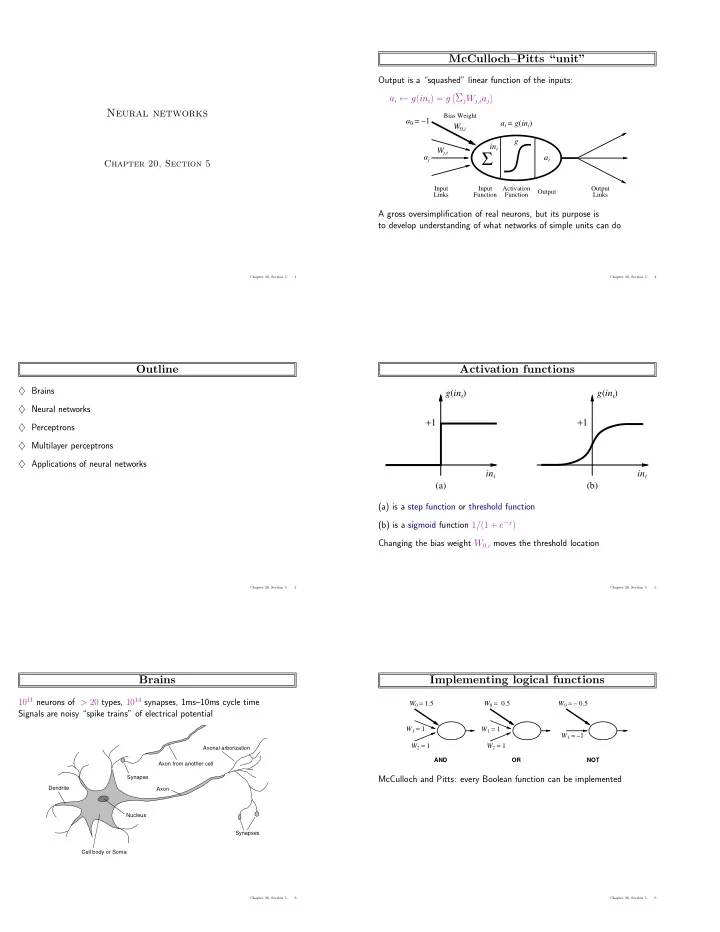
SLIDE 2 Network structures
Feed-forward networks: – single-layer perceptrons – multi-layer perceptrons Feed-forward networks implement functions, have no internal state Recurrent networks: – Hopfield networks have symmetric weights (Wi,j = Wj,i) g(x) = sign(x), ai = ± 1; holographic associative memory – Boltzmann machines use stochastic activation functions, ≈ MCMC in Bayes nets – recurrent neural nets have directed cycles with delays ⇒ have internal state (like flip-flops), can oscillate etc.
Chapter 20, Section 5 7
Feed-forward example W
1,3 1,4
W
2,3
W
2,4
W W
3,5 4,5
W 1 2 3 4 5
Feed-forward network = a parameterized family of nonlinear functions: a5 = g(W3,5 · a3 + W4,5 · a4) = g(W3,5 · g(W1,3 · a1 + W2,3 · a2) + W4,5 · g(W1,4 · a1 + W2,4 · a2)) Adjusting weights changes the function: do learning this way!
Chapter 20, Section 5 8
Single-layer perceptrons
Input Units Units Output
Wj,i
2 4 x1
x2 0.2 0.4 0.6 0.8 1 Perceptron output
Output units all operate separately—no shared weights Adjusting weights moves the location, orientation, and steepness of cliff
Chapter 20, Section 5 9
Expressiveness of perceptrons
Consider a perceptron with g = step function (Rosenblatt, 1957, 1960) Can represent AND, OR, NOT, majority, etc., but not XOR Represents a linear separator in input space:
ΣjWjxj > 0
W · x > 0
(a) x1 and x2 1 1 x1 x2 (b) x1 or x2 1 1 x1 x2 (c) x1 xor x2 ? 1 1 x1 x2
Minsky & Papert (1969) pricked the neural network balloon
Chapter 20, Section 5 10
Perceptron learning
Learn by adjusting weights to reduce error on training set The squared error for an example with input x and true output y is E = 1 2Err 2 ≡ 1 2(y − hW(x))2 , Perform optimization search by gradient descent: ∂E ∂Wj = Err × ∂Err ∂Wj = Err × ∂ ∂Wj
j = 0Wjxj)
Simple weight update rule: Wj ← Wj + α × Err × g′(in) × xj E.g., +ve error ⇒ increase network output ⇒ increase weights on +ve inputs, decrease on -ve inputs
Chapter 20, Section 5 11
Perceptron learning contd.
Perceptron learning rule converges to a consistent function for any linearly separable data set
0.4 0.5 0.6 0.7 0.8 0.9 1 10 20 30 40 50 60 70 80 90 100 Proportion correct on test set Training set size - MAJORITY on 11 inputs Perceptron Decision tree 0.4 0.5 0.6 0.7 0.8 0.9 1 10 20 30 40 50 60 70 80 90 100 Proportion correct on test set Training set size - RESTAURANT data Perceptron Decision tree
Perceptron learns majority function easily, DTL is hopeless DTL learns restaurant function easily, perceptron cannot represent it
Chapter 20, Section 5 12