W in = ! N 12 ( h mix ! T 0 s mix ) + T 0 S irr Minimum Work of - - PowerPoint PPT Presentation

w in n 12 h mix t 0 s mix t 0
SMART_READER_LITE
LIVE PREVIEW

W in = ! N 12 ( h mix ! T 0 s mix ) + T 0 S irr Minimum Work of - - PowerPoint PPT Presentation

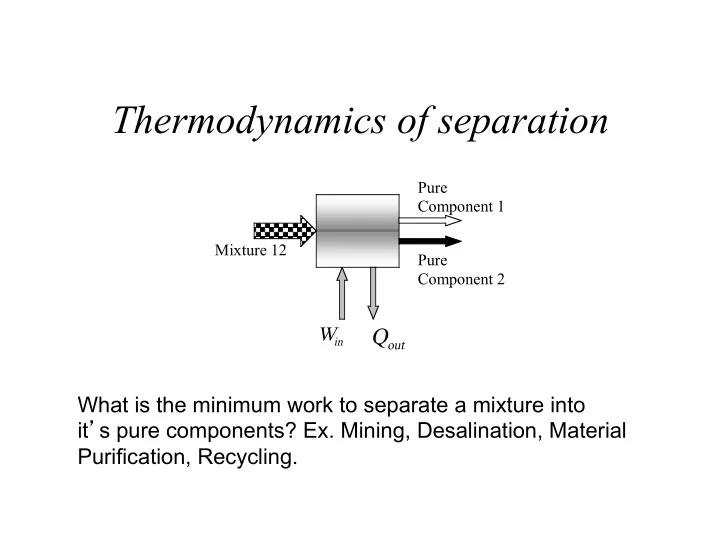
Thermodynamics of separation Pure Component 1 Mixture 12 Pure Component 2 W Q in out What is the minimum work to separate a mixture into it s pure components? Ex. Mining, Desalination, Material Purification, Recycling. Balance Eq ns


slide-1
SLIDE 1

Pure Component 2 Pure Component 1 Mixture 12

in

W

  • ut

Q

Thermodynamics of separation

What is the minimum work to separate a mixture into it’s pure components? Ex. Mining, Desalination, Material Purification, Recycling.

slide-2
SLIDE 2

Pure Component 2 Pure Component 1 Mixture 12

in

W

  • ut

Q

dNi,sys dt = Ni,in ! Ni,out

dE dt = ! Qout + Win + H12 ! H1 ! H2

dS dt = ! Qout T0 + S12 ! S1 ! S2 + Sirr

Win = (( H1 + H2) ! H12) ! To(( S1 + S2) ! S12) + To Sirr

Win = ! N12( hmix ! T0 smix) + T0 Sirr

Balance Eq’ns for Mass, Energy & Entropy

Sirr

slide-3
SLIDE 3

Win = ! N12 go

mix + T0

Sirr

wmin = Wmin N12 = ! g#

mix

Win = ! N12( hmix ! T0 smix) + T0 Sirr

Minimum Work of Separation

slide-4
SLIDE 4

Gibbs Free Energy of Mixing*

Δgo

mix = Δho mix –T0 Δso mix.

Δgo

mix ≈ –T0 Δsmix =

–T0 (s12 –x1s1 – x2s2)

For non-interacting molecules entropy can dominate

  • ften resulting in a negative Gibbs Free Energy and hence

spontaneous mixing. I.e. Δgo

mix < 0

* at standard conditions

slide-5
SLIDE 5

S = k ln Ω

Boltzmann’s entropy equation

! = n! r!(n r)!

How many ways can “r” atoms be positioned in a lattice with “n” locations?

slide-6
SLIDE 6

wmin = T0Δsmix = k T0 (ln Ω12)

  • Ex. 4 atoms in 8 locations

! 12 = n! r!(n r)! = 8! 4!4! = 70 1

slide-7
SLIDE 7

wmin = ! T0R(xln x + (1! x)ln(1! x))

Using Stirling’s Approximation

Where x is mol fraction r/n, and R = k Navo

ln N! = N ln N - N

slide-8
SLIDE 8

Multi-component System

! = n! n1!n2!.....nj!

wmin = ! T0R xi

i=1 j

ln xi

slide-9
SLIDE 9

“Separation”

wmin = ! T0R xi

i=1 n

ln xi

slide-10
SLIDE 10

)) )) x ln( N x ln ln N ( R T W

) N ( min min

i

! + ! = 1

2 1

)) 1 ln( ln ) 1 ((

2 1 ) 1 ( min

1

x N x N R T W N ! + ! ! =

!

wmin, 1 = T0R(ln 1 x1 )

“Extraction”

slide-11
SLIDE 11

Separation Examples

  • From the atmosphere
  • From the Ocean
  • Solutions

– Polymer – Water based – Liquid metals (activity coef)

slide-12
SLIDE 12

The minimum work to separate O2 from the atmosphere

ex,O2

  • = T0R(ln 1

xO2 ) ! 298(K) # 8.314(J / molK)ln(0.212) = 3.84(kJ / mol)

In wet air you get 3.97 kJ/mol : compare with Szargut

Table from the EngineeringToolBox.com

slide-13
SLIDE 13

Energy kg(target) = kg (processed) kg (target) i Energy kg (processed) ~ 1 g i Energy kg (processed)

slide-14
SLIDE 14

energy requirements for mining and milling, possible future trends

Chapman and Roberts p 113 & 116 underground ~ 1000/g (MJ/t metal)

  • pen pit ~ 400/g (MJ/t metal)
slide-15
SLIDE 15

Sherwood plot showing the relationship between the concentration

  • f a target material in a feed stream and the market value of (or cost to remove)

the target material [Grübler 1998].

slide-16
SLIDE 16

Exergy of a Mixture

eo

x x, mixture =

xi

!

eo

x, i + RT

xi

!

ln xi

slide-17
SLIDE 17

CRUST at To, po Ore value at mine Pure ore (e.g. Fe2O3) Pure metal Metal alloy Mixing in product Mixing in waste stream Further mixing and corrosion Exergy Purification Stages Recycle to pure metal

Theoretical Exergy Values for a metal extracted from the earth’s crust shown at various stages of a product life cycle (not to scale)