Ariane 501 Incident December 1, 1994 Ariane 4 at Three Levels of - - PowerPoint PPT Presentation

ariane 501 incident
SMART_READER_LITE
LIVE PREVIEW

Ariane 501 Incident December 1, 1994 Ariane 4 at Three Levels of - - PowerPoint PPT Presentation

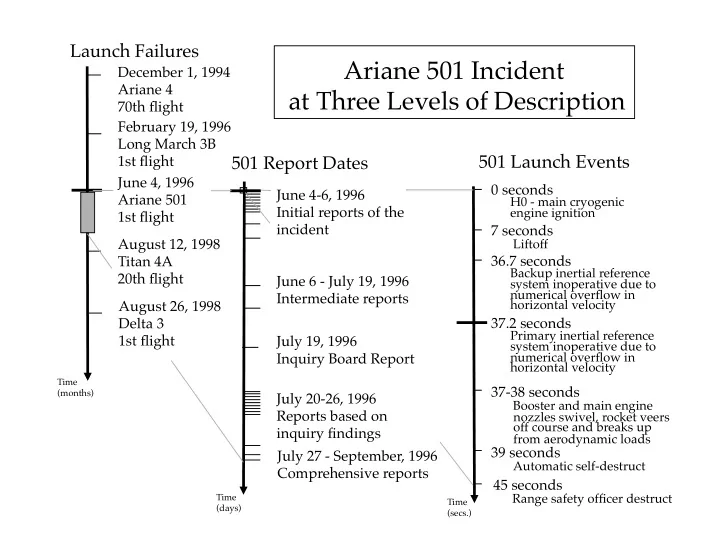
Launch Failures Ariane 501 Incident December 1, 1994 Ariane 4 at Three Levels of Description 70th flight February 19, 1996 Long March 3B 501 Launch Events 1st flight 501 Report Dates June 4, 1996


slide-1
SLIDE 1

December 1, 1994 Ariane 4 70th flight February 19, 1996 Long March 3B 1st flight

Launch Failures

  • Time

(months)

0 seconds

H0 - main cryogenic engine ignition

7 seconds Liftoff 36.7 seconds

Backup inertial reference system inoperative due to numerical overflow in horizontal velocity

37.2 seconds

Primary inertial reference system inoperative due to numerical overflow in horizontal velocity

37-38 seconds Booster and main engine

nozzles swivel, rocket veers

  • ff course and breaks up

from aerodynamic loads

501 Launch Events

  • Time

(secs.)

39 seconds Automatic self-destruct 45 seconds

Range safety officer destruct

June 4-6, 1996 Initial reports of the incident June 6 - July 19, 1996 Intermediate reports July 19, 1996 Inquiry Board Report July 20-26, 1996 Reports based on inquiry findings July 27 - September, 1996 Comprehensive reports

501 Report Dates

  • Time

(days)

August 12, 1998 Titan 4A 20th flight August 26, 1998 Delta 3 1st flight June 4, 1996 Ariane 501 1st flight

Ariane 501 Incident at Three Levels of Description

slide-2
SLIDE 2

Ariane 5 Flight 501 Failure: Report by the Inquiry Board (July 19, 1996) Inertial Reference Software Error Blamed for Ariane 5 Failure; Defense Daily (July 24, 1996)

  • Software Design Flaw Destroyed Ariane 5; next flight in 1997;
  • Aerospace Daily (July 24, 1996)
  • Ariane 5 Rocket Faces More Delay; The Financial Times Limited

(July 24, 1996) Flying Blind: Inadequate Testing led to the Software Breakdown that Doomed Ariane 5; The Financial Times Limited (July 25, 1996) Board Faults Ariane 5 Software; Aviation Week and Space Technology (July 29, 1996) Ariane 5 Explosion Caused by Faulty Software; Satellite News

  • (August 5, 1996)

Ariane 5 Report Details Software Design Errors ; Aviation Week and Space Technology (September 9, 1996)

  • Ariane 5 Loss Avoidable with Complete Testing; Aviation Week and

Space Technology (September 16, 1996)

  • “High Profit” Documents
slide-3
SLIDE 3

Titles/Dates are Weak Cues to Content

slide-4
SLIDE 4
  • S3: the rocket blew up after 44 seconds
  • S6: they reused the inertial guidance system from the

Ariane 4

  • S5: the number overflowed because it was too large
  • S6: inaccurate description of why the rocket

unexpectedly swiveled

  • S3: monetary loss could be recovered by insurance

Inaccurate Statements Resulting From Inaccurate Information

slide-5
SLIDE 5

Participant 6’s Process Trace on Unexpected Swiveling

slide-6
SLIDE 6

Participant 7’s Process Trace on Unexpected Swiveling

slide-7
SLIDE 7
  • S9: the cause of the failure was mechanical
  • S6, S7: the Cluster satellite program was discontinued
  • S8: the 502 launch was originally scheduled for the first

half of 97

  • S4: the original date for the 502 launch was May 1997
  • S6: the delay to the 502 launch was about 6 months

Inaccurate Statements Resulting From Stale Information

slide-8
SLIDE 8

Participant 6’s Process Trace on Cluster Satellite Program

“The immediate impact were that the solar wind experiment was destroyed. They couldn’t afford to build any more satellites so they couldn’t pursue that anymore.”

slide-9
SLIDE 9

Predicted 502 Launch Delays

  • Prior to 501 Launch
  • September ‘96
  • Right after 501 incident
  • (June 4, ‘96)
  • December ‘96
  • After Inquiry Board Report
  • (July 19, ‘96)
  • December ‘96
  • March ‘97
  • Actual 502

Launch Date March - June ‘97 July ‘97

  • September ‘97
  • October 30, ‘97
  • Projected Launch Date
  • Announcement Date
  • June 96

July Aug Sept Oct Nov Dec Jan 97 Feb Mar Apr May June July Aug Sept Oct Nov June 96 July Aug Sept Oct Nov Dec Jan 97 Feb Mar Apr May June July Aug Sept Oct Nov

Launch

  • Date
  • Report
  • Date
slide-10
SLIDE 10

Launch

  • Date
  • Report
  • Date
  • Participant 6

Launch

  • Date
  • Report
  • Date
  • Participant 4

Report

  • Date
  • Participant 5

Launch

  • Date
  • June 96

July Aug Sept Oct Nov Dec Jan 97 Feb Mar Apr May June July Aug Sept Oct Nov June 96 July Aug Sept Oct Nov Dec Jan 97 Feb Mar Apr May June July Aug Sept Oct Nov Launch

  • Date
  • Report
  • Date
  • Process Traces on 502 Launch Delays

Main Updates

slide-11
SLIDE 11

Participant 6 Briefing: “It delayed the next launch about six months”

June 96 July Aug Sept Oct Nov Dec Jan 97 Feb Mar Apr May June July Aug Sept Oct Nov

Launch

  • Date
  • Report
  • Date
  • June 96

July Aug Sept Oct Nov Dec Jan 97 Feb Mar Apr May June July Aug Sept Oct Nov

June 4, 1996:

  • A few months from now
  • June 6, 1996:
  • Delayed for at least six months
  • June 5, 1996:
  • Within next few months
  • July 25, 1996
  • Postponed to mid-
  • semester 1997
  • July 5, 1996:
  • In or around June 1997
  • Participant’s Response
  • Article Date/Content
  • nothing
  • nothing
  • nothing
  • nothing
  • “…it delayed the

second test launch”

slide-12
SLIDE 12

June 4, 1996:

  • Launch preparation will
  • begin June 16
  • October 13, 1997:
  • Rescheduled to Oct. 28, 1997.

Initially scheduled for June 1997, reset to Sept. 15, then Sept. 30

  • March 27, 1997:
  • Put back to mid Sept…initially
  • set for May, put back to June,
  • then July
  • October 30, 1997:
  • Today Ariane 5 rocket was

successfully launched

  • Participant’s Response
  • Article Date/Content
  • “Second launch scheduled

for June 16, 97” (can’t tell if that is a delay from original schedule) “Second launch scheduled for October 28” (would like to find out when second launch was originally scheduled) “So it was originally scheduled to be launched in May and it was launched in October.” “Originally set for May 1997.” (thinks should get the actual date the flight

  • ccurred)

Participant 4 Briefing: “Impacts…delay of second flight of Ariane 5.”

  • June 96

July Aug Sept Oct Nov Dec Jan 97 Feb Mar Apr May June July Aug Sept Oct Nov

Launch

  • Date
  • Report
  • Date
  • June 96

July Aug Sept Oct Nov Dec Jan 97 Feb Mar Apr May June July Aug Sept Oct Nov

slide-13
SLIDE 13

June 96 July Aug Sept Oct Nov Dec Jan 97 Feb Mar Apr May June July Aug Sept Oct Nov

Launch Date

  • Report Date
  • June 96

July Aug Sept Oct Nov Dec Jan 97 Feb Mar Apr May June July Aug Sept Oct Nov

Participant 5 briefing: “The next flight of the vehicle was scheduled already. Apparently one article said the first six months of 97. I looked at another article that said March or April and I saw another that said it was going to happen in July, so it was getting backed off and the final launch, I believe, was in October. The second launch, the 502 vehicle, which is Ariane 502.”

Participant’s Response

  • Article Date/Content
  • July 25, 1996: mid-semester 1997
  • nothing
  • March 25, 1997: until at least September
  • (wants to see actual

502 launch date)

  • June 5, 1996: within the next few months
  • nothing
  • October 30, 1997: today...launched
  • (notes the launch

anomaly on 502)

  • June 4, 1996: a few months from now
  • nothing
  • July 28, 1996: first half of 1997
  • “predicts delay for 502”
  • June 5, 1996: early 1997
  • nothing
  • June 6, 1996: later this year
  • nothing
  • June 10, 1996: early 1997
  • “delay qualification
  • f Ariane 5”
  • July 24, 1996: March at the earliest
  • July 24, 1996: mid-1997
  • “next flight in 1997”
  • nothing
slide-14
SLIDE 14

Cues to “Data Quality”

Source Document Description

Depth and breadth of theme coverage Temporal relationship to events (do not have all the information right away) If given official responsibility to do an analysis Amount quoted directly from official document Distance from the original data: secondhand, translated Length Reputation for credibility Reputation of bias Reputation for expertise in a particular area Level of sensationalism Technical language Temporal relationship to updates (can be “stale”)

slide-15
SLIDE 15

On topic:

contains information that is relevant to the task at hand

Types of Documents

High-profit:

detailed, accurate description of important events from a credible, low bias source

Comprehensive:

long, on-topic, article from a credible, low-bias source that is not immediately after the event and not overly distanced from the original data

Peripheral mentions:

documents that reference the event briefly but whose focus is on items of low relevance to the user’s tasks and goals

Unrelated collections:

documents that contain many unrelated themes that are not ordered in a meaningful way

Themed:

documents that address a single particular theme

slide-16
SLIDE 16

Circumscribed roles for active “intelligence” Mixed initiative cooperation

  • Analyst
  • Directly manipulate
  • Select
  • Expand/ Contract
  • Add
  • Define

Machine

  • Structure
  • Seed
  • Followup
  • Learn
  • Remind
  • Critique
slide-17
SLIDE 17

Sub-document Bundles From Notes Grouped by Theme

Raymond Orye, head of the Ariane-5 program, said the exhaust nozzles at the base of two booster rockets swiveled abnormally and broke off, triggering an on-board self-destruction mechanism. About 500 channels of good telemetry were acquired until the breakup, which along with movie and video footage should provide an accident investigation board with sufficient data. ESA and CNES officials were forming the board late last week, and want an independent report by mid-July detailing the cause of the accident and proposed modifications. Attempts will be made to recover the on-board computers and other key parts. The terrain is a mixture of savannah and muddy mangrove trees. The rocket veered off course 37 seconds into flight and was destroyed, raining flaming debris near the European Space Agency's launch center off French Guiana. Journalists at the control centre heard two explosions and saw a giant wreath of orange flames and blazing wreckage about five kilometres away. Officials then hustled them indoors and evacuated the area. The Ariane 5 launcher failed on its first flight last week after gimbals on all three rocket engines moved to full deflection. The gimballing caused the 1.6-million-lb. launcher to pitch and yaw at rates estimated at 30 deg./sec. It quickly broke up from the airloads, and the breakup triggered an auto-destruct system that reduced Ariane 5 to a broad shower of flaming debris. Though spectacular, the debris caused no known injuries or property damage. KOUROU, FRENCH GUIANA, 1996 JUN 4 (NB)

  • - The maiden launch of Europe's Ariane-5 rocket

went badly wrong this morning in Kourou, French Guiana when the rocket exploded just seconds into

  • flight. The rocket was seen to climb strongly for

several seconds before nose diving towards the ground and exploding.Members of the ground crew, journalists, guests, and those down range from the launch site were immediately evacuated because of the danger of falling debris, much of which was white hot, and an almost full tank of flaming fuel. THE INDEPENDENT INVESTIGATION BOARD APPOINTED AFTER THE FAILED ARIANE 501 LAUNCH ON JUNE 4 SUBMITTED ITS REPORT ON JULY 16. ANALYSIS OF THE TELEMETRY AND AN EXAMINATION OF ONE OF THE INERTIAL REFERENCE SYSTEMS (IRS) RECOVERED REVEALED THE CAUSE OF THE FAILURE AND HOW IT ORIGINATED: A MALFUNCTION OF THE IRS SOFTWARE FOLLOWING NUMERICAL OVERFLOW IN AN UNPROTECTED DATA VARIABLE DUE TO A DESIGN FLAW. THE VARIOUS ENGINEERING TEAMS HAVE LOST NO TIME IN DEALING WITH THE PROBLEM, AND QUALIFICATION FLIGHT 502 IS NOW EXPECTED IN THE FIRST HALF OF 1997.

Description of the failure

The Ariane 5, developed over 10 years at a cost of $ 7 billion, was to be the successor to the Ariane 4.

Background

Ariane5's disastrous maiden launch, which ended when the rocket and its Pounds 500 million cargo had to be blown up a minute into their flight. The Ariane 5 rocket took off from a South American jungle base at 8:35 a.m. EDT loaded with four solar science satellites valued at $ 500 million. Qualification flight V501 on June 4 was conducted by the European and French space agencies (ESA and CNES) and carried four Cluster magnetospheric research satellites worth $500 million that were to be placed in a 22,350 X 175-

  • mi. geosynchronous transfer orbit (see p. 22).

Aerospatiale is the ``industrial architect'' for Ariane 5 and is responsible for the main cryogenic stage and solid rocket boosters (AW&ST May 6, p. 60).

Payload

The next flight, Ariane V502, was set for October- November but may be delayed to early 1997, depending on the report. One of its two payloads is to be the Atmospheric Reentry Demonstrator, and officials are offering discounts to fill the other slot with a commercial satellite. Flight V502 was to be the second and final qualification flight, and ``we have no reason yet to consider an additional qualification flight,'' said Michel Mugnier, head of the CNES launcher

  • division. ``Financial issues could arise in the last

quarter of 1996 if there was a requirement to implement major and costly modifications.'' If it turns out to be the software that sent the rocket to oblivion, that would suit everybody. 'That's the easiest thing to put right,'

Impact on 502

The Ariane explosion should not be allowed to

  • bscure the ESA's proud record. Commercially,

Europe is the world's leader in the launching of

  • satellites. The Ariane disaster, although it involved a

scientific rather than a commercial launch, may dent the ESA's reputation for reliability and threaten future contracts, but it should be borne in mind that rocket launches are inherently risky. Evidence to date suggests that the agency is the most rigorous of

  • perators. That

record should help it to survive this setback. The Ariane 5 rocket failure caused reverberations in the international insurance market yesterday, even though it was not insured and the loss will be borne by the European Space Agency. After Tuesday's disaster underwriters are likely to take a more careful approach to commercial launches anywhere and insurance premiums may rise. The European programme has a relatively good reputation among satellite underwriters. 'If they have got it wrong, we're going to be that much more cautious,' said Mr Simon Clapham, underwriter at Marham Space Consortium at Lloyd's of London. On the other hand, the Ariane 5 failure might persuade backers of future launches to take out more insurance. The immediate impact will be to delay qualification

  • f Ariane 5, but industry officials expect the long-

term effect on Arianespace will be small (see p. 21). The failure is the worst accident in European space history, coming at the culmination of an 8-10-year, $8-billion development program. Ariane 5 was designed to be man-rated with higher reliability than Ariane 4, but the new redundant computers appear to have allowed, if not caused, a fatal mistake.

  • - not least because no astronauts were involved. A

further 14 rockets are in the Arianespace production line, so providing the fault is not generic, the program will not suffer too much.

Impacts - economic, insurance, reputation
slide-18
SLIDE 18

Sub-Document Bundles Grouped by Theme

Impacts Failure Description 502 Econ. Payload Background

slide-19
SLIDE 19

report dates report space disrupting event event thread prediction of future event analysis of past event

Visual Narratives

(ongoing plan) Sort, Selection Mechanism Epoch landmark

slide-20
SLIDE 20

Visual Narratives

  • interwoven, partially decomposable threads in time
  • sequences of events at multiple levels
  • backdrop of ongoing plans and expectations
  • disruptions to a plan generate visual activity
  • landmarks, epochs
  • updates over time make information “stale”
  • predictions have predictable signatures

– the farther the time before the event, the less believable – they generally “slide” in one temporal direction – the closer to the event, the more predictions converge