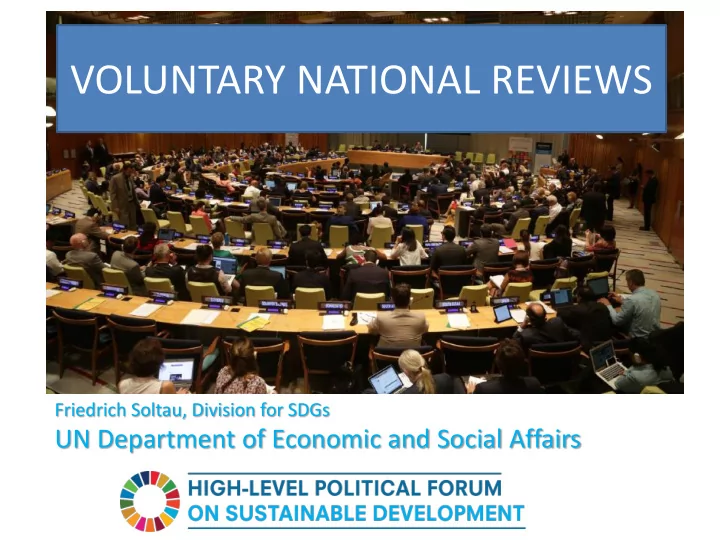
Friedrich Soltau, Division for SDGs
VOLUNTARY NATIONAL REVIEWS Friedrich Soltau, Division for SDGs UN - - PowerPoint PPT Presentation
VOLUNTARY NATIONAL REVIEWS Friedrich Soltau, Division for SDGs UN Department of Economic and Social Affairs 2018 High-Level Political Forum The 2018 session will take place 9-18 July at UN Headquarters in New York The theme is
2018 High-Level Political Forum
- The 2018 session will take place 9-18 July at UN
Headquarters in New York
- The theme is “Transformation towards sustainable
and resilient societies”
- 47 countries will present their voluntary national
reviews
- Set of goals for the in-depth review of progress:
- Draft programme:
https://sustainabledevelopment.un.org/hlpf/2018
HLPF Voluntary National Reviews
- VNRs are state-led:
country driven reviews of progress at national and sub- national levels,
- Learning experience:
facilitate the sharing of experiences, including successes, challenges and lessons learned, part of a process
- National circumstances:
reviews in accordance with national circumstances, policies and priorities, together with relevant partners
BENEFITS OF THE VNRS
- CATALYZER – the preparatory process provides a great chance for including
all relevant stakeholders in the SDG implementation
- STOCKTAKING – for many countries the VNR has been a kick-starter for
mapping existing policies and their compatibility with the SDGs, implementation gaps and data availability
- COORDINATION – VNR preparation requires a coordinated effort and for
many countries the institutional arrangements made have proved useful also for SDG implementation
- “WHOLE-OF-GOVERNMENT” APPROACH – VNR provides a chance for
- btaining buy-in in from civil servants and creating incentives for integrated
policy-making and service delivery
- AREAS FOR SUPPORT – tool for identifying and communicating the areas in
which the country requires additional support for implementation
- COMMUNICATION TOOL of the agenda to citizens, civil society, academia,
sub-national and local governments etc.
UN Secretary-General’s voluntary common reporting guidelines
- Help countries structure VNR reports HLPF
- Promote comparability and consistency
- Voluntary nature of process - each country
free to decide on scope of its review and format for presentation of findings
- Updated for 2018: analysis/explanation of
policies, addressing “leaving no one behind” (LNOB), cover all SDGs
LESSONS LEARNED
- Designate coordinator(s) and the “penholder(s)”
- Engage a broad range of stakeholders early on
- Focus on quality, not quantity
- Include analysis, explanations, lessons learned &
examples (minimize listing of strategies, etc.)
- Cover strengths and weaknesses
- Include a statistical annex, if suitable
- Identify areas where additional support is needed
- Spell out the next steps in implementation
VNR Handbook/Manuel/ليلد
https://sustainabledevelopment.un.org/vnrs/