Vocational Education & Training/Yrkeskunnande och lrande - - PowerPoint PPT Presentation
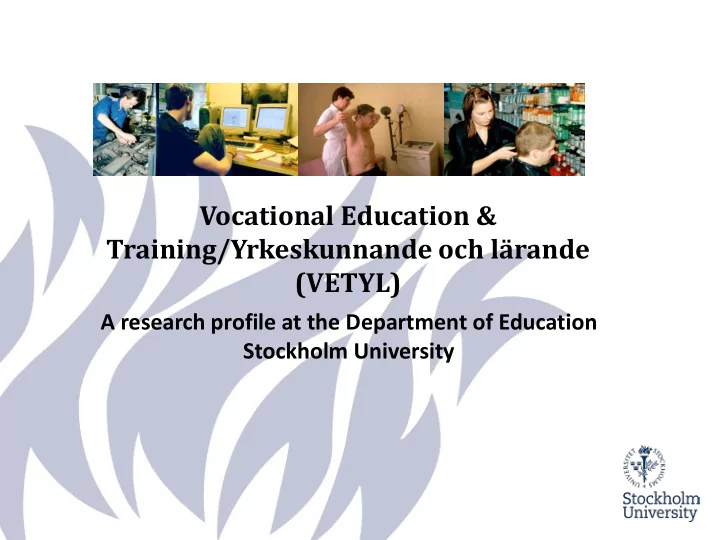
Vocational Education & Training/Yrkeskunnande och lrande (VETYL) A research profile at the Department of Education Stockholm University Field of Education & Research Authored by Professor Lzaro Moreno Herrera, Scientific Leader
Field of Education & Research
Authored by Professor Lázaro Moreno Herrera, Scientific Leader VETYL, Department of Education, Stockholm University
Research Group Vocational Education & Training/Yrkeskunnande och lärande (VETYL)
Our Commitment To contribute to the development of the research field Vocational Education & Training, the scientific grounds of the teacher training program for vocational subjects at Stockholm University and cooperating with institutions for vocational education and training of youth and adults.
Authored by Professor Lázaro Moreno Herrera, Scientific Leader VETYL, Department of Education, Stockholm University
Vocational Education & Training/Yrkeskunnande
- ch lärande (VETYL)
A research group with a strong international profile Examples of networks and areas
- VENET The European Network of Vocational Education & Training as
part of EERA.
- Strong partnership with researchers in different countries in Europe
- NordYrk The Nordic Network of Vocational Educational & Training
- South East Asia VET Network
- South African TVET Network
- Latin Aerica – Universities in Cuba and Chile
Authored by Professor Lázaro Moreno Herrera, Scientific Leader VETYL, Department of Education, Stockholm University
Vocational Education & Training/Yrkeskunnande
- ch lärande (English:Vocational Knowing) (VETYL)
Who are we?
Staff
- 1 Professor
- 4 Associate Professors
- 5 Senior Lecturers
- 1 Assistant Professor
- 4 Research Students (PhDs)
Two undergraduate programs Vocational teachers and Vocational teacher for caring sciences
Authored by Professor Lázaro Moreno Herrera, Scientific Leader VETYL, Department
- f Education, Stockholm University
Vocational Education & Training (VET) – Framing the field
A history in Swedish context dating back to the 19th century. Today an intricate and complex area with own identity where research problems and research questions often intercept an overlap at different levels.
Authored by Professor Lázaro Moreno Herrera, Scientific Leader VETYL, Department of Education, Stockholm University
Vocational Education & Training (VET) – Framing the field
- 12 three-year programmes in Swedish upper secondary
- school. At least 15 weeks out of the three study years are
work-placed learning.
- Key figures:
- 8 913 vocational subject teachers employed full-time or
part-time. 37.5% women and 62.5% men.
- About 107,000 pupils in the vocational programmes
- 27.1% of pupils study in privately owned (public
financed) schools.
(Swedish National Agency of Education 2014c)
Authored by Professor Lázaro Moreno Herrera, Scientific Leader VETYL, Department of Education, Stockholm University
Vocational program m es/ Apprenticeship education
- Child and Recreation
- Building and Construction
- Electricity and Energy
- Vehicle and Transport
- Business and Administration
- Handicraft
- Hotel and Tourism
- Industrial technology
- Natural Resource Use
- Restaurant Management and
Food
- HVAC and Property Management
- Health and Social Care
Higher education preparatory program m es
- Business Management and
Economics
- Arts
- Humanities
- Natural Science
- Social Science
- Technology
I ntroductory program m es
- Preparatory education
- Programme oriented
individual options
- Vocational introduction
- Individual alternative
- Language introduction
Education in upper secondary school
Slide authored by Swedish National Agency for Education
The variety of research questions and development tasks at the levels of vocational education and training systems (macro level), the organization and design of vocational training programs and institutions (meso level) and the analysis and shaping of education and learning processes (micro level) leads to the integration of different scientific disciplines and research traditions. VET research therefore can be organized only in an interdisciplinary way. Rauner &
Maclean, 2008, p. 13
Authored by Professor Lázaro Moreno Herrera, Scientific Leader VETYL, Department of Education, Stockholm University
Challenges of Research in VET
Authored by Professor Lázaro Moreno Herrera, Scientific Leader VETYL, Department of Education, Stockholm University
Contextual aspects influencing our research
Moreno Herrera, 2000, p. 38
Restructuring of working life in ‘postmodern’ society – The qualifications required
(Moreno Herrera, 2000, p. 41, after Schienstock & Koski, 1997).
- Knowledge: Theoretical knowledge. Technical knowledge.
Practical, tacit knowledge.
- Skills: Professional skills (multi-skilling). International skills.
Social skills. Management skill.
- Normative: Leadership. Entrepreneurship. Industrial
- citizenship. Work as a problem solving process.
Challenges for research in VET
Authored by Professor Lázaro Moreno Herrera, Scientific Leader VETYL, Department
- f Education, Stockholm University
Challenges for research in VET
- Learning
Value learning outcomes acquired in non- formal settings. Learning theories and its didactic implication
- Organization related aspect
From organization to Learning organization
- Didactics & dialectics
The general & the particular Wholeness & its parts
- …
Authored by Professor Lázaro Moreno Herrera, Scientific Leader VETYL, Department of Education, Stockholm University
Labour market and work life demands
Research concerns within the VETYL group
Community of the diversity
Vocations and specific vocations teacher training related issues Policy issues & curriculum design Socio-cultural & socio- economic aspects Intersectionality Learning & didactical questions in school and workplace
Authored by Professor Lázaro Moreno Herrera, Scientific Leader VETYL, Department
- f Education, Stockholm University
The questions that are at the core of VETYL activity inspires and demands interdisciplinary research, multi-methodological approach and diverse theoretical basis. Didactic and pedagogic questions related to knowledge creation, curriculum design and design of learning processes in relation vocational knowing in schools and work life. Assessment of vocational knowing and competences in relation, for example, social questions and power and possibilities to influence.
(Source: Research profile VET/YL www.su.se)
Relevance of cooperation across profiles and disciplines
Authored by Professor Lázaro Moreno Herrera, Scientific Leader VETYL, Department
- f Education, Stockholm University
Examples of research projects within VETYL group
(by October 2016)
- Vocational bildung didactics - The didactics of vocational bildung
how stories matter in VET research (PhD due March 2017)
- Literacy and cross-subject cooperation in VET context (PhD due late
spring 2017)
- Vocational knowing in training nurses and health care staff (On-going
PhD)
- Formation of vocational knowing in florist´s education (PhD
defended Sept 2016)
- Simulation in health care education (On-going)
- Technology education in compulsory education and motivation for
VET (submitted project proposal)
- Migration - recognition of prior knowledge and transition to work
life (in planning stage)
- VET and cultural historical theory (special issue)
Authored by Professor Lázaro Moreno Herrera, Scientific Leader VETYL, Department
- f Education, Stockholm University
VETYL and the research road ahead- Our motto!
Authored by Professor Lázaro Moreno Herrera, Scientific Leader VETYL, Department
- f Education, Stockholm University