Vocational/Career Program IP IPP P Program m Prepares students - - PDF document

vocational career program
SMART_READER_LITE
LIVE PREVIEW

Vocational/Career Program IP IPP P Program m Prepares students - - PDF document

10/28/13 Shelley Lawrence Professor/Coordinator Deaf Studies Division Vocational/Career Program IP IPP P Program m Prepares students for entry level interpreting work Pre-requisites required prior to entry All


slide-1
SLIDE 1

10/28/13 ¡ 1 ¡

Shelley Lawrence Professor/Coordinator Deaf Studies Division

IP IPP P Program m

ž Vocational/Career

Program

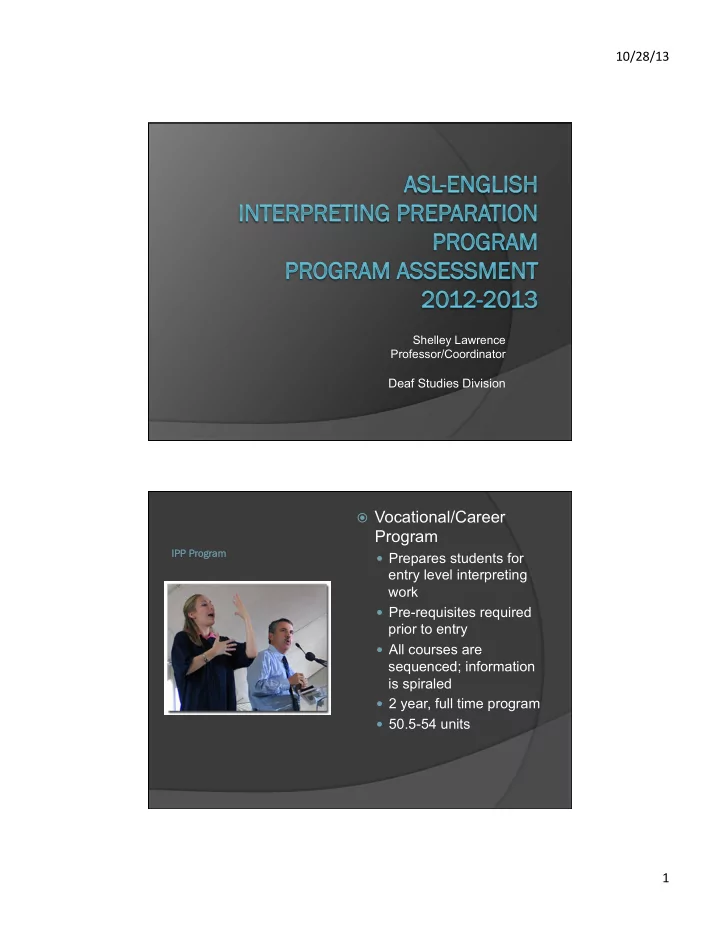
— Prepares students for

entry level interpreting work

— Pre-requisites required

prior to entry

— All courses are

sequenced; information is spiraled

— 2 year, full time program — 50.5-54 units

slide-2
SLIDE 2

10/28/13 ¡ 2 ¡

IPP Program Objectives

ž Display the ability to create and maintain

professional relationships and appropriate cultural sensitivities with various stakeholders including members of the deaf community, professional interpreters and interpreter agencies through effective interpersonal and cross-cultural communication skills.

ž Demonstrate critical thinking skills by assessing

potential demands of various interpreting situations and construct appropriate responses to mitigate those demands, and by applying and defending appropriate decision-making skills when ethical dilemmas arise.

IPP Program Objectives

ž Perform entry-level Sign Language

Interpreting skills in post secondary educational and/or community settings.

slide-3
SLIDE 3

10/28/13 ¡ 3 ¡

Course Assessed: INT 295 -Internship

ž Since all classes linked to previous classes, 4th

semester classes targeted for assessment

— Internship Course (on-line)

○ 2 placements, 4 weeks each (full time) ○ 180 hours ○ Plus two discussion forums, reading and assignment

analysis — Students prepare for work

○ Shadow working interpreters ○ Assume role as team ○ Debrief

— Mentors in position to determine if student is work-

ready

Assessment Tool

ž Monkey Survey ž 12 mentors sent survey (Fall 2012) — 2 returned – undeliverable — 6 responses (50%) ž 10 questions — Likert scale [ Highly agree to Highly

Disagree] & 4 Open-ended questions

— All questions allowed for comments

slide-4
SLIDE 4

10/28/13 ¡ 4 ¡

Survey Questions

  • 1. The set-up of the program was clearly

explained in person, email or via program documents. 4.67/6.0

  • 2. The meetings and communication prior

to the start of the program were

  • effective. 4.5/6.0
  • 3. The availability of the coordinator prior

to the start of the program were

  • effective. 4.83/6.0

Questions (continued)

ž 4. The module block [4 weeks] is

  • effective. 2.83/6.0

ž 5. The Mentor Evaluation form and the

Intern Feedback form were effective and easy to use. 4.17/6.0

ž 6. The meeting with the intern and the

coordinator was helpful. 4.5/6.0

slide-5
SLIDE 5

10/28/13 ¡ 5 ¡

Questions-Open-ended (continued)

ž 7. Did the students come to you prepared? What

do you feel they were missing, if anything?

ž 8. Do you feel the students demonstrated

professionalism, had effective communication and decision-making skills?

ž 9. How do you feel your participation in this

internship contributed to the student’s ability to work as entry-level Interpreter?

ž 10. How could this course be improved by

additions, deletions or revisions?

Analysis & Follow up

ž Effective in preparing students for entry-level work ž Students have the information they need;

communication is effective

ž Forms are clear ž Mentors feel their role & participation is helpful in

transitioning students to entry-level interpreters

ž Most feel the students are prepared to act as

professionals

ž Several felt students were well prepared for their

next step. Others felt that more time was needed.
slide-6
SLIDE 6

10/28/13 ¡ 6 ¡

Feedback that requires action

ž 4-week block-adjustments made this

spring

— Two face-to-face meetings with students

○ How to maximize their time

— Brought in a mentor from Ohlone (a former

grad) to speak about attitude and navigation

  • f internship

— Recommended students contact placement

sites prior to the beginning of module

Work Samples

ž Starting internships with evidence of

work product, decision-making…

— Portfolio development from previous classes — Possibility of restricted website to showcase

students

slide-7
SLIDE 7

10/28/13 ¡ 7 ¡

Transition from Student to Interpreter

ž Work needs to be done — Reducing student hesitancy — Gaining confidence (or projecting it) — Role of intern vs. equal part of team — Focus on self care

slide-8
SLIDE 8

10/28/13 ¡ 8 ¡

IPP Graduate Survey Fall 2012

ž 67 responses (out of 103 sent) — Graduated between 1982-2012 — 97% received an end degree

○ 43% AA ○ 48% Certificate of Completion ○ 1% received both ○ 3% no response

— 88% are working as interpreters

Certification

ž RID Written Exam — 94% passed

○ 6% never took it

ž Certification: — 81% hold national certification

slide-9
SLIDE 9

10/28/13 ¡ 9 ¡

Graduates felt ready for entry- level work

ž Yes - 93% — Emphatically (1.3) — Solidly (58%) — With reservations (23%) ž No - .6 %

Programs Strengths

ž Quality of the faculty ž Community

connections made through the program

ž Strong foundation of

cultural awareness

ž Structured, multi-

pronged curriculum

ž Rigor of developing

interpreting and self- analysis skills

ž Practicum

experiences

ž High standards ž Cohort model ž Small class size

slide-10
SLIDE 10

10/28/13 ¡ 10 ¡

Next Steps

ž Re-survey Mentors at the end of S’13 ž Evaluate effectiveness of 4-week block — Student focus group — Faculty ž Next course to evaluate: — INT 299 Capstone course

Question 4- 4 week block

— Those who commented noted:

○ Gives students a quick view of life in the field-

longer might give more depth

○ 4-weeks give concentration; 8-weeks would

have the benefit of depth

○ Understanding constraints of program and

students, limited time to provide proper feedback on experience

slide-11
SLIDE 11

10/28/13 ¡ 11 ¡

Question 7: Students prepared? What was missing?

ž Students eager and open to be

challenged

— Yes. All ready for professional world — Good basic preparation-need more speed

and stamina (comes with time and experience)

— Would have liked to see work sample prior to

placement-students do not come with that

— Need a transition mind-set from student to

working interpreter

Question 8: Students professional, effective communication and decision-making skills?

ž 4 responses- yes! — It is a pleasure to work with them and

engage with their questions

— Some IPP students have some with

  • utstanding potential while others were less

than adequate

— Professional-yes. Effective communication-

  • no. Too much hesitancy. Decision-making

skills, hard line to walk-want them to be better prepared to walk the line and deal with consequences if they mis-step.

slide-12
SLIDE 12

10/28/13 ¡ 12 ¡

Question 9: Internship’s role in preparation of entry-level interpreters

ž . — Good beginning. 4 weeks not enough but

several 4-week sessions help a lot to begin at entry-level

— Being able to meet working interpreters,

making connections, seeing different responses to various situations starts them

  • n their path

— We provide real-life situations and get their

hands up to start doing what they have been well trained for

Continued

— This could be an effective placement

because it is essentially, an extended job

  • interview. Students could get much more
  • ut of it if they had the right mindset.

— I talk with the students about a variety of

nuts and bolts issues which they will face. Their in-class mentors have all done

  • utstanding jobs of going into great detail

regarding so many aspects of working as a new interpreter.

slide-13
SLIDE 13

10/28/13 ¡ 13 ¡

Question 10: How could the course be improved?

ž Nothing comes to mind right now. ž Make it a bit longer. Seems to take some time at the

beginning to set up a system & arrange for scheduling; Just as a rhythm is established, it ends pretty quickly.

ž I continue to be puzzled regarding how few students

are able to process verbal instructions, who do not make notes when given instructions as a new intern and who do not see themselves as becoming a member of an educational team when working in

  • schools. In this regard, their focus 84 that they need

to be better informed regarding self care. All in all, my experience has been that most of the Ohlone IPP graduates become excellent interpreters.

10 (continued)

ž Only to have more time with the intern over

an extended period rather than just 4 weeks

ž Maybe more time could be spent on how to

have an effective internship beforehand? Then a student would not have to figure that part out while they were in the midst of the internship itself...?

slide-14
SLIDE 14

10/28/13 ¡ 14 ¡

F ‘13 Changes made for S ‘14

ž Changed schedule for mentorship — Blocked two 4-week modules back to back

○ Allows students to extend time at one site.

ž Mandated pre-mentorship meeting with

site.

○ Allows students to start mentorship on time to

receive a full benefits of each site.