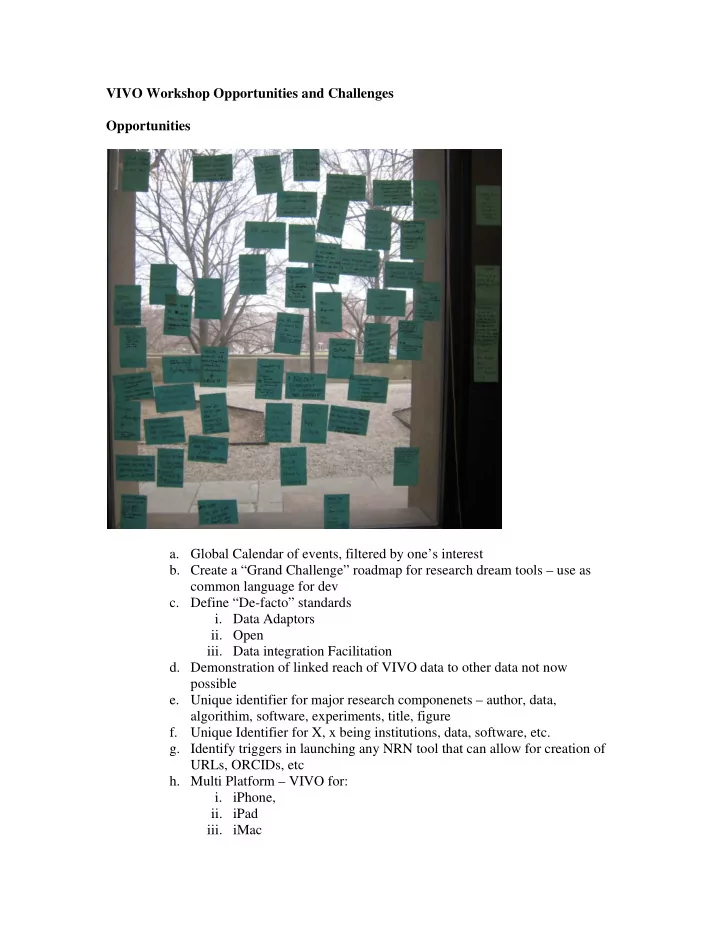
VIVO Workshop Opportunities and Challenges Opportunities a. Global - - PDF document

vivo workshop opportunities and challenges opportunities
SMART_READER_LITE
LIVE PREVIEW

VIVO Workshop Opportunities and Challenges Opportunities a. Global - - PDF document

VIVO Workshop Opportunities and Challenges Opportunities a. Global Calendar of events, filtered by ones interest b. Create a Grand Challenge roadmap for research dream tools use as common language for dev c. Define De-facto


slide-1
SLIDE 1

VIVO Workshop Opportunities and Challenges Opportunities

  • a. Global Calendar of events, filtered by one’s interest
  • b. Create a “Grand Challenge” roadmap for research dream tools – use as

common language for dev

  • c. Define “De-facto” standards
  • i. Data Adaptors
  • ii. Open
  • iii. Data integration Facilitation
  • d. Demonstration of linked reach of VIVO data to other data not now

possible

  • e. Unique identifier for major research componenets – author, data,

algorithim, software, experiments, title, figure

  • f. Unique Identifier for X, x being institutions, data, software, etc.
  • g. Identify triggers in launching any NRN tool that can allow for creation of

URLs, ORCIDs, etc

  • h. Multi Platform – VIVO for:
  • i. iPhone,
  • ii. iPad
  • iii. iMac
slide-2
SLIDE 2
  • iv. other phones
  • i. Ability to have closed/private/local instance and select publishing of data

to “public framework”

  • j. Establish precedent for global NRN URI namespace
  • k. Vocabularies like MESH for other fields
  • l. Intentional Ontology Registry
  • m. VIVO as source of trustworthy identity information – ORCID
  • n. Need for quality open data is increasingly recognized across

constituencies

  • . Integrate local and federal data, Reporter, research.gov, etc
  • p. Cross community matchmaking
  • q. Open Data to link across domains (engineering, medical, CS, etc)
  • r. Link funding sources into VIVO
  • s. A way to join VIVO if my school doesn’t have one
  • t. Bounty network for scientific problems (mini-grants and micro-grants)
  • u. Enhance research collaborative
  • v. Link VIVO data to semantic publishing
  • w. VIVO Collab VIVO & Exhibit & Institutional Repos & Publishing
  • pportunities & Auto vita
  • x. Skills search engine
  • y. Multi-disciplinary development of VIVO
  • z. “Expert” Locator
  • aa. To recommend people to one that they wouldn’t look for necessarily
  • i. “things & people I didn’t think about”
  • bb. Recommender system
  • i. Other researchers working in same field & same or different

expertise

  • cc. Automatic generation of 2-3 person “potential” teams for calls for

proposals

  • dd. View the context of a research topic or a team:
  • i. “near” topics/papers
  • ii. Places
  • iii. Current/old collaborations
  • iv. Timeline of activities
  • ee. Multi-perspective VIVO profiles
  • ff. Disciplinary “map” key:
  • i. People
  • ii. Journal
  • iii. Funding sources
  • iv. Conferences
  • v. (stuff for someone new to area)
  • gg. A builder component to complement/fee exhibit
  • hh. Combine LOD with private research data for projects
  • ii. Virtual field trips through science
  • jj. VIVO app Store
slide-3
SLIDE 3
  • kk. Encourage more requests for features from “real life” tools (ie. Netflix) to

generate new ideas from researchers

  • ll. Different level of comparison
  • i. Person
  • ii. Group (team)
  • iii. Institution/Department
  • iv. University
  • v. Country
  • mm. Publication outlet recommendations
  • nn. Cross-pollination
  • i. Trade where do:
  • 1. Trainees
  • 2. Jr. Faculty
  • 3. Sr. Faculty
  • 4. Career trajectories
  • o. Tracking scholarly outputs
  • i. Publications
  • ii. Reviewing
  • iii. Courses taught
  • iv. For incentivizing
  • v. For measuring impact
  • pp. Automated CVS (per agency)
  • qq. Status/Prestige within multiple academic fields of:
  • i. People
  • ii. Institutes
  • iii. Geographic areas
  • rr. Credit report-like dossier for tenure funding decisions
  • ss. Custom/personal research “newsletter” (weekly/monthly reports of

“important” events)

  • tt. LinkedIn style trusted recommendations
  • uu. Link research outcomes & “newer” indicators
  • vv. Personalize conference Recommendation system
  • i. Whom should I meet
  • ii. Which session should I attend
  • iii. Which paper should I read
  • ww. Define roles and request contacts to fill them for collab. Team

formation tool:

  • i. I need ____, _____, ______ (list positions, VIVO gives name

suggestions)

  • xx. Determine which combination of researchers increase productivity,

quality, productivity of research

  • yy. Creation of distributed VIVO-based peer-review networks for article

publication reviews and evaluations/discussions 2.

  • a. Analytics that help policy makers/funding orgs
  • b. Temporal – monitoring of topic trends of my publishing community
slide-4
SLIDE 4
  • c. Geo-Locate – I want to “check-in” to VIVO when I’m at a conference so I

can have a log of where I’ve been and so I can connect with others at the same conference

  • d. Topical – published meta-analysis paper based only on VIVO repository

data

  • 3. Misc.
  • a. I want VIVO to send me alerts via text, email, sms about any RDF that I

watch

  • b. Educate Tech community re. semantic web
  • i. Train students in semantic web
  • c. Standards for higher education data warehouses
  • d. Create partnerships with commercial tools for cases & intros, eg TopBraid
  • e. More data in VIVO from more sites around the world

Challenges

slide-5
SLIDE 5
  • a. Managing Person data quality decay
  • b. Invitational Constraints
  • i. Funding and/or human resources
  • ii. Semantic web expertise
  • c. Data Sources for Humanities (book chapters, etc.)
  • d. Semantic Web learning curve
  • i. For university developers
  • e. Openly usable datasets
  • f. Data – completeness, quality, timeliness
  • g. Identifying persistent, high quality semantic web data providers
  • h. Recruiting Data, keeping it up-to-date
  • i. Sustained Authoritative Content
  • j. Trust in VIVO data and relationships
  • k. Provenance management
  • l. Dealing with dead VIVO researchers (Historical VIVO data)
  • m. Establishing registries – who should step up?
  • n. Multiple personas
  • . Multi-level cartography for the management of science:
  • i. Individuals-teams-topics-organizations
  • ii. During time and space
  • p. Institutional policies on sharing data via LOD (& differences in

state/applicable laws)

  • q. How to get NIH to adopt/use VIVO or other NRN
  • i. This would ensure 50% adoption rate
  • r. “MIT Physicist Problem” – Research networking systems make high

profile researchers appear more visible/accessible than they can be

  • s. I just graduated and people won’t work with me because I don’t have

anything to put in my profile yet

  • t. Researcher Response “I want to control how I am presented to the world”
  • u. Researcher Response “don’t create a profile for me unless you can

guarantee it is complete and accurate”

  • v. Access control for information
  • w. Providing flexible, strong access control in an open data environment
  • x. Public vs. Private (IP)
  • y. Access control for RDF triples
  • z. Add annual faculty research data to VIVO/NRN data
  • aa. What are the 3 words/sentences to summarize what VIVO can do and
  • ther existing tools cannot
  • bb. Searching across all VIVO repositories
  • cc. Reconciling administrative vs. researcher goals/needs
  • dd. Semantic tools not as scalable as RDBMs tools yet
  • ee. Proxy access for support staff/administrators vs control
  • ff. I care about 10-100 people not about 10,000
  • i. Need VIVO for just my lab/team
  • gg. Coordinating VIVO community for development, standards
  • hh. Ontology
slide-6
SLIDE 6
  • i. Create
  • ii. Maintain
  • iii. Version
  • iv. Population
  • v. How to include data about ideas, projects
  • ii. Deal with conflicts
  • i. Property
  • ii. Ontologies
  • iii. Access
  • jj. Adoption implement critical mass/number research network tools that

provide semantic web linked data (RDF & ontology)

  • kk. Potential adopters getting time/resources to hurdle the semantic web

learning gap