
SLIDE 1
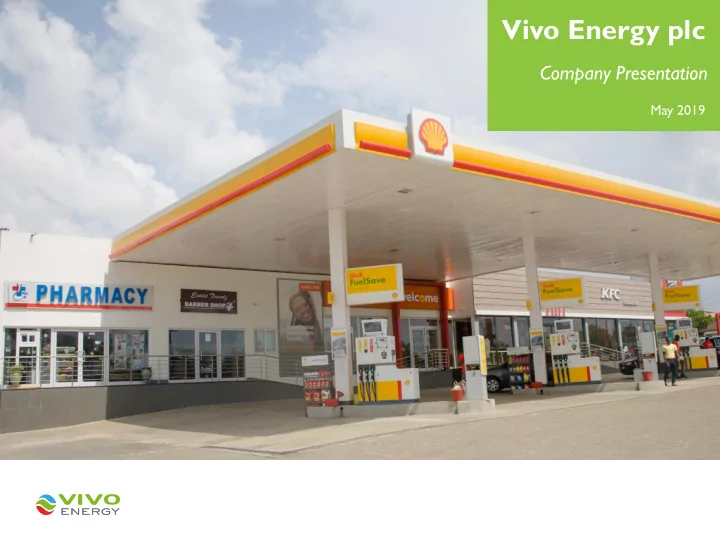
Vivo Energy plc
Company Presentation
May 2019
Vivo Energy plc Company Presentation May 2019 Legal disclaimer - - PowerPoint PPT Presentation
Vivo Energy plc Company Presentation May 2019 Legal disclaimer IMPORTANT: Please read the following before continuing. No offer or solicitation This presentation is provided for informational purposes only and is not intended to and shall not
Company Presentation
May 2019
Legal disclaimer
IMPORTANT: Please read the following before continuing. No offer or solicitation This presentation is provided for informational purposes only and is not intended to and shall not constitute an offer to sell or the solicitation of an offer to sell or the solicitation of an offer to buy any securities of Vivo Energy plc (the “Company”) or a solicitation of any vote of approval, nor shall there be any sale of securities in any jurisdiction in which such offer, solicitation or sale would be unlawful prior to registration or qualification under the securities laws of any such jurisdiction. Neither the contents of the Company’s website, nor the contents of any other website accessible from hyperlinks on such websites, is incorporated herein or forms part of this presentation. Forward-looking statements This presentation includes forward-looking statements. These forward-looking statements involve known and unknown risks and uncertainties, many of which are beyond the Company’s control and all of which are based on the Directors’ current beliefs and expectations about future events. Forward-looking statements are sometimes identified by the use of forward-looking terminology such as: “believe”, “expects”, “may”, “will”, “could”, “should”, “shall”, “risk”, “intends”, “estimates”, “aims”, “plans”, “predicts”, “continues”, “assumes”, “positioned”, “anticipates” or “targets” or the negative thereof, other variations thereon or comparable terminology. These forward-looking statements include all matters that are not historical facts. They appear in a number of places throughout this report and include statements regarding the intentions, beliefs or current expectations of the Directors or the Group concerning, among other things, the future results of
No assurance can be given that such future results will be achieved; actual events or results may differ materially as a result of risks and uncertainties facing the Group. Such risks and uncertainties could cause actual results to vary materially from the future results indicated, expressed, or implied in such forward-looking statements. Such forward-looking statements contained in this report speak only as of the date of this report. The Company and the Directors expressly disclaim any obligation or undertaking to update these forward-looking statements contained in the document to reflect any change in their expectations or any change in events, conditions, or circumstances on which such statements are based, unless required to do so by applicable law.
1
2
1,269 1,900 230 2012 Current
1
Introduction
3
Established in December 2011, we are a leading
Pan-African fuel retailer, operating under the Shell and Engen brands, in high growth markets
We source, distribute, market and supply high
quality fuels and lubricants to retail and commercial customers in 23 countries
Operate under the Shell-brand in 15 countries and
from March 2019, began to operate under Engen- brand in 8 new markets
Strong growth track record – retail portfolio
grown by over 65% since 2012
One of Africa’s largest retailers with over 800,000
customers served daily in 2018
Experienced management team, with a proven
track record of delivery
Strong performance-driven culture
Number of Retail Sites
68%
1,269 2,130
(1) As at December 2018, pro-forma for Engen sites. Engen number of retails sites based on Engen management information reporting
Engen brand
A leading pan-African business
Source UN Population Prospects 2018 Note: Information as of December 2018 (1) Engen number of retails sites based on Engen management information reporting (2) Pro-forma to include Engen management information reported volumes in 2018 (3) Represents fuel storage capacity and includes equity share of storage capacity in joint ventures. It excludes bitumen and LPG. Includes Engen storage based on management information
23 countries Access to over 450 million consumers 2,1301 retail sites +1 billion litres of storage3 +10 billion litres of fuel volumes in 20182
Vivo Energy today
SENEGAL GUINEA CÔTE D’IVOIRE GHANA MALI MOROCCO CAPE VERDE BURKINA FASO TUNISIA UGANDA NAMIBIA BOTSWANA MADAGASCAR GABON ZAMBIA KENYA MAURITIUS REUNION MALAWI MOZAMBIQUE ZIMBABWE Shell brand RWANDA TANZANIA
4
We operate an integrated business across three core segments
Retail
2018 Adj. EBITDA split
Second largest retailer in Africa
site numbers Retail fuels
Sale of petrol and diesel fuels at
2,1301 Shell and Engen-branded service stations in 23 countries across Africa Non-fuel retail
Multi-branded Convenience
Retail and Quick Service Restaurant offering Commercial Integrated offering to 5,000+ customers across long term contracts, tenders and spot sales Core Commercial
Supplying mining, construction,
transport, power and industrial
primarily to consumers Aviation and Marine
Supplying aviation fuel, plus
bunkering for marine traders and other shipping companies Lubricants Integrated manufacturing, distribution and marketing
Retail Lubricants
Providing products to
consumers at retail sites, as well as through a network of distributors Commercial Lubricants
Supplying specialist lubricants to
mining companies, B2B customers and export sales
Source: Company information.
57% 13% 30%
5
(1) As at December 2018, pro-forma for Engen sites. Engen number of retails sites based on Engen management information reporting
Our integrated model provides a sustained competitive advantage
(1) Represents fuel storage capacity only and includes equity share of storage capacity in joint ventures, excluding bitumen and LPG. JV storage is included on a pro rata basis based on
(2) As at December 2018, pro-forma for Engen sites. Engen number of retails sites based on Engen management information reporting (3) Fuel and lubricants sales in 2018 pro-forma for Engen markets (4) Via 50% SVL joint venture. Vivo Energy either owns or has operational control of 5 of the 6 plants
Terminals / storage: +1 billion litres of capacity across 20 countries(1) Fuel supply (domestic refineries & tenders, Vivo Energy
Retail sites: 2,130 sites(2) +150,000 km driven daily to deliver our products Commercial customers: c.4.4bn litres(3) Retail customers: c.5.8.bn litres(3) Access to 6 lubricants blending plants(4)
Vivo Energy ownership / operational control
6
Our key strategic objectives
Preserve lean and agile organisation and performance-driven culture
Maximise the value of our existing business
Pursue value-accretive growth
Maintain attractive returns through disciplined financial management
7
Remain a responsible and respected business in our communities
RAPID URBANISATION GROWING MIDDLE CLASS STRONG POPULATION GROWTH YOUNG POPULATION
Favourable African macro trends underpin our growth
RAPID VEHICLE GROWTH STRONG INFRASTRUCTURE DEVELOPMENT STRONG GDP GROWTH IN VIVO ENERGY COUNTRIES INCREASING CONSUMER SPENDING
8
Urban population to grow from 40% to
56% from 2015 – 2050
Median age of 19 vs. 30 and 38 in Asia
and USA, respectively(2)
376 million to 582 million people from
2013 – 2030
1.2 billion more people by 2050(1) 57% of global population growth $150bn of annual infrastructure
spending required by 2025
5.1% CAGR 2018 – 2023 4% household consumption CAGR
2015 – 2025
7% CAGR 2016 – 2021(3) 66 vehicles per 1,000 people
Source: BMI, UN World Population Prospects 2017, UN World Urbanization Prospects 2014, McKinsey Global Institute: “Lions on the move II: realizing the potential of Africa’s economies”, Deloitte: “The Deloitte Consumer Review Africa: A 21st century view” (1) As compared to 2015 population (2) As of December 2015 (3) Includes motorbikes
8
20 40 60 80 100 120 140 60 80 100 120 140 160 180 200 2000 2001 2002 2003 2004 2005 2006 2007 2008 2009 2010 2011 2012 2013 2014 2015 2016 2017 2018
Demand in Vivo Energy countries (left hand side axis) Demand in Europe and US (left hand side axis)
In markets with resilient and growing fuel demand
Source: BMI, CITAC, FactSet (1) Demand indexed to 100
(Indexed demand(1))
FUEL DEMAND HAS KEPT GROWING DESPITE A FLUCTUATING OIL PRICE
($/bbl)
AFRICAN FUEL DEMAND CHARACTERISTICS + 83%
Brent (right hand side axis)
Few public transport alternatives
Roads are the primary transport route
Staple product
Car parc growth, lower vehicle efficiency and expanding road network
9
Regulated Engen market
Vivo Energy’s Existing Markets
SENEGAL 112 service stations Total volume: 517 Market share: 26% GUINEA 86 service stations Total volume: 320 Market share: 24% BURKINA FASO 71 service stations Total volume: 297 Market share: 18% GHANA 226 service stations Total volume: 617 Market share: 13% MALI 39 service stations Total volume: 303 Market share: 23% MOROCCO 340 service stations Total volume: 2,153 Market share: 24% CAPE VERDE 26 service stations Total volume: 257 Market share: 48% CÔTE D’IVOIRE 215 service stations Total volume: 666 Market share: 30% TUNISIA 169 service stations Total volume: 1,140 Market share: 26% UGANDA 150 service stations Total volume: 465 Market share: 24% NAMIBIA 59 service stations Total volume: 366 Market share: 30% BOTSWANA 87 service stations Total volume: 385 Market share: 32% KENYA 203 service stations Total volume: 1,136 Market share: 19% Regulated Shell Market
10
TOTAL VOLUMES: 9.4bn litres
MARKET SIZE: 41.1bn litres MARKET SHARE: 23%
De-regulated Shell Market MAURITIUS 47 service stations Total volume: 511 Market share: 31% MADAGASCAR 70 service stations Total volume: 196 Market share: 21%
Note: Total volumes measured in litres. Market shares based on Company Information and Citac as of December 2018
Regulated Engen market
Note: Total volumes measured in litres. Market shares based on Company Information and Citac as of December 2018 (1) Based on Engen management information reporting
Our new markets
ZIMBABWE 63 service stations Total volume: 151 Market share: 12% GABON 22 service stations Total volume: 128 Market share: 17% ZAMBIA 33 service stations Total volume: 103 Market share: 6% Existing Shell market
11
TOTAL VOLUMES: 1.0bn litres MARKET SIZE: 9.1bn litres
MARKET SHARE: 11%
Commercial 49% Lubricants 2% Retail 49%
VOLUME MIX NOT CURRENTLY OPTIMISED1
(% of 2018 EVO volumes)
RWANDA 20 service stations Total volume: 51 Market share: 20% KENYA 15 service stations Total volume: 81 Market share: n/a MOZAMBIQUE 18 service stations Total volume: 217 Market share: 13% TANZANIA 7 service stations Total volume: 57 Market share: 2% REUNION 36 service stations Total volume: 206 Market share: 21% MALAWI 16 service stations Total volume: 37 Market share: 8% Sites being re-branded to Shell
12
Consistent Delivery of Adjusted EBITDA growth
ADJUSTED EBITDA
($ in millions)
142 188 227 227 76 82 107 122 22 32 42 51 240 302 376 400
2015 2016 2017 2018
Retail Commercial Lubricants
+21% +14% +0%
13
Working capital is structurally negative and self-liquidating
− Retail payments are on average 6 days after delivery − Creditors operate on longer terms
Focus is to continually improve working capital position In 2018, working capital amounted to a $36 million benefit
to cash flow
Disciplined capital allocation and structurally negative working capital drive strong returns
14 Days Payable Outstanding Days Inventory Outstanding Days Sales Outstanding 2017 53 22 17 2018 56 24 16 DISCLIPINED CAPITAL ALLOCATION STRUCTURALLY NEGATIVE WORKING CAPITAL ROACE CONSISTENTLY ABOVE 20%(1) 20% 25% 23% FY 2016 FY 2017 FY 2018 Rigorous return requirements for any investment
controlled by a central team
USD IRR hurdle rate of 20% for retail projects and 25%
for commercial projects
Group and individual countries incentivised for return on
capital
Annual post-investment reviews
(1) 2017 and 2018 include the impact of the SVL acquisition
Strong adjusted free cash flow generation
Net income 130 146 Adjustment for non-cash items / other 157 167 Change in working capital 75 36 Income tax paid (114) (103) Cash flow from operating activities 248 246 Net additions to PP&E and intangible assets (119) (144) Free cash flow 129 102 Special items related to non-GAAP measures (cash impact) 9 47 Adjusted free cash flow 138 149
($ in millions)
2017 2018 Structural negative working capital
position due to the nature of the business, with stable DSO and DPO during the year
KEY HIGHLIGHTS Increase in net additions primarily
due to roll-out of new ERP system and continued retail investments
Significant IPO & Engen related
expenses together with costs related to streamlining the central
15
2019 Outlook and performance to date
Total volume growth of 7% to 2,441 million litres
Volume growth of 13% in March following completion of Engen transaction
Group Gross Cash Unit Margin of $69 per thousand litres
16 METRIC
2019 GUIDANCE Total Volumes (%)
Low to mid double-digit volume growth
Group Gross Cash Unit Margin ($)
High sixties per thousand litres
New Retail Sites
80-100 new service stations Around $150 million (including Engen capex)
Capital Expenditure ($) Q1 PERFORMANCE
Continued innovation to enhance our business
Premium fuel roll-out Loyalty ERP - Optima Non-fuel partnerships
Expanding our customer value proposition Embracing data analytics
Site Automation
17
Energy Efficiency
Resilient operations with diversification across the African continent
Summary
Dynamic business led by an experienced management team Delivering strong growth and +20% return on capital employed
18
VP 241
Operate in high growth markets backed by strong macro fundamentals
Company Owned, Company Operated Company Owned, Dealer Operated Dealer Owned, Dealer Operated
The right operating model for each opportunity
SITE OPERATING MODELS
Preferred model for sites in medium- potential locations
Medium term viability
Lower Vivo Energy involvement
Local non-fuel offer
Low level of operational complexity
Preferred model for sites in high- potential locations
High Vivo Energy involvement
Strategic locations with long-term viability
Strong non-fuel offer
Freehold or leasehold land
Medium level of operational complexity
Enables large / highway sites to be run 100% by Vivo Energy
Showcase Vivo Energy flagship sites
Vivo Energy quality of service and
Focus on convenience retail, QSR and
Higher margin capture
High level of operational complexity
Sometimes mandatory initial platform 20
Vivo Energy Dealer
Clear division of responsibilities with consistent standards and control framework for our fuel business
Source: Company information.
Margin capture COCO CODO DODO Responsibilities
Marketing margin
Vivo Energy Vivo Energy By negotiation
Retailer margin
Dealer Dealer
QSR & CR offer
Vivo Energy Vivo Energy Dealer with Vivo Energy input
Operating costs
Dealer Dealer
Maintenance – buildings
Vivo Energy
Maintenance – equipment
Vivo Energy (except for DO without capex)
Capex
Vivo Energy: Pumps & branding Dealer: Other capex
Wet stock
Dealer Dealer
Operational excellence and standards
Vivo Energy manages and controls HSSE, marketing and branding, site and service standards
21
Landed cost of product Primary transport Storage Secondary transport Oil marketer margin Duties Wholesale price Retailer margin Regulated pump price
Regulated price build-up provides an allowed margin with some upside from more efficient supply chain
ILLUSTRATIVE RETAIL PUMP PRICE BUILD-UP
Source: Company information. (1) Vivo Energy also captures the retailer margin under the COCO model
Scope for lower supply chain costs vs. regulatory allowance
Regulators sets pump prices using assumed supply
chain costs
The regulated price contains an allowed margin for oil
marketers
Oil marketer margin generally 5 – 10% of pump price Oil marketing companies can make margins above the
regulated marketing margin by achieving lower supply chain costs than those in the pump price formula
Savings are driven by reach, scale and efficiency which
can be achieved by large, vertically-integrated players − Vivo Energy has a structural advantage vs. small independents
REGULATED MARGIN WITH EFFICIENCY UPSIDE
Scope for lower supply chain costs Vivo Energy’s margin(1)
22
Supply Regular fuel margin Subsidies Morocco Deregulated Deregulated Bottled LPG only Uganda Deregulated Deregulated None Ghana Partially regulated Deregulated None Namibia Deregulated Regulated Rural areas only Kenya Tender Regulated None Botswana Deregulated Regulated Kerosene only Madagascar Deregulated Regulated None Mali Deregulated Regulated LPG only Zimbabwe Deregulated Regulated None Rwanda Deregulated Regulated None Malawi Deregulated Regulated None Mozambique Tender Regulated None Reunion Tender Regulated None Zambia Tender Regulated None Cape Verde Tender Regulated None Guinea Tender Regulated All fuel products Tanzania Partially regulated Regulated None Senegal Partially regulated Regulated None Mauritius Partially regulated Regulated LPG only Gabon State monopoly Regulated None Burkina Faso State monopoly Regulated LPG only(1) Côte D’Ivoire State monopoly Regulated LPG only Gabon State monopoly Regulated None Tunisia State monopoly Regulated All fuel products(2)
Overview of fuel market regulation in our countries
Source: Company information. (1) And Société Nationale d'électricité du Burkina Faso (SONABEL). (2) Except jet fuel.
REGULATION Low High 23
Our operating environment
Stocks / oil price
Fluctuations in oil price reflected in the pump price, not borne by the Company
Margins are either fixed via a regulated price structure (12 of 15 countries) or through market dynamics (3 countries)
Countries manage stock levels with maximum and minimum stock levels through manual
CHALLENGE MITIGATION
Currency
~70% of 2018 Adjusted EBITDA derived from currencies pegged to the EUR / USD
Utilise hedging strategies to mitigate major FX risks (i.e. importing fuels into a country)
Upstream dividends from operating units where possible into USD
Compliance
Robust and proven internal control framework with limited historical losses from fraud / bribery
The first company in Africa to achieve ISO 37001 certification for our anti-bribery management system Credit
Robust credit approvals process with central oversight, local empowerment and use of credit risk mitigation measures when required
Bad debts represented less than 0.5% of gross cash profits during 2018 Supply
Access to over 1.0 billion litres of storage in Africa helps to mitigate major supply risks
Utilise over 100 suppliers, with Vitol, the worlds largest oil trader, representing 30% of Group supply
24
Continuing to invest in growth
BREAKDOWN OF CAPITAL EXPENDITURE 43 33 46 51 66 68 63 72 11 6 13 24 120 107 122 147
2015 2016 2017 2018
Maintenance Growth Special Projects Continued investment into growing
internal cash flow
Major investment into the roll-out
for overall increase in capex
Investment into our retail network
represented 45% of total capex and was primarily for expansion and development of the network
KEY HIGHLIGHTS
($ in millions)
25 20% 25% 23% 15%
ROACE
($ in millions)
Strong balance sheet with low leverage
(1) Includes lease liabilities (2) Excludes predominantly short-term debt used for working capital purposes in the operating units. All values represent the contractual undiscounted cash flows
LEVERAGE 2018 Total debt excluding short - term bank borrowings 503 Long-term debt 392 Less cash and cash equivalents (393) Net debt 318 Net debt / Adj. EBITDA(1) 0.79x CAPITAL STRUCTURE OVERVIEW Lease liabilities 111 Short-term bank borrowings 208 0.97x 0.79x FY 2017 FY 2018 Net debt / Adjusted EBITDA(1) 168 233 40 51 43 208 284 43 0-2 years 2-5 years 5+ years Term loan Lease liabilities OUTSTANDING LONG TERM DEBT MATURITY PROFILE2
($ in millions)
26
Segmental Performance
27
Glossary of terms
EBITDA before special items ATP Average Throughput B2B Business-to-Business B2C Business-to-Consumer CAGR Compound Annual Growth Rate COCO Company Owned Company Operated CODO Company Owned Dealer Operated COGS Cost of Goods Sold CR Convenience Retail DO Dealer Owned DODO Dealer Owned Dealer Operated Gross Cash Profit Gross profit after primary, depot and secondary transport costs to final customer before depreciation and amortisation HFO Heavy Fuel Oil HSSE Health, Safety, Security and Environment KPI Key Performance Indicator LOBP Lubricating Oils Blending Plant LPG Liquid Petroleum Gas MD Managing Director MGO Marine Gas Oil NFR Non-Fuel Retail NWC Net Working Capital ONFR Other Non-Fuel Retail OTIF On Time In Full OU Operating Unit POS Point of Sale QSR Quick Service Restaurant ROACE Return on Average Capital Employed ROMI Return on Marketing Investment RTM Route To Market SKU Stock Keeping Unit SVL Shell & Vivo Lubricants TRCF Total Recordable Case Frequency YoY Year on Year growth
28