
SLIDE 1
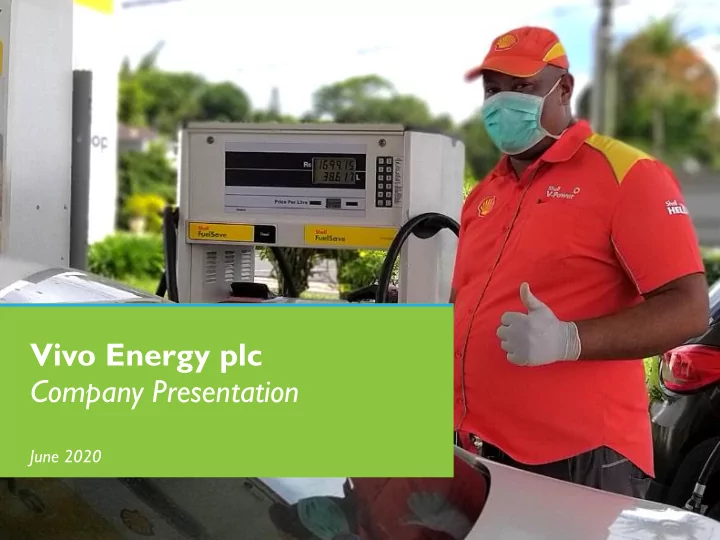
Vivo Energy plc Company Presentation June 2020 Disclaimer - - PowerPoint PPT Presentation
Vivo Energy plc Company Presentation June 2020 Disclaimer IMPORTANT: Please read the following before continuing. No offer or solicitation This presentation is provided for informational purposes only and is not intended to and shall not
IMPORTANT: Please read the following before continuing. No offer or solicitation This presentation is provided for informational purposes only and is not intended to and shall not constitute an offer to sell or the solicitation of an offer to sell or the solicitation of an offer to buy any securities of Vivo Energy plc (the “Company”) or a solicitation of any vote of approval, nor shall there be any sale of securities in any jurisdiction in which such offer, solicitation or sale would be unlawful prior to registration or qualification under the securities laws of any such jurisdiction. Neither the contents of the Company’s website, nor the contents of any other website accessible from hyperlinks on such websites, is incorporated herein or forms part of this presentation. Forward-looking statements This presentation includes forward-looking statements. These forward-looking statements involve known and unknown risks and uncertainties, many of which are beyond the Company’s control and all of which are based on the Directors’ current beliefs and expectations about future events. Forward-looking statements are sometimes identified by the use of forward-looking terminology such as: “believe”, “expects”, “may”, “will”, “could”, “should”, “shall”, “risk”, “intends”, “estimates”, “aims”, “plans”, “predicts”, “continues”, “assumes”, “positioned”, “anticipates” or “targets” or the negative thereof, other variations thereon or comparable terminology. These forward-looking statements include all matters that are not historical facts. They appear in a number of places throughout this report and include statements regarding the intentions, beliefs or current expectations of the Directors or the Group concerning, among other things, the future results of
No assurance can be given that such future results will be achieved; actual events or results may differ materially as a result of risks and uncertainties facing the Group. Such risks and uncertainties could cause actual results to vary materially from the future results indicated, expressed, or implied in such forward-looking statements. Such forward-looking statements contained in this report speak only as of the date of this report. The Company and the Directors expressly disclaim any obligation or undertaking to update these forward-looking statements contained in the document to reflect any change in their expectations or any change in events, conditions, or circumstances on which such statements are based, unless required to do so by applicable law.
1
Benefitting from positive long-term African macro and fuel market fundamentals
Highly cash generative business model, with +20% ROACE in last 3 years
Diversified operations with resilient margins largely uncorrelated to oil prices
2
Market leading positions across Africa, with premium brands
Q1 Gross cash profit of $179 million, up 6%
YoY
Jan and Feb saw +20% gross cash profit growth1 Volumes in last two weeks of March affected by
COVID-19 related measures
Margins impacted in March primarily due to the
impact of the reduction in demand and valuation
Three months ended 30 March 2020 2019 Change Volumes (million litres) 2,602 2,441 +7% Gross Cash Unit Margin ($/’000 litres) 69 69
($ million) 179 169 +6%
KEY PERFORMANCE INDICATORS1 3
(1) Includes benefit of 2 additional months of Engen contribution compared to 2019
4
1,000-5,000 cases 500-1,000 cases 1-500 cases
(1) Source: John Hopkins University – 09 June 2020
5,000-10,000 cases
REPORTED CASES IN OPERATING COUNTRIES
>10,000 cases
MOROCCO – Countrywide lockdown 10 June UGANDA – Countrywide lockdown lifted 2 June MAURITUS - Countrywide lockdown lifted 1 June CAPE VERDE - Countrywide lockdown lifted 29 May REUNION - Countrywide lockdown lifted 11 May TUNISIA – Countrywide lockdown lifted 4 May RWANDA – Countrywide lockdown lifted 4 May MADAGASCAR - Curfew since 23 Mar MALAWI - Partial lockdown since 18 Apr KENYA - Curfew since 23 Mar CÔTE D’IVOIRE – Urban restrictions since 23 Mar2 ZIMBABWE – Ongoing since 27 March
Countrywide Lockdown Curfew / Partial Lockdown Social Distancing1
(1) Measures within each country vary and include closure of schools, borders, limitations on movement and large gatherings (2) Nationwide curfew lifted, but restrictions around Abidjan remain
Volumes were around half of expected levels in April due to Government restrictions
9 countries were in full lock-down, 10 in partial lock-down and 3 using social distancing
On-going, slow relaxation of restrictions happening across the continent since April
SENEGAL – Curfew lifted 4 June BURKINA FASO – Curfew lifted 3 June BOTSWANA – Countrywide lockdown lifted 22 May GUINEA – Curfew lifted 15 May GABON – Partial lockdown lifted 11 May MALI – Curfew lifted 9 May NAMIBIA – Partial locked lifted 4 May GHANA - Urban restrictions removed 20 Apr ZAMBIA - Schools closed 25 Mar TANZANIA - Schools closed 23 Mar MOZAMBIQUE - State of emergency 19 Mar
5
Key:
Countries in green moved from countrywide lock-down to partial lock-down Countries in purple moved from countrywide lock-down to social distancing Countries in blue moved from partial lock- down to social distancing Countries in black remain unchanged
6
Regulated retail fuels 34% De-regulated retail fuels 20% Commercial fuels 16% Lubricants 10% LPG 8% Aviation and Marine 5% Non-fuel retail 4% Premium fuels 3%
PERCENTAGE GROSS CASH PROFIT CONTRIBUTION BY BUSINESS IN 2019
65% 35%
Pegged currencies (USD/EUR) Floating currencies FX RISK MINIMISED DUE TO CURRENCY PEGS
7
(% of 2019 adjusted EBITDA pegged to USD/EUR)
21% 11% 11% 7% 6% 5% 5% 5% 28%
Morocco Tunisia Kenya Ivory Coast Ghana Senegal Mauritius Uganda Others HIGHLY GEOGRAPHICALLY DIVERSE
(Eight largest markets represented ~70% of 2019 group volumes)
69 74 73 71
2016 2017 2018 2019 Gross cash unit margin
10 20 30 40 50 60 70 80 90
USD/bbl & $ per 000 litres
Brent
Fluctuations in oil price reflected in the pump price, not borne by the Company
Unit margins are either fixed via a regulated price structure (20 of 23 countries) or through market dynamics (3 countries) − They are not a percentage of the pump price
Countries carefully manage supply and stock levels to minimise oil price risk − Average of 24 days of inventory in 2019
Combined impact of lower demand and monthly revaluation of stock impacted unit margins in March 2020
Potential for further stock related impact on reported margins in Q2 before inventory levels normalise
Source: Company information.
8
MARGINS HAVE LIMITED CORRELATION TO OIL PRICE
(Gross cash unit margin vs Brent Crude price)
20 40 60 80 100 120 140 60 80 100 120 140 160 180 200 2000 2001 2002 2003 2004 2005 2006 2007 2008 2009 2010 2011 2012 2013 2014 2015 2016 2017 2018 2019
Demand in Vivo Energy 23 countries (left hand side axis)
Source: CITAC, FactSet (1) Demand indexed to 100
(Indexed demand(1))
FUEL DEMAND HAS HISTORICALLY GROWN DESPITE A FLUCTUATING OIL PRICE
($/bbl)
AFRICAN FUEL DEMAND CHARACTERISTICS + 97%
Brent (right hand side axis)
Few public transport alternatives
Roads are the primary transport route
Staple product
Car parc growth, lower vehicle efficiency and expanding road network
9
10
We are a fast and agile business and have taken rapid action to adapt our business Africa is a resilient continent that will bounce back - fuel is an essential part of that recovery Longer term strategy remains unchanged:
– Deliver on the potential from our new Engen countries – Expand non-fuel offerings at our sites to enhance convenience – Drive Shell-branded volumes by maximising use of the premium brand on the continent – Leverage our investment in technology that sets us apart from our competition
11
Travel ban imposed from January Range of preventive and protective health and
safety measures implemented
Supporting dealer network to protect local jobs Rolling out new initiatives for customers
PROTECTING OUR PEOPLE AND CUSTOMERS SUPPORTING OUR COMMUNITIES 12
Morocco Funding production of 400 respirators & providing free fuel for healthcare workers Zambia Donation of 60 boxes of sanitiser, and 2,000 litres of fuel to the Zambia National Public Health Institute Kenya Produced & gifted thousands
bottles
sanitiser for the Government of Kenya Uganda Donated 5,000 litres to emergency medical care services Tunisia Partnering with a local organisation to
13 PROTECTING OUR BUSINESS
Our business model drives a lean cost base
Total headcount of ~2,700 people across 23 countries
Reducing discretionary spend around marketing and uncommitted capex
Reducing supply of fuels to balance lower demand Closely monitoring credit exposures Prudent decision to withdraw recommendation of the payment of the 2019 final dividend
Will consider an additional dividend payment once more certainty in our markets
14
Strong balance sheet and access to liquidity $1.6 billion of available liquidity as at the end of March
Undrawn committed multi-currency revolving credit facility of $238 million
Total of $1.0 billion undrawn unsecured short-term bank facilities within our 23 operating entities
Cash balances of $353 million (spread between the HoldCo and the OpCos)
Average utilisation rates of short term facilities approximately 30% at the end of March Long-term debt principal repayments of $82 million due in 2020 – covered by cash on hand in HoldCo
15
SHAREHOLDER STRUCTURE1
Source: Company information (1) As at 31 October 2019
OVERVIEW MANAGEMENT TEAM
Johan Depraetere
Chief Financial Officer
Christian Chammas
Chief Executive Officer
Eric Gosse
EVP Business Development, Support and Indian Ocean Islands
Hans Paulsen
EVP East and Southern Africa
Franck Konan-Yahaut
EVP West Africa
Joined Vivo Previous experience
2012 2012 2018 2012 2013
Completed Initial Public Offering on the London Stock
Exchange in May 2018 with a simultaneous inward secondary listing on the Johannesburg Stock Exchange
At the time was the largest African IPO for 10 years Market capitalisation: £1.1bn ($1.4bn) as at 1 June 2020 Member of the FTSE 250 Index and JSE All Share Index UK Governance code compliant Board of Directors Dividend policy: minimum payout ratio of 30% of net income
Vitol Group 36% Helios Investment Partners 29% Engen Group 5% Management 1% Institutional holders 29% 16
(1) Represents fuel storage capacity only and includes equity share of storage capacity in joint ventures, excluding bitumen and LPG. JV storage is included on a pro rata basis based on
(2) As at December 2019 (3) Fuel and lubricants sales in 2019 (4) Via a combination of direct ownership and the 50% SVL joint venture
Terminals / storage: +1 billion litres of capacity across 20 countries(1) Fuel supply (domestic refineries & tenders, Vivo Energy
Retail sites: +2,220 sites(2) 3rd party transportation of fuels in accordance with Vivo Energy standards and controls Commercial customers: c.4.4bn litres(3) Retail customers: c.5.9.bn litres(3) Access to 6 lubricants blending plants(4)
Vivo Energy ownership / operational control
17
Owning storage assets in Africa is essential to control costs, guarantee supply and manage HSSE and product quality
Company Operated Dealer Operated Dealer Owned (~35% of portfolio)
Forecourt operating risk transferred to the Dealer, whilst we focus on supply and standards
Dealer manages employees, opex, working capital and interaction with the consumer − In return, receive the fixed “retailer” margin
Vivo Energy retains responsibility for supply, branding, marketing,
− In return, receive fixed “marketer/distributor” margin
Captive channel and low operating complexity as our “consumer” is the dealer
Generally flagship or highway sites
Sometimes mandatory initial platform due to regulations
Vivo Energy is responsible for all operating costs and interaction with the consumer
Higher margin capture
High level of operational complexity
18
~5% of portfolio Company Owned (~65% of portfolio) Dealer Operated ~95% of portfolio is Dealer Operated
Source: Company information (1) Volume percentage based on 2019 total volume of each country (2) Excludes countries where subsidies exist relating to LPG (3) Vivo Energy also captures the retailer margin under the COCO model.
OVERVIEW OF RETAIL PRICE REGULATION IN OUR COUNTRIES Landed cost of product Primary transport Storage Secondary transport Oil marketer margin Duties Wholesale price Retailer margin Regulated pump price Scope for lower supply chain costs through scale benefits
Vivo Energy’s margin(3)
Regulated fuel markets are common in emerging markets
– Government sets the pump price, which changes periodically to reflect the current oil price and input costs – Marketing margins are fixed per litre
Regulated markets can be also be Subsidised, where the pump
price is stable and doesn’t reflect the oil price – Marketing margins are fixed per litre
Deregulated markets are more common in developed
economies – Pump prices fluctuate frequently due to oil price and competition – Marketing margins are variable per litre
MARGINS IN REGULATED MARKETS ARE COST PLUS 19
Regulated (no subsidies) 18 countries (52% of volumes(1)) Regulated (with subsidies(2)) 2 countries (15% of volumes(1))
Regulators set pump prices using assumed supply
chain costs
The regulated price contains an allowed margin for
Oil marketing companies can make margins above this
by achieving lower supply chain costs than those in the pump price formula
Savings are driven by the reach, scale and
efficiency which can be achieved by large, vertically- integrated player
REGULATED MARGIN WITH EFFICIENCY UPSIDE
De-regulated 3 countries (33% of volumes(1))
Supply Regular fuel margin Subsidies Morocco Deregulated Deregulated Bottled LPG only Uganda Deregulated Deregulated None Ghana Partially regulated Deregulated None Namibia Deregulated Regulated Rural areas only Botswana Deregulated Regulated Kerosene only Madagascar Deregulated Regulated None Mali Deregulated Regulated LPG only Zimbabwe Deregulated Regulated None Rwanda Deregulated Regulated None Malawi Deregulated Regulated None Kenya Tender Regulated None Mozambique Tender Regulated None Reunion Tender Regulated None Zambia Tender Regulated None Cape Verde Tender Regulated None Guinea Tender Regulated All fuel products Tanzania Partially regulated Regulated None Senegal Partially regulated Regulated None Mauritius Partially regulated Regulated LPG only Gabon State monopoly Regulated None Burkina Faso State monopoly Regulated LPG only(1) Côte D’Ivoire State monopoly Regulated LPG only Tunisia State monopoly Regulated All fuel products(2)
Source: Company information. (1) And Société Nationale d'électricité du Burkina Faso (SONABEL). (2) Except jet fuel.
REGULATION Low High 20
CHALLENGE MITIGATION Stocks / oil price Currency Compliance Credit Supply
Fluctuations in oil price reflected in the pump price, not borne by the Company
Margins are either fixed via a regulated price structure (20 of 23 countries) or through market dynamics (3 countries)
Countries manage stock levels with maximum and minimum stock levels through manual of authorities
~65% of 2019 Adjusted EBITDA derived from currencies pegged to the EUR / USD
Utilise hedging strategies to mitigate major FX risks (i.e. importing fuels into a country)
Upstream dividends from operating units where possible into USD
Robust credit approvals process with central oversight, local empowerment and use of credit risk mitigation measures when required
Bad debts represented around 1% of gross cash profits during 2019
Robust and proven internal control framework with limited historical losses from fraud / bribery
The first company in Africa to achieve ISO 37001 certification for our anti-bribery management system
Access to over 1.0 billion litres of storage in Africa helps to mitigate major supply risks
Utilise over 100 suppliers, with Vitol, the worlds largest oil trader, representing 30% of Group supply in 2019
21