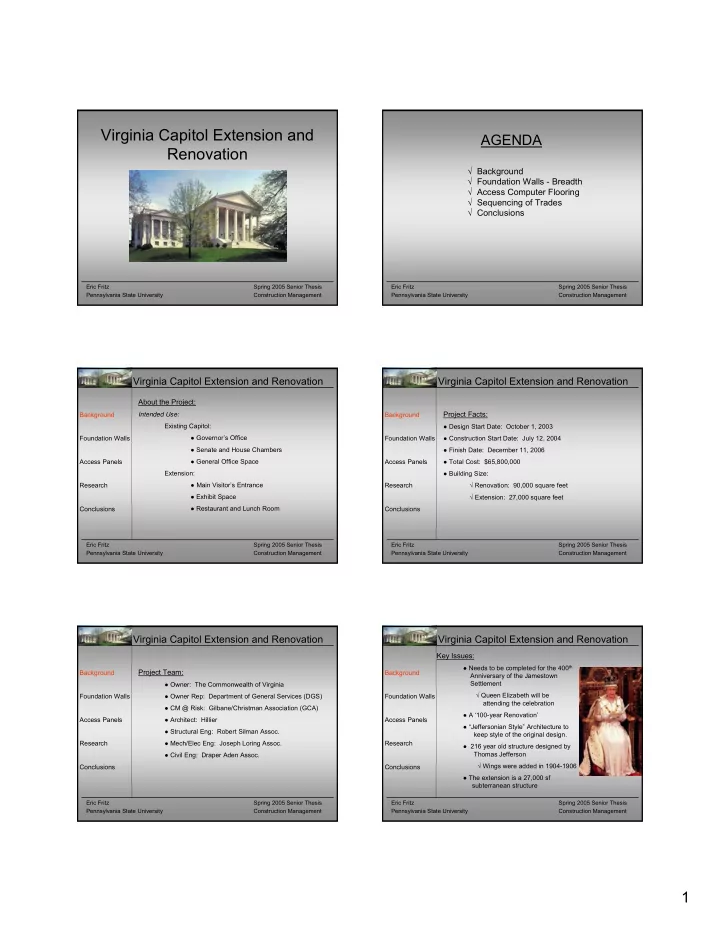
Virginia Capitol Extension and AGENDA Renovation Background - - PDF document

virginia capitol extension and
SMART_READER_LITE
LIVE PREVIEW

Virginia Capitol Extension and AGENDA Renovation Background - - PDF document

Virginia Capitol Extension and AGENDA Renovation Background Foundation Walls - Breadth Access Computer Flooring Sequencing of Trades Conclusions Eric Fritz Spring 2005 Senior Thesis Eric Fritz Spring 2005 Senior Thesis


slide-1
SLIDE 1

1

Virginia Capitol Extension and Renovation

Eric Fritz Pennsylvania State University Spring 2005 Senior Thesis Construction Management Eric Fritz Pennsylvania State University Spring 2005 Senior Thesis Construction Management

√ Background √ Foundation Walls - Breadth √ Access Computer Flooring √ Sequencing of Trades √ Conclusions

AGENDA

Eric Fritz Pennsylvania State University Spring 2005 Senior Thesis Construction Management

Virginia Capitol Extension and Renovation

Background Foundation Walls Access Panels Research Conclusions

About the Project:

Intended Use: Existing Capitol:

  • Governor’s Office
  • Senate and House Chambers
  • General Office Space

Extension:

  • Main Visitor’s Entrance
  • Exhibit Space
  • Restaurant and Lunch Room

Eric Fritz Pennsylvania State University Spring 2005 Senior Thesis Construction Management

Virginia Capitol Extension and Renovation

Background Foundation Walls Access Panels Research Conclusions

Project Facts:

  • Design Start Date: October 1, 2003
  • Construction Start Date: July 12, 2004
  • Finish Date: December 11, 2006
  • Total Cost: $65,800,000
  • Building Size:

√ Renovation: 90,000 square feet √ Extension: 27,000 square feet

Eric Fritz Pennsylvania State University Spring 2005 Senior Thesis Construction Management

Virginia Capitol Extension and Renovation

Background Foundation Walls Access Panels Research Conclusions

Project Team:

  • Owner: The Commonwealth of Virginia
  • Owner Rep: Department of General Services (DGS)
  • CM @ Risk: Gilbane/Christman Association (GCA)
  • Architect: Hillier
  • Structural Eng: Robert Silman Assoc.
  • Mech/Elec Eng: Joseph Loring Assoc.
  • Civil Eng: Draper Aden Assoc.

Eric Fritz Pennsylvania State University Spring 2005 Senior Thesis Construction Management

Virginia Capitol Extension and Renovation

Background Foundation Walls Access Panels Research Conclusions

Key Issues:

  • Needs to be completed for the 400th

Anniversary of the Jamestown Settlement √ Queen Elizabeth will be attending the celebration

  • A ‘100-year Renovation’
  • “Jeffersonian Style” Architecture to

keep style of the original design.

  • 216 year old structure designed by

Thomas Jefferson √ Wings were added in 1904-1906

  • The extension is a 27,000 sf

subterranean structure

slide-2
SLIDE 2

2

Eric Fritz Pennsylvania State University Spring 2005 Senior Thesis Construction Management

Virginia Capitol Extension and Renovation

Background Foundation Walls Access Panels Research Conclusions

Analysis Purpose:

  • Guarantee Completion Date

√ Stiff Penalties for late completion

  • Higher quality building and design
  • Improve constructability
  • Improve overall construction process

Eric Fritz Pennsylvania State University Spring 2005 Senior Thesis Construction Management

Virginia Capitol Extension and Renovation

Background Foundation Walls Access Panels Research Conclusions

Estimate:

Eric Fritz Pennsylvania State University Spring 2005 Senior Thesis Construction Management

Virginia Capitol Extension and Renovation

Background Foundation Walls Access Panels Research Conclusions

Site Plan:

Eric Fritz Pennsylvania State University Spring 2005 Senior Thesis Construction Management

Virginia Capitol Extension and Renovation

Background Foundation Walls Access Panels Research Conclusions

Site Model:

Eric Fritz Pennsylvania State University Spring 2005 Senior Thesis Construction Management

Virginia Capitol Extension and Renovation

Background Foundation Walls Access Panels Research Conclusions

Foundation Wall Proposal:

  • Issue: There is currently a lack of skilled labor in the

Richmond area due to an abundance of projects downtown.

  • Projects include:

√ Virginia Capitol Extension and Renovation √ Performing Arts Center √ City Hall Renovation √ Finance Building – Extensive Renovation √ MVC Medical Campus √ VCU Educational Campus

Eric Fritz Pennsylvania State University Spring 2005 Senior Thesis Construction Management

Virginia Capitol Extension and Renovation

Background Foundation Walls Access Panels Research Conclusions

Foundation Wall Proposal:

  • Current System: A cast-in-place concrete wall on both

sides of the subterranean extension. √ Walls range in size from 1’ to 2’ wide and from 12’ to 28’ high.

  • Proposed System: A precast wall design with the same

dimensions.

  • Solution: The precast system would save a good deal on

labor and schedule, but do to the design complexity the CIP system would be more suitable for this project.

slide-3
SLIDE 3

3

Eric Fritz Pennsylvania State University Spring 2005 Senior Thesis Construction Management

Virginia Capitol Extension and Renovation

Background Foundation Walls Access Panels Research Conclusions

Current Foundation Wall Section:

  • The wall has a bentonite

waterproofing system backfilled by gravel for drainage purposes.

Eric Fritz Pennsylvania State University Spring 2005 Senior Thesis Construction Management

Virginia Capitol Extension and Renovation

Background Foundation Walls Access Panels Research Conclusions

Feasibility Study:

  • Design of precast would need to include dowels for

moment loads and embeds for waterproofing hangers.

  • Crane use:

√ Current crane: 100-ton Link Belt with lifting capacity

  • f 10,000 pounds and an 80 foot turning radius.

▪ Maximum precast lift is 36,000 pounds √ A 140 ton Manitowoc crane would be needed with a lifting capacity of 41,300 pounds and a turning radius of 60 feet.

Eric Fritz Pennsylvania State University Spring 2005 Senior Thesis Construction Management

Virginia Capitol Extension and Renovation

Background Foundation Walls Access Panels Research Conclusions

Disadvantages:

  • Cost

√ CIP Concrete ▪ Foundation Walls: $300,200 ▪ Beams: $121, 200 ▪Total Cost: $421,400 √ Precast Concrete ▪ Structural Wall Panels: $315,400 ▪ Beams: $113,900 ▪ Total Cost: $429,300 Total Cost Increase: $7,900

Virginia Capitol Extension and Renovation

Eric Fritz Pennsylvania State University Spring 2005 Senior Thesis Construction Management

Background Foundation Walls Access Panels Research Conclusions

Advantages:

  • Labor Needed = Precast would save 1,568 labor hours

2880 4448

Total Labor Hours

6 34 4 76

# of days to complete

72 72 200 48

Daily Labor Hours

Beams Wall Panels Beams Walls

Precast Cast-in-Place

  • Time Required

√ Precast would take 40 days to complete √ CIP would require 80 days to complete. ▪ 8 weeks saved

Virginia Capitol Extension and Renovation

Eric Fritz Pennsylvania State University Spring 2005 Senior Thesis Construction Management

Background Foundation Walls Access Panels Research Conclusions

Can be constructed during most weather conditions. Weather needs to be in desired temperature range and it needs to be protected from moisture. Weather Requires use of crane. A 100 ton link belt crane is

  • n current site. Lifting capacity of 5 tons with an 80

foot radius. A Manitowoc 3900 crane is needed for the desired lifting capacity. Requires use of a concrete pump truck Crane/Pump Use Manufactured in controlled factory environment. High quality Corners could be cut. Quality depends upon the laborers on site. Quality

  • Challenging. Building is on a slope, so the joints

and pieces will be difficult to design and erect Difficult to build formwork for the slopes involved. Constructa- bility Area for direct picks from trucks. Ease of installation. Plenty of room available on site Installation 2880 4448 Labor Hours 40 days 80 days Time $429,300 $421,400 Cost Precast Concrete Cast-in-Place Concrete

Table of Results:

Eric Fritz Pennsylvania State University Spring 2005 Senior Thesis Construction Management

Virginia Capitol Extension and Renovation

Background Foundation Walls Access Panels Research Conclusions

Access Floor Proposal:

  • Issue: The project is a ‘100 year renovation.’ The current

system does not accommodate future expansion of utilities.

  • Current System: Utility trenches exist under the slab on
  • grade. These tunnels are made of concrete, sealed with

a 6” precast plank, and then topped with a 2” concrete slab.

slide-4
SLIDE 4

4

Eric Fritz Pennsylvania State University Spring 2005 Senior Thesis Construction Management

Virginia Capitol Extension and Renovation

Background Foundation Walls Access Panels Research Conclusions

Access Floor Proposal:

  • Proposal: RWC Series Access Panel made by Maxcess
  • Technologies. This system would require the same

trench system, but the computer access panels allows for easy access to the utilities.

  • Solution: Proposed system has similar time and cost

constraints, but due to the higher quality and the possibility of future expansion the RWC Access Panels would be more suitable.

Eric Fritz Pennsylvania State University Spring 2005 Senior Thesis Construction Management

Virginia Capitol Extension and Renovation

Background Foundation Walls Access Panels Research Conclusions

Advantages:

  • Labor: Saves 168 labor hours (248 to 80).
  • Installation: 2’x2’ sections could easily be installed and

connected within the space requirements.

  • Utilities: Access panels allows for easy future expansion.
  • Quality: RWC is considered a premier product line with an

epoxy finish for wear and tear resistance.

Eric Fritz Pennsylvania State University Spring 2005 Senior Thesis Construction Management

Virginia Capitol Extension and Renovation

Background Foundation Walls Access Panels Research Conclusions

Disadvantages:

$26,600 plus trench cost $23,000 plus trench cost Cost 5 days 3 days Time Access Flooring Plank and Slab

  • These disadvantages do not outweigh the benefits

that the access flooring supplies the owner.

Eric Fritz Pennsylvania State University Spring 2005 Senior Thesis Construction Management

Virginia Capitol Extension and Renovation

Background Foundation Walls Access Panels Research Conclusions

How Technology Benefits the Sequence of Trades:

  • Why is this an issue on the VA Capitol Project?

√ Tenant move-out due to the renovation √ Congested utility trenches and plenum spaces

  • Why is this an issue in the construction industry?

√ Construction projects are becoming more and more complex. √ New visualization technology has started to enter the workforce in the past decade. ▪ This research focused on the benefits of 3D and 4D technology. ▪ Also shows some drawbacks to using this technology to enhance 2D drawings.

Eric Fritz Pennsylvania State University Spring 2005 Senior Thesis Construction Management

Virginia Capitol Extension and Renovation

Background Foundation Walls Access Panels Research Conclusions

2D CAD

  • Construction documentation largely remains in 2D format.
  • Mental visualization is needed for 2D documents.

3D CAD

  • Introduces the ‘z’ variable as a third plane of visualization.
  • Visualization starts the second someone lays eyes on the

model.

4D CAD

  • Allows the visualization of 3D model with the schedule

interval tied into the model. Major sequencing benefits would include: √ Work Space – Who and what is being constructed at a given time. √ Storage Spaces – allows person to visualize storage spaces at a given time. This eases congestion on the site. √ Work Flow – coordination and construction process improves allowing better productivity.

Eric Fritz Pennsylvania State University Spring 2005 Senior Thesis Construction Management

Virginia Capitol Extension and Renovation

Background Foundation Walls Access Panels Research Conclusions

Difference in visualization between 2D and 3D CAD

Building Section (Morley) 3D Model of Building Section (Morley)

slide-5
SLIDE 5

5

Eric Fritz Pennsylvania State University Spring 2005 Senior Thesis Construction Management

Virginia Capitol Extension and Renovation

Background Foundation Walls Access Panels Research Conclusions

  • What are the advantages of 3D and 4D CAD?

Good for quantity take-offs Better understanding of the structures and systems Better understanding of the structures and systems Able to create 2D drawings by slicing the 3D model Good for MEP coordination Good for MEP coordination Allows project team to find interferences Allows project team to find interferences Increases clarity of the design Increases clarity of the design Reduces construction cost Reduces construction cost Personnel does not have to be skilled to visually see construction sequence Expedites the construction in the field Able to see schedule sequence better than the Gantt chart Materials can be shop fabricated more easily after using 3D CAD Shows work flow, work spaces, material flow, and storage at a given time Forces trades to build a job and make it fit into a space Improved visualization Improved visualization

Advantages of 4D CAD Advantages of 3D CAD

Virginia Capitol Extension and Renovation

Eric Fritz Pennsylvania State University Spring 2005 Senior Thesis Construction Management

Background Foundation Walls Access Panels Research Conclusions

  • What are the major obstacles/drawbacks to 3D and 4D CAD?

More use of computers would equal less time a person is looking at the drawings themselves. This would cut down on their technical knowledge of the project 8. Having the entire team buy into the usefulness 7. Not efficient on simple projects 6. Changes in the design or sequencing of the construction requires the re-rendering of the images and updating the 4D project; therefore longer to make revisions 5. Time to produce the model and obtain the needed accuracy 4. Finding someone with technical expertise to use the 3D or 4D model and cost associated with the person 3. Upfront time and cost of the new technology 2. Unwillingness of current industry members to learn the new technology 1.

Obstacles / Drawbacks of 3D and 4D CAD √ Best Quote about obstacles: “Old dogs do not want to learn new tricks.” – Lynn Rogien

Eric Fritz Pennsylvania State University Spring 2005 Senior Thesis Construction Management

Virginia Capitol Extension and Renovation

Background Foundation Walls Access Panels Research Conclusions

Conclusions:

  • Total Cost Increase: $3,600
  • Total Schedule Increase: 2 days
  • Total Manhours Saved: 168 labor hours
  • Higher Quality Project without minimal cost or schedule
  • verruns = happier client and project team

Eric Fritz Pennsylvania State University Spring 2005 Senior Thesis Construction Management

Virginia Capitol Extension and Renovation

Background Foundation Walls Access Panels Research Conclusions

Acknowledgements

  • Gilbane / Christman Association
  • Virginia Department of General Services (DGS)
  • Nitterhouse Concrete
  • Maxcess Technologies
  • Morley Building Company
  • AE Faculty and Staff
  • Friends and family

Eric Fritz Pennsylvania State University Spring 2005 Senior Thesis Construction Management

Virginia Capitol Extension and Renovation

Background Foundation Walls Access Panels Research Conclusions

Questions???