SLIDE 1 VIDEO_ Andreas Eenfeldt - Presentation (San Diego 2017)
- Dr. Andreas Eenfeldt: I'm sure most of you already know this, but that we have an
amazing opportunity to change the world, an opportunity to help hundreds of millions
- f people potentially, maybe 1 billion people to have a better life. And everybody in
this room could be an important part of that, because changing the world isn't easy, it's never been easy as far as I know. But just... it's possible right? That's amazing. So let me start with the disclosure. So me and my colleagues we run the health website DietDoctor.com, the largest low-carb and keto site in the world. How many people have visited it sometime? Okay, cool! Thanks. So it's funded by an optional membership section and our goal is to empower people by making low-carb simple. We take no industry money, we show no ads and we sell no products. So today I want to talk about three things. And the first one is the mistake behind the obesity epidemic. The second thing... how surprisingly hard it is to fix this mistake, even when we know what needs to be done? And number three - a possible solution to this problem. So let's start with number
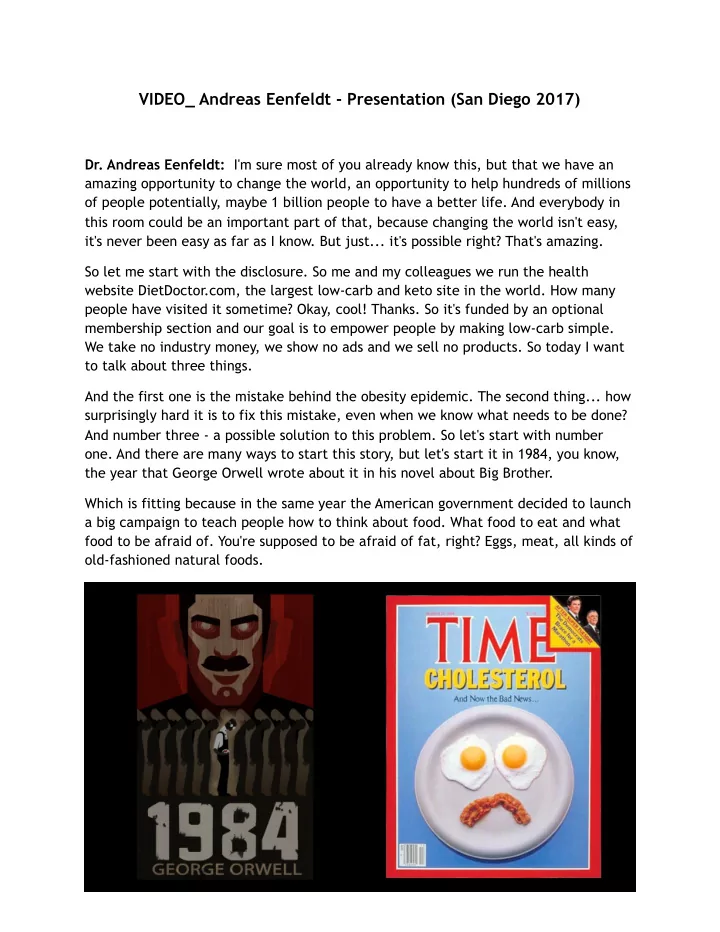
- ne. And there are many ways to start this story, but let's start it in 1984, you know,
the year that George Orwell wrote about it in his novel about Big Brother. Which is fitting because in the same year the American government decided to launch a big campaign to teach people how to think about food. What food to eat and what food to be afraid of. You're supposed to be afraid of fat, right? Eggs, meat, all kinds of
- ld-fashioned natural foods.
SLIDE 2 And a lot of people inspired by this, despite the lack of evidence, started to eat fake foods where you remove the fat and you add more sugar instead, more refined carbohydrates that raise the blood sugar and the insulin levels, the fat storing
- hormone. So more sugar when you eat less fat. And this is what happened to obesity
rates in in America. This is 1985, so the blue states you have around 10% obesity. Move ahead to 1991 and something is happening. Dark blue states turn up with over 15% obesity, so a huge increase even there.
SLIDE 3
In 1997 yellow states with over 20% obesity. 2003 orange states, over 25% obesity.
SLIDE 4
'09 red states with over 30% obesity. And now dark brown states with over 35% obesity.
SLIDE 5
So obesity has become common in just a few decades and kids are affected too, right? And obesity rates tripled in just one generation making America great, at least in size.
SLIDE 6 And the heavyweight champion of the world, the top of the rankings, right? So you're showing the way for the rest of the world and we are all following you into this interesting predicament. So I'm from Sweden. It's actually a bit downward, a little bit behind you down here. And yeah 12% obesity in Sweden, which means that 88% of Swedes still look like this. I'm not sure if that's a good thing or not, but... Yeah, that's ABBA. So on a more serious note it's not just about obesity. Because this is far more serious, actually... Diabetes. So diabetes is the disease where you have too much sugar in the blood, sugar that comes from the food that you eat. And back in the 80s there used to be 30 million people with type 2 diabetes in the world. So how many people do we have today with diabetes? 420 million, 13 times more in this short time and it keeps going up, it's exploding in India, China and all the world. So in a few decades it's going to be way past half a billion people. And these people are expected to just get worse every year, to get complications like Alzheimer's disease, heart disease, cancer, amputations, kidney disease. We have to fix this problem, it can't wait. So what people are saying is that the way to lose weight or reverse your diabetes if it's even impossible, is to eat less and exercise more. And that's exactly what we've been saying to people for 30 years, while it's going in an entirely wrong direction, right? So what do you do? Well the idea today is that that maybe we can fix this with a final surgical solution where we simply operate on people so that they can't eat too much, right? So gastric bypass surgery and similar surgeries are getting super common in the
- world. And while they are super effective in the short term, I think we have to really
think about whether this is the right way to go. Because is there really a disease inside those organs where we operate?
SLIDE 7 The stomach, the part of the stomach that we operate, take away or the part of intestines that we take away or reconnect somehow? No, these are healthy organs that we are operating on. So in a way we are trying to surgically adapt our bodies to better handle the industrial food supply instead of doing the opposite, meaning adapting the food to our bodies, which would seem to be more reasonable. Of course the common argument for this kind of thing is that the people who end up
- n the operating table, they have already tested everything, right? There's nothing
else to do, they have tested all the diets. Only surgery remains. But it's not true. I've heard so many stories from people not being true. And this is just one of them. This is Johanna Engström. When she was in the 40s she felt she had struggled with her weight for long enough and she decided, "These surgeries seem like the right thing for me." And her doctor agreed. So she got set up on the waiting list and when time came she went to the hospital, checked into the hospital and the next morning, early, she was going to be rolled into surgery. But that night in the hospital she had some kind of panic attack. She really felt that this was wrong for her and she felt that she simply couldn't go through with it. So she went out to the people in the ward and she said, "I'm truly sorry, really, really sorry, "I don't know what to do, but I can't go through with this. You simply have to give the surgery to someone else." And then she went home. And the next days she started to eat a low-carb high-fat diet, which is something that she'd been considering for long time, but never gave it a serious, serious try. And she even asked her doctor, "Is this right for me... low-carb?" And her doctor said, "No, it's just a fad diet, it doesn't work long-term. It's dangerous, don't do it." But she did it anyway. And in one year she lost more than 100 pounds without being hungry. And this is what she looked like in a makeover sort of story...
SLIDE 8 And she did this with all her healthy organs intact, right? And she is really proud of herself for that. And I would think a lot of people should be given the opportunity and the support and the knowledge and at least, you know, their doctor shouldn't tell them not to try it. You know, why not? Well, a lot of people healthcare professional... I'm a family doctor and I used to be guilty of this myself... We think, or thought, that eating an omelet for breakfast is extreme. It's too extreme to recommend in the healthcare system. So instead we recommend operating on healthy organs, cutting them out, you know, by the thousands. Because this food that people have been eating for thousands or millions of years is
- bviously too extreme, dangerous to even consider recommending. So that's how
crazy the world is today, really is that way. And if we don't look out it can get worse, because people who do these surgeries, they tend to lose a tremendous amount of weight in the first year, but what happens after that if they keep living the way they used to live, the weight starts coming back and it's not uncommon for people to gain back most of the weight again, maybe even all the weight, maybe even more than that. And what do you do? So people are experimenting with different options, because, you know, it's all found in surgery or pills. So for example some people have been experimenting with brain electrodes into the reward centers of the brain, trying to tell the brain not to want to eat food, right? And really, nothing says 1984... quite as much as brain electrodes telling you what to want, right? Not a great idea... they even tried to put this in a pill, so people wouldn't feel like eating. But it turned out they didn't feel like doing anything. They got depressed and some of them killed themselves so they had to take away that pill. So maybe that's not the
SLIDE 9
- solution. So what is? I'm embarrassed to say that the next option comes from my
country, Sweden. It's FDA approved now in the US. It's a tube that you put into your stomach, hanging out underneath your clothes, so the idea is you eat the food that you want to eat and then once you've finished you go to the bathroom, you pull out the tube and you pour the contents into the toilet. Well, this is happening in the US right now. So of course it's like surgically, you know, prescribed bulimia. It really is. And what really makes me smile-- It's sad, but still I can't help smiling, because why are these surgeons putting a tube into the stomach? There's already a tube into the stomach, right? We already have one, it's called
- esophagus. So I don't recommend bulimia, but if you're going to do that, then why pay
for expensive dangerous surgery? I don't know. Fortunately there might be an even better idea. How about just eating real food? So this is a friend of mine called Ronnie Mathisen. And a few years ago he asked on his Facebook page, "Is it possible to lose 20 pounds in 10 weeks?" And a friend answered him that, "Yeah, it's possible with low-carb high-fat." So Ronnie decided, "I'm going to try this." And he did something unusual, he took a picture of himself in his underwear before and after and then he put these pictures into his computer and had it calculate what he looked like in between. So it becomes like a movie or morph, right? Let's see how it looks. This is Ronnie eating all he needs except sugar and starch. You know, no hunger and the fat sort of melts away. Pretty cool, right? This is from the side. So he lost 70 pounds with no hunger in one year and his friend was actually right because he lost more than 20 pounds in the first 10 weeks. So I am not saying it works this well for everybody, but it works really well for a lot of people. And at least people should be given the chance I think to try this, because it's not just a few stories, even hundreds or thousands of stories... There is even the best quality gold standard evidence that we have you know, randomized controlled trials, the gold standard of scientific studies, comparing low-carb to conventional today, you know, low-fat low-calorie diets for weight loss. And there's been thousands of these studies. And I did a list of these a few years ago comparing the ones that show, you know, a clear winner, statistically, significantly better results with one diet. And there were 20 studies showing better results with low-carb. How many would low-fat? None, zero. So 20 - 0, that's pretty bad considering, you know, low-fat is still what we recommend, low-calorie. And a few weeks ago I talked at a conference in England put up by the Public Health Collaboration, an organization of doctors and they did a similar review of all the studies and they found a little bit more studies now, 29 actually, but it's still 29 - 0. That's pretty amazing! And I think actually today a lot of people are starting to accept this, that low-carb diets are effective for weight loss. And that's not really what's holding people back today.
SLIDE 10
What's holding people back is that it's perceived still to be dangerous, right? The cholesterol thing, the heart disease thing. That wasn't really proved back in the 80s. How about now? Actually when you look at all the evidence, when you do systematic reviews of all the evidence, there's really nothing there. So for example a few years ago scientists looked at all observational evidence, meaning, you know, when you look at how people eat and you compare it to whether they get sick or not and they found no evidence in all of the science to say that people who ate lots of butter got any less healthy than other people. So it's nothing there. And if you look at the gold standard evidence, the interventional trials, where you take a group of people, put them on less fat and compare it to a group with more fat and you make that trial to go on for a year, or two, or three, or more. And you look at all these trials and you put them together. The result is that replacing saturated fat with unsaturated fat is unlikely to have any positive effect. Meaning no effect on heart disease, no effect on how long you're going to live. This is from the summary of the review. And the they say that, "These findings have implications for current dietary recommendations". And of course, you know scientists, they are all careful with how they express themselves. But what they mean by implications is that the current dietary recommendations are wrong. And not just a little bit wrong, but completely wrong, rotten at the core. Because it's all based on this old faulty idea that fat is bad for you. But it's not. And a lot of people are waking up to it. So in the 80s cholesterol was the bad guy. Now a few years ago Time had this cover, I'm sure many of you had seen it. So it says, "Eat Butter" and scientists labeled fat the enemy. Why? They were wrong. So that's the mistake behind the obesity epidemic, we know the mistake behind it. Fat was never a problem and carbs can be a problem for obesity and diabetes. So why is it
SLIDE 11 so hard to fix this? Did any of you read this? I'm sure many of you did. So this summer the American Heart Association said that the coconut oil is really dangerous for you. It's saturated, just like butter and that's... We said it's dangerous for 30 years, we're going to keep saying it's dangerous. It's unbelievable, right? Study after study showing no effect and they keep saying what they used to say. And some people claim that,
- kay, the American Heart Association just by coincidence a few months earlier, they
got $700 million from the soybean manufacturers and that's why. But I don't think that is the only reason. I think there is a deeper reason. And that is that it takes a long time for humans to change their minds. And actually most people never do. If they really, truly believe in something, they never change their minds. And this has been shown over and over again. So this guy is called Ignaz Semmelweis, he was a Hungarian obstetrician back in the 19th century. And back then there was a huge problem in the cities in Europe, because when women came to the hospital to give birth, after giving birth they often
- died. They got a fever, get sicker and sicker and a few days later they died. So 10%,
maybe up to 25% of women... this happened to them. So incredible tragedies. And Ignaz Semmelweis, he got an idea. He noticed that when doctors went to the morgue to autopsy patients and then they went to examine women, they died even more often. And he thought, you know, maybe there are some sort of particles on these dead bodies that end up on the hands of the physicians and then they take them to the women that they examined. And this really sounded crazy, because they didn't know about bacteria or infections, right? They had no conception of it. So everybody thought, "That's crazy, Semmelweis, it can't be it." But he was in charge of a ward and the decided, "Hey, to get into my ward, you'll have to wash your hands with chloride." And this is what happened... So these infections, these death rates just plummeted. Actually if a physician washed his hands 10 times, he or she saved the live of one woman. Pretty amazing, right? Return
Yeah, but they didn't because it all sounded crazy, too crazy. And obviously doctors don't have dirty hands, we know that. So they kept doing what they did and women kept dying, Semmelweis ended up in a mental hospital where he died. And it took decades until people knew about bacteria and it started to make sense and they thought, "Maybe Semmelweis was right." So they put him on a postage stamp. This is something at least for his efforts. But this is the way it usually goes, it takes decades. So how can we do that? A person who is smarter than me, a physicist called Max Planck, he said something famous. He said that, "A new scientific truth does not triumph "by convincing his opponents and making them see the light, "but rather because its opponents eventually die, and a new generation grows up that is familiar with it." So maybe we'll have to wait for everybody to die. How long is that going to take? Will it be 2030, will it be 2050? How long will they live? I don't know, if they eat soybean
SLIDE 12
- il maybe they will die a little bit earlier. I'm not sure. Anyway there are lots of
Semmelweis's alive today. These are some of my personal heroes... And they are all sort of spread out across the
- world. So Gary Taubes, of course he's going to speak at this conference, he's one of my
personal heroes and one of the reasons why I'm here today. His book "Good Calories, Bad Calories" and many other things that he's done. And he also started a research
- rganization to fund research into low-carb. Unfortunately, you know, they are
dependent on rich sponsors and when they pull their support it's hard to do that. So we'll see how it goes. Nina Teicholz, of course, another real hero... Great book called "The Big Fat Surprise". And she's trying to lobby politicians and other people in Washington which is like almost mission impossible I think, but if she is successful, it could certainly be extremely influential. So good luck to her. And then we have Dr. Annika Dahlquist in Sweden up there. Yeah, many people have heard that story I'm sure. She tried low-carb herself, lost her excess weight, felt great and then she started a blog and got a lot of attention, ended up in the media, TV, and a lot of dietitians got afraid and thought, you know, "If a lot of Swedes start to eat butter again, what's going to happen? Obviously everybody is going to die from heart disease, we know that." So they notified the national Board of Health and Welfare who started an investigation and this took two years up until 2008. And when they came to the conclusion they said, "Hey, it's okay, keep doing what you're doing." Because low-carb is compatible with science and best practice. So that was really influential in Sweden, that's when low- carb really took off in Sweden. And it's still going strong. So then we have professor Tim Noakes of course in South Africa, who has been hugely influential in making people in South Africa, you know, wake up to the potential of low-carb to help people with metabolic syndrome. Unfortunately he tweeted a tweet a few years ago and ended up in court for years, you know, three years and then they came to the conclusion this spring and said, "You are innocent, keep doing what you're doing." But that got appealed so he is back in court, God knows for how long... For
So that's what can happen and what's even more bizarre perhaps if it's possible is Dr. Gary Fettke in Australia, an orthopedic surgeon. He got fed up with having to amputate people's legs, left or right, for diabetes. So he read up on it and decided, "Hey, it seems possible to use a low-carb diet to improve your diabetes and then maybe I won't have to amputate people's legs" So he started telling people to do that and it went really well. He didn't have to amputate a lot of legs. But his professional association, he got notified, somebody reported him for "inappropriately curing someone with diabetes." Here we have a doctor who's inappropriately curing people. Let's not do that, right?
SLIDE 13
So they said, "You can no longer talk about nutrition with your patients or in the media "or we might, you know, do something bad, take away your medical license or something." That's amazing, right? Because they felt that, "It's just a doctor, what does he know about nutrition? He shouldn't say anything about nutrition. " Which is I guess fair enough. You know, I guess he, like me, we all learned it after medical school. But anyway Gary Fettke keeps talking to his patients, he keeps talking in the media, he refuses to be silenced. So he's another brave hero today. But anyway these guys, they're all spread out, we're all spread out across the world, it's really hard to make a big impact. Not only because it's hard for people to change their minds, but also because there is such a resistance from these guys, right? These companies making billions and billions of dollars on the status quo, they don't want to change... And have to redo all their food products. Or when it comes to pharmaceutical companies... You know, what happens if people go and inappropriately cure people? It's really bad for business, right? These people with diabetes, they are supposed to eat their drugs every day for the rest of their lives, right? It's super good, they are very good customers. So don't interfere with it. Yeah so it's hard to fix it for these reasons. What about a possible solution to this? How could we empower people everywhere to revolutionize their health? Victor Hugo may have said it best, this is his famous quote. He said that, "All the forces in the world are not so powerful as an idea whose time has come." You've all heard it, I'm sure. And even these guys are not that powerful. They can all be swept
SLIDE 14 away by a change from the bottom up. When people demand it, it's going to happen. If enough people demand it. So how do we speed this up, how do we fuel it? Because we have something that's been proven to work in the best gold standard quality science there is. We have lots and lots of stories of people who've done this over and over and over again. Black swans in, you know, how many I don't know... We have 500 people that have sent their before-and-after pictures and stories to our
- site. That's just a small piece of all the thousands, maybe you know hundreds of
thousands perhaps of stories on the Internet, right? And really what we need, the only thing we need is real food that is available basically anywhere. And we have the Internet which makes it free to spread this knowledge anywhere in the world. So I'm thinking perhaps there is a way... you know, indulge me, let's say we build... All the people and their doctors need to make low-carb simple. All the guides, all the recipes, the meal plans get started, you know, one, two, three do this and all the trouble shooting and all the social networking that they could need and all that stuff to inspire each other. But let's say we make the organization trustworthy and we make it inspiring, delicious, funny then to do this and then put it online for free. And then we translate it to every major language in the world. Wouldn't that be cool? I mean the good news I think is that this is very doable. It's free to spread it, all we have to do is build it and that might only take the work of a few dozen people or maybe a few hundred people. And another piece of good news is that we already have a sort of a model for how we could fund this and we've already started doing it and it seems to be working. So it's exciting, definitely it's exciting and I'm going to talk more about it. But even though we have all this resistance from all these players, they can all be swept away by an idea whose time has come. Maybe the time has come for high-fat diet. So how many people have read this little thing? Anybody... a few, yeah? So this is a big report from an investment bank in Switzerland, called Credit Swiss, a big, big company and they came up with this report two years ago saying... Well, it's called, "Fat, the new health paradigm". And they say that, "Hey, fat is apparently not dangerous at all." And people are starting to understand that. So if you had money to invest, you should invest it in companies that produce high-fat foods and you should take it away from companies that produce sugary foods. Do you think they were right? This is a picture from Sweden, where I come from, a few years back.
SLIDE 15 It's a truck driver getting arrested for smuggling butter across the border. So why would someone smuggle butter into a country? Well, it's because the stores are all out
- f it and the people want more. And this spread over into our neighboring country of
Norway and ended up on the Colbert report about this terrible tragedy of butter shortage in Norway. But it didn't stop there. Yeah this is a newspaper ad from Norway. If you buy this luxury Audi car for $300,000, they will give you a pound of butter for free. And it keeps going, you know. There's been a butter shortage in Canada yeah and this spring actually a butter shortage in Australia. And then this summer, oh no, a butter shortage in France. And actually last week there's a butter shortage coming up in all of the continent of Europe, running out... It's never been so expensive, because, you know, demand keeps
- utstripping supply. So yeah, we might need to stockpile back home. Maybe this is a
sign that this is an idea whose time has come. And that no forces in the world are powerful enough to stop it. So because we all have stories about how we ended up in this room. Briefly, just about me for a minute. I got obsessed with this 15 years ago back in 2002. I was two years out of med school, I had had one week of nutrition training in med school and nobody taught me about insulin and blood sugar in that kind of way and I read a couple of books about it and it seemed like made so much sense. And yet I knew nothing about it and it seemed like this is something that could help a tremendous amount of patients of mine. So I started trying it after, you know, reading the science, testing it on myself and my family, then I started trying it on my patients and something extraordinary happened. I was used to people coming, you know, they need more drugs, every year the numbers are slightly worse and often you put them
- n another drug for diabetes or blood pressure or something.
SLIDE 16 But now when I told them to go on low-carb, the opposite happened. They came back and they were sort of younger. At least they were happier and they didn't need as many drugs, you could take it away, so there was amazing to me. And I read more and more about this. I had a girlfriend back then and she said, "Andreas, you're going to have to stop talking about carbohydrates for a while. "I really can't handle it anymore. We have to talk about other things too." So that relationship didn't last long. But my love affair with low-carb diets is still going strong, so don't feel bad for me. Anyway, in 2007 I read Gary Taubes's book, "Good Calories, Bad Calories", I had already read all his science in New York Times articles and so on, and that was a sort of Matrix kind of thing, swallowing the red pill, the pieces fell into place and... I mean of course that book might not be 100% right about everything, but it really made me see things in a new way. And I started thinking-- you know, that's a thick book... How many people have read it, "Good Calories, Bad Calories"? Good job, guys. So I thought what if... I've read it several times but that's just how crazy I am... What if I could write a way thinner, simpler book in Swedish? So I started going and then thought, you know, "How about starting a blog?" You know, it's simpler... So I got started. So I started a blog in Swedish 10 years ago, called KostDoktorn and that means DietDoctor in Swedish. And this has been an exciting journey for me, because I mean I knew nothing about writing, lots of people write better than I do, lots of people dress better than I do. It could be important because lots of blogs back then they were about the daily outfits that the people were wearing. This is Kenza, the most popular blogger in Sweden. So I thought, "Hey, if I do the same, I'm going to be equally massive and have so many visitors." But unfortunately that turned out to be a bad idea. So I had to go back to stuff that I actually know something about, which is diet, and science, and health, the boring stuff really. Boring stuff, but still in a month 500 people were visiting this little website every day. And one year later 5,000 people. I thought, "Wow, this is exciting!" This is something else than talking to one person at the time, right? And a few years later 50,000 people every day. Yeah, so I had to think, you know, there are not many Swedes left. Well, there are a few of course, but I thought, "Hey there's nothing really awesome", back then at least there was nothing really awesome in English and I thought, "Why not start an English site as well?" So I got the DietDoctor.com address and I started that one, and that started to take
- ff and, you know, I got a few people to help me out, I was working part-time, my
brother was working part-time in the company and so on. A few people were helping us as freelancers. And it was an exciting journey. Where would it end? But I had like a choice to make I think. Because this is where I used to work as a family doctor in a Swedish clinic. And I was there everyday trying to... The most days
SLIDE 17 working part-time... trying to help one person at a time and that's really great, right? But what if you believe that you could help 10 people in the same amount of time? Maybe in the future 100 people or 1000 people or even more in the same time? Can you still stay there and do it? I kind of felt that if I believed in that and I did, then I had to quit. So I did two and a half years ago and I decided I'm just going to focus on doing this company right and making as big of a difference as possible. And now we are a whole team, not just me. We have 220,000 visits every day. Every day, that's insane, right? Thank you. I'm still kind of amazed by that. Making it the biggest low-carb or keto site in the world. And yeah, we try to make low-carb simple for people. We supply free recipes for, you know, what you may want, we supply success stories, people send us success stories and they are always, to me, amazing to read. We have hundreds and hundreds of people who have sent us those. And we have, you know, free guide, what kind of vegetables you should eat if you are on low-carb. Do you know? If not, you can check it out on our site. And how do you do a keto diet right, a really strict low-carb diet, you can find that
- ut. You can find these meal plans where... this is new for this year, really trying to
make low-carb simple. So what's hard about it? I think the number one thing is, "What should I eat tonight?" So we thought, "Hey, what if you get everything? What if you get a weekly meal plan and you get a shopping list and get everything... Like this shopping list. And now you can even choose how many people you want to serve and you can choose... you can switch any meal, you can skip any meal and this sort of adapts... kind of cool, but you can do it on Internet. We have tons of video; movies, interviews, presentations, video courses and so on. That's I think great, we're trying to make it like the low-carb version of Netflix. Might be a slight influence there. So when we started this we thought we don't want to have ads, we don't want to sell any products, we're going to try to keep it as unbiased as we can. So we thought, "Should we do donations? Maybe that's not going to be effective enough so we thought, "Okay, we do a membership”. We have everything that people need is free and then some bonus stuff is for members and that's free for a month too. After that it's $9 a month, so it's like Netflix
- r Spotify... You know, these kinds of things. And a lot of people said when we get
started that this is never going to work. Absolutely not. Because there is so much free stuff on the Internet, nobody pays for anything on Internet... although Netflix are doing well anyway. So three years we did
- this. And we're actually up to 37,000 members, so thank you for that, that's pretty
- awesome. Now the members, they are the ones who make it possible this thing.
So we went from 18,000 supporting members in January to 37,000. It's really exciting. And it used to be a million, a couple of people working part-time. Now we're 14
SLIDE 18 people full-time and lots of people freelancing and helping us out. Several of them are here in the audience tonight. We also have our awesome video team who is recording everything and put it online in super high quality. So, Giorgos, Simon, Jill, Mattias. And we have writers, some of them are here in the audience like Jenni Calihan and Kristie Sullivan and Dr. Evelyne Bourdua-Roy, and other people around the world. So it's a big team now. But it's still very small, really compared to the challenge. Because the challenge is enormous right. How do we even make a dent in this? Half a billion people, it must be
- impossible. But it's not, it's really not impossible, because it can all turnaround with
an idea whose time has come. All we need to do is spread that idea. So what if all these heroes of mine could have even more support, like editors and, you know, video people making fantastic productions with them, recipe people making it simple for people to get started, putting it online for free if you need it? That's what we are trying to do and keep building on this and this is what could happen to a billion people. Lynne Ivey: I'll just kind of start with the beginning. I always struggled with weight. Paulos Hughes: I just need to tell people, I have been on a number of diets. Maureen Brenner: By this time I was on two different diabetic medications. Desi Miller: I used to really feel like the weight was like some kind of moral failing. Lisa Colclasure: It's hard, you know, it's hard because people are saying, "It's not good for you, you shouldn't do that." Hanna Boethius: I had tried everything by the book. Lynne Ivey: Here's another doctor, he's going to tell me I need to eat 800 cal and exercise an hour a day. Paulo Hughes: Every day that I've been on, they always tell me, "Lower your fat." Lisa Colclasure: I came across the low-carb high-fat thing. I tried it, for two weeks.
- Dr. Eenfeldt: So, what happened?
Maureen Brenner: Then the weight started to come down and in a year I lost 64 pounds. Paulo Hughes: And that is where I lost the most weight without being hungry. Lynne Ivey: 2 ½ years later I went from 374 pounds to 139 pounds. No surgery.
SLIDE 19
- Dr. Eenfeldt: That's incredible.
Lynne Ivey: No surgery. It is, it's a miracle. Hanna Boethius: My blood sugar, all of a sudden was just rock bottom. Paulo Hughes: Clicking my belt on the airplane... It's totally different... Totally different. Lisa Colclasure: It's fantastic, the energy and then the other thing, which is why I'm so sure I won't be on antidepressants again, is the mental clarity I've gained. Desi Miller: I think for me, the biggest benefit, more than the weight, is the mental clarity, the calmness, I don't feel so impulsive, I feel like work wise, I can be more focused on projects and get through projects better. Maureen Brenner: It's very hard I think to convince people, until they can prove it to themselves. Lynne Ivey: I don't think of it as a diet anymore, it's a lifestyle. Paulo Hughes: People are amazed at what I've done.
- Dr. Eenfeldt: It's pretty amazing... the stories you get here. I would love for a billion
people to be able to experience that thing. And we're going to try to make that
- happen. So, yeah, we're hiring. Everything we get, all the resources we get are used
to build this company and do it more faster. So if you go to our website and you scroll to the bottom you can see a link to the careers page, and we need help from writers, we need help from Spanish translators, we're launching a Spanish site very soon and a lot of other people as well. And even if you don't see anything that matches your skills, maybe can send us an email anyway if you feel that you have something to contribute. And even if you don't want to work with us, maybe you have ideas for how we can do this better, faster help more people, make low-carb simple. You can email me at andreas@dietdoctor.com So like I said in the beginning, we have an amazing
- pportunity to change the world. It's a billion people we'll get a better life in the
future. It's going to happen whether we are here or not, because eventually scientific truth is going to win out. The problem like I talked about is that it usually takes decades. And that's not okay. But together we can make it happen much faster, so let's do that. Let's change the world together. Thank you.