
SLIDE 1
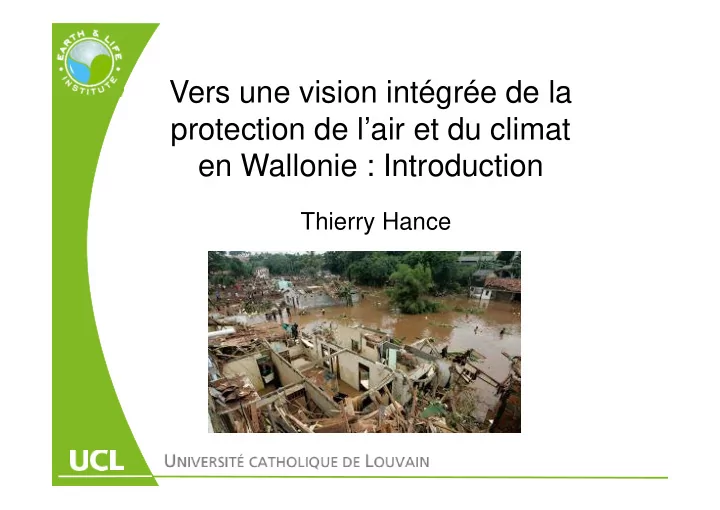
Vers une vision intgre de la protection de lair et du climat en - - PowerPoint PPT Presentation
Vers une vision intgre de la protection de lair et du climat en Wallonie : Introduction Thierry Hance UCL Vol 461 | 24 September 2009 FE ATUR E Asa feope ra tingspa ceforhum a nity
morethan what couldbeconsiderednatural.
andfreshwater environments
17.Thespeedof
18.
thiscentury19.
regional level,but it canhavepervasiveeffects
suchasdisease,andat agreater risk of tipping intoundesiredstates
8,21.
20,21,littleisknownqua
22.
theroleof biodiversityin regulatingtheresil-
significant erosion of ecosystem resilience.
23.At thepla
theysignificantlyperturbtheglobal cyclesof thesetwoimportant elements
24,25.
2
radiativeforcing.
27.The
processes.
straightforward.Wehavedefinedthebound-
theimplicationsof tryingtoreachthistarget,
boundary.
25,28.
timesthenatural backgroundrateof influx.
inducepast ocean anoxicevents
29.
in phosphorusflowingintotheoceans(com- pared with pre-industrial levels),then anoxic
humanitytosafelysteer awayfrom therisk of
andfreshwater systems.
tightlycoupled.Wedonot havetheluxuryof concentratingour effortson anyoneof them
2
and thusaffectingtheclimateboundary.
state.
31,dra
474
NATURE|Vol 461 |24 September 2009
472-475 Opinion Planetary Boundaries MH AU.indd 474 18/9/09 11:12:44
lthough E a rth ha sunde rg
ny pe riodsof s ignifica nt e nvironme n- ta l cha ng e ,thepla ne t’se nvironme nt ha sbe e nunus ua llys ta blefor thepa s t 1 ,0 ye a rs
1 –3.Thispe
riodof s ta bility—knownto g e
is tsa stheHoloc e ne—ha ss e e nhum a n civiliza tionsa ris e ,de ve lopa ndthrive .S uch s ta bilityma ynowbeunde r thre a t.S inc ethe Indus tria l R e volution,ane we raha sa ris e n, theAnthropoce ne
4,inwhichhuma
na ctions ha vebe c
indrive r of g loba l e nvi- ronme nta l cha ng e
e ehuma n a ctivitie spus htheE a rths ys te mouts idethe s ta blee nvironme nta l s ta teof theHoloce ne , withcons e que nce stha t a rede trime nta l or
even catastrophicfor largepartsof theworld.
During the Holoce ne , e nvironme ntal c ha ng eoccurre dna tura llya ndE a rth ’sre g u- la toryca pa cityma inta ine dtheconditions tha t e na ble dhuma nde ve lopme nt.R e g ula r te mpe ra ture s , fre s hwa te r a va ila bility a nd
biogeochemical flowsall stayedwithin arela-
tive lyna rrowra ng e .Now ,la rg e lybe ca us eof ara pidlyg rowingre lia nc eonfos s il fue lsa nd indus tria lize dformsof a g riculture ,huma n a ctivitie sha vere a c he dale ve ltha tcouldda m
g ethes ys te m stha tke e pE a rthinthede s ira ble Holoc e nes ta te .There s ult c
ve rs
nd,ins
ec a s e s ,a brupte nvironm e nta l cha ng e ,le a dingtoas ta tele s sconduciveto huma nde ve lopme nt6.W ithoutpre s s urefrom huma ns ,theHoloce neise xpe cte dtocontinue
for at least several thousandsof years
7.
Planetary boundaries T
e t thecha lle ngeof ma inta iningthe Holoce nes ta te , wepropos eafra me work bas e d on ‘pla ne ta ry bounda rie s ’. The se
Identifyingandquantifyingplanetaryboundariesthat must not betransgressedcouldhelpprevent human activitiesfromcausingunacceptableenvironmental change,argueJ
ks trÖ m and colleagues.
Figure1| Beyond the boundary. Theinner green shadingrepresentstheproposed safeoperating spacefor nineplanetary systems. Thered wedgesrepresent an estimateof thecurrent position for each variable. Theboundariesin threesystems(rateof biodiversity loss, climatechangeand human interferencewith thenitrogen cycle), havealready been exceeded.
A t m
p h e r i c B i
i v e r s i t y l
s C h a n g e i n l a n d u s e G l
a l P h
p h
u s N i t r
e n ( b i
e
h e m i c a l S t r a t
p h e r i c O c e a n a c i d i fi c a t i
C l i m a t e c h a n g e C h e m i c a l p
l u t i
( n
y e t q u a n t i fi e d ) a e r
l
d i n g ( n
y e t q u a n t i fi e d )
e d e p l e t i
f r e s h w a t e r u s e fl
b
n d a r y ) c y c l e c y c l e
SUMMARY
development
consequencesfor humanity
bounda rie sde finethes a feope ra tings pa ce for huma nitywithre s pe ct totheE a rths ys te m a nd a rea s s
te d with thepla ne t’sbio- phys ic a l s ubs ys te msor proce s s e s .Althoug h E a rth ’sc
ple xs ys te m ss
time sre s pond s moothlytoc ha ng ingpre s s ure s ,it s e e m stha t thiswill provetobethee xc e ptionra the r tha n therule .Ma nys ubs ys te msof E a rthre a ct in anonline a r,ofte na brupt,wa y ,a nda repa r- ticula rlys e ns itivea roundthre s holdle ve lsof c e rta inke yva ria ble s .If the s ethre s holdsa re cros s e d,the nim porta nt s ubs ys te ms ,s ucha sa mons
ys te m,c
hift intoane ws ta te ,
n with de le te riousor pote ntia lly e ve n
disastrousconsequencesfor humans
8,9.
Mos t of the s ethre s holdsc a nbede fine dby acritica l va luefor oneor morecontrol va ri- a ble s ,s uc ha sca rbondioxidec
e ntra tion. Nota llproc e s s e sors ubs ys te m sonE a rthha ve we ll-de fine d thre s holds , a lthough huma n a ctionstha t unde rminethere s ilie nc eof s uc h proce s s e sor s ubs ys te ms—for e xa m ple ,la nd a ndwa te rde g ra da tion—ca nincre a s etheris k tha t thre s holdswill a ls
s e dinothe r
processes,such astheclimatesystem.
W eha vetrie dtoide ntifytheE a rth-s ys te m proce s s e sa nda s s
ia te dthre s holdswhic h,if cros s e d,couldg e ne ra teuna cce pta blee nvi- ronme nta l c ha ng e .W eha vefoundnines uc h proce s s e sfor which webe lie veit isne ce s
a rytode finepla ne ta rybounda rie s :c lima te cha ng e ;ra teof biodive rs itylos s(te rre s tria l a ndma rine );inte rfe re ncewiththenitrog e n a ndphos phoruscycle s ;s tra tos phe ricozone de ple tion;oce a na cidifica tion;g loba l fre s h- wa te r us e ;c ha ng einla ndus e ;che mica l pol- lution;a nda tmos phe rica e ros
ding(s e e
Fig.1and Table). In general,planetaryboundariesarevalues
for control va ria ble stha t a ree ithe r a t a‘s a fe ’ dis ta ncefromthre s holds—for proce s s e s withe vide nceof thre s holdbe ha viour —or a t da ng e rousle ve ls—for proce s s e swithout
472
Vol 461 |24 September 2009
472-475 Opinion Planetary Boundaries MH AU.indd 472 18/9/09 11:12:39
e vide nceof thre s holds .De te rminingas a fe dis ta nceinvolve snorma tivejudg e me ntsof hows
tie schoos etode a l withris k a nd unce rta inty .W eha veta ke nacons e rva tive , ris k-a ve rs ea pproa c htoqua ntifyingourpla n- e ta rybounda rie s ,ta kingintoa ccountthela rg e unce rta intie stha t s urroundthetruepos ition
nythre s holds .(Ade ta ile dde s cription
rie s—a ndthea na lys e sbe hind
them —isgiven in ref.10.)
Huma nityma ys
pproa chingthe bounda rie sfor g loba l fre s hwa te r us e ,c ha ng e inla ndus e ,oce a na c idific a tiona ndinte rfe r- e nc ewiththeg loba l phos phorouscycle(s e e
Fig.1).Our analysissuggeststhat threeof the
E a rth-s ys te mproc e s s e s—c lima tec ha ng e ,ra te
rs itylos sa ndinte rfe re nc ew iththe nitrog e ncycle—ha vea lre a dytra ns g re s s e d the ir bounda rie s .F
tte r twoof the s e , thec
ria ble sa rethera teofs pe cie slos s a ndthera tea t whic hN
2isre
move dfromthe a tm
phe rea ndc
rte dtore a ctivenitrog e n forhuma nus e ,re s pe ctive ly .The s ea rera te sof c ha ng etha t c a nnot c
ithout s ig nifi- ca ntlye rodingthere s ilie nceofma jorcom po- ne ntsof E a rth-s ys te mfunctioning .He rewe
describethesethreeprocesses.
Climatechange Anthropog e nicc lima tec ha ng eisnowbe yond dis pute , a nd in therun-up to theclima te ne g
tionsinC
nha g e nthisDe c e mbe r, theinte rna tiona l dis cus s ionsonta rg e tsfor c lima temitig a tionha veinte ns ifie d.The reis ag ro wingc
rg e nc etowa rdsa‘2°Cg ua rd- ra il’ a pproa ch,tha t is ,conta iningtheris ein g loba l me a nte m pe ra turetonomoretha n2°C
abovethepre-industrial level.
Our propos e dclima tebounda ryisba s e d
ta tive lydiffe re nt c lima te
ys te ms ta te s .It ha s twopa ra me te rs :a tmos phe ricc
e ntra tion
rbondioxidea ndra dia tiveforcing(the ra teof e ne rgy cha ng epe r unit a re aof the g lobea sme a s ure da t thetopof thea tmos
re ).W epropos etha t huma ncha ng e sto a tmos phe ricC O
2 conc
e ntra tions s hould not e xc e e d3 5 0pa rtspe r millionbyvolume ,a nd tha tra dia tiveforc ings houldnote xc e e d1wa tt pe r s qua reme trea bovepre
tria l le ve ls . T ra ns g re s s ingthe s ebounda rie sw ill inc re a s e theris kofirre ve rs iblec lima tec ha ng e ,s uc ha s thelos sof ma jor ices he e ts ,a cce le ra te ds e a
ve l ris ea nda brupt s hiftsinfore s t a nda g ri- cultura l s ys te ms .C urre nt C O
2 c
e ntra tion s ta ndsa t3 8 7p.p.m.v .a ndthec ha ng einra dia
The rea rea t le a s t thre ere a s
pos e dclima tebounda ry . F irs t, curre nt cli- ma temode lsma ys ig nific a ntlyunde re s tima te thes e ve rityof long
rmc lima tec ha ng efor ag ive nconc e ntra tionof g re e nhous eg a s e s
1 2.
Mos t mode ls
11 s
ugg e s t tha t adoublingin a tmos phe ricC O
2 c
e ntra tio n will le a d to a g loba l te mpe ra tureris eof a bout 3°C(witha proba bleunc e rta intyra ng eof 2 –4 .5°C )onc e thec lima teha sre g a ine de quilib rium.B utthe s e mode lsdonot inc ludelong
rmre inforc ing fe e dba c kproc e s s e stha t furthe r w a rmthec li- ma te ,s uc ha sde c re a s e sinthes urfa c ea re aof ic ec
rorc ha ng e sinthedis tributionofve g
ta tion.If the s es lowfe e dba c ksa reinc lude d, do ublingC O
2le
ve lsg ive sa ne ve ntua lte m pe ra
a s eof 6°C(withaproba bleunc e r- ta intyra ng eof 4 –8°C ).Thiswouldthre a te n thee c
ica l life
upport s ys te mstha t ha ve de ve lope dinthela teQua te rna rye nviro nme nt, a ndw
e ve re lyc ha lle ng ethevia bilityof
contemporaryhuman societies.
Thes e c
ide ra tionisthes ta bilityof thela rg epola r ic es he e ts .P a la e
lima teda ta fromthepa s t 100million ye a rss howtha t C O
2
conc e ntra tions w e re a ma jor fa ctor in the long
rmcoolingofthepa s t5 0millionye a rs . More
r,thepla ne twa sla rg e lyic e
euntil CO
2conce
ntra tionsfe ll be low450p.p.m.v . (±1 0p.p.m.v .),s ug g e s tingtha tthe reisacrit- ica l thre s holdbe twe e n3 50a nd55 0p.p.m.v . (re f.1 2 ).Our bounda ryof 3 50p.p.m.v .a ims
toensurethecontinued existenceof thelarge polar icesheets.
Third,wea rebe g inningtos e ee vide nc etha t s
a rth ’ss ubs ys te msa rea lre a dymov- ingouts idethe ir s ta bleHoloc e nes ta te .This include sthera pidre tre a t of thes umme r s e a
icein theArcticocean13,theretreat of moun-
ta ing la cie rsa roundtheworld
11,thelos
sof
massfrom theGreenland and West Antarctic
ic es he e ts
1 4 a
nd the a c ce le ra ting ra te s
e a
15.
Rateof biodiversityloss S pe cie se xtinctionisana tura l proce s s ,a nd would occur without huma n a ctions . How- e ve r,biodive rs itylos sintheAnthropoc e neha s a c ce le ra te dma s s ive ly .S pe cie sa rebe c
e xtinct a t ara tetha t ha snot be e ns e e ns inc e
thelast global mass-extinction event16.
Thefos s il re cord s howstha t theba ck- g rounde xtinctionra teforma rinelifeis0 .1 –1 e xtinctionspe r millions pe cie spe r ye a r;for
PLANETARY BOUNDARIES
E arth-system process P arameters Proposed boundary Current status Pre-industrial value
Climatechange (i) Atmospheric carbondioxide concentration (partsper million by volume) 350 387 280 (ii) Changein radiativeforcing (watts per metresquared) 1 1 .5 R ateof biodiversity loss E xtinctionrate(number of species per million speciesper year) 1 >1 00 0.1 –1 Nitrogen cycle(part
phosphoruscycle) Amount of N2 removed from theatmospherefor human use (millions of tonnesper year) 35 1 21 Phosphoruscycle(part
nitrogencycle) Quantity of Pflowinginto the
1 1 8.5–9.5 ~ 1 S tratospheric ozone depletion Concentration of ozone(Dobson unit) 276 283 290 Ocean acidification Global mean saturation state of aragoniteinsurfaceseawater 2.75 2.90 3.44 Global freshwater use Consumptionof freshwater by humans(km3 per year) 4,000 2,600 41 5 Changein land use P ercentageof global land cover converted tocropland 1 5 1 1 .7 Low Atmospheric aerosol loading Overall particulate concentration in theatmosphere,on aregional basis T
Chemical pollution F
endocrinedisrupters,heavy metals and nuclear wastein,theglobal environment,or theeffectson ecosystem and functioningof E arth system thereof T
Boundariesfor processesin red havebeencrossed.Datasources:ref.1 0 and supplementary information
473
NATUR E|Vol 461 |24 September 2009
FEATURE
472-475 Opinion Planetary Boundaries MH AU.indd 473 18/9/09 11:12:44
planetary boundaries. Green zone is the safe operating space (below the boundary), yellow represents the zone of uncertainty (increasing risk), and red is the high-risk zone. The planetary boundary itself lies at the inner heavy
(between the two heavy circles); the center of the figure therefore does not represent values of 0 for the control variables. The control variable shown for climate change is atmospheric CO2 concentration. Processes for which global-level boundaries cannot yet be quantified are represented by gray wedges; these are atmospheric aerosol loading, novel entities and the functional role of biosphere integrity. Modified from (1).
variables for (A) biogeochemical flows – P, (B) biogeochemical flows – N, (C) land-system change, and (D) freshwater use. In each panel, green areas are within the boundary (safe); yellow areas are within the zone of uncertainty (increasing risk); and red areas are beyond the zone of uncertainty (high risk). Gray areas in (A) and (B) are areas where P and N fertilizers are not applied, in (C) are areas not covered by major forest biomes, and in (D) are areas where river flow is very low so that environmental flows are not allocated. See Table 1 for values of the boundaries and their zones of uncertainty, and 33 for more details on methods and results.
Transformation de 43 % de l’écosystème terrestre en écosystème agricole Fragmentation et dégradation des écosystèmes naturels Pollution des Océans avec l’apparition de zones mortes
450 zones mortes représentant 6,6 millions de Km2 Changements climatiques Pollution de l’air
Les 9 élements qui posent les limites des conditions de vie sur terre sont étroitement liés et interdépendants
Agir sur le climat
raisons économiques Repenser l’économie