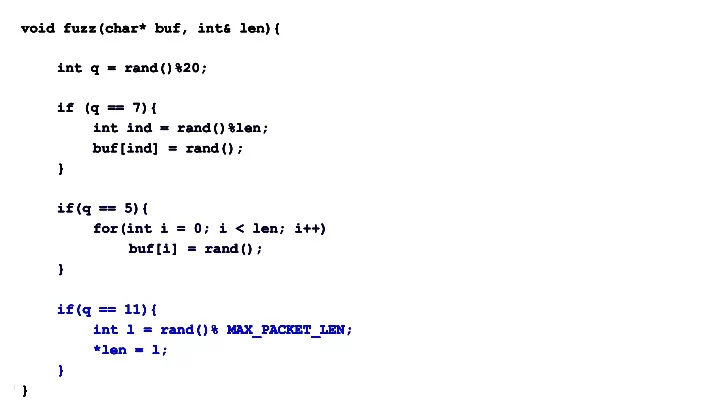
SLIDE 1 void fuzz(char* buf, int& len){ int q = rand()%20; if (q == 7){ int ind = rand()%len; buf[ind] = rand(); } if(q == 5){ for(int i = 0; i < len; i++) buf[i] = rand(); } if(q == 11){ int l = rand()% MAX_PACKET_LEN; *len = l; } } void fuzz(char* buf, int& len){ int q = rand()%20; if (q == 7){ int ind = rand()%len; buf[ind] = rand(); } if(q == 5){ for(int i = 0; i < len; i++) buf[i] = rand(); } if(q == 11){ int l = rand()% MAX_PACKET_LEN; *len = l; } } void fuzz(char* buf, int& len){ int q = rand()%20; if (q == 7){ int ind = rand()%len; buf[ind] = rand(); } if(q == 5){ for(int i = 0; i < len; i++) buf[i] = rand(); } if(q == 11){ int l = rand()% MAX_PACKET_LEN; *len = l; } } void fuzz(char* buf, int& len){ int q = rand()%20; if (q == 7){ int ind = rand()%len; buf[ind] = rand(); } if(q == 5){ for(int i = 0; i < len; i++) buf[i] = rand(); } if(q == 11){ int l = rand()% MAX_PACKET_LEN; *len = l; } } void fuzz(char* buf, int& len){ int q = rand()%20; if (q == 7){ int ind = rand()%len; buf[ind] = rand(); } if(q == 5){ for(int i = 0; i < len; i++) buf[i] = rand(); } if(q == 11){ int l = rand()% MAX_PACKET_LEN; *len = l; } }
SLIDE 2
Adventures in Video Conferencing
SLIDE 3 About Me
- Natalie Silvanovich AKA natashenka
- Project Zero member
- Previously did mobile security on Android and
BlackBerry
- Defensive-turned-offensive researcher
SLIDE 4 Video Conferencing
- Video conferencing has expanded greatly in the past 5 years
○ Browsers ○ FaceTime ○ WhatsApp ○ Facebook ○ Signal
SLIDE 5
WebRTC
SLIDE 6 What is WebRTC?
- RTC = Real Time Communication
- Audio and video conferencing library maintained by Chrome
- Used by
○ Browsers (Chrome, Firefox, Safari) ○ Messaging applications (Whatsapp, Facebook Messenger, Signal, SnapChat, Slack, etc.)
- Little security information available
SLIDE 7
SLIDE 8
WebRTC Architecture
SLIDE 9
WebRTC Architecture
SLIDE 10 Packet Decoding Sequence
RTP decrypt RTP error correction VP8/VP9/H264
payload format decoding codec decoding Audio or video
SLIDE 11 Idea 1: Session Description Protocol
- SDP is the most sensitive interface of WebRTC
○ WebRTC requires parsing untrusted SDP with no user interaction
- Used WebRTC library to create SDP fuzzer on commandline
- Reviewed SDP code
- No bugs!
- Some platforms implement separately
SLIDE 12 Idea 2: RTP and Media Protocols
- WebRTC has already implemented fuzzers for RTP
, media protocols and codecs ○ But what about end-to-end?
- Wrote end-to-end fuzzer for RTP
SLIDE 13 Evolution of a fuzzer
Prototype
- Altered Chrome to add fuzzer
- Had one browser instance ‘call’ another
- Crashed roughly every 30 seconds
- Learned that the concept would generally work
- Got very shallow bugs that blocked fuzzing fixed
SLIDE 14 Evolution of a fuzzer
Client Fuzzer
- Wrote C++ client that interacts with browser
○ Lighter weight than browser ○ Can run against any target ○ Pro: crashes are guaranteed to work on browser ○ Con: slow
- Found additional end-to-end vulnerabilities in WebRTC
SLIDE 15 Evolution of a fuzzer
Distributed Fuzzer
- Wrote command line RTP emulator with help of WebRTC
team ○ Pro: extremely fast, runs on multiple cores ○ Pro: supports coverage ○ Con: not an exact representation of any WebRTC implementation
SLIDE 16 Results
- 7 vulnerabilities found and fixed
○ CVE-2018-6130 -- out-of-bounds memory issue related to in VP9 ○ CVE-2018-6129 -- out-of-bounds read in VP9 ○ CVE-2018-6157 -- type confusion in H264 ○ CVE-2018-6156 -- overflow in FEC ○ CVE-2018-6155 -- use-after-free in VP8 ○ CVE-2018-16071 -- a use-after-free in VP9 ○ CVE-2018-16083 -- out-of-bounds read in FEC
SLIDE 17
CVE-2018-6130
std::map<int64_t, GofInfo> gof_info_ RTC_GUARDED_BY(crit_); gof_info_.emplace(unwrapped_tl0, GofInfo(&scalability_structures_[current_ss_idx_], frame->id.picture_id)); if (frame->frame_type() == kVideoFrameKey) { GofInfo info = gof_info_.find(codec_header.tl0_pic_idx)->second; FrameReceivedVp9(frame->id.picture_id, &info); UnwrapPictureIds(frame); return kHandOff; }
SLIDE 18
CVE-2018-6130
std::map<int64_t, GofInfo> gof_info_ RTC_GUARDED_BY(crit_); gof_info_.emplace(unwrapped_tl0, GofInfo(&scalability_structures_[current_ss_idx_], frame->id.picture_id)); if (frame->frame_type() == kVideoFrameKey) { GofInfo info = gof_info_.find(codec_header.tl0_pic_idx)->second; FrameReceivedVp9(frame->id.picture_id, &info); UnwrapPictureIds(frame); return kHandOff; }
SLIDE 19
CVE-2018-6130
const_iterator std::map::find ( const key_type & __x ) const [inline] Tries to locate an element in a map. Parameters: x Key of (key, value) pair to be located. Returns: Read-only (constant) iterator pointing to sought-after element, or end() if not found.
SLIDE 20 WebRTC Security Problems
- WebRTC has billions of users
- WebRTC provided no way to report security bugs
- WebRTC documentation provided no guidance on updates
SLIDE 21
FaceTime
SLIDE 22 FaceTime
- FaceTime is closed-source and proprietary
- Needed to modify binary to log packets
SLIDE 23 FaceTime Encryption
- Used IDA to identify call to encryption function
SLIDE 24 Hooking Functions on MacOS
- CCCryptorUpdate seemed a good candidate for recording
RTP
- DYLD_INTERPOSE can be used to redirect library calls on
Macs
- Requires setting an environment variable
○ This isn’t possible for AVConference, which is started as a daemon
SLIDE 25 Hooking Functions on MacOS
- DYLD_INTERPOSE can also be called in the static section
- f a library loaded by a Mac binary
- Found insert_dylib on github
https://github.com/Tyilo/insert_dylib
- Inserted static library that hooked CCCryptorUpdate
SLIDE 26
DYLD_INTERPOSE(mycryptor, CCCryptorUpdate); CCCryptorStatus mycryptor( CCCryptorRef cryptorRef, const void *dataIn, size_t dataInLength, void *dataOut, size_t dataOutAvailable,size_t *dataOutMoved) {
SLIDE 27 Hooking Functions on MacOS
- Tried making a call
- Needed some refinement
○ Limited hooking to functions that sent RTP ○ Added a spinlock ○ Patched binary to pass length
- Could alter RTP in real time, but replay did not work!
SLIDE 28 Hooking Functions on MacOS
Encoded AV Internet Decoded AV Caller Callee encrypt decrypt log or replay
SLIDE 29 Investigating RTP Packets
- Read through _SendRTP function to figure out packet
generation
- Discovered RTP headers were created well after
encryption
SLIDE 30 Interesting Parts of RTP Headers
- SSRC is a random identifier that identifies a stream
○ FaceTime cannot be limited to a single stream
- Payload type is a constant that identifies content type
- Extensions are extra information that is independent of
the stream data ○ Screen orientation ○ Mute ○ Quality ○ Wait a sec, these totally depend on stream data
SLIDE 31
- Tried replaying with existing headers
- Hooked sendmsg to capture and log header
○ Needed to tie encrypted message to header ○ sendmsg NOT called on packets in the same order as encryption (even with a spinlock) ○ Need to ‘fix’ SSRC and sequence number
Hooking Headers?
SLIDE 32 Fixing headers
Encoded AV Internet Decoded AV Caller Callee add header decrypt Encrypted AV Full packet sendmsg encrypt
SLIDE 33 Fixing headers (send)
Encoded AV Internet Decoded AV Caller Callee add header decrypt Encrypted AV Full packet sendmsg encrypt log log
SLIDE 34 Fixing headers (replay)
Encoded AV Internet Decoded AV Caller Callee add header decrypt Encrypted AV Full packet sendmsg encrypt Copy payload from log Copy header from log and fix SSRC
SLIDE 35
- Patched endpoint to remove encryption
○ This worked, but can’t do it on an iPhone ○ Audio data clearly getting corrupted in decryption
- Created a cryptor queue for each SSRC, and
encrypted the data in order
- Discovered encryption is XTS with sequence number
as counter
Still Didn’t Work
SLIDE 36 Fixing headers
Encoded AV Internet Decoded AV Caller Callee add header decrypt Encrypted AV Full packet sendmsg encrypt create cryptor
SLIDE 37 Steps to Log
- Hook CCCryptorCreate to log cryptors as they are created
○ Store cryptors by thread in queues
- Hook CCCryptorUpdate, and prevent packets from being
encrypted
- Hook sendmsg, log unencrypted packet, and then encrypt
it using the cryptor from the queue
SLIDE 38 Fixing headers (send)
Encoded AV Internet Decoded AV Caller Callee add header decrypt Encoded AV Full packet sendmsg do not encrypt create cryptor queue log entire packet then encrypt payload
SLIDE 39
- Hook CCCryptorCreate to log cryptors as they are created
○ Store cryptors by thread in queues
- Hook sendmsg, save current ssrc and sequence number if
it hasn’t been seen before
- Copy logged packet into current packet
Steps to Replay
SLIDE 40
- Replace logged ssrc with ssrc for payload type
- Replace logged sequence number with logged sequence
number - starting logged sequence number + starting sequence number for ssrc
- Pop a cryptor for the payload type and encrypt the payload
○ If there are no cryptors left, don’t send and wait
Steps to Replay
SLIDE 41 Fixing headers (replay)
Encoded AV Internet Decoded AV Caller Callee add header decrypt Encrypted AV Full packet sendmsg create cryptor queue copy logged packet fix SSRC and seq num encrypt payload
SLIDE 42
Demo
SLIDE 43 Results
- CVE-2018-4366 -- out-of-bounds read in video processing on
Mac
- CVE-2018-4367 -- stack corruption
- CVE-2018-4384 -- kernel heap corruption in video processing
○ CVE-2015-7006 (found by Adam Donenfeld of Zimperium) is similar and exploitable
- CVE-2019-6224 -- overflow in splitting RED packets
SLIDE 44
WhatsApp
SLIDE 45 WhatsApp
○ Desktop app does not do voice
- No symbols, but log entries from libsrtp and PJSIP
○ PJSIP is a commercial library similar to WebRTC
- Identified memcpy from packet to buffer before
encryption (looked for srtp_protect log entries)
SLIDE 46
- Wrote a Frida script that hooked all memcpy instances
- Frida is awesome!
hook_code ="" Interceptor.attach (Module.findExportByName ( "libc.so", "read"), {
- nEnter: function (args) {
send (Memory.readUtf8String (args [1])); },
- nLeave: function (retval) {
}
WhatsApp
SLIDE 47
- Frida is too slow to make a call without a lot of lag
○ Good for debugging binary changes though
- Changed specific memcpy to point to function I wrote in
ARM64
- Assembly of my function overwrote GIF transcoder
WhatsApp
SLIDE 48
- Had issues with calls disconnecting, turned out I was
corrupting a used register
- After a few fixes could log and alter incoming packets
- Replaying packets by pure copying did not work
WhatsApp
SLIDE 49
- WhatsApp has FOUR RTP streams, even when muted
- Luckily, they have different payload types
- Fixing ssrc and sending logged packets worked
WhatsApp
SLIDE 50
- WhatsApp handles signal crashes internally
○ Creates crash reports in unknown format ○ FB Messenger and other apps also do this
- WhatsApp crashes do not get logged by logcat
- Stubbed out signal() and sigset() in library to get around
this
- Crashes were logged by Android after this
Crash Detection
SLIDE 51 Result
- CVE-2018-6344 -- Heap Corruption in RTP Processing
SLIDE 52 WhatsApp Signalling
- While reversing RTP processing, it became clear signalling
messages were processed by native code
- Processing was not limited to correct packets for the state
- Reviewed each entry point
- Found boring crashes, but nothing interesting
○ Service respawns
SLIDE 53 WhatsApp Signalling
- Discovered signalling processes a large JSON blob
“voip_params” from the server
- Sets dozens of parameters internally
- Discovered a peer could send this blob in one packet type
- Reviewed the code
- Fuzzed the parser with help from Tavis Ormandy
- No bugs ...
SLIDE 54 WhatsApp Signalling
- WhatsApp was aware of these attack surfaces
- Was aware of other voip_params issues
○ Fixed the one I reported quickly ○ Considering signing
- Has plans to reduce the attack surface of signalling
SLIDE 55
Conclusions
SLIDE 56
SLIDE 57 Bug Summary
- WebRTC: 7 bugs
- FaceTime: 5 bugs
- WhatsApp: 1 bug
SLIDE 58 Bug Location
- RTP: 0
- Error correction: 3
- Payload format: 7
- Codec: 2
SLIDE 59 Timing
- WebRTC: 4 weeks
- FaceTime: 6 weeks
- WhatsApp RTP: 2 days
- WhatsApp signalling: 3 weeks
SLIDE 60 Conclusions
- Video conferencing contained many vulnerabilities
○ Complexity is a cause, but probably necessary ○ Patching is a concern
- Video conferencing lacks test tools
○ Tooling was time consuming but worth it ○ https://github.com/googleprojectzero/Street-Party
- Signaling is a possible area for more bugs
- RTP needs more fuzzing
SLIDE 61
Questions
https://googleprojectzero.blogspot.com/ @natashenka natashenka@google.com