Chapter 7: Runtime Environment Run time memory organization. char - - PowerPoint PPT Presentation

chapter 7 runtime environment
SMART_READER_LITE
LIVE PREVIEW

Chapter 7: Runtime Environment Run time memory organization. char - - PowerPoint PPT Presentation

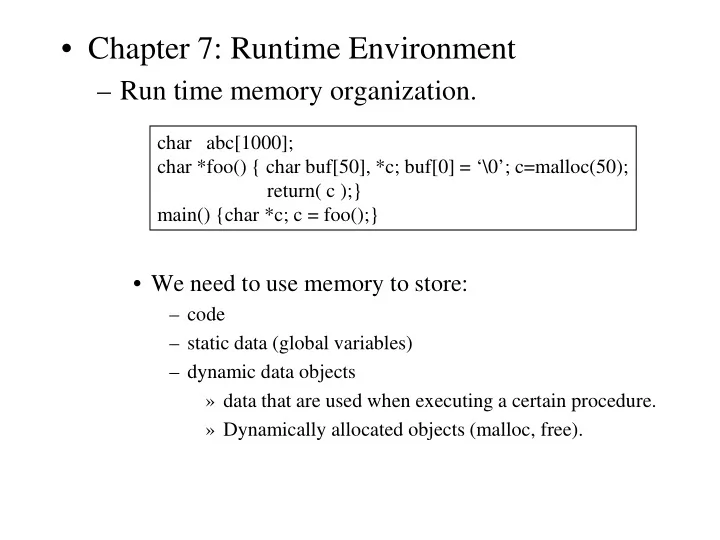
Chapter 7: Runtime Environment Run time memory organization. char abc[1000]; char *foo() { char buf[50], *c; buf[0] = \0; c=malloc(50); return( c );} main() {char *c; c = foo();} We need to use memory to store: code


slide-1
SLIDE 1
  • Chapter 7: Runtime Environment

– Run time memory organization.

  • We need to use memory to store:

– code – static data (global variables) – dynamic data objects » data that are used when executing a certain procedure. » Dynamically allocated objects (malloc, free). char abc[1000]; char *foo() { char buf[50], *c; buf[0] = ‘\0’; c=malloc(50); return( c );} main() {char *c; c = foo();}

slide-2
SLIDE 2

– Typical organization of run-time memory

Code Static Data (global variables) stack (memory for procedures) heap (memory for dynamically allocated data)

slide-3
SLIDE 3
  • Activation Records:
  • also called frames
  • Information(memory) needed by a single execution
  • f a procedure
  • A general activation record:

Return value actual parameters

  • ptional control link
  • ptional access link

machine status local variables temporaries

slide-4
SLIDE 4

– Storage Allocation Strategies

  • static allocation lays out storage for all data objects

at compile time.

– Restrictions: » size of object must be known and alignment requirements must be known at compile time. » No recursion. » No dynamic data structure

  • Stack allocation manages the run time storage as a

stack

– The activation record is pushed on as a function is entered. – The activation record is popped off as a function exits. – Restrictions:

» values of locals cannot be retained when an activation ends. » A called activation cannot outlive a caller.

slide-5
SLIDE 5
  • Heap allocation -- allocates and deallocates stroage

as needed at runtime from a data area known as heap.

– Most flexible: no longer requires the activation of procedures to be LIFO. – Most inefficient: need true dynamic memory management.

  • Note: static allocation too restricted, heap allocation

too inefficient. Most current compiler/language/processor uses the stack allocation scheme.

slide-6
SLIDE 6

– Example of stack allocation:

Program sort var procedure readarray; …. function partition(…) …. procedure quicksort(…) …… partition quicksort quicksort …. Begin …… readarray quicksort end Main readarray quicksort(1, 9) partition(1, 9) quicksort(1, 3) partition(1, 3) quicksort(1, 0)

slide-7
SLIDE 7
  • How would this happen (push and pop the

activation record)?

– Everything must be done by the compiler. – What makes this happen is known as calling sequence (how to implement a procedure call).

  • A calling sequence allocates an activation record

and enters information into its fields (push the activation record).

– On the opposite of the calling sequence is the return sequence.

  • Return sequence restores the state of the machine so

that the calling procedure can continue execution.

slide-8
SLIDE 8
  • A possible calling sequence:

– The caller evaluates actuals and push the actuals on the stack – The caller saves return address(pc) the old value of sp into the stack – The caller increments the sp – The callee saves registers and other status information – The callee initializes its local variables and begin execution.

  • A possible return sequence:

– The callee places a return value next to the activation record of the caller. – The callee restores other registers and sp and return (jump to pc). – The caller copies the return value to its activation record.

  • In today’s processors, there is usually special support for

efficiently realizing calling/return sequence: executing procedures is too important!!

slide-9
SLIDE 9
  • Access to nonlocal variables.

– Nonlocal variables in C (without nested procedures):

  • Still have nested scopes (blocks).
  • Solution:

– All data declared outside procedures are static. – Other names must be at the activation record at the top of the stack, can be accessed from sp. » Treat a block as a parameter-less procedure » Allocates space for all blocks in a procedure.

  • Example: Fig. 7.18 in page 413.
slide-10
SLIDE 10
  • Access to nonlocal variables.

– Nonlocal variables in PASCAL (with nested procedures):

  • the scheme for C will break.
slide-11
SLIDE 11
  • Access to nonlocal variables.

– Nonlocal variables in PASCAL (with nested procedures):

  • The scheme for C will break (static for all non-

locals).

  • Access links

– If p is nested immediately within q in the source text, then the access link in an activation record for p points to the access link in the record for the most recent activation of q. – A procedure p at nesting depth n_p accesses a nonlocal a at nesting depth n_a: (1) following n_p – n_a links and (2) using the relative offset in the activation record.

slide-12
SLIDE 12
slide-13
SLIDE 13
slide-14
SLIDE 14
  • Display:
  • An alternative to access link ( a faster method to

access nonlocals ).

  • Using an array d of pointers to activation records,

the array is called a display.

– Referencing nonlocal variables always requires only two memory references.

  • Suppose control is in a procedure p at nesting depth

j, then the first j-1 elements of the display point to the most recent activation of the procedures that lexically enclose procedure p, and d[j] points to the activation of p.

slide-15
SLIDE 15
  • Setting up the display:
  • When a new activation record for a procedure at

nesting depth k:

– save the value of d[k] in the new activation record – set d[k] to point to the new activation record.

slide-16
SLIDE 16

– Parameter passing

  • The method to associate actual parameters with

formal parameters.

  • The parameter passing method will effect the code

generated.

  • Call-by-value:

– The actual parameters are evaluated and their r-values are passed to the called procedure. – Implementation: » a formal parameter is treated like a local name, so the storage for the formals is in the activation record of the called procedure. » The caller evaluates the actual parameters and places their r-values in the storage for the formals.

slide-17
SLIDE 17

– Call-by-reference:

  • also called call-by address or call-by-location.
  • The caller passes to the called procedure a pointer to

the storage address of each actual parameter.

– Actuall parameter must have an address -- only variables make sense, an expression will not (location of the temporary that holds the result of the expression will be passed).

– Copy-restore:

  • A hybrid between call-by-value and call-by-

reference.

– The actual parameters are evaluated and its r-values are passed to the called procedure as in call-by-value. – When the control returns, the r-value of the formal parameters are copied back into the l-value of the actuals.