Variable and Address Variable = Storage in computer Memory memory - - PDF document

variable and address
SMART_READER_LITE
LIVE PREVIEW

Variable and Address Variable = Storage in computer Memory memory - - PDF document

2/25/14 Variable and Address Variable = Storage in computer Memory memory 0 70 char 1 31 Pointers o Contains some value 2 4 int 3 6 o Must reside at a specific location 4 30 called address 5 1 6 10 o Basic unit byte


slide-1
SLIDE 1

2/25/14 ¡ 1 ¡

Pointers

Based on slides from K. N. King and Dianna Xu Bryn Mawr College CS246 Programming Paradigm

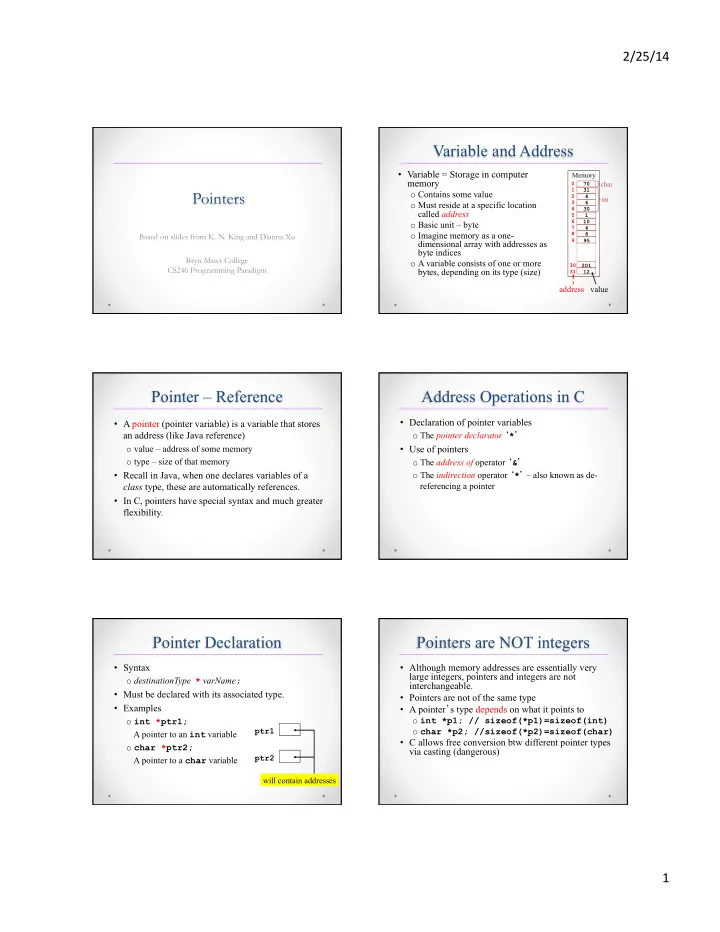
Variable and Address

  • Variable = Storage in computer

memory

  • Contains some value
  • Must reside at a specific location

called address

  • Basic unit – byte
  • Imagine memory as a one-

dimensional array with addresses as byte indices

  • A variable consists of one or more

bytes, depending on its type (size)

Memory

70 31 4 6 30 1 10 4 6 95 201 12 1 2 3 4 5 6 7 8 9 30 31

address value

char int

Pointer – Reference

  • A pointer (pointer variable) is a variable that stores

an address (like Java reference)

  • value – address of some memory
  • type – size of that memory
  • Recall in Java, when one declares variables of a

class type, these are automatically references.

  • In C, pointers have special syntax and much greater

flexibility.

Address Operations in C

  • Declaration of pointer variables
  • The pointer declarator ‘*’
  • Use of pointers
  • The address of operator ‘&’
  • The indirection operator ‘*’ – also known as de-

referencing a pointer

Pointer Declaration

  • Syntax
  • destinationType * varName;
  • Must be declared with its associated type.
  • Examples
  • int *ptr1;

A pointer to an int variable

  • char *ptr2;

A pointer to a char variable

ptr1 ptr2 will contain addresses

Pointers are NOT integers

  • Although memory addresses are essentially very

large integers, pointers and integers are not interchangeable.

  • Pointers are not of the same type
  • A pointer’s type depends on what it points to
  • int *p1; // sizeof(*p1)=sizeof(int)
  • char *p2; //sizeof(*p2)=sizeof(char)
  • C allows free conversion btw different pointer types

via casting (dangerous)

slide-2
SLIDE 2

2/25/14 ¡ 2 ¡

Address of Operator

  • Syntax
  • & expression

The expression must have an address. E.g., a constant such as “1” does not have an address.

  • Example
  • int x = 1;

f(&x); The address of x (i.e. where x is stored in memory), say, the memory location 567, (not 1) is passed to f.

x 1

address = 567

Pointer Assignment

  • A pointer p points to x if x’s address is stored in p
  • Example
  • int x = 1;

int *p; p = &x; Interpreted as:

p 567 x 1

address = 567

p x 1

Pointer Diagram

0012FF88 8 ip i (@0012FF88)

int i = 8; int *ip; ip = &i;

Pointer Assignment

  • A pointer p points to x if x’s address is stored in p
  • Example
  • int x = 1;

int *p, *q; p = &x; q = p; Interpreted as:

p 567 x 1

address = 567

p x 1 q 567 q

Pointer Assignment

  • Example
  • int x=1, y=2, *p, *q;

p = &x; q = &y; q = p;

p 567 y 2

address = 988

q 988 x 1

address = 567

567

Indirection Operator

  • Syntax
  • * pointerVar
  • Allows access to value of memory being pointed to
  • Also called dereferencing
  • Example
  • int x = 1, *p;

p = &x; printf("%d\n", *p); *p refers to x; thus prints 1

p x 1

Note: ‘*’ in a declaration and ‘*’ in an expression are different. int *p; int * p; int* p;

slide-3
SLIDE 3

2/25/14 ¡ 3 ¡

Assignment Using Indirection Operator

  • Allows access to a variable indirectly through a

pointer pointed to it.

  • Pointers and integers are not interchangeable
  • Example
  • int x = 1, *p;

p = &x; *p = 2; printf("%d\n", x);

  • *p is equivalent to x

p x 1 p x 2

Schematically

int x = 1; int *p; p = &x; printf("%d", *p); *p = 2; printf("%d", x);

x

1

p

prints 1

x

1

p

prints 2

x

2

p

Notes

  • Pointer and integers are not exchangeable
  • Levels of addressing (i.e. layers of pointers) can

be arbitrarily deep

  • Remember the & that you MUST put in front of

scanf variables?

  • Failing to pass a pointer where one is expected or

vise versa always leads to segmentation faults.