Using R for analysing spatio-temporal datasets: Bigiarini a - - PowerPoint PPT Presentation

using r for analysing spatio temporal datasets
SMART_READER_LITE
LIVE PREVIEW

Using R for analysing spatio-temporal datasets: Bigiarini a - - PowerPoint PPT Presentation

EGU2017- 18343 (R4SREs) M. Zambrano- Using R for analysing spatio-temporal datasets: Bigiarini a satellite-based precipitation case study 2-minute madness Session Rs deliberate role in Earth sciences Motivation Precipitation


slide-1
SLIDE 1

EGU2017- 18343 (R4SREs)

  • M. Zambrano-

Bigiarini 2-minute madness Motivation

Precipitation Limitations Why SREs?

Datasets

Selected SREs

Point-to-pixel R functions

Downloading raster hydroTSM hydroGOF

Results Ongoing work References

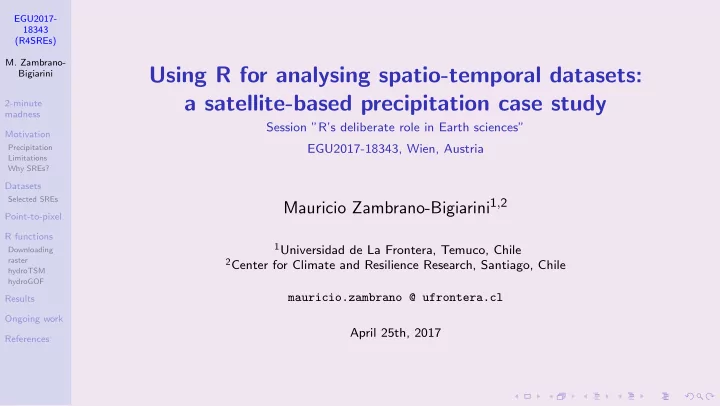
Using R for analysing spatio-temporal datasets: a satellite-based precipitation case study

Session ”R’s deliberate role in Earth sciences” EGU2017-18343, Wien, Austria

Mauricio Zambrano-Bigiarini1,2

1Universidad de La Frontera, Temuco, Chile 2Center for Climate and Resilience Research, Santiago, Chile

mauricio.zambrano @ ufrontera.cl April 25th, 2017

slide-2
SLIDE 2

EGU2017- 18343 (R4SREs)

  • M. Zambrano-

Bigiarini 2-minute madness Motivation

Precipitation Limitations Why SREs?

Datasets

Selected SREs

Point-to-pixel R functions

Downloading raster hydroTSM hydroGOF

Results Ongoing work References

Outline

1 2-minute madness 2 Motivation

Precipitation: a key hydrological forcing Limitations of station-based precipitation Why using SREs ?

3 Datasets

Selected SREs

4 Point-to-pixel comparison 5 R functions and scripts

Automatic downloading of SRE files raster package hydroTSM package hydroGOF package

6 Results 7 Ongoing work

slide-3
SLIDE 3

EGU2017- 18343 (R4SREs)

  • M. Zambrano-

Bigiarini 2-minute madness Motivation

Precipitation Limitations Why SREs?

Datasets

Selected SREs

Point-to-pixel R functions

Downloading raster hydroTSM hydroGOF

Results Ongoing work References

Problem description

  • Precipitation is a key driver of the water and energy cycles.
slide-4
SLIDE 4

EGU2017- 18343 (R4SREs)

  • M. Zambrano-

Bigiarini 2-minute madness Motivation

Precipitation Limitations Why SREs?

Datasets

Selected SREs

Point-to-pixel R functions

Downloading raster hydroTSM hydroGOF

Results Ongoing work References

Problem description

  • Precipitation is a key driver of the water and energy cycles.
  • Traditional (i.e., station-based) representation of the spatio-temporal variability
  • f precipitation has several limitations.
slide-5
SLIDE 5

EGU2017- 18343 (R4SREs)

  • M. Zambrano-

Bigiarini 2-minute madness Motivation

Precipitation Limitations Why SREs?

Datasets

Selected SREs

Point-to-pixel R functions

Downloading raster hydroTSM hydroGOF

Results Ongoing work References

Problem description

  • Precipitation is a key driver of the water and energy cycles.
  • Traditional (i.e., station-based) representation of the spatio-temporal variability
  • f precipitation has several limitations.
  • In the last decades, several satellite-based rainfall estimates (SREs) have provided

an unprecedented opportunity for improving the spatio-temporal representation

  • f precipitation.
slide-6
SLIDE 6

EGU2017- 18343 (R4SREs)

  • M. Zambrano-

Bigiarini 2-minute madness Motivation

Precipitation Limitations Why SREs?

Datasets

Selected SREs

Point-to-pixel R functions

Downloading raster hydroTSM hydroGOF

Results Ongoing work References

Problem description

  • Precipitation is a key driver of the water and energy cycles.
  • Traditional (i.e., station-based) representation of the spatio-temporal variability
  • f precipitation has several limitations.
  • In the last decades, several satellite-based rainfall estimates (SREs) have provided

an unprecedented opportunity for improving the spatio-temporal representation

  • f precipitation.
  • State-of-the-art SREs are provided in different file formats (e.g., .bin, .nc, .tiff),

with different spatial extents and different temporal frequencies (e.g., half-hourly, 3-hours, daily, monthly).

slide-7
SLIDE 7

EGU2017- 18343 (R4SREs)

  • M. Zambrano-

Bigiarini 2-minute madness Motivation

Precipitation Limitations Why SREs?

Datasets

Selected SREs

Point-to-pixel R functions

Downloading raster hydroTSM hydroGOF

Results Ongoing work References

Problem description

  • Precipitation is a key driver of the water and energy cycles.
  • Traditional (i.e., station-based) representation of the spatio-temporal variability
  • f precipitation has several limitations.
  • In the last decades, several satellite-based rainfall estimates (SREs) have provided

an unprecedented opportunity for improving the spatio-temporal representation

  • f precipitation.
  • State-of-the-art SREs are provided in different file formats (e.g., .bin, .nc, .tiff),

with different spatial extents and different temporal frequencies (e.g., half-hourly, 3-hours, daily, monthly).

  • Hydrological models usually require long time series (e.g., 30 years) of

precipitation to run and explore climate impacts on streamflows.

slide-8
SLIDE 8

EGU2017- 18343 (R4SREs)

  • M. Zambrano-

Bigiarini 2-minute madness Motivation

Precipitation Limitations Why SREs?

Datasets

Selected SREs

Point-to-pixel R functions

Downloading raster hydroTSM hydroGOF

Results Ongoing work References

Problem description

  • Precipitation is a key driver of the water and energy cycles.
  • Traditional (i.e., station-based) representation of the spatio-temporal variability
  • f precipitation has several limitations.
  • In the last decades, several satellite-based rainfall estimates (SREs) have provided

an unprecedented opportunity for improving the spatio-temporal representation

  • f precipitation.
  • State-of-the-art SREs are provided in different file formats (e.g., .bin, .nc, .tiff),

with different spatial extents and different temporal frequencies (e.g., half-hourly, 3-hours, daily, monthly).

  • Hydrological models usually require long time series (e.g., 30 years) of

precipitation to run and explore climate impacts on streamflows. ∴ it is computationally challenging to read and analyse hundreds/thousands of station-based time series and SRE files.

slide-9
SLIDE 9

EGU2017- 18343 (R4SREs)

  • M. Zambrano-

Bigiarini 2-minute madness Motivation

Precipitation Limitations Why SREs?

Datasets

Selected SREs

Point-to-pixel R functions

Downloading raster hydroTSM hydroGOF

Results Ongoing work References

My R solution:

1 To develop R scripts to automatically download daily SRE files for a

user-defined time period and clip them to the desired spatial extent (if necessary).

slide-10
SLIDE 10

EGU2017- 18343 (R4SREs)

  • M. Zambrano-

Bigiarini 2-minute madness Motivation

Precipitation Limitations Why SREs?

Datasets

Selected SREs

Point-to-pixel R functions

Downloading raster hydroTSM hydroGOF

Results Ongoing work References

My R solution:

1 To develop R scripts to automatically download daily SRE files for a

user-defined time period and clip them to the desired spatial extent (if necessary).

2 To use the raster package to read, plot, and carry out an EDA, in order to

detect unexpected problems (e.g., rotated spatial domains, wrong order of variables in NetCDF files, missing NA flags).

slide-11
SLIDE 11

EGU2017- 18343 (R4SREs)

  • M. Zambrano-

Bigiarini 2-minute madness Motivation

Precipitation Limitations Why SREs?

Datasets

Selected SREs

Point-to-pixel R functions

Downloading raster hydroTSM hydroGOF

Results Ongoing work References

My R solution:

1 To develop R scripts to automatically download daily SRE files for a

user-defined time period and clip them to the desired spatial extent (if necessary).

2 To use the raster package to read, plot, and carry out an EDA, in order to

detect unexpected problems (e.g., rotated spatial domains, wrong order of variables in NetCDF files, missing NA flags).

3 To use raster along with the hydroTSM package to aggregate SRE files and

rain gauge time series into different temporal scales (daily, monthly, seasonal, annual).

slide-12
SLIDE 12

EGU2017- 18343 (R4SREs)

  • M. Zambrano-

Bigiarini 2-minute madness Motivation

Precipitation Limitations Why SREs?

Datasets

Selected SREs

Point-to-pixel R functions

Downloading raster hydroTSM hydroGOF

Results Ongoing work References

My R solution:

1 To develop R scripts to automatically download daily SRE files for a

user-defined time period and clip them to the desired spatial extent (if necessary).

2 To use the raster package to read, plot, and carry out an EDA, in order to

detect unexpected problems (e.g., rotated spatial domains, wrong order of variables in NetCDF files, missing NA flags).

3 To use raster along with the hydroTSM package to aggregate SRE files and

rain gauge time series into different temporal scales (daily, monthly, seasonal, annual).

4 To use hydroTSM along with the hydroGOF package to carry out a

point-to-pixel comparison between ts observed at 366 stations and the corresponding grid cell of each SRE.

slide-13
SLIDE 13

EGU2017- 18343 (R4SREs)

  • M. Zambrano-

Bigiarini 2-minute madness Motivation

Precipitation Limitations Why SREs?

Datasets

Selected SREs

Point-to-pixel R functions

Downloading raster hydroTSM hydroGOF

Results Ongoing work References

My R solution:

1 To develop R scripts to automatically download daily SRE files for a

user-defined time period and clip them to the desired spatial extent (if necessary).

2 To use the raster package to read, plot, and carry out an EDA, in order to

detect unexpected problems (e.g., rotated spatial domains, wrong order of variables in NetCDF files, missing NA flags).

3 To use raster along with the hydroTSM package to aggregate SRE files and

rain gauge time series into different temporal scales (daily, monthly, seasonal, annual).

4 To use hydroTSM along with the hydroGOF package to carry out a

point-to-pixel comparison between ts observed at 366 stations and the corresponding grid cell of each SRE. Are you curious about specific functions and results? → go to Spot A.4.

slide-14
SLIDE 14

EGU2017- 18343 (R4SREs)

  • M. Zambrano-

Bigiarini 2-minute madness Motivation

Precipitation Limitations Why SREs?

Datasets

Selected SREs

Point-to-pixel R functions

Downloading raster hydroTSM hydroGOF

Results Ongoing work References

Outline

1 2-minute madness 2 Motivation

Precipitation: a key hydrological forcing Limitations of station-based precipitation Why using SREs ?

3 Datasets

Selected SREs

4 Point-to-pixel comparison 5 R functions and scripts

Automatic downloading of SRE files raster package hydroTSM package hydroGOF package

6 Results 7 Ongoing work

slide-15
SLIDE 15

EGU2017- 18343 (R4SREs)

  • M. Zambrano-

Bigiarini 2-minute madness Motivation

Precipitation Limitations Why SREs?

Datasets

Selected SREs

Point-to-pixel R functions

Downloading raster hydroTSM hydroGOF

Results Ongoing work References

Precipitation (rainfall, snow, hail, ...)

  • It is a key component of the water and energy cycles, that contributes to

moderate the climate.

slide-16
SLIDE 16

EGU2017- 18343 (R4SREs)

  • M. Zambrano-

Bigiarini 2-minute madness Motivation

Precipitation Limitations Why SREs?

Datasets

Selected SREs

Point-to-pixel R functions

Downloading raster hydroTSM hydroGOF

Results Ongoing work References

Precipitation (rainfall, snow, hail, ...)

  • It is a key component of the water and energy cycles, that contributes to

moderate the climate.

  • Several ecosystems and economic activities depend on it, in particular

silviculture and agriculture.

slide-17
SLIDE 17

EGU2017- 18343 (R4SREs)

  • M. Zambrano-

Bigiarini 2-minute madness Motivation

Precipitation Limitations Why SREs?

Datasets

Selected SREs

Point-to-pixel R functions

Downloading raster hydroTSM hydroGOF

Results Ongoing work References

Precipitation (rainfall, snow, hail, ...)

  • It is a key component of the water and energy cycles, that contributes to

moderate the climate.

  • Several ecosystems and economic activities depend on it, in particular

silviculture and agriculture.

  • In contrast to other meteorological variables (e.g., Temp), precipitation

presents a low correlation in time and space. In particular, its distribution might be fractal in space and discontinuous in time.

slide-18
SLIDE 18

EGU2017- 18343 (R4SREs)

  • M. Zambrano-

Bigiarini 2-minute madness Motivation

Precipitation Limitations Why SREs?

Datasets

Selected SREs

Point-to-pixel R functions

Downloading raster hydroTSM hydroGOF

Results Ongoing work References

Precipitation (rainfall, snow, hail, ...)

  • It is a key component of the water and energy cycles, that contributes to

moderate the climate.

  • Several ecosystems and economic activities depend on it, in particular

silviculture and agriculture.

  • In contrast to other meteorological variables (e.g., Temp), precipitation

presents a low correlation in time and space. In particular, its distribution might be fractal in space and discontinuous in time.

  • Moreover, local variations of topography might have an important effect on

the total amount of an event.

slide-19
SLIDE 19

EGU2017- 18343 (R4SREs)

  • M. Zambrano-

Bigiarini 2-minute madness Motivation

Precipitation Limitations Why SREs?

Datasets

Selected SREs

Point-to-pixel R functions

Downloading raster hydroTSM hydroGOF

Results Ongoing work References

Precipitation (rainfall, snow, hail, ...)

  • It is a key component of the water and energy cycles, that contributes to

moderate the climate.

  • Several ecosystems and economic activities depend on it, in particular

silviculture and agriculture.

  • In contrast to other meteorological variables (e.g., Temp), precipitation

presents a low correlation in time and space. In particular, its distribution might be fractal in space and discontinuous in time.

  • Moreover, local variations of topography might have an important effect on

the total amount of an event. ∴ The correct assessment of its amount, distribution and intensity it is of utmost importance for the integrated water resources management of a basin.

slide-20
SLIDE 20

EGU2017- 18343 (R4SREs)

  • M. Zambrano-

Bigiarini 2-minute madness Motivation

Precipitation Limitations Why SREs?

Datasets

Selected SREs

Point-to-pixel R functions

Downloading raster hydroTSM hydroGOF

Results Ongoing work References

Type of precipitation data

In general, available data on precipitation can be classified in:

1 Station-based (In situ) only: e.g., raingauges, CRU TS, GPCC,

APHRODITE, PREC/L.

slide-21
SLIDE 21

EGU2017- 18343 (R4SREs)

  • M. Zambrano-

Bigiarini 2-minute madness Motivation

Precipitation Limitations Why SREs?

Datasets

Selected SREs

Point-to-pixel R functions

Downloading raster hydroTSM hydroGOF

Results Ongoing work References

Type of precipitation data

In general, available data on precipitation can be classified in:

1 Station-based (In situ) only: e.g., raingauges, CRU TS, GPCC,

APHRODITE, PREC/L.

2 Satellite-based only: e.g., PERSIANN, CMORPH, CHOMPS, etc.

slide-22
SLIDE 22

EGU2017- 18343 (R4SREs)

  • M. Zambrano-

Bigiarini 2-minute madness Motivation

Precipitation Limitations Why SREs?

Datasets

Selected SREs

Point-to-pixel R functions

Downloading raster hydroTSM hydroGOF

Results Ongoing work References

Type of precipitation data

In general, available data on precipitation can be classified in:

1 Station-based (In situ) only: e.g., raingauges, CRU TS, GPCC,

APHRODITE, PREC/L.

2 Satellite-based only: e.g., PERSIANN, CMORPH, CHOMPS, etc. 3 Combination of in situ and satellite: e.g., GPCP, CMAP, TRMM 3B42, etc.

slide-23
SLIDE 23

EGU2017- 18343 (R4SREs)

  • M. Zambrano-

Bigiarini 2-minute madness Motivation

Precipitation Limitations Why SREs?

Datasets

Selected SREs

Point-to-pixel R functions

Downloading raster hydroTSM hydroGOF

Results Ongoing work References

Some limitations of station-based precipitation:

  • Incomplete time series → gap filling (from other incomplete time series).
slide-24
SLIDE 24

EGU2017- 18343 (R4SREs)

  • M. Zambrano-

Bigiarini 2-minute madness Motivation

Precipitation Limitations Why SREs?

Datasets

Selected SREs

Point-to-pixel R functions

Downloading raster hydroTSM hydroGOF

Results Ongoing work References

Some limitations of station-based precipitation:

  • Incomplete time series → gap filling (from other incomplete time series).
  • Low spatial density of stations in high-elevation areas (installation and

maintenance costs), where usually most of the precipitation happens.

slide-25
SLIDE 25

EGU2017- 18343 (R4SREs)

  • M. Zambrano-

Bigiarini 2-minute madness Motivation

Precipitation Limitations Why SREs?

Datasets

Selected SREs

Point-to-pixel R functions

Downloading raster hydroTSM hydroGOF

Results Ongoing work References

Some limitations of station-based precipitation:

  • Incomplete time series → gap filling (from other incomplete time series).
  • Low spatial density of stations in high-elevation areas (installation and

maintenance costs), where usually most of the precipitation happens.

  • Underestimation of the precipitation amount in high-elevation areas → high

uncertainties in hydrological modelling applications (as input data)

slide-26
SLIDE 26

EGU2017- 18343 (R4SREs)

  • M. Zambrano-

Bigiarini 2-minute madness Motivation

Precipitation Limitations Why SREs?

Datasets

Selected SREs

Point-to-pixel R functions

Downloading raster hydroTSM hydroGOF

Results Ongoing work References

Some limitations of station-based precipitation:

  • Incomplete time series → gap filling (from other incomplete time series).
  • Low spatial density of stations in high-elevation areas (installation and

maintenance costs), where usually most of the precipitation happens.

  • Underestimation of the precipitation amount in high-elevation areas → high

uncertainties in hydrological modelling applications (as input data)

  • Moreover, in situ measurements of precipitation are affected by wind,

installation errors, and other systematic and random errors.

slide-27
SLIDE 27

EGU2017- 18343 (R4SREs)

  • M. Zambrano-

Bigiarini 2-minute madness Motivation

Precipitation Limitations Why SREs?

Datasets

Selected SREs

Point-to-pixel R functions

Downloading raster hydroTSM hydroGOF

Results Ongoing work References

Why using satellite-based rainfall estimates (SREs)?

  • SREs were developed to overcome many of the limitations of in situ

measurements

slide-28
SLIDE 28

EGU2017- 18343 (R4SREs)

  • M. Zambrano-

Bigiarini 2-minute madness Motivation

Precipitation Limitations Why SREs?

Datasets

Selected SREs

Point-to-pixel R functions

Downloading raster hydroTSM hydroGOF

Results Ongoing work References

Why using satellite-based rainfall estimates (SREs)?

  • SREs were developed to overcome many of the limitations of in situ

measurements

  • Several SREs have become operational in last decades, with quasi-global

spatial coverage and relatively high temporal and spatial resolution.

slide-29
SLIDE 29

EGU2017- 18343 (R4SREs)

  • M. Zambrano-

Bigiarini 2-minute madness Motivation

Precipitation Limitations Why SREs?

Datasets

Selected SREs

Point-to-pixel R functions

Downloading raster hydroTSM hydroGOF

Results Ongoing work References

Why using satellite-based rainfall estimates (SREs)?

  • SREs were developed to overcome many of the limitations of in situ

measurements

  • Several SREs have become operational in last decades, with quasi-global

spatial coverage and relatively high temporal and spatial resolution.

  • SREs have opened unprecedent opportunities for hydrological applications

in areas with scarce or inexistent data.

slide-30
SLIDE 30

EGU2017- 18343 (R4SREs)

  • M. Zambrano-

Bigiarini 2-minute madness Motivation

Precipitation Limitations Why SREs?

Datasets

Selected SREs

Point-to-pixel R functions

Downloading raster hydroTSM hydroGOF

Results Ongoing work References

Why using satellite-based rainfall estimates (SREs)?

  • SREs were developed to overcome many of the limitations of in situ

measurements

  • Several SREs have become operational in last decades, with quasi-global

spatial coverage and relatively high temporal and spatial resolution.

  • SREs have opened unprecedent opportunities for hydrological applications

in areas with scarce or inexistent data.

  • Many satellite-based precipitation products combine information coming from

different satellites (i.e., multi-satellite).

slide-31
SLIDE 31

EGU2017- 18343 (R4SREs)

  • M. Zambrano-

Bigiarini 2-minute madness Motivation

Precipitation Limitations Why SREs?

Datasets

Selected SREs

Point-to-pixel R functions

Downloading raster hydroTSM hydroGOF

Results Ongoing work References

Outline

1 2-minute madness 2 Motivation

Precipitation: a key hydrological forcing Limitations of station-based precipitation Why using SREs ?

3 Datasets

Selected SREs

4 Point-to-pixel comparison 5 R functions and scripts

Automatic downloading of SRE files raster package hydroTSM package hydroGOF package

6 Results 7 Ongoing work

slide-32
SLIDE 32

EGU2017- 18343 (R4SREs)

  • M. Zambrano-

Bigiarini 2-minute madness Motivation

Precipitation Limitations Why SREs?

Datasets

Selected SREs

Point-to-pixel R functions

Downloading raster hydroTSM hydroGOF

Results Ongoing work References

Selected satellite-based rainfall estimates (SREs)

SRE Full name (with hyperlink) Latitudinal Spatial Temporal Temporal References Coverage Resol. Coverage Resol. CMORPH NOAA Climate Prediction Center (CPC) MORPHing technique 60◦N-60◦S 0.07◦, 0.25◦ Dec-2002

  • present

half-hourly, 3-hourly, daily

Joyce et al. 2004; CPC-NCEP- NWS-NOAA-USDC 2011

PERSIANN-CDR PERSIANN Climate Data Record, Ver- sion 1 Revision 1 60◦N-60◦S 0.25◦ Jan-1983

  • present

daily

Sorooshian et al. 2014; Ashouri et al. 2015

PERSIANN-CCS-adj Precipitation Estimation from Remotely Sensed Information us- ing Artificial Neural Networks 50◦N-50◦S 0.04◦ Jan-2003

  • present

daily

Yang et al. 2016; Hong et al. 2004

3B42v7 TRMM Multi-satellite Precipitation Analysis research product 3B42 Ver- sion 7 50◦N-50◦S 0.25◦ Jan-1998

  • present

3-hourly, daily

Huffman et al. 2007, 2010

CHIRPSv2 Climate Hazards group Infrared Precipitation with Stations Version 2.0 50◦N-50◦S 0.05◦ Jan-1981

  • present

daily, pentadal, monthly

Funk et al. 2015

MSWEPv1.1 Multi-Source Weighted-Ensemble Precipitation Version 1.1 90◦N-90◦S 0.25◦ Jan-1979 Dec-2014 3-hourly, daily

Beck et al. 2016

PGFv3 Princeton University Global Meteoro- logical Forcing Version 3 17◦S-57◦S 0.25◦ Jan-1979 Dec-2010 daily

Peng et al. 2016; Sheffield et al. 2006
slide-33
SLIDE 33

EGU2017- 18343 (R4SREs)

  • M. Zambrano-

Bigiarini 2-minute madness Motivation

Precipitation Limitations Why SREs?

Datasets

Selected SREs

Point-to-pixel R functions

Downloading raster hydroTSM hydroGOF

Results Ongoing work References

Outline

1 2-minute madness 2 Motivation

Precipitation: a key hydrological forcing Limitations of station-based precipitation Why using SREs ?

3 Datasets

Selected SREs

4 Point-to-pixel comparison 5 R functions and scripts

Automatic downloading of SRE files raster package hydroTSM package hydroGOF package

6 Results 7 Ongoing work

slide-34
SLIDE 34

EGU2017- 18343 (R4SREs)

  • M. Zambrano-

Bigiarini 2-minute madness Motivation

Precipitation Limitations Why SREs?

Datasets

Selected SREs

Point-to-pixel R functions

Downloading raster hydroTSM hydroGOF

Results Ongoing work References

Comparison SREs vs rain gauges

Procedure to compare SRE against rain gauge data:

slide-35
SLIDE 35

EGU2017- 18343 (R4SREs)

  • M. Zambrano-

Bigiarini 2-minute madness Motivation

Precipitation Limitations Why SREs?

Datasets

Selected SREs

Point-to-pixel R functions

Downloading raster hydroTSM hydroGOF

Results Ongoing work References

Comparison SREs vs rain gauges

Procedure to compare SRE against rain gauge data:

1 Download satellite images for each selected SRE.

slide-36
SLIDE 36

EGU2017- 18343 (R4SREs)

  • M. Zambrano-

Bigiarini 2-minute madness Motivation

Precipitation Limitations Why SREs?

Datasets

Selected SREs

Point-to-pixel R functions

Downloading raster hydroTSM hydroGOF

Results Ongoing work References

Comparison SREs vs rain gauges

Procedure to compare SRE against rain gauge data:

1 Download satellite images for each selected SRE. 2 Re-project and apply a zonal mask.

slide-37
SLIDE 37

EGU2017- 18343 (R4SREs)

  • M. Zambrano-

Bigiarini 2-minute madness Motivation

Precipitation Limitations Why SREs?

Datasets

Selected SREs

Point-to-pixel R functions

Downloading raster hydroTSM hydroGOF

Results Ongoing work References

Comparison SREs vs rain gauges

Procedure to compare SRE against rain gauge data:

1 Download satellite images for each selected SRE. 2 Re-project and apply a zonal mask. 3 To aggregate raster files into different temporal resolutions (daily → monthly

→ → annual).

slide-38
SLIDE 38

EGU2017- 18343 (R4SREs)

  • M. Zambrano-

Bigiarini 2-minute madness Motivation

Precipitation Limitations Why SREs?

Datasets

Selected SREs

Point-to-pixel R functions

Downloading raster hydroTSM hydroGOF

Results Ongoing work References

Comparison SREs vs rain gauges

Procedure to compare SRE against rain gauge data:

1 Download satellite images for each selected SRE. 2 Re-project and apply a zonal mask. 3 To aggregate raster files into different temporal resolutions (daily → monthly

→ → annual).

4 Point-to-pixel comparison: SRE vs raingauge (Thiemig et al., 2012), using continuous

and categorical performance indices. All the previous steps were carried out with R (R Core Team, 2016), ”the” open source software for statistic computations and graphics.

slide-39
SLIDE 39

EGU2017- 18343 (R4SREs)

  • M. Zambrano-

Bigiarini 2-minute madness Motivation

Precipitation Limitations Why SREs?

Datasets

Selected SREs

Point-to-pixel R functions

Downloading raster hydroTSM hydroGOF

Results Ongoing work References

Outline

1 2-minute madness 2 Motivation

Precipitation: a key hydrological forcing Limitations of station-based precipitation Why using SREs ?

3 Datasets

Selected SREs

4 Point-to-pixel comparison 5 R functions and scripts

Automatic downloading of SRE files raster package hydroTSM package hydroGOF package

6 Results 7 Ongoing work

slide-40
SLIDE 40

EGU2017- 18343 (R4SREs)

  • M. Zambrano-

Bigiarini 2-minute madness Motivation

Precipitation Limitations Why SREs?

Datasets

Selected SREs

Point-to-pixel R functions

Downloading raster hydroTSM hydroGOF

Results Ongoing work References

1) Automatic downloading of SRE files

slide-41
SLIDE 41

EGU2017- 18343 (R4SREs)

  • M. Zambrano-

Bigiarini 2-minute madness Motivation

Precipitation Limitations Why SREs?

Datasets

Selected SREs

Point-to-pixel R functions

Downloading raster hydroTSM hydroGOF

Results Ongoing work References

2) Main raster functions used in the analysis - I

  • raster: it reads any single raster file supported by GDAL (and the ncdf4

pkg) into a RasterLayer object. x < −raster(”path to my file”)

slide-42
SLIDE 42

EGU2017- 18343 (R4SREs)

  • M. Zambrano-

Bigiarini 2-minute madness Motivation

Precipitation Limitations Why SREs?

Datasets

Selected SREs

Point-to-pixel R functions

Downloading raster hydroTSM hydroGOF

Results Ongoing work References

2) Main raster functions used in the analysis - I

  • raster: it reads any single raster file supported by GDAL (and the ncdf4

pkg) into a RasterLayer object. x < −raster(”path to my file”)

  • stack: it reads all the file(s) stored in a directory into a (multi-band)

RasterStack object. s < −stack(”path to my directory”)

slide-43
SLIDE 43

EGU2017- 18343 (R4SREs)

  • M. Zambrano-

Bigiarini 2-minute madness Motivation

Precipitation Limitations Why SREs?

Datasets

Selected SREs

Point-to-pixel R functions

Downloading raster hydroTSM hydroGOF

Results Ongoing work References

2) Main raster functions used in the analysis - I

  • raster: it reads any single raster file supported by GDAL (and the ncdf4

pkg) into a RasterLayer object. x < −raster(”path to my file”)

  • stack: it reads all the file(s) stored in a directory into a (multi-band)

RasterStack object. s < −stack(”path to my directory”)

  • brick: it reads a single (multi-band) file into a (multi-layer) RasterBrick
  • bject. Processing time should be shorter when using a RasterBrick
  • bject.

b < −brick(”path to my multiband file”)

slide-44
SLIDE 44

EGU2017- 18343 (R4SREs)

  • M. Zambrano-

Bigiarini 2-minute madness Motivation

Precipitation Limitations Why SREs?

Datasets

Selected SREs

Point-to-pixel R functions

Downloading raster hydroTSM hydroGOF

Results Ongoing work References

2) Main raster functions used in the analysis - I

  • raster: it reads any single raster file supported by GDAL (and the ncdf4

pkg) into a RasterLayer object. x < −raster(”path to my file”)

  • stack: it reads all the file(s) stored in a directory into a (multi-band)

RasterStack object. s < −stack(”path to my directory”)

  • brick: it reads a single (multi-band) file into a (multi-layer) RasterBrick
  • bject. Processing time should be shorter when using a RasterBrick
  • bject.

b < −brick(”path to my multiband file”)

  • plot: it plots any raster object already read with raster/stack/brick.

plot(x) ; plot(s) ; plot(b)

slide-45
SLIDE 45

EGU2017- 18343 (R4SREs)

  • M. Zambrano-

Bigiarini 2-minute madness Motivation

Precipitation Limitations Why SREs?

Datasets

Selected SREs

Point-to-pixel R functions

Downloading raster hydroTSM hydroGOF

Results Ongoing work References

2) Main raster functions used in the analysis - II

  • crop: it returns a geographic subset of a Raster* object as specified by an

Extent object. e < −extent(−160, 10, 30, 60) rc < −crop(x, e)

slide-46
SLIDE 46

EGU2017- 18343 (R4SREs)

  • M. Zambrano-

Bigiarini 2-minute madness Motivation

Precipitation Limitations Why SREs?

Datasets

Selected SREs

Point-to-pixel R functions

Downloading raster hydroTSM hydroGOF

Results Ongoing work References

2) Main raster functions used in the analysis - II

  • crop: it returns a geographic subset of a Raster* object as specified by an

Extent object. e < −extent(−160, 10, 30, 60) rc < −crop(x, e)

  • extract: it extracts values from a Raster* object at the locations of other

spatial data. stations < −readOGR(”.”, ”raingauges”) rp < −extract(x, stations)

slide-47
SLIDE 47

EGU2017- 18343 (R4SREs)

  • M. Zambrano-

Bigiarini 2-minute madness Motivation

Precipitation Limitations Why SREs?

Datasets

Selected SREs

Point-to-pixel R functions

Downloading raster hydroTSM hydroGOF

Results Ongoing work References

2) Main raster functions used in the analysis - II

  • crop: it returns a geographic subset of a Raster* object as specified by an

Extent object. e < −extent(−160, 10, 30, 60) rc < −crop(x, e)

  • extract: it extracts values from a Raster* object at the locations of other

spatial data. stations < −readOGR(”.”, ”raingauges”) rp < −extract(x, stations)

  • writeRaster: it writes a Raster* object into any format supported by GDAL

(and the ncdf4 pkg). x < −writeRaster(x, filename = ”my file.tif ”, format = ”GTiff ”)

slide-48
SLIDE 48

EGU2017- 18343 (R4SREs)

  • M. Zambrano-

Bigiarini 2-minute madness Motivation

Precipitation Limitations Why SREs?

Datasets

Selected SREs

Point-to-pixel R functions

Downloading raster hydroTSM hydroGOF

Results Ongoing work References

3) Main hydroTSM functions used in the analysis

  • daily2monthly: it transforms a daily (sub-daily or weekly) regular time series

into a monthly one. data(SanMartinoPPts) d < −SanMartinoPPts m < −daily2monthly(d, FUN = sum, na.rm = TRUE)

slide-49
SLIDE 49

EGU2017- 18343 (R4SREs)

  • M. Zambrano-

Bigiarini 2-minute madness Motivation

Precipitation Limitations Why SREs?

Datasets

Selected SREs

Point-to-pixel R functions

Downloading raster hydroTSM hydroGOF

Results Ongoing work References

3) Main hydroTSM functions used in the analysis

  • daily2monthly: it transforms a daily (sub-daily or weekly) regular time series

into a monthly one. data(SanMartinoPPts) d < −SanMartinoPPts m < −daily2monthly(d, FUN = sum, na.rm = TRUE)

  • daily2annual: it transforms a (sub)daily/monthly (weekly and quarterly)

regular time series into an annual one. a < −daily2annual(d, FUN = sum, na.rm = TRUE)

slide-50
SLIDE 50

EGU2017- 18343 (R4SREs)

  • M. Zambrano-

Bigiarini 2-minute madness Motivation

Precipitation Limitations Why SREs?

Datasets

Selected SREs

Point-to-pixel R functions

Downloading raster hydroTSM hydroGOF

Results Ongoing work References

3) Main hydroTSM functions used in the analysis

  • daily2monthly: it transforms a daily (sub-daily or weekly) regular time series

into a monthly one. data(SanMartinoPPts) d < −SanMartinoPPts m < −daily2monthly(d, FUN = sum, na.rm = TRUE)

  • daily2annual: it transforms a (sub)daily/monthly (weekly and quarterly)

regular time series into an annual one. a < −daily2annual(d, FUN = sum, na.rm = TRUE)

  • dm2seasonal: it computes a seasonal value for every year of a

sub-daily/daily/weekly/monthly time series. dm2seasonal(d, FUN = sum, season = ”DJF”)

slide-51
SLIDE 51

EGU2017- 18343 (R4SREs)

  • M. Zambrano-

Bigiarini 2-minute madness Motivation

Precipitation Limitations Why SREs?

Datasets

Selected SREs

Point-to-pixel R functions

Downloading raster hydroTSM hydroGOF

Results Ongoing work References

4) Continuous performance indices (hydroGOF)

Modified Kling-Gupta efficiency (KGE ′)

It was used along with its three individual components; linear correlation (r), bias (β) and variability (γ); to identify possible sources of systematic errors in each SRE.

slide-52
SLIDE 52

EGU2017- 18343 (R4SREs)

  • M. Zambrano-

Bigiarini 2-minute madness Motivation

Precipitation Limitations Why SREs?

Datasets

Selected SREs

Point-to-pixel R functions

Downloading raster hydroTSM hydroGOF

Results Ongoing work References

4) Continuous performance indices (hydroGOF)

Modified Kling-Gupta efficiency (KGE ′)

It was used along with its three individual components; linear correlation (r), bias (β) and variability (γ); to identify possible sources of systematic errors in each SRE.

1 KGE ′ = 1 −

  • (r − 1)2 + (β − 1)2 + (γ − 1)2
slide-53
SLIDE 53

EGU2017- 18343 (R4SREs)

  • M. Zambrano-

Bigiarini 2-minute madness Motivation

Precipitation Limitations Why SREs?

Datasets

Selected SREs

Point-to-pixel R functions

Downloading raster hydroTSM hydroGOF

Results Ongoing work References

4) Continuous performance indices (hydroGOF)

Modified Kling-Gupta efficiency (KGE ′)

It was used along with its three individual components; linear correlation (r), bias (β) and variability (γ); to identify possible sources of systematic errors in each SRE.

1 KGE ′ = 1 −

  • (r − 1)2 + (β − 1)2 + (γ − 1)2

2 r = Cov(S,O) σS·σO

slide-54
SLIDE 54

EGU2017- 18343 (R4SREs)

  • M. Zambrano-

Bigiarini 2-minute madness Motivation

Precipitation Limitations Why SREs?

Datasets

Selected SREs

Point-to-pixel R functions

Downloading raster hydroTSM hydroGOF

Results Ongoing work References

4) Continuous performance indices (hydroGOF)

Modified Kling-Gupta efficiency (KGE ′)

It was used along with its three individual components; linear correlation (r), bias (β) and variability (γ); to identify possible sources of systematic errors in each SRE.

1 KGE ′ = 1 −

  • (r − 1)2 + (β − 1)2 + (γ − 1)2

2 r = Cov(S,O) σS·σO 3 β = µs µo

slide-55
SLIDE 55

EGU2017- 18343 (R4SREs)

  • M. Zambrano-

Bigiarini 2-minute madness Motivation

Precipitation Limitations Why SREs?

Datasets

Selected SREs

Point-to-pixel R functions

Downloading raster hydroTSM hydroGOF

Results Ongoing work References

4) Continuous performance indices (hydroGOF)

Modified Kling-Gupta efficiency (KGE ′)

It was used along with its three individual components; linear correlation (r), bias (β) and variability (γ); to identify possible sources of systematic errors in each SRE.

1 KGE ′ = 1 −

  • (r − 1)2 + (β − 1)2 + (γ − 1)2

2 r = Cov(S,O) σS·σO 3 β = µs µo 4 γ = CVs CVo = σs/µs σo/µo

slide-56
SLIDE 56

EGU2017- 18343 (R4SREs)

  • M. Zambrano-

Bigiarini 2-minute madness Motivation

Precipitation Limitations Why SREs?

Datasets

Selected SREs

Point-to-pixel R functions

Downloading raster hydroTSM hydroGOF

Results Ongoing work References

4) Continuous performance indices (hydroGOF)

Modified Kling-Gupta efficiency (KGE ′)

It was used along with its three individual components; linear correlation (r), bias (β) and variability (γ); to identify possible sources of systematic errors in each SRE.

1 KGE ′ = 1 −

  • (r − 1)2 + (β − 1)2 + (γ − 1)2

2 r = Cov(S,O) σS·σO 3 β = µs µo 4 γ = CVs CVo = σs/µs σo/µo

where:

  • S: Satellite-based precipitation values, [mm].
  • O: Precipitation values observed at the raingauge, [mm].
slide-57
SLIDE 57

EGU2017- 18343 (R4SREs)

  • M. Zambrano-

Bigiarini 2-minute madness Motivation

Precipitation Limitations Why SREs?

Datasets

Selected SREs

Point-to-pixel R functions

Downloading raster hydroTSM hydroGOF

Results Ongoing work References

5) Categorical performance indices (hydroGOF)

Rainfall event Intensity (i), [mm d−1] No rain [0 , 1) Light rain [1 , 5) Moderate rain [5 , 20) Heavy rain [20 , 40) Violent rain ≥ 40 Satellite-product Observed rainfall Yes No Total Yes Hit (H) False Alarm (FA) H + FA No Miss(M) Correct Negative (CN) M + CN Total H + M FA + CN Ne

slide-58
SLIDE 58

EGU2017- 18343 (R4SREs)

  • M. Zambrano-

Bigiarini 2-minute madness Motivation

Precipitation Limitations Why SREs?

Datasets

Selected SREs

Point-to-pixel R functions

Downloading raster hydroTSM hydroGOF

Results Ongoing work References

5) Categorical performance indices (hydroGOF)

Rainfall event Intensity (i), [mm d−1] No rain [0 , 1) Light rain [1 , 5) Moderate rain [5 , 20) Heavy rain [20 , 40) Violent rain ≥ 40 Satellite-product Observed rainfall Yes No Total Yes Hit (H) False Alarm (FA) H + FA No Miss(M) Correct Negative (CN) M + CN Total H + M FA + CN Ne

1 Percent correct: PC = H+CN Ne

slide-59
SLIDE 59

EGU2017- 18343 (R4SREs)

  • M. Zambrano-

Bigiarini 2-minute madness Motivation

Precipitation Limitations Why SREs?

Datasets

Selected SREs

Point-to-pixel R functions

Downloading raster hydroTSM hydroGOF

Results Ongoing work References

5) Categorical performance indices (hydroGOF)

Rainfall event Intensity (i), [mm d−1] No rain [0 , 1) Light rain [1 , 5) Moderate rain [5 , 20) Heavy rain [20 , 40) Violent rain ≥ 40 Satellite-product Observed rainfall Yes No Total Yes Hit (H) False Alarm (FA) H + FA No Miss(M) Correct Negative (CN) M + CN Total H + M FA + CN Ne

1 Percent correct: PC = H+CN Ne 2 Probability of detection: POD = H H+M

slide-60
SLIDE 60

EGU2017- 18343 (R4SREs)

  • M. Zambrano-

Bigiarini 2-minute madness Motivation

Precipitation Limitations Why SREs?

Datasets

Selected SREs

Point-to-pixel R functions

Downloading raster hydroTSM hydroGOF

Results Ongoing work References

5) Categorical performance indices (hydroGOF)

Rainfall event Intensity (i), [mm d−1] No rain [0 , 1) Light rain [1 , 5) Moderate rain [5 , 20) Heavy rain [20 , 40) Violent rain ≥ 40 Satellite-product Observed rainfall Yes No Total Yes Hit (H) False Alarm (FA) H + FA No Miss(M) Correct Negative (CN) M + CN Total H + M FA + CN Ne

1 Percent correct: PC = H+CN Ne 2 Probability of detection: POD = H H+M 3 False alarm ratio: FAR = FA H+FA

slide-61
SLIDE 61

EGU2017- 18343 (R4SREs)

  • M. Zambrano-

Bigiarini 2-minute madness Motivation

Precipitation Limitations Why SREs?

Datasets

Selected SREs

Point-to-pixel R functions

Downloading raster hydroTSM hydroGOF

Results Ongoing work References

5) Categorical performance indices (hydroGOF)

Rainfall event Intensity (i), [mm d−1] No rain [0 , 1) Light rain [1 , 5) Moderate rain [5 , 20) Heavy rain [20 , 40) Violent rain ≥ 40 Satellite-product Observed rainfall Yes No Total Yes Hit (H) False Alarm (FA) H + FA No Miss(M) Correct Negative (CN) M + CN Total H + M FA + CN Ne

1 Percent correct: PC = H+CN Ne 2 Probability of detection: POD = H H+M 3 False alarm ratio: FAR = FA H+FA 4 Equitable threat score: ETS = H−He (H+F+M)−He

slide-62
SLIDE 62

EGU2017- 18343 (R4SREs)

  • M. Zambrano-

Bigiarini 2-minute madness Motivation

Precipitation Limitations Why SREs?

Datasets

Selected SREs

Point-to-pixel R functions

Downloading raster hydroTSM hydroGOF

Results Ongoing work References

5) Categorical performance indices (hydroGOF)

Rainfall event Intensity (i), [mm d−1] No rain [0 , 1) Light rain [1 , 5) Moderate rain [5 , 20) Heavy rain [20 , 40) Violent rain ≥ 40 Satellite-product Observed rainfall Yes No Total Yes Hit (H) False Alarm (FA) H + FA No Miss(M) Correct Negative (CN) M + CN Total H + M FA + CN Ne

1 Percent correct: PC = H+CN Ne 2 Probability of detection: POD = H H+M 3 False alarm ratio: FAR = FA H+FA 4 Equitable threat score: ETS = H−He (H+F+M)−He 5 Frequency bias: fBias = H+F H+M

slide-63
SLIDE 63

EGU2017- 18343 (R4SREs)

  • M. Zambrano-

Bigiarini 2-minute madness Motivation

Precipitation Limitations Why SREs?

Datasets

Selected SREs

Point-to-pixel R functions

Downloading raster hydroTSM hydroGOF

Results Ongoing work References

Outline

1 2-minute madness 2 Motivation

Precipitation: a key hydrological forcing Limitations of station-based precipitation Why using SREs ?

3 Datasets

Selected SREs

4 Point-to-pixel comparison 5 R functions and scripts

Automatic downloading of SRE files raster package hydroTSM package hydroGOF package

6 Results 7 Ongoing work

slide-64
SLIDE 64

EGU2017- 18343 (R4SREs)

  • M. Zambrano-

Bigiarini 2-minute madness Motivation

Precipitation Limitations Why SREs?

Datasets

Selected SREs

Point-to-pixel R functions

Downloading raster hydroTSM hydroGOF

Results Ongoing work References

Results

You can see the results of this work on Thursday 27th, 16:00 hrs:

  • Session: HS7.1/AS1.11/NH1.15/NP10.11 - Precipitation: from measurement

to modelling and application in catchment hydrology (co-organized), room B.

  • EGU2017-10425: Assessing the temporal and spatial performance of

satellite-based rainfall estimates across the complex topographical and climatic gradients of Chile.

slide-65
SLIDE 65

EGU2017- 18343 (R4SREs)

  • M. Zambrano-

Bigiarini 2-minute madness Motivation

Precipitation Limitations Why SREs?

Datasets

Selected SREs

Point-to-pixel R functions

Downloading raster hydroTSM hydroGOF

Results Ongoing work References

Outline

1 2-minute madness 2 Motivation

Precipitation: a key hydrological forcing Limitations of station-based precipitation Why using SREs ?

3 Datasets

Selected SREs

4 Point-to-pixel comparison 5 R functions and scripts

Automatic downloading of SRE files raster package hydroTSM package hydroGOF package

6 Results 7 Ongoing work

slide-66
SLIDE 66

EGU2017- 18343 (R4SREs)

  • M. Zambrano-

Bigiarini 2-minute madness Motivation

Precipitation Limitations Why SREs?

Datasets

Selected SREs

Point-to-pixel R functions

Downloading raster hydroTSM hydroGOF

Results Ongoing work References

Ongoing work

  • To upload to CRAN the new stable version of hydroTSM package, with many

new features and source code on Github.

  • To upload to CRAN the new stable version of hydroGOF package, with many

new functions and source code on Github.

  • To release the first beta of a new package (under-development) for automatic

processing of different SRE files.

slide-67
SLIDE 67

EGU2017- 18343 (R4SREs)

  • M. Zambrano-

Bigiarini 2-minute madness Motivation

Precipitation Limitations Why SREs?

Datasets

Selected SREs

Point-to-pixel R functions

Downloading raster hydroTSM hydroGOF

Results Ongoing work References

References I

Ashouri, H., Hsu, K.L., Sorooshian, S., Braithwaite, D.K., Knapp, K.R., Cecil, L.D., Nelson, B.R., Prat, O.P., 2015. PERSIANN-CDR: Daily precipitation climate data record from multisatellite observations for hydrological and climate studies. Bulletin of the American Meteorological Society 96, 69–83. doi:10.1175/BAMS-D-13-00068.1. Beck, H.E., van Dijk, A.I.J.M., Levizzani, V., Schellekens, J., Miralles, D.G., Martens, B., de Roo, A.,

  • 2016. MSWEP: 3-hourly 0.25◦ global gridded precipitation (1979-2015) by merging gauge, satellite,

and reanalysis data. Hydrology and Earth System Sciences Discussions , 1doi:10.5194/hess-2016-236. CPC-NCEP-NWS-NOAA-USDC, 2011. NOAA CPC Morphing Technique (CMORPH) Global Precipitation

  • Analyses. Technical Report. Boulder CO. doi:10.5065/D6CZ356W. [Last Accessed: 25.Jan.2016].

Funk, C., Peterson, P., Landsfeld, M., Pedreros, D., Verdin, J., Shukla, S., Husak, G., Rowland, J., Harrison, L., Hoell, A., Michaelsen, J., 2015. The climate hazards infrared precipitation with stations-a new environmental record for monitoring extremes. Sci Data 2, 150066. doi:10.1038/sdata.2015.66. Hijmans, R.J., 2016. raster: Geographic Data Analysis and Modeling. URL: https://CRAN.R-project.org/package=raster. r package version 2.5-8. Hong, Y., Hsu, K.L., Sorooshian, S., Gao, X., 2004. Precipitation estimation from remotely sensed imagery using an artificial neural network cloud classification system. Journal of Applied Meteorology 43, 1834–1853.

slide-68
SLIDE 68

EGU2017- 18343 (R4SREs)

  • M. Zambrano-

Bigiarini 2-minute madness Motivation

Precipitation Limitations Why SREs?

Datasets

Selected SREs

Point-to-pixel R functions

Downloading raster hydroTSM hydroGOF

Results Ongoing work References

References II

Huffman, G.J., Adler, R.F., Bolvin, D.T., Gu, G., Nelkin, E.J., Bowman, K.P., Hong, Y., Stocker, E.F., Wolff, D.B., 2007. The TRMM multisatellite precipitation analysis (TMPA): Quasi-global, multiyear, combined-sensor precipitation estimates at fine scales. Journal of Hydrometeorology 8, 38. doi:10.1175/JHM560.1. Huffman, G.J., Adler, R.F., Bolvin, D.T., Nelkin, E.J., 2010. The TRMM multi-satellite precipitation analysis (TMPA), in: Gebremichael, M., Hossain, F. (Eds.), Satellite Rainfall Applications for Surface

  • Hydrology. Springer Dordrecht Heidelberg, London New York, pp. 3–22.

doi:10.1007/978-90-481-2915-7_1. Joyce, R.J., Janowiak, J.E., Arkin, P.A., Xie, P., 2004. CMORPH: A method that produces global precipitation estimates from passive microwave and infrared data at high spatial and temporal

  • resolution. Journal of Hydrometeorology 5, 487–503.

doi:10.1175/1525-7541(2004)005<0487:CAMTPG>2.0.CO;2. Peng, L., Sheffield, J., Verbist, K.M.J., 2016. Merging station observations with large-scale gridded data to improve hydrological predictions over Chile, in: 2016 AGU Fall Meeting Abstract, 12-16 December 2016, San Francisco, CA, USA. R Core Team, 2016. R: A Language and Environment for Statistical Computing. R Foundation for Statistical Computing. Vienna, Austria. URL: https://www.R-project.org/. Sheffield, J., Goteti, G., Wood, E.F., 2006. Development of a 50-year high-resolution global dataset of meteorological forcings for land surface modeling. Journal of Climate 19, 3088. doi:10.1175/JCLI3790.1.

slide-69
SLIDE 69

EGU2017- 18343 (R4SREs)

  • M. Zambrano-

Bigiarini 2-minute madness Motivation

Precipitation Limitations Why SREs?

Datasets

Selected SREs

Point-to-pixel R functions

Downloading raster hydroTSM hydroGOF

Results Ongoing work References

References III

Sorooshian, S., Hsu, K., Braithwaite, D., Ashouri, H., NOAA CDR Program , 2014. NOAA Climate Data Record (CDR) of Precipitation Estimation from Remotely Sensed Information using Artificial Neural Networks (PERSIANN-CDR), Version 1 Revision 1. [2003-2014]. Technical Report. NOAA National Centers for Environmental Information. doi:10.7289/V51V5BWQ. [access date: 30-Jan-2016]. Thiemig, V., Rojas, R., Zambrano-Bigiarini, M., Levizzani, V., De Roo, A., 2012. Validation of satellite-based precipitation products over sparsely gauged African river basins. Journal of Hydrometeorology 13, 1760–1783. doi:10.1175/JHM-D-12-032.1. Yang, Z., Hsu, K., Sorooshian, S., Xu, X., Braithwaite, D., Verbist, K.M.J., 2016. Bias adjustment of satellite-based precipitation estimation using gauge observations-a case study in Chile. Journal of Geophysical Research: Atmospheres doi:10.1002/2015JD024540. Zambrano-Bigiarini, M., 2016a. hydroGOF: Goodness-of-fit functions for comparison of simulated and

  • bserved hydrological time series. URL: http://CRAN.R-project.org/package=hydroGOF. R package

version 0.4-0 [under-development]. Zambrano-Bigiarini, M., 2016b. hydroTSM: Time Series Management, Analysis and Interpolation for Hydrological Modelling. URL: http://CRAN.R-project.org/package=hydroTSM. r package version 0.5-0 [under-development].