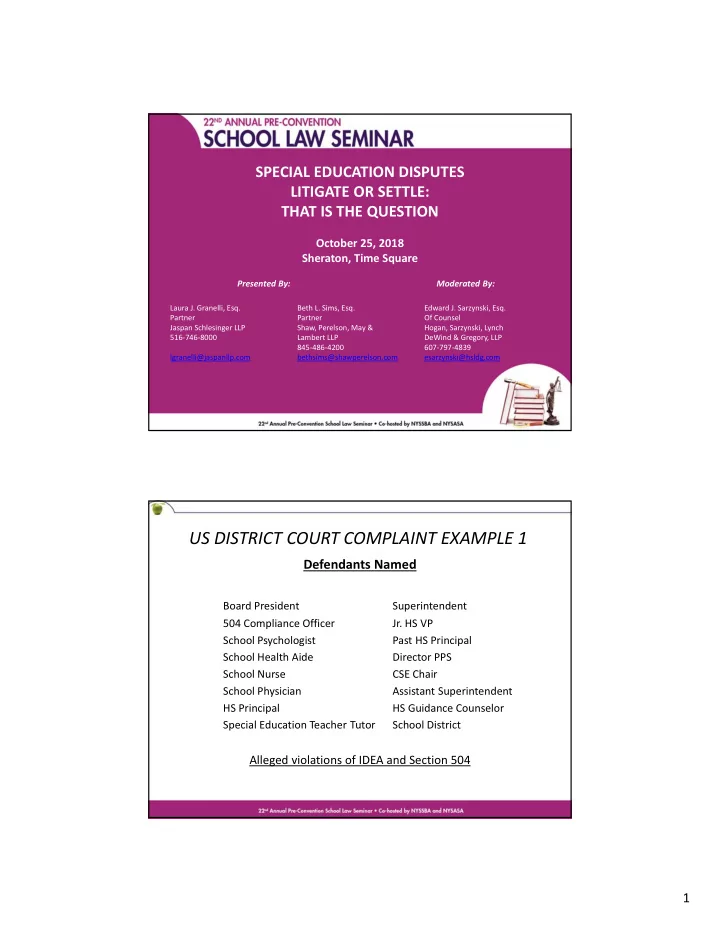
US DISTRICT COURT COMPLAINT EXAMPLE 1 Defendants Named Board - - PDF document

us district court complaint example 1
SMART_READER_LITE
LIVE PREVIEW

US DISTRICT COURT COMPLAINT EXAMPLE 1 Defendants Named Board - - PDF document

SPECIAL EDUCATION DISPUTES LITIGATE OR SETTLE: THAT IS THE QUESTION October 25, 2018 Sheraton, Time Square Presented By: Moderated By: Laura J. Granelli, Esq. Beth L. Sims, Esq. Edward J. Sarzynski, Esq. Partner Partner Of Counsel Jaspan


slide-1
SLIDE 1

1

Laura J. Granelli, Esq. Beth L. Sims, Esq. Edward J. Sarzynski, Esq. Partner Partner Of Counsel Jaspan Schlesinger LLP Shaw, Perelson, May & Hogan, Sarzynski, Lynch 516‐746‐8000 Lambert LLP DeWind & Gregory, LLP 845‐486‐4200 607‐797‐4839 lgranelli@jaspanllp.com bethsims@shawperelson.com esarzynski@hsldg.com

SPECIAL EDUCATION DISPUTES LITIGATE OR SETTLE: THAT IS THE QUESTION

October 25, 2018 Sheraton, Time Square

Presented By: Moderated By:

US DISTRICT COURT COMPLAINT EXAMPLE 1

Defendants Named

Board President Superintendent 504 Compliance Officer

  • Jr. HS VP

School Psychologist Past HS Principal School Health Aide Director PPS School Nurse CSE Chair School Physician Assistant Superintendent HS Principal HS Guidance Counselor Special Education Teacher Tutor School District

Alleged violations of IDEA and Section 504

slide-2
SLIDE 2

2

US DISTRICT COURT COMPLAINT EXAMPLE 2

Defendants Named Component School District Superintendent Principal BOCES Teacher Alleged Violations of IDEA and Section 504

US DISTRICT COURT COMPLAINT EXAMPLE 1

Relief Requested

  • Declare private school appropriate
  • Reimbursement of tuition and related expenses
  • Attorney and expert fees and costs
  • Tuition reimbursement for education and aides/services

from an institution of higher education at parent’s selection

  • $2,500,000 in compensatory and punitive damages

(case was filed in 1998)

  • Other equitable and just relief.
slide-3
SLIDE 3

3

US DISTRICT COURT COMPLAINT EXAMPLE 2

Relief Requested

  • Attorney’s fees and costs
  • Ten Million Dollars in Compensatory

and Punitive Damages (case was filed in 2009)

slide-4
SLIDE 4

4

HYPOTHETICAL

In the Litigation Central School District, parents of a special education student by the name of Collin Dilemma have brought an Impartial Hearing challenging the appropriateness of their son’s Individualized Education Program (IEP) for the 2018‐2019 school year. It is the Parents’ contention that the Student’s individual needs resulting from anxiety and ADHD can’t be appropriately addressed in the recommended 15‐1‐1 Special Class setting recommended by the CSE. The Parents allege that the public school environment lacks adequate structure for the Student’s distractibility and anxiety. They further allege that there is a dissimilarity of student management and academic needs among the students in the 15‐1‐1 Special Class and that the counseling support which was recommended by the CSE is inadequate.

HYPOTHETICAL

The Parents had a great deal of faith in the Special Class teacher that Collin had during the 2017‐18 school year, but she accepted a job in a school district out of State. The Parents obtained a private psychological evaluation of the Student during the summer of 2018. The report indicated that the Student has school phobia and anxiety, which are on the rise. The evaluator recommended a small and charming school with additional therapeutic support. The District has not conducted a psychological evaluation in two years. Collin attended the recommended District placement for the first three weeks of September, 2018 and appeared to be making good progress. Then, without advance notice, his Parents unilaterally placed him in the Charming School and filed a Due Process Complaint. The Parents are seeking tuition reimbursement for the Charming School, a private school which offers small class sizes and a supportive and relatively small school environment at a tuition cost of $97,000 annual for a Day Placement. The Charming School is not on the NYSED approved list.

slide-5
SLIDE 5

5

HYPOTHETICAL

  • Mrs. Dilemma, the parent of Collin, is active in a District special

education parent advocacy group. There are at least 3 other students in the District who have been placed at the Charming School that have not yet brought an Impartial Hearing and one student that attends the Charming School pursuant to a stipulation whereby the District pays for the student’s tuition to attend. The District also has two other Impartial Hearing unrelated requests pending. One of the members of the Board of Education has a child with a disability. The attorney representing the Dilemma family is an accomplished Special Education attorney who bills at $400 per hour. The decisions of the Hearing Officer selected off the rotational list to hear the Dilemma case are routinely overruled on appeal by the New York State Review Officer (SRO).

HYPOTHETICAL

SHOULD THE DISTRICT LITIGATE OR SETTLE: THAT IS THE QUESTION!

slide-6
SLIDE 6

6

SETTLEMENT FACTORS

  • Frequency
  • Nature and Length of Process
  • Can We Win?
  • Cost
  • Settlement Terms
  • Setting Precedent
  • The Nature of the Dispute

FREQUENCY

Top 6 US States/Jurisdictions for due Process Complaints Per Year* Puerto Rico California District of Columbia Pennsylvania New York New Jersey 2015‐16: NY = 5,305 out of 17,325 National Due Process Complaints Filed. Approx. 31%

*Per capita filings between 2006‐2011 as per Trends in Impartial Hearings Under the IDEA: A Follow‐Up Analysis, Perry A. Zirkel, 303 Ed. Law Rep. 1, 7 (2014)

slide-7
SLIDE 7

7

FREQUENCY

FREQUENCY

Due Process Complaints 2013‐2016 (per capita values based on # events per 10K students)

Taken from IDEA Dispute Resolution Summary Data for NY 2004‐2005 to 2015‐2016, CADRE

2013‐ 2014 13‐14 Events per 10K* 2014‐2015 14‐15 Events per 10K* 2015‐2016 15‐16 Events per 10K* Due Process Complaints Filed 6,417 141.0 5,170 105.7 5,305 106.2 Resolution Meeting Agreements 272 6.0 231 4.7 161 3.2 Fully Adjudicated Hearings 813 17.9 459 9.4 453 9.1 Due Process Complaints Pending 1,726 37.9 1219 24.9 1747 35 Due Process Complaints Withdrawn, Dismissed or Resolved Without a Hearing 3,878 85.2 3,492 71.4 3,105 62.2

slide-8
SLIDE 8

8

FREQUENCY

General Trends:

  • Most IDEA special education disputes in NY are due

process complaints.

  • On average, the total # DPC per year = approximately

1% of the special education population

  • On average, 62% of DPC were withdrawn, dismissed,
  • r settled without a hearing

FREQUENCY

  • District Trends

Frequency and Nature of Activity District Measures – e.g., training, relationships Compound Impact: fiscal and human costs

slide-9
SLIDE 9

9

FREQUENCY

Hypothetical

  • 3rd ongoing impartial hearing
  • Already had one settlement
  • What will other parents do?

NATURE AND LENGTH OF PROCESS

  • It is helpful to understand how the process

works and how long it takes.

  • Who filed the complaint?
  • Jurisdiction and/or Statute of Limitations (can

all or a part be dismissed?)

slide-10
SLIDE 10

10

NATURE AND LENGTH OF PROCESS

  • IHO Rotational List
  • Responses
  • Resolution Session in 15 Days
  • Mediation
  • Pre‐Hearing Conference
  • IHO Decision Deadline

NATURE AND LENGTH OF PROCESS

  • NY’s Two‐Tiered System
  • Deadlines for SRO
  • Going to Court
  • Understanding

Pendency and its Costs: the “then current placement”

slide-11
SLIDE 11

11

NATURE AND LENGTH OF PROCESS

  • The Human Cost
  • 2013 National Superintendent’s Association

Survey Regarding the Effects of Due Process Hearings

(The following tables are drawn from Rethinking Special Education Due Process, compiled by the Due Process Sub‐Committee

  • f SELPA Administrators of California (July 2014))

NATURE AND LENGTH OF PROCESS

Please choose your level of agreement with the following statement: the threat of IDEA due process requires teachers, related service personnel and administrators in my district to spend time and resources compiling paperwork that would be better allocated to providing high quality services and programs for students with disabilities.

Response Superintendent Count Percent Strongly Agree 141 68.78% Agree 50 24.39% Neither Agree or Disagree 11 5.37% Disagree 2 .97% Strongly Disagree 1 .49%

slide-12
SLIDE 12

12

NATURE AND LENGTH OF PROCESS

My district acquiesces to parent requests for students (regarding services, accommodations, placements, etc.) that we find to be unreasonable and/or inconsistent with IDEA requirements to avoid a due process complaint, hearing or litigation. Response Superintendent Count Percent Strongly Agree 94 46.08% Agree 13 6.37% Neither Agree or Disagree 50 24.51% Disagree 38 18.63% Strongly Disagree 9 4.41%

NATURE AND LENGTH OF PROCESS

How would you characterize the degree of stress experienced by special education teachers, related service professionals and special education administrators when they are engaged in a due process hearing or subsequent litigation?

Response Superintendent Count Percent Very High 162 81% High 28 14% Moderate 8 4% Low 1 .5% Very Low 0% Unchanged 1 .5%

slide-13
SLIDE 13

13

NATURE AND LENGTH OF PROCESS

Have you noticed a trend of special education teachers either leaving the district or requesting to be transferred to the general education classrooms after being involved in a due process hearing, state complaint or other litigation related to special education?

Response Superintendent Count Percent Yes, 50% or more of the time, teachers either leave the district or request a transfer out of special education after being engaged in due process hearings or similar proceedings 23 11.68% Yes, 26‐49% or more of the time, teachers either leave the district or request a transfer

  • ut of special education after being engaged in

due process hearings or similar proceedings 16 8.12% Yes, 10‐25% or more of the time, teachers either leave the district or request a transfer

  • ut of special education after being engaged in

due process hearings or similar proceedings 48 24.37% No, there is no change 94 47.72%

Nature and Length of Process

Hypothetical

  • No notice of unilateral placement
  • Cases overturned at the SRO level
  • Effect on Staff/Resources
slide-14
SLIDE 14

14

CAN WE WIN?

A District’s obligation to provide FAPE: From Rowley Educational instruction specifically designed to meet the unique needs of the [disabled] child, supported by services as are necessary to permit the child to ‘benefit’ from instruction. to Endrew F.: Districts must offer an IEP reasonably calculated to enable a child to make progress appropriate in light

  • f

the child’s circumstances. Effect in New York

slide-15
SLIDE 15

15

CAN WE WIN?

Burden of Proof:

  • Schaffer v. Weast, 546 US 49 (2005): burden is on

the party seeking relief BUT decision left up to the states.

  • NY Education Law 4401(1)(c): burden is generally on

school district except the burden is on the parent to establish the appropriateness

  • f

a unilateral placement when seeking tuition reimbursement.

CAN WE WIN?

Tuition Reimbursement Claims Burlington Carter Three‐Prong Test:

(1) Did the District offer FAPE?

(Procedural and Substantive Considerations)

(2) Was the Parent’s Private Placement Appropriate? (3) Consideration of the Equities

slide-16
SLIDE 16

16

CAN WE WIN?

Practical Proof:

Staff as Witnesses Availability and Quality of Documents Nature of Adversary Personalities of the Parents Quality of Potential Witnesses for the

Parents

CAN WE WIN?

Hypothetical

  • Was FAPE being offered?
  • Was it the LRE?
  • Evaluations
  • Were behavior mods in place?
  • What did IEPs look like?
  • How are the witnesses?
  • Parent connections with staff members and/or related

service providers

slide-17
SLIDE 17

17

COSTS COSTS

Monetary Damages

  • Compensatory Damages
  • Punitive Damages
  • Not available under the IDEA but may be

under other statutes

slide-18
SLIDE 18

18

COSTS

Attorneys’ Fees: Parent as Prevailing Party

  • Judicially

sanctioned change in the relationship of the parties. Buckhannon, 532 US 598 (2001)

  • “So Ordered” Settlements

COSTS

  • Fees For:
  • Attorneys,
  • Non Profit/Pro Bono Attorneys,
  • Law Student Interns
  • Paralegals
  • No Fees For:
  • Parents representing their own children,
  • Lay Advocates
  • Expert Witnesses (Arlington v. Murphy)
slide-19
SLIDE 19

19

COSTS

Calculating Fees:

  • The reasonableness of the proposed rate,

and

  • The reasonableness of the amount of

time billed

COSTS

The 12 Johnson Factors

448 F2d 714 (5th Cir. 1974) Time and labor required Novelty and difficulty of question Level of skill needed Preclusion of employment due to case Attorneys’ customary hourly rate Whether fee is fixed or contingent Time limitations Amount involved and results

  • btained

Experience, reputation, and ability of attorneys Undesirability of the case Nature and length of professional relationship with client Awards in similar cases

slide-20
SLIDE 20

20

COSTS

  • K.F. v. NYCDOE, 2011 US Dist LEXIS 88653 (SDNY 2011):

$375/hour

  • S.A. v. NYCDOE, 2015 US Dist LEXIS 126874 (EDNY 2015):

$475/hour for main partner, $375 for another partner, $225/200 for associates, $150 for chief paralegal, $125 for

  • ther paralegals and legal intern.

Court awarded $66, 104.49 in fees and $2,698.58 in costs. Hearing cost and attorneys’ fees can exceed total tuition or

  • ther liability.

COSTS

Partial Victories and Attorney’s Fees

  • Where a party is successful on only some claims and the failing

claims are unrelated and severable, fees will only be awarded for time spent on successful claims. Hensley v. Eckerhart, 461 U.S. 424, 434 (1983); Green v. Torres, 361 F.3d 96, 98 (2d Cir. 2004); Concerned Citizens Neighborhood Ass'n v. Cty of Albany, 522 F. 3d 182, 190 (2d Cir. 2008).

  • However, courts will not reduce fee requests due to an

unsuccessful claims where the successful and unsuccessful claims are inextricably intertwined and involve a common core of facts or are based upon related legal theories. E.S. v. Katonah‐ Lewisboro Sch. Dist,796 F Supp. 2d 421, 427 (S.D.N.Y. 2011).

slide-21
SLIDE 21

21

COSTS

Additional Considerations: Offer of Settlement Rule (20 USC §1415(i)(3)(D)(i) and Rule 68 of the FRCP)

Written offer is made greater than 10 days before

proceeding begins

Offer is rejected Court/IHO finds that relief finally obtained by parents is

not more favorable than the offer of settlement

Must include offer to pay reasonable attorneys fees

incurred to date Exception where parent was substantially justified in rejecting the settlement offer.

COSTS

Additional Considerations:

  • Communications with

District’s Insurance Company

  • Court Reporter Costs
  • IHO Costs
  • Other Costs
  • Loss of Employee Time/Costs of Subs
slide-22
SLIDE 22

22

COSTS

Hypothetical

  • $400/hour special education attorney
  • Possible/Probable appeal
  • Cost of public program v. cost of private

school (where applicable, consider aid)

  • Hearing costs/incidentals

SETTLEMENT TERMS

  • When can settlements be entered into?
  • Resolution Sessions
  • Mediation
slide-23
SLIDE 23

23

SETTLEMENT TERMS

Examples of Substantive Obligations:

  • Partial or whole tuition reimbursement
  • Evaluations
  • Parent/staff training
  • Technology soft/hardware
  • IEP modifications
  • Related services
  • Compensatory services
  • Transportation services
  • Attorneys fees
  • Prospective services

SETTLEMENT TERMS

Complaint Withdrawal Release of Claims Stay‐Put Consents

slide-24
SLIDE 24

24

SETTLEMENT TERMS

  • Settlement Enforcement
  • Contract Law
  • Changes in Circumstances
  • Read the fine print!

SETTING PRECEDENT

Confidentiality:

  • Mediation
  • Resolution sessions
  • As part of settlement
  • During hearing
slide-25
SLIDE 25

25

SETTING PRECEDENT

The “Human Nature” Factor:

  • How active is the community?
  • Is there an influx of youngsters?
  • Are there more CSEs with

advocates/attorneys?

  • Has there been an uptick in hearings?
  • Nature of SEPTA

SETTLEMENT TERMS/SETTING PRECEDENT

Hypothetical

  • Settlement likely monetary, not

services

  • Waiver of claims
  • Stay‐Put provision
slide-26
SLIDE 26

26

SETTLEMENT TERMS/SETTING PRECEDENT Hypothetical

  • Possible Confidentiality Clause
  • The other students in the private school
  • The other hearing requests outstanding
  • Board Member part of special education

community

THE NATURE OF THE DISPUTE

Differences Between the IDEA v. 504

Timeline Expert Fees may be Recoverable Hearing Officer Tuition Reimbursement Standards Pendency Damages

slide-27
SLIDE 27

27

THE NATURE OF THE DISPUTE

  • State Complaints
  • Court Actions
  • ADA, 1983, Tort Actions
  • OCR Complaints ‐ 504

THE NATURE OF THE DISPUTE

Hypothetical

  • Process, vulnerabilities of an IDEA claim
  • Will there be additional

actions in other venues under other theories???

  • Board 504 Policy Implications
slide-28
SLIDE 28

28

Laura J. Granelli, Esq. Beth L. Sims, Esq. Edward J. Sarzynski, Esq. Partner Partner Of Counsel Jaspan Schlesinger LLP Shaw, Perelson, May & Hogan, Sarzynski, Lynch 516‐746‐8000 Lambert LLP DeWind & Gregory, LLP 845‐486‐4200 607‐797‐4839 lgranelli@jaspanllp.com bethsims@shawperelson.com esarzynski@hsldg.com

SPECIAL EDUCATION DISPUTES LITIGATE OR SETTLE: THAT IS THE QUESTION

October 25, 2018 Sheraton, Time Square

Presented By: Moderated By: