Urban Freight Trip Generation: Case of Chennai City C. Divya Priya - - PowerPoint PPT Presentation

urban freight trip generation case of chennai city
SMART_READER_LITE
LIVE PREVIEW

Urban Freight Trip Generation: Case of Chennai City C. Divya Priya - - PowerPoint PPT Presentation

Urban Freight Trip Generation: Case of Chennai City C. Divya Priya Gayathri Devi Gitakrishnan Ramadurai 1 Freight System Shippers, carriers, distribution centers, consumers, government Characterizing the freight system is challenging
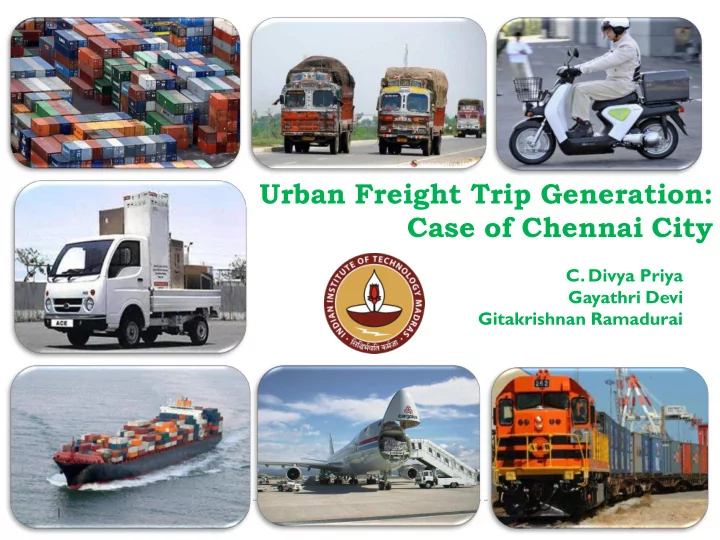

slide-1
SLIDE 1

Urban Freight Trip Generation: Case of Chennai City

  • C. Divya Priya

Gayathri Devi Gitakrishnan Ramadurai

1

slide-2
SLIDE 2

Freight System

 Shippers, carriers, distribution centers, consumers, government  Characterizing the freight system is challenging  Lack of maintenance of data at different levels by the

stakeholders – makes research efforts difficult

2

slide-3
SLIDE 3

Freight Trip Generation: Literature Review

 Trip rate per unit of site area – Brogan (1979)  Simple and straightforward  FTG varies highly from one region to another

 Regression models

 Tadi & Balbach (1994) –

 Independent variable – Site area  Average vehicle weights – Weighted trip ends

 Iding (2002)

 Independent variables – Site area and number of employees  Calculated total number of trips and applied mode share of delivery

vans, light trucks and heavy trucks

3

slide-4
SLIDE 4

Literature Review

 Regression models

 Shin, Kawamura (2005)

 FTG is directly related to decision-making behavior with respect to

supply chain management (SCM) and logistics strategies adopted

 Commodity - fast-moving and slow-moving goods / weigh-out and

cube-out goods

 Short-term factors - sales and hours of operation over time of the

year

 Logit regression model for a chain of furniture and shoe stores chain

which received only one or two deliveries in a week from its Distribution Centre

4

slide-5
SLIDE 5

Literature Review

 Regression models

 Bastida and Holguín-Veras (2008)

 Interaction effects of commodity type with employment and sales  Multiple Classification Models - classification structure within the

independent variable that can give a better estimation of FTG models

 Lawson et al (2012)

 Classification by land-use category  Independent variable – Number of employees  Ordinary least squares, MCA models

5

slide-6
SLIDE 6

Literature Review

 Regression models

 Holguín-Veras et al (2013)

 Checked transferability of regression models developed

 External validation of developed models  NCFRP 25, QRFM and ITE models  5 datasets  Econometric models to assess the statistical significance of specific geographic

locations

 Pooled the datasets  Included binary variables for each location  Evaluated significance from t-statistic

 Under-estimation for small firms and over-estimation for large firms in

constant FTG per unit of independent variable

 Synthetic correction procedure

6

slide-7
SLIDE 7

Literature Review

 Regression models  Holguín-Veras et al (2013)

 Land-use constraints, network characteristics and other urban shape

features affect the frequency in which firms decide to transport the cargo

 Independent variables

 land-market value, commodity type, number of vendors, employment,

Sales, dist. to truck route, minimum dist. to Large Traffic Generator (LTG)

 mean distance to LTGs, distance to the primary network, width of street in

front of establishment

 Holguín-Veras et al (2002)

 Predict volume of inbound and outbound truck volume at seaport

terminals

 Independent variables - area of container terminals, number of TEUs

and container boxes

7

slide-8
SLIDE 8

Literature review

 Time Series

 Al-Deek (2000)

 Predict volumes of large inbound and outbound trucks at seaport

terminal of Miami

Factors affecting truck volume - amount and direction of cargo vessel freight and the particular weekday of operation

 Artificial Neural Networks (ANN)

 Al-Deek (2001)

 Compared methods of regression and ANN to predict the daily inbound

and outbound truck trips at seaport terminal of Miami

 Drawbacks

 Regression – too many assumptions  ANN - lack of well-defined guiding rules regarding choice of network, method

  • f training, number of neurons, topology, and configuration

 Applied modal split of freight traffic to trucks and rail cars

8

slide-9
SLIDE 9

Literature Review

 Data collection techniques in NCHRP Synthesis 410

 State of the practice methods in conducting surveys at different

levels of freight transportation

 Roadside intercept, Commercial trip diary, Establishment survey,

Commodity flow survey

 Face-face and telephone interviews:

 Better response rate, better quality  detailed information and in-depth discussions  provides opportunity to query responses  Expensive and time consuming

 Self-completion forms:

 Cheaper, but low-response rates  difficult to ensure that right person in organization will respond,  whether the respondent has understood the questions  no opportunity to check/clarify or discuss responses 9

slide-10
SLIDE 10

LITERATURE REVIEW: Summary

 Constant trip rate

 Constant trips per establishment or employee  Simple and straightforward  Underestimation for smaller establishments and overestimation

for larger establishments

 Regression

 Ordinary least squares method  Most predominant  Interaction effects – ex. Employment with sales

10

slide-11
SLIDE 11

LITERATURE REVIEW: Summary

11

 Multiple Classification Analysis

 Classification structure within the independent variable  Resulted in better prediction of models

 Recent studies

 Land-use – land use type, land-market value  Economic – commodity type, number of vendors,

employment, sales

 Network – distance to truck route, minimum distance to

Large Traffic Generator (LTG), mean distance to LTGs, distance to the primary network, width of street in front of establishment

slide-12
SLIDE 12

OBJECTIVES

 T

  • collect data on freight trips in Chennai by conducting

face-to-face interviews

 T

  • understand the problems and trends concerning

freight transport

 T

  • analyse the data collected and develop freight trip

generation models

12

slide-13
SLIDE 13

SCOPE

 Area of study - Chennai  Data collection units - Include all kinds of commercial

establishments that generate freight transport

13

slide-14
SLIDE 14

Modified from survey conducted in New Y

  • rk as part of NCHRP program;

Extensive inputs from Jose and his team at RPI

14

slide-15
SLIDE 15

Questionnaire Design:

 Additions:

 Number of years the establishment has been in business  Working hours of the establishment and timing of shifts  Type of establishment:

Wholesale/Retail/Services/Mall/Market/Industrial

 Bikes and three-wheeler vehicles  Type of parking (on-street or off-street), parking space, number

  • f loading docks

 Record of trucks trips made per month in addition to per day

and per week

 Comments by the respondent

15

slide-16
SLIDE 16

Sample Collection

 Ideal case: Random sampling from a list of all enterprises

in Chennai that generate freight transport

 Sources:

 Websites like

Yellow Pages, Sulekha, Just Dial

 Specific search for each establishment type  Many level of sub-categories adds to the complexity of sampling

process

 Chennai Corporation (professional tax and trade licenses)

 Central areas of Chennai - missing  Not all trades and professions available; several very small shops

 Commercial Taxes Department (CTD)  Economic Census (2005)

16

slide-17
SLIDE 17

Sample Collection

 Ideal case: Random sampling from a list of all enterprises in

Chennai that generate freight transport

 Sources:

 Websites like Yellow Pages, Sulekha, Just Dial  Chennai Corporation (professional tax and trade licenses)  Commercial

Taxes Department (CTD)

 Online search by TIN-11 digit number: low probability of a hit  They have shared a random list of 1000 establishments – used in second

phase of survey

 Fifth Economic Census in 2005 by CSO

 Prepared a directory of establishments with more than 10 employees  Revealed in pilot studies that establishments less than 10 employees are

also present

 Only 10340 establishments in Chennai – Underestimate

17

slide-18
SLIDE 18

Sample Collection:

 Economic Census (2005):

 Problems while sampling

 Old directory  Complete address is not specified  Missing letters or misspelled names - Intelligent Character

Recognition (ICR) technology

 Only name or address  Very small stores such as tea stall  No specification for an establishment

 Decided to go ahead with this directory in first phase of survey

18

slide-19
SLIDE 19

Pilot Studies

 30 establishments in Adyar, T.Nagar and Sowcarpet

Establishment type Number of establishments Apparels, Bags, Footwear 8 Departmental, Food, Groceries, Edible oil 6 Electrical, Electronics 4 Restaurant, Hotel 4 Pharmacy 2 Furniture, Home Appliances 2 Hardware 1 Miscellaneous (Chemicals, Jute) 3

19

slide-20
SLIDE 20

Pilot Studies

Problems faced during the survey:

 Locating the addresses  Employees are busy to respond to the surveys, wait or

come back again later

 Do not want to disclose about their operations especially

jewellery stores

 Misinformation that result in inconsistent figures between

number of trips and goods produced or received

 Difficult to quantify certain commodities  T

  • o many items that are harder to classify

 Respondent does not know the exact floor area of the

establishment

20

slide-21
SLIDE 21

Pilot Studies

 Observations:

 Interaction with the employees is more fruitful when the

enumerator knows the local language

 Bullock and man drawn carts were observed in Sowcarpet area

  • f Chennai

 Certain group of establishments get their consignment

together in a truck when they have less than truck load goods to be transported

 Night time deliveries  On street parking during loading and unloading of goods

21

slide-22
SLIDE 22

Pilot Studies

 Correlation

 gross floor area and number of trips = 0.22  number of employees and number of trips = 0.49

 Inclusion of restaurants – lesser area but generate more

number of trips due to frequent home deliveries

 Aggregate results cannot be used to draw conclusions

without classifying the establishments

22

slide-23
SLIDE 23

Data Collection

 Establishments Visited: 150  Obtained responses: 88  Response rate: 58 %  Almost all areas within

Chennai city area

 Few more to be done on

the newly added areas to Chennai Metropolitan Area

 Dense areas have more

samples: proof of random sample?

23

slide-24
SLIDE 24

Descriptive Statistics

Type of establishment Number of

  • bservations

Wholesale/Retail 41 Hotel/Restaurants 18 Hospitals 8 Office Services 5 Other (Manufacturing, Printing, Processing metals, Repair) 16 Total 88

24

slide-25
SLIDE 25

Descriptive Statistics

Vehicle T ype Daily Weekly Monthly Bikes 168 1241 5415 3-wheeler vehicles 59 446 1955 Cars 3 22 106 Small pick-ups/Vans (Tata Ace) 170 1243 5387 2 axle single unit trucks 70 495 2207 3 or 4 axle single unit trucks 3 33 156 Large trucks Others 39 295 1266 Mean trips per establishment 5.8 42.9 187.4

25

slide-26
SLIDE 26

Descriptive Statistics

26

slide-27
SLIDE 27

Descriptive Statistics

27

slide-28
SLIDE 28

Descriptive Statistics

28

slide-29
SLIDE 29

Descriptive Statistics

Variable 1 Variable 2 Correlation Value No.of.employees Area 0.33 No.of.employees Daily trips 0.25 No.of.employees Weekly trips 0.24 No.of.employees Monthly trips 0.24 Area Daily trips 0.34 Area Weekly trips 0.34 Area Monthly trips 0.34

29

slide-30
SLIDE 30

Descriptive Statistics

30

slide-31
SLIDE 31

Descriptive Statistics

31

slide-32
SLIDE 32

Descriptive Statistics

32

slide-33
SLIDE 33

Summary

 Bikes and small pick-up vans (Tata Ace) are commonly

used mode for freight transport inside city.

 Because of the low value of correlation, both the

variables - employees and floor area - can be incorporated in preliminary regression model

 Hotels/Restaurants and Hospitals make almost twice the

number of trips than Wholesale/Retail shops. Trips to

  • ffices are comparatively lesser.

33

slide-34
SLIDE 34

Caveats

 Are we missing out on large traffic generators?

 Have had very few cases with establishments larger than 20

employees or shops with floor area more than 1000 sq ft.

 Random sampling or weighted sampling – which is better?

 Are we getting the right numbers?

 “The manual counts (15 site observations) provided more accurate

truck trip generation rates than did telephone interviews. The interview responses indicated approximately ten to twelve trucks per day in comparison to the average of 18 trucks per day counted at each store by observers.” - Truck trip generation by grocery stores, McCormack et al. (2010)

34

slide-35
SLIDE 35

Acknowledgments

 Center of Excellence in Urban Transport, IIT Madras

sponsored by Ministry of Urban Development, Govt. of India

 Center of Excellence in Sustainable Urban Freight

Systems, RPI, Troy, NY

 Special thanks to Prof. Jose Holguín-Veras and his team for

supporting and guiding us through out

 Foot soldiers: our enumerators – students and staff of

CoE at IIT Madras!

35

slide-36
SLIDE 36

Thank You! Questions?

Gitakrishnan Ramadurai gitakrishnan@iitm.ac.in +91-44-22574298 Skype: gitakrishnan.ramadurai

36