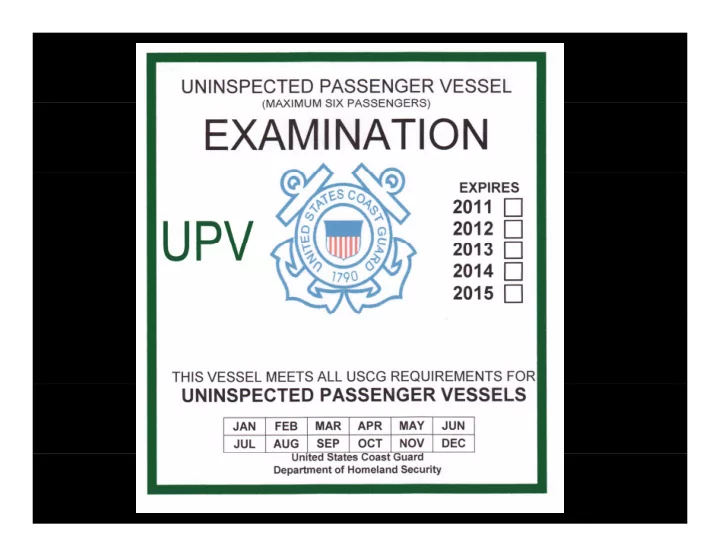
SLIDE 1
UPV DECAL UPV DECAL
SLIDE 2 So what is the UPV Program? So what is the UPV Program?
It is for any charter boats carrying 6 or fewer f hi ( USCG COI ) passengers for hire. ( no USCG ‐ COI ) A way to let charter boat operators know if they are in compliance with all required Federal Regulations p q g applicable to 6 packs (UPVs). If the charter boat operator is in compliance, they are issued a UPV decal which is good for two years are issued a UPV decal which is good for two years.
SLIDE 3 So Why Should I Get the UPV Decal?
- Economic benefit – You can advertise & demonstrate
to the world, that you are in compliance with all Federal Regulations for 6 Pack Charter Boats. Shows your professionalism.
- You significantly lower the probability of being
stopped by the USCG for a boarding which takes stopped by the USCG for a boarding, which takes fishing time away from your customers.
- As long as nothing changes aboard your boat, you
have protected yourself from fines or law suits for have protected yourself from fines or law suits for not being in compliance.
SLIDE 4 Why All these New Requirements?
- These are not new requirements. The items that
are checked during the UPV Exam have been are checked during the UPV Exam have been around for many years.
- Some of the regulations can carry fines of up to
$1100.00 per day for not being in compliance.
- The UPV Examination Check Off Sheets only covers
equipment & regulations applicable to UPVs. q p g pp
SLIDE 5 Who Will be Examining my Boat? g y
- A specially trained professional group of
USCG A ili E i h h b USCG Auxiliary Examiners that have become certified by the USCG to issue the USCG UPV d l l b k l d bl UPV decal to vessels run by knowledgeable professional USCG licensed operators, like you, h i li that are in compliance.
- The UPV Exam is as much a check of
compliance to regulations as it is an p g educational opportunity.
SLIDE 6
USCG Inspectors & UPV Examiners on their day off UPV Examiners on their day off
SLIDE 7
UPV or Recreational Vessel?
A UPV must meet all the A UPV must meet all the Standards and Requirements of a Recreational Vessel as well as the additional requirements for the additional requirements for a UPV ‐ because you have passengers‐for‐hire aboard.
SLIDE 8
When you are ready for a UPV Exam, Request a UPX Exam at www d1upv org Request a UPX Exam at www.d1upv.org
SLIDE 9 What Can your Association do to Help its Members be Compliant? Help its Members be Compliant?
- Educate your members about all the Federal Regs
Educate your members about all the Federal Regs. and help them come into compliance. Encourage them to get a UPV Exam them to get a UPV Exam.
- Provide them with documents that help them be
compliant.
SLIDE 10 What Can your Association Do to Help its Members be Compliant? Members be Compliant?
like yours should regulate like yours, should regulate themselves.
- In this Litigious Society,
if you have a Serious Marine Incident (SMI), the customer’s lawyer will look for situations where you were negligent ( not in compliance ).
SLIDE 11 What regulates your industry Uninspected Passenger Vessels Uninspected Passenger Vessels
- You operate commercial vessels that are
required to be operated by a USCG licensed required to be operated by a USCG licensed
Y d t t l t d th
- You need to carry at least one and no more than
6 passengers‐ for‐hire aboard. You have specific regulations contained in 46 CFR / 33 CFR / 49 CFR / 46 USC
See the CFR & USC regs listed on the Examination form See the CFR & USC regs. listed on the Examination form
11
http://ecfr.gpoaccess.gov/
SLIDE 12 What are the Compliance items?
- Look at the list of items on the UPV Examination
Check Off Sheet Check Off Sheet items with ** l ti are only suggestions
SLIDE 13
A UPV operator having a UPV Exam
SLIDE 14 What are some of the Compliance Issues?
See Item # 32
46 CFR 26.03-4
Y t h b d t l t You must have on board at least 1 up-to-date Chart for your AOR
SLIDE 15 46 CFR 26.03-4
TITLE 46 - SHIPPING CHAPTER I - COAST GUARD, DEPARTMENT OF HOMELAND SECURITY SUBCHAPTER C UNINSPECTED VESSELS SUBCHAPTER C - UNINSPECTED VESSELS PART 26 - OPERATIONS 26.03 - 4 - Charts and nautical publications. (a) As appropriate for the intended voyage all vessels must carry adequate (a) As appropriate for the intended voyage, all vessels must carry adequate and up-to-date (1) Charts of appropriate scale to make safe navigation possible; (2) U.S. Coast Pilot or similar publication; (3) Coast Guard light list; (4) Tide tables; and (5) Current tables, or a river current publication ; ( ) ; ( ) , p issued by the U.S.
SLIDE 16 What are some of the Compliance Issues?
You must have b d
the current the current Local Notice to Mariners for the areas for the areas you operate in
SLIDE 17 What are some of the Compliance Issues?
You must have
the current Coast Pilot for the areas for the areas you operate in y p
SLIDE 18 What are some of the Compliance Issues?
You must have
the current Light List for the areas for the areas you operate in
SLIDE 19 Easy to Comply ‐ and Free!
Light list – Coast Pilot – Local Notice to Mariners
You can down load and print these You can down load and print these Items for the areas you operate in f y p
http://www.navcen.uscg.gov/pdf/lightLists/LightList%20V1.pdf http://www.nauticalcharts.noaa.gov/nsd/coastpilot_w.php?book=2 http // na cen scg go /?pageName lnmMain http://www.navcen.uscg.gov/?pageName=lnmMain
d1
All these links are available at www.d1upv.org
SLIDE 20
What are some of the Compliance Issues?
You must have on board a current copy board a current copy Tide & Current Tables f h for the areas you operate in you operate in
SLIDE 21 What are some of the Compliance Issues?
Y E Ch k ff Li t t Your Emergency Checkoff List must be able to be seen by your passengers y y p g
ROUGH WEATHER AT SEA OR CROSSING HAZARDOUS BARS
- a. Keep all weather tight and watertight doors, hatches and airports closed to prevent taking water aboard.
- b. Keep bilges dry to prevent loss of stability.
ROUGH WEATHER AT SEA OR CROSSING HAZARDOUS BARS
K ll h i h d i h d h h d i l d ki b d
- c. Keep passengers seated and evenly distributed.
- d. Ensure all passengers are wearing life preservers in conditions of very rough seas or if about to cross a bar under hazardous conditions.
- e. Initiate an International Distress call and a call to the Coast Guard if assistance is needed (if radiotelephone equipped).
PERSON OVERBOARD
- a. Keep all weather tight and watertight doors, hatches and airports closed to prevent taking water aboard.
- b. Keep bilges dry to prevent loss of stability.
- c. Keep passengers seated and evenly distributed.
- d. Ensure all passengers are wearing life preservers in conditions of very rough seas or if about to cross a bar under hazardous conditions.
- e. Initiate an International Distress call and a call to the Coast Guard if assistance is needed (if radiotelephone equipped).
PERSON OVERBOARD
- a. Throw ring buoy overboard, as close to the victim as possible.
- b. Post lookout to keep the victim in sight.
- c. Have a crewmember, wearing a life preserver and lifeline, standing by ready to jump into the water to assist the victim back aboard.
- d. Initiate an International Distress call and a call to the Coast Guard if assistance is needed (if radiotelephoneequipped).
e Continue the search until after radiotelephone consultation with the Coast Guard if at all possible
PERSON OVERBOARD
- a. Throw ring buoy overboard, as close to the victim as possible.
- b. Post lookout to keep the victim in sight.
- c. Have a crewmember, wearing a life preserver and lifeline, standing by ready to jump into the water to assist the victim back aboard.
- d. Initiate an International Distress call and a call to the Coast Guard if assistance is needed (if radiotelephone equipped).
- e. Continue the search until after radiotelephone consultation with the Coast Guard, if at all possible.
FIRE AT SEA
- a. Cutoff air supply to the fire by closing hatches, ports, doors and ventilators, etc.
- b. Discharge portable extinguishers at the base of the flames or flammable liquid or grease fires or apply water to fires in combustible
solids
- e. Continue the search until after radiotelephone consultation with the Coast Guard, if at all possible.
FIRE AT SEA
- a. Cutoff air supply to the fire by closing hatches, ports, doors and ventilators, etc.
- b. Discharge portable extinguishers at the base of the flames or flammable liquid or grease fires or apply water to fires in combustible solids.
If th fi i i hi h t ff th f l l d til ti d di h i t ll d fi d fi fi hti t solids.
- c. If the fire is in machinery spaces, shut off the fuel supply and ventilation and discharge any installed fixed fire fighting systems.
- d. Maneuver the vessel to minimize the effect of wind on the fire.
- e. Initiate an International Distress call and a call to the Coast Guard if assistance is needed (if radiotelephone equipped).
- f. Move passengers away from the fire and have them don life preservers.
- c. If the fire is in machinery spaces, shut off the fuel supply and ventilation and discharge any installed fixed fire fighting systems.
- d. Maneuver the vessel to minimize the effect of wind on the fire.
- e. Initiate an International Distress call and a call to the Coast Guard if assistance is needed (if radiotelephone equipped).
- f. Move passengers away from the fire and have them don life preservers.
SLIDE 22
What are some of the Compliance Issues?
Your Life Jackets ( PFD) must be: 1) Type I Adult & Child sizes. 2) Have 200 Sq Cm of retro‐reflective i l i id & if ibl material inside & out if reversible. 3) H t li ht tt h d 3) Have water‐lights attached. (if batteries – they must have current ( f y dates)
SLIDE 23 PFD Water‐lights being checked during a UPV Exam
g have batteries, th t h they must have dates on them and they must not be outdated
SLIDE 24 What are some of the Compliance Issues?
Your Life Jackets ( PFD) must be: continued 4) Be stored separately from other types of life jackets you may have types of life jackets you may have aboard. 5) Have donning instructions in the 5) Have donning instructions in the life jacket locker (container) or posted d d f
- r demonstrated in Safety Lecture.
SLIDE 25
What are some of the Compliance Issues?
Life Jacket ‐ Donning Sheet ‐ Offshore type
SLIDE 26
What are some of the Compliance Issues?
Life Jacket ‐ Donning Sheet ‐ inshore type
SLIDE 27
What are some of the Compliance Issues?
You must give a Safety Lecture to your passengers it must contain passengers it must contain….. a) Location of Life Jackets. a) Location of Life Jackets. b) Type & Location of all safety devices on board. c) Location of Emergency Checkoff List. d) P d i & Adj ti Lif d) Proper donning & Adjusting Life Jackets (unless instructions are posted).
SLIDE 28 What are some of the Compliance Issues?
Safety lecture could be reduced to: 1)Where are any non-PFD safety devices kept aboard devices kept aboard 2)Point out this Emergency Emergency CheckOff List 3)Make sure the Life Jacket locker (container) has the lif j k t proper life jacket donning sheet
SLIDE 29 What are some of the Compliance Issues?
As of December 2011 Th TWIC d i d d f
- The TWIC card is not needed for
licensed personal unless the vessel licensed personal unless the vessel has a restricted area (inspected vessels).
- You do not need it for license renewal
you need to fill out an additional form relative to the TWIC relative to the TWIC
SLIDE 30
What are some of the Compliance Issues?
DRUG Program…. Th E l i ibl f The Employer is responsible for meeting all parts of his meeting all parts of his Drug & Alcohol Program Fines for non compliance are Fines for non‐compliance are $5500.00 per person per day $5500.00 per person per day
SLIDE 31
Drug Program From USCG DAPI Officer Drug Program…. 1) Crew needs a Pre‐employment drug test or a waiver (Transferred drug test or a waiver. (Transferred from another DOT Regulated Employer or had a drug test within past 6 months) past 6 months) 2) Proof Captain & Crew are enrolled 2) Proof Captain & Crew are enrolled in a Random Drug Testing Program
SLIDE 32 Drug Program continued 3) You must have a D E R
(Designated Employer Representative) (Designated Employer Representative).
He is the person who oversees your drug program. The DER must be an employee The DER must be an employee
All your crew must know who he is.
SLIDE 33 Drug Program continued 4) Y h C P li 4) You must have a Company Policy that, at the least, explains all the that, at the least, explains all the pieces of your Drug Program.
Are all your crew aware of this Company Policy?
5) You must do a Background Check
- n all new hires by checking with
- n all new hires by checking with
their previous employers for the previous 2 years.
SLIDE 34 Drug Program continued
Sample Company Company Policy
These sample forms are to help you be compliant relative to the Drug Program Requirements
www.d1upv.org
SLIDE 35
Drug Program continued
Sample Drug & Drug & Alcohol Background check check You must look back 2 years back 2 years
SLIDE 36
Drug Program continued You must have proof that all crew have attended an Educatioal have attended an Educatioal Assistance Program (EAP) where
Hotline Numbers were either given to them or they are posted in a common place for them to see & that you reviewed the company to see & that you reviewed the company policy with them & you covered effects of drug and alcohol use on personal health drug and alcohol use on personal health, safety, and the work environment.
SLIDE 37 Drug Program continued
Sample Employer Employer Assistance Program
These sample forms Can be downloaded at
www.d1upv.org
SLIDE 38
Drug Program continued
Sample Crew Crew swapping Contract
SLIDE 39
Drug Program continued if you have a Serious Marine Incident (SMI) (SMI) D h t t th Do you have a way to meet the 2 hr Alcohol Rule and 2 hr Alcohol Rule and Do you know about the 32 hour Drug Test Requirement
SLIDE 40 Questions for the Crew
- 1. Who is the Designated Employer Representative (DER)?
- 1. Who is the Designated Employer Representative (DER)?
Ans: My company/vessel DER is Mr. John Doe. The DER is the person that selects/receive random drug test notifications and informs crew.
- 2. What is the company's drug policy?
- 2. What is the company s drug policy?
Ans: Company has a policy regarding drug and alcohol use in the workplace.
- 3. Are you enrolled in a random drug testing program?
Ans: Yes. All crewmembers must be enrolled in a random testing program and should know Ans: Yes. All crewmembers must be enrolled in a random testing program and should know that they are enrolled.
- 4. Where can you access Employee Assistance Program (EAP) information and hotline numbers?
Ans: EAP information and hotline numbers could be posted on the vessel or were given to me Ans: EAP information and hotline numbers could be posted on the vessel or were given to me at a 1 hr training seminar on XXXXX presented by XXXXXX.
- 5. Who do you call/where do you go for Serious Marine Incident (SMI) Testing?
Ans: In the event of an SMI I call 1‐800‐XXXX. EVERYONE should know who to call and/or Ans: In the event of an SMI I call 1 800 XXXX. EVERYONE should know who to call and/or where to go for SMI testing.
- 6. Have you received EAP training?
Ans: Yes. Each crewmember has received and can document having attended an EAP Training Program. s: es. ac c e e be as ece ed a d ca docu e t a g atte ded a a g
This training consisted of material on effects & consequences of drug & alcohol use on your health, safety, and work environment, along with indicators of drug & alcohol abuse.
SLIDE 41 Questions for the Master
- 1. Are alcohol testing devices kept onboard?
Ans: Alcohol testing devices kept onboard if not within 2 hours of a test facility.
- 2. What are the time requirements for drug and alcohol testing following a SMI?
Ans: 2 Hours for alcohol testing and 32 hours for drug testing following a SMI.
- 3. What is the company's drug and alcohol policy?
Ans: Company‐ has a policy regarding drug and alcohol use in the workplace.
- 4. Have you received 60 minutes of EAP training?
Ans: Yes. All supervisors (captains) must receive and have documented 60 minutes
- f an EAP Training Program.
- 5. Where can crew & you access Employee Assistance Program (EAP)
information and hotline numbers? Ans: EAP Education Program information and hotline numbers could be posted on Ans: EAP Education Program information and hotline numbers could be posted on the vessel or know when & who did the EAP Education Program.
SLIDE 42 Documents Required On‐Board or Produce within 48 hours Produce within 48 hours
- 1. Company policy/program
- 2. EAP education information and hotline number
(unless posted at dock office) ( p ff )
- 3. Certificate of enrollment in a Random Drug program with a
list of covered crewmembers that perform safety sensitive duties list of covered crewmembers that perform safety sensitive duties
- 4. Phone number/address for 24 hr SMI testing facility if not carrying
alcohol testing devices aboard alcohol testing devices aboard
- 5. Documentation of 1 hr Supervisor and Crew EAP Education &
T i i P Training Program.
- 6. Copy of USCG MIS report (if applicable)
SLIDE 43 What to Know about your Consortium
- 1. Do they file Management Information System (MIS)
report for you? 2 Do they have a hotline or information on 24 hour
- 2. Do they have a hotline or information on 24 hour
Serious Marine Incident (SMI) testing?
- 3. Does Consortium provide Employee Assistance Program
(EAP) training and documentation?
- 4. Does Consortium select 50% of your company or 50%
f ll h b ll d i h i ?
- f all the crewmembers enrolled in the consortium?
SLIDE 44
Another UPV operator in compliance
SLIDE 45
Being awarded the UPV Decal
SLIDE 46 Any Questions ?
Th k
UNINSPECTED PASSENGER VESSEL
(MAXIMUM SIX PASSENGERS)
Thank you for taking time
EXAMINATION
EXPIRES
2011
f g to understand the
2012 2013 2014 2015
UPV
UPV Program
THIS VESSEL MEETS ALL USCG REQUIREMENTS FOR
UNINSPECTED PASSENGER VESSELS
For more information go to
JAN FEB MAR APR MAY JUN JUL AUG SEP OCT NOV DEC
United States Coast Guard Department of Homeland Security
For more information go to
www d1upv org www.d1upv.org