UPS Slide 7 / 82 Slide 8 / 82 Units Units While traveling in - - PDF document

ups slide 7 82 slide 8 82
SMART_READER_LITE
LIVE PREVIEW

UPS Slide 7 / 82 Slide 8 / 82 Units Units While traveling in - - PDF document

Slide 1 / 82 Slide 2 / 82 Algebra I Relationships Between Quantities 2015-11-02 www.njctl.org Slide 3 / 82 Slide 4 / 82 Table of Contents Click on the topic to go to that section Relationships Between Relationships Between Different Units


slide-1
SLIDE 1

Slide 1 / 82 Slide 2 / 82

Algebra I

Relationships Between Quantities

2015-11-02 www.njctl.org

Slide 3 / 82

· Relationships Between Different Units of Measurement. · Picking the Appropriate Unit of Measurement · Choosing the Appropriate Level of Accuracy

Table of Contents

· Glossary

Click on the topic to go to that section

Slide 4 / 82

Relationships Between Different Units of Measurement

Return to Table

  • f Contents

Slide 5 / 82

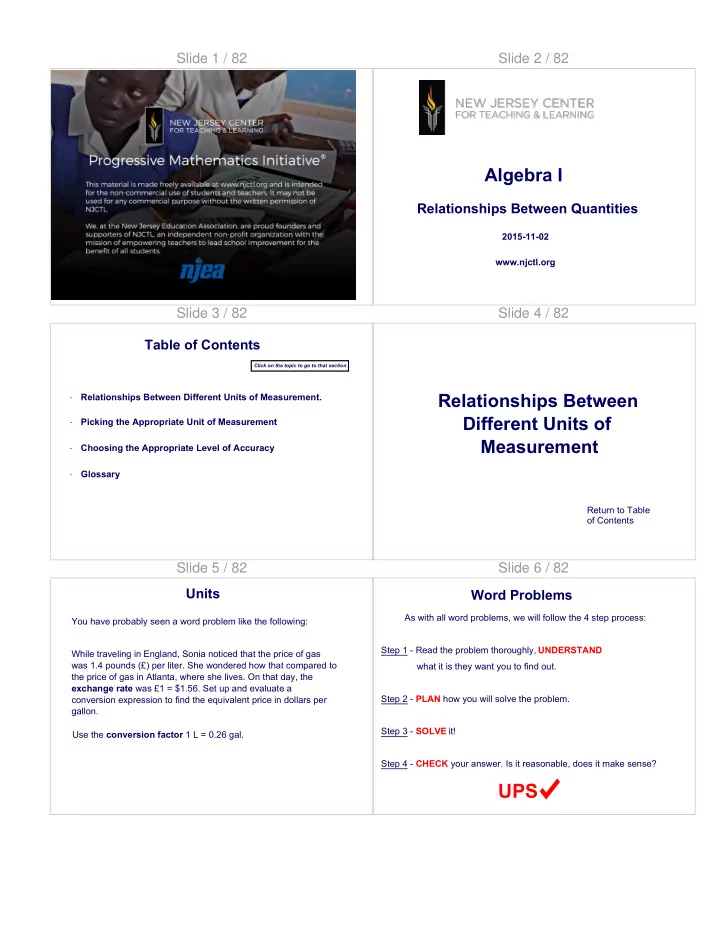
You have probably seen a word problem like the following: While traveling in England, Sonia noticed that the price of gas was 1.4 pounds (£) per liter. She wondered how that compared to the price of gas in Atlanta, where she lives. On that day, the exchange rate was £1 = $1.56. Set up and evaluate a conversion expression to find the equivalent price in dollars per gallon.

Units

Use the conversion factor 1 L = 0.26 gal.

Slide 6 / 82

As with all word problems, we will follow the 4 step process: Step 1 - Read the problem thoroughly, UNDERSTAND what it is they want you to find out. Step 2 - PLAN how you will solve the problem. Step 3 - SOLVE it! Step 4 - CHECK your answer. Is it reasonable, does it make sense?

UPS

Word Problems

slide-2
SLIDE 2

Slide 7 / 82

Sonia wants to find out how the price of gas compares from England to the U.S. In order to find this out we will need to convert units. England uses metric measurement. While traveling in England, Sonia noticed that the price of gas was 1.4 pounds (£) per liter. She wondered how that compared to the price of gas in Atlanta, where she lives. On that day, the exchange rate was £1 = $1.56. Set up and evaluate a conversion expression to find the equivalent price in dollars per gallon. Use the conversion factor 1 L = 0.26 gal.

Units
The US uses a system called the Customary System. (Outside of the US it is referred to as the US Measurement System).

Slide 8 / 82

We will also need to convert the currency since England uses pounds and the U.S. uses dollars so we can use the ratio of While traveling in England, Sonia noticed that the price of gas was 1.4 pounds (£) per liter. She wondered how that compared to the price of gas in Atlanta, where she lives. On that day, the exchange rate was £1 = $1.56. Set up and evaluate a conversion expression to find the equivalent price in dollars per gallon. Use the conversion factor 1 L = 0.26 gal.

Units $1.56 £1 Slide 9 / 82

While traveling in England, Sonia noticed that the price of gas was 1.4 pounds (£) per liter. She wondered how that compared to the price of gas in Atlanta, where she lives. On that day, the exchange rate was £1 = $1.56. Set up and evaluate a conversion expression to find the equivalent price in dollars per gallon. Use the conversion factor 1 L = 0.26 gal.

£1.4 1L

Use a proportion to solve this problem.

Units

First we have to create a ratio out of our initial value.

Slide 10 / 82

Remember, we want to change to dollars per gallon but that means we have to change both the top and the bottom. That also means we need two more ratios. and While traveling in England, Sonia noticed that the price of gas was 1.4 pounds (£) per liter. She wondered how that compared to the price of gas in Atlanta, where she lives. On that day, the exchange rate was £1 = $1.56. Set up and evaluate a conversion expression to find the equivalent price in dollars per gallon. Use the conversion factor 1 L = 0.26 gal.

£1 $1.56 1L .26gal Units Slide 11 / 82

Next multiply all three ratios together. Notice that they are set up so that the labels that are not needed are diagonal from each other. While traveling in England, Sonia noticed that the price of gas was 1.4 pounds (£) per liter. She wondered how that compared to the price of gas in Atlanta, where she lives. On that day, the exchange rate was £1 = $1.56. Set up and evaluate a conversion expression to find the equivalent price in dollars per gallon. Use the conversion factor 1 L = 0.26 gal.

£1 $1.56 1L .26gal = ? x x £1.4 1L Units Slide 12 / 82

Notice that all of the unwanted labels have been cancelled out.

£1 $1.56 1L .26gal = ? x x £1.4 1L 1.4 x 1 x 1.56 2.184 .26 1 x .26 x 1 = $8.40 per gallon =

While traveling in England, Sonia noticed that the price of gas was 1.4 pounds (£) per liter. She wondered how that compared to the price of gas in Atlanta, where she lives. On that day, the exchange rate was £1 = $1.56. Set up and evaluate a conversion expression to find the equivalent price in dollars per gallon. Use the conversion factor 1 L = 0.26 gal.

Units

slide-3
SLIDE 3

Slide 13 / 82

Does your answer make sense? Liters are a much smaller quantity than gallons, .26 to be exact. The exchange rate of the pound is £1 for every $1.56, so it does make sense that the price per gallon should be more than it is per liter. About 4 times more. While traveling in England, Sonia noticed that the price of gas was 1.4 pounds (£) per liter. She wondered how that compared to the price of gas in Atlanta, where she lives. On that day, the exchange rate was £1 = $1.56. Set up and evaluate a conversion expression to find the equivalent price in dollars per gallon. Use the conversion factor 1 L = 0.26 gal.

Units $8.40 per gallon Slide 14 / 82

A cupcake shop sells an average of 14 dozen cupcakes a day to about 50 customers What is their average sales rate, in cupcakes per customer? **HINT: There are 12 units in a dozen. Try this! x = = 3.36 = 12 1 doz. 14 doz. 50 customers 12 x 14 1 x 50 168 50 = 3.36 cupcakes per customer

Click to reveal proportion and answer

Proportion Slide 15 / 82

1 Is this the correct conversion to convert 13 pints to gallons? (There are 8 pints in a gallon.) True False x 8 pts. 1 gal. 13 pts. x

Slide 16 / 82

2 Which expression correctly shows how to convert 50 liters per minute into milliliters per second?

Remember that unwanted units should cancel

Hint

1 min 50 liters 1 min 60 sec 1000 ml 1 liter x x 1 min 50 liters 1 min 60 sec 1000 ml 1 liter x x 1 min 50 liters 1 min 60 sec 1000 ml 1 liter x x A B C

Slide 17 / 82

3 A car burns .85 gallons of gas per hour while idling. Express this rate in quarts per minute. Round your answer to the hundredths place. Remember to check to see if your answer is reasonable.

Slide 18 / 82

4 A police officer saw a car traveling at 1800 feet in 30

  • seconds. The speed limit is 55 mph. Was the person

speeding? Yes No

slide-4
SLIDE 4

Slide 19 / 82

Another important skill with units is being able to graph a situation with the appropriate scale and labels. On the following slides, we will look at some real life examples and examine the thought process behind creating graphs that are correct and meaningful.

Graphs Slide 20 / 82

Let's try one! Stop the video after 1:08 Click on the house below

Graphs Slide 21 / 82

Now watch the video again but this time ask yourself the following questions: Stop the video after 1:08 Click on the house below "How high do you think he was at the top of the stairs? How did you estimate that elevation?" "Were there intervals of time when his elevation wasn't changing? Was he still moving?"

Graphs Slide 22 / 82

Now we are ready to graph. Why do we need to know his height at the beginning? We need to come up with a scale and we need to know where to start our graph. Let's use a scale of 0 to 40 feet with intervals of 10 feet for the y axis. What about the x axis? That should be the time it took him to come down the stairs. Let's use a scale of 0 to 15 with intervals of one.

Click to reveal. Click to reveal.

Graphs Slide 23 / 82

Good, now what's next?

Graphs Slide 24 / 82

Now we need to label the axes.

feet time (in seconds)

Graphs

slide-5
SLIDE 5

Slide 25 / 82

feet time (in seconds)

Now it's time to plot our data. What did you estimate his starting height to be? We will use 30 feet for this example He then went down until he reached a landing at second 5, then another landing at second 8 and finally the bottom at second 12. We will assume that each landing was 10 feet.

Graphs Slide 26 / 82

So, let's compare our graph to the one in the video. Go back to the clip and watch until the end this time.

Graphs Slide 27 / 82

5 A man climbs a ladder, stops at the top and works for awhile, descends the ladder and then puts it away in his

  • basement. Which graph correctly depicts this situation?

feet feet feet feet minutes minutes minutes minutes

A B C D

Slide 28 / 82

6 Which of the following situations could match the graph? A A tomato plant grows at a steady rate, slows down and then dies. B A tomato plant grows at a steady rate, slows down and then grows again. C A tomato plant grows at a steady pace, then grows very quickly, then slows. D A tomato plant never sprouts. weeks inches

Slide 29 / 82

7 At which interval did the plant grow the most quickly? A weeks 0-4 B weeks 4-6 C weeks 6-8

weeks

inches

Slide 30 / 82

Picking the Appropriate Unit of Measurement

Return to Table

  • f Contents
slide-6
SLIDE 6

Slide 31 / 82

For instance: How could you express the number of car accidents in NJ? What unit of measure would you use? Take a minute and discuss with your group and then see what the rest of the class came up with. When given a problem, we need to choose the correct unit for the answer.

Units of Measurement Slide 32 / 82

Here is another example: What type of measurements would you use to express your income and expenses per month? Jot some ideas down and then discuss with your

  • classmates. Can you agree on one?

Units of Measurement Slide 33 / 82

Obviously income and expenses need to be measured

  • monetarily. But should it be dollars, pesos, euros? That would

be determined by what country you live in. Did you think about breaking your income and expenses down so that it was by week, or day or hour? Each situation is unique and requires thought as to what makes the most sense.

Units of Measurement Slide 34 / 82

To make a budget for yourself, you would most likely want to express your income and expenses in dollars per month. But if you were trying to figure out how much of a mortgage you could afford on a house, you would need to know your income and expenses for the year. When the situation changes, the type of measurement may change.

Units of Measurement Slide 35 / 82

8 A good measure of highway safety is: A fatalities per year B fatalaties per driver C fatalities per miles driven D all of the above

Slide 36 / 82

9 Would dollars per ounce be a good measure for whether or not to purchase a dining room table? Yes No

slide-7
SLIDE 7

Slide 37 / 82

10 Which would be the best measure of what kitchen table to buy? A dollars per foot B dollars per person C people per foot

Slide 38 / 82

11 Dan is using a standard tape measurer for his height, to see if he's tall enough for a local rollercoaster. To which measurement should he be accurate? A Yards B Miles C Centimeters D Millimeters

Slide 39 / 82

12 Vern is painting his dining room. He's done the math, and he knows that if he works alone, the job should take 6

  • hours. His two brothers decide to help, and work at the

same rate as Vern. Which is a reasonable estimate for how long the job should take? A 3 hours B 4 hours C 2 hours D 1.5 hours

Slide 40 / 82

Choosing the Appropriate Level

  • f Accuracy

Return to Table

  • f Contents

Slide 41 / 82

The context of a problem can help you to know what degree of accuracy is needed. One of the most prominent examples for accuracy is when a problem deals with money. Rounding your answer to the 10 thousandths place doesn't make sense in the majority of cases with money because our monetary system only allows for the hundredths place.

Accuracy Slide 42 / 82

Another example is math problem involving people. If a problem asked how many people were wearing red, could you answer 3 ? NO! It's not possible. We must round to a whole person.

1 2

Accuracy

slide-8
SLIDE 8

Slide 43 / 82

Other problems may not be as clear. How accurately should the measurement of the width of an Olympic swimming pool be? Would you choose miles, meters, kilometers? Hopefully you would have chosen meters since the other measures would be too large.

Accuracy Slide 44 / 82

What is the most sensible level of accuracy to describe your height? inches For what situation might you want more accuracy? If I were ordering clothes online Why? Because I would want them to fit just right What tool of measurement would you use to achieve this goal? A ruler or tape measure in inches.

Accuracy

click click click click

Slide 45 / 82

What is the most sensible level of accuracy to describe your age? Years For what situation might you want more or less accuracy? For an infant Why? Because they haven't reached the age of 1 year yet and their age is measured in months.

Accuracy

click click click

Slide 46 / 82

13 To measure the width of your locker, you would use a yard stick. True False

Slide 47 / 82

14 The best way to price a loaf of bread is: A $2.573 B $2.57 C $2.5734

Slide 48 / 82

15 Which instrument would be the best to use at a swim meet to time the swimmers? A A watch with a second hand B Your cell phone clock C A digital stopwatch

slide-9
SLIDE 9

Slide 49 / 82

16 Estimate the cost of 10 gallons of gas when the cost per gallon is $3.347.

Slide 50 / 82

17 Jake weighs 152 pounds exactly. If 1 kilogram equals approximately 2.2 pounds, how many kilograms does Jake weigh? A approximately 69.1 kg B approximately 334.4 kg C approximately 0.04 kg

Slide 51 / 82

The digits of a number that express the accuracy of that number are called significant digits. The zeros of a number are not always considered significant. It depends on where they are located in the number.

Significant Digits Slide 52 / 82

3.14159 are 6 significant digits of π. 200 has 1 significant digit, the 2. The zeros in the tens and units places are simply place holders and could be the result of rounding. 200.00 has 5 significant digits as opposed to the "200" above because the".00" at the end shows that the accuracy for this number being the hundredths place. Therefore, the digit for accuracy and all of the digits to the left are included. 0.0025 has 2 significant digits, the 2 and 5. The zeros in the units, tenths, and hundredths places are again place holders. 0.00250 has 3 significant digits, the final three numbers: 2, 5, and 0. The first three zeroes, again, are place holders and the final 0 shows the accuracy for this number being the hundred-thousandths place, so it is included. 30,032 has 5 significant digits. Even though there are two zeros in this number, we need to count them since they lie in the middle.

Significant Digits Examples Slide 53 / 82

Based on the examples on the previous slide, we can determine some rules for significant digits: 1) All nonzero digits are significant

  • e.g. 3.14159 had 6 significant digits

2) All zeros between significant digits are significant.

  • e.g. 30,032 had 5 significant digits

3) All zeros which are both to the right of the decimal point and to the right of all nonzero significant digits are themselves significant

  • e.g. last zero in 0.00250 is significant

Significant Digits Slide 54 / 82

18 Determine the amount of significant digits in the number: 987,000 A 6 B 5 C 4 D 3

slide-10
SLIDE 10

Slide 55 / 82

19 Determine the amount of significant digits in the number: 0.0349 A 3 B 4 C 5 D 6

Slide 56 / 82

20 Determine the amount of significant digits in the number: 4,309,800 A 4 B 5 C 6 D 7

Slide 57 / 82

21 Determine the amount of significant digits in the number: 0.04670 A 6 B 5 C 4 D 3

Slide 58 / 82 Significant Digits

Sometimes questions will ask you to round your answer using significant digits, as opposed to decimal places. Below are two situations. Compare and contrast how each person rounded their answer. Brandon Michelle 587,234.168 590,000 587,234.168 587,234.17

Slide 59 / 82

22 Round 7,469,078 to 5 significant digits. A 7,469,000 B 7,469,100 C 7,469,078.00000 D 7,470,000

Slide 60 / 82

23 Round 89,056 to 3 significant digits. A 89,000 B 89,000 C 89,100 D 89,056.000

slide-11
SLIDE 11

Slide 61 / 82

24 Round 0.23984 to 2 significant digits. A 0.24 B 0.23 C 0.240 D 0.2398

Slide 62 / 82

25 Round 0.09532 to 3 significant digits. A 0.100 B 0.095 C 0.0953 D 0.09532

Slide 63 / 82 Significant Digits

The real question that probably comes to mind is, "How do I determine the appropriate amount of significant digits when I round?" It really depends on the operation involved with the problem at hand. Let's do some examples to see what we are talking about.

Slide 64 / 82 Significant Digits

You measure a box that you need to fill with a liquid. Its length is 4.9 inches, its width is 4.7 inches, and its height is 3.6 inches. You need to calculate the amount of liquid that will fill the box. The question is asking you to find the volume of the box. In order to do so, you multiply the length, width, and height together, making your volume 82.908 cubic inches. But can you really claim that you measured the volume of the box to the thousandth

  • f a cubic inch? Not really. Each of your original measurements

was rounded off to the nearest tenth of an inch, making the number of significant digits used for accuracy 2. Therefore, you cannot claim that your answer (82.908) has an accuracy of 5 significant digits. You can only claim the same number of significant digits for accuracy, which is 2. That would make your answer 83 cubic inches.

Slide 65 / 82 Significant Digits

In your home, you are installing a wallpaper border around your

  • bedroom. The measurements that you found are 15.25 ft, 3.5 ft,

6.167 ft, 21.4167 ft, 17.5 ft, and 16.9167 ft. How would you find the length of the border that you need to purchase?

Slide 66 / 82 Significant Digits

In your home, you are installing a wallpaper border around your

  • bedroom. The measurements that you found are 15.25 ft, 3.5 ft,

6.167 ft, 21.4167 ft, 17.5 ft, and 16.9167 ft. Now that you have the exact answer, how would you determine the correct amount of significant digits? You actually use the same decimal place, or significant digit column, as the least accurate number. Which decimal place would that be for our measurements? What would be our final answer?

slide-12
SLIDE 12

Slide 67 / 82

Based on the previous examples, we can determine some rules for rounding w/ significant digits: 1) When multiplying (& dividing), use the least amount of significant digits

  • e.g. All of the box measurements had 2 significant digits, so

82.908 cubic feet rounded to 83 cubic feet. 2) When adding (& subtracting), use the least accurate place value.

  • e.g. The least accurate place value was the tenths place, so

80.7504 ft rounded to 80.8 feet

Significant Digits Slide 68 / 82

26 How many significant digits will be in the answer of the multiplication problem 6.1 ∙ 9.531? A 1 B 2 C 3 D 4

Slide 69 / 82

27 How many significant digits will be in the answer of the multiplication problem 9.8531 ∙ 2.46? A 5 B 4 C 3 D 2

Slide 70 / 82

28 Which place value will you be rounding to in the addition problem 18.7 + 12.84 + 21 + 37.976 + 22.03? A units B tenths C hundredths D thousandths

Slide 71 / 82

29 Which place value will you be rounding to in the subtraction problem 291.7 - 22.387 - 41.56 - 9.855? A units B tenths C hundredths D thousandths

Slide 72 / 82

30 Jill is purchasing some fencing to enclose her backyard. The dimensions required are 12.75 yd, 55 yd, 122.5 yd, 55 yd, and 13.625 yd. How much fencing should she buy? A 259 yd B 258.9 yd C 258.88 yd D 258.875 yd

slide-13
SLIDE 13

Slide 73 / 82

31 You measure that a rectangular sandbox has a length of 20.875 feet and a width of 15.4 feet. You are purchasing a tarp to cover the sandbox when it rains. What is the area of a tarp? A 321.475 sq ft B 321.46 sq ft C 321.5 sq ft D 321 sq ft

Slide 74 / 82

Glossary

Return to Table

  • f Contents

Slide 75 / 82

Different than precision!

Back to Instruction

Accuracy

How close a measured value is to the actual (true) value. Slide 76 / 82

1 year 52 weeks= 1 year 52 weeks

1foot = 12 in.

  • 12in. 1foot

1 day = 24 hours 24 hours 1 day

Back to Instruction

Conversion Factor

A ratio written in fraction form that can express the same value or quantity in two different units. Slide 77 / 82

Back to Instruction

Customary System

System of measurement in the United States. Slide 78 / 82

USD to CanD USD to Euro USD to Aus.

Back to Instruction

Exchange Rate

The ratio at which one currency can be exchanged for another.

*as of 8-7-2015

slide-14
SLIDE 14

Slide 79 / 82

Back to Instruction

Metric Measurement

System of measuring (SI) Slide 80 / 82

Back to Instruction

Proportion

An equation that states two ratios are equal.

2 3 14 21

=

1 2 20 40

=

5 8 15 x

=

x3 x3

x = 24

Slide 81 / 82

Back to Instruction

Ratio

A comparison of two numbers by division.

3 different ways: "the ratio of a to b"

a to b a : b

a

b

There are 48 animals in the field. Twenty are cows and the rest are horses. What is the number

  • f cows to the total

number of animals?

20 to 48 20:48 20 48 Slide 82 / 82

Back to Instruction

Significant Digits

Digits of a number that express the accuracy for a measurement.

numbers beginning w/ the left most nonzero digit, or w/ the first digit after the decimal point 62,450 54.00 0.3125 all have 4 significant digits when numbers end in zero(s) to the left of the decimal point, the zeros do not count

doesn't count do count