UPRT: The Three Pillars of Prevention Dr Wayne Martin BAvMan, - - PowerPoint PPT Presentation

uprt the three pillars of prevention
SMART_READER_LITE
LIVE PREVIEW

UPRT: The Three Pillars of Prevention Dr Wayne Martin BAvMan, - - PowerPoint PPT Presentation

UPRT: The Three Pillars of Prevention Dr Wayne Martin BAvMan, MAvMgmt, MBus, PhD, FRAeS CRICOS QLD00244B NSW 02225M TEQSA:PRF12081 Topics The problem with LOC-I Common Precursors to LOC-I The Three Pillars of Prevention CRICOS


slide-1
SLIDE 1

CRICOS QLD00244B NSW 02225M TEQSA:PRF12081
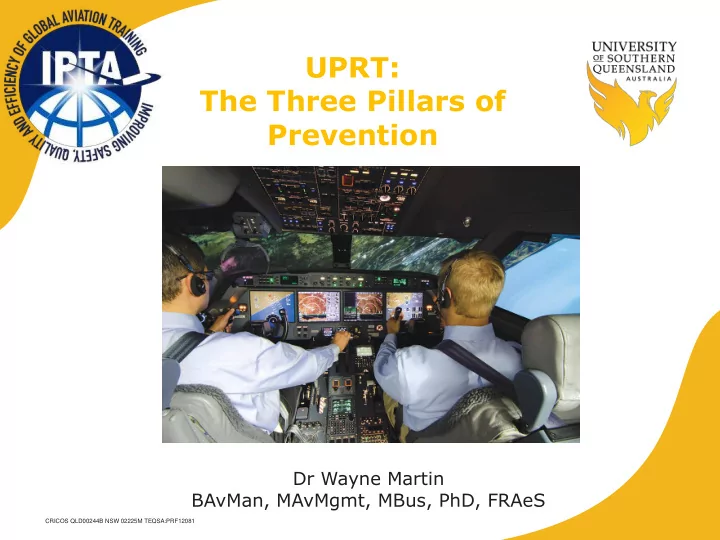
UPRT: The Three Pillars of Prevention

Dr Wayne Martin BAvMan, MAvMgmt, MBus, PhD, FRAeS

slide-2
SLIDE 2

CRICOS QLD00244B NSW 02225M TEQSA:PRF12081

  • The problem with LOC-I
  • Common Precursors to LOC-I
  • The Three Pillars of Prevention

Topics

slide-3
SLIDE 3

CRICOS QLD00244B NSW 02225M TEQSA:PRF12081

Colgan Air – Buffalo 2009

The Problem with Loss

  • f Control
slide-4
SLIDE 4

CRICOS QLD00244B NSW 02225M TEQSA:PRF12081

Turkish Airlines – Amsterdam 2009

The Problem with Loss

  • f Control
slide-5
SLIDE 5

CRICOS QLD00244B NSW 02225M TEQSA:PRF12081

Air France – Atlantic Ocean 2009

The Problem with Loss

  • f Control
slide-6
SLIDE 6

CRICOS QLD00244B NSW 02225M TEQSA:PRF12081

Pinnacle Airlines – Jefferson City 2004

The Problem with Loss

  • f Control
slide-7
SLIDE 7

CRICOS QLD00244B NSW 02225M TEQSA:PRF12081

West Caribbean Airlines – Venezuela 2005

The Problem with Loss

  • f Control
slide-8
SLIDE 8

CRICOS QLD00244B NSW 02225M TEQSA:PRF12081

Air Asia – Indonesia 2014

The Problem with Loss

  • f Control
slide-9
SLIDE 9

CRICOS QLD00244B NSW 02225M TEQSA:PRF12081

Environmental Factors

Common Precursors to Loss of Control

  • Severe turbulence, including clear air and

mountain wave turbulence.

  • Windshear;
  • Thunderstorms;
  • Microbursts;
  • Wake turbulence; and
  • Aircraft icing
slide-10
SLIDE 10

CRICOS QLD00244B NSW 02225M TEQSA:PRF12081

Aircraft System Anomalies

Common Precursors to Loss of Control

  • Flight instruments;
  • Autoflight systems; and
  • Flight control and other anomalies
slide-11
SLIDE 11

CRICOS QLD00244B NSW 02225M TEQSA:PRF12081

Misinterpretation or Breakdowns in Cross- checking Information

Common Precursors to Loss of Control

slide-12
SLIDE 12

CRICOS QLD00244B NSW 02225M TEQSA:PRF12081

Adjusting Attitude and Power

Common Precursors to Loss of Control

slide-13
SLIDE 13

CRICOS QLD00244B NSW 02225M TEQSA:PRF12081

Vertigo or Spatial Disorientation

Common Precursors to Loss of Control

slide-14
SLIDE 14

CRICOS QLD00244B NSW 02225M TEQSA:PRF12081

Distraction from Primary Cockpit Duties

Common Precursors to Loss of Control

slide-15
SLIDE 15

CRICOS QLD00244B NSW 02225M TEQSA:PRF12081

Inattention

Common Precursors to Loss of Control

slide-16
SLIDE 16

CRICOS QLD00244B NSW 02225M TEQSA:PRF12081

Improper Use of Aircraft Automation

Common Precursors to Loss of Control

slide-17
SLIDE 17

CRICOS QLD00244B NSW 02225M TEQSA:PRF12081

Pilot Techniques

(including Pilot Induced Oscillation Avoidance or Recovery)

Common Precursors to Loss of Control

slide-18
SLIDE 18

CRICOS QLD00244B NSW 02225M TEQSA:PRF12081

Surprise An unexpected event that violates a pilot’s expectations and can affect the mental processes used to respond to the event

(FAA, 2015)

Common Precursors to Loss of Control

slide-19
SLIDE 19

CRICOS QLD00244B NSW 02225M TEQSA:PRF12081

Startle An uncontrollable, automatic muscle reflex, raised heart rate, blood pressure, etc., elicited by exposure to a sudden, intense event that violates a pilot’s expectations.

(FAA, 2015)

Common Precursors to Loss of Control

slide-20
SLIDE 20

CRICOS QLD00244B NSW 02225M TEQSA:PRF12081

Prevention of Loss of Control remains the highest priority for dealing with the LOC-I problem. There needs to be holistic processes put in place which allow more attention to be focussed on the problem at both an organisational and personal level.

Prevention of LOC-I

slide-21
SLIDE 21

CRICOS QLD00244B NSW 02225M TEQSA:PRF12081

Training Interventions

UPRT Guidance

Becoming widespread across the world

slide-22
SLIDE 22

CRICOS QLD00244B NSW 02225M TEQSA:PRF12081

The Three Pillars of Prevention

slide-23
SLIDE 23

CRICOS QLD00244B NSW 02225M TEQSA:PRF12081

The 1st Pillar: Knowledge Elements

slide-24
SLIDE 24

CRICOS QLD00244B NSW 02225M TEQSA:PRF12081

The 1st Pillar: Knowledge Elements

  • Aerodynamics;
  • Causes and contributing factors of upsets;
  • Safety reviews of accidents and incidents relating to aircraft upsets;
  • G awareness;
  • Energy management;
  • Flight path management;
  • Recognition;
  • Upset prevention and recovery techniques;
  • System malfunctions;
  • Various specialised training elements (e.g., spiral dives and recovery

from stick-pusher);

  • Human factors
  • Recovery procedures;
  • Factors leading to a stall event;
  • Airplane-specific systems knowledge; and
  • Airplane certification differences
slide-25
SLIDE 25

CRICOS QLD00244B NSW 02225M TEQSA:PRF12081

The 2nd Pillar: Motivation

While Pilots may practise emergencies in the sim for perhaps four days a year, the remainder of the 360+ days are often routine and emergency-free. This leads to a ‘Conditioned Expectation for Normalcy’ On those rare occasions when things do go wrong, then a lack of expectation can produce some heightened surprise and stress reactions, with negative effects on situation

  • utcome.
slide-26
SLIDE 26

CRICOS QLD00244B NSW 02225M TEQSA:PRF12081

The 3rd Pillar: Effective Monitoring

slide-27
SLIDE 27

CRICOS QLD00244B NSW 02225M TEQSA:PRF12081

The 3rd Pillar: Effective Monitoring

The following are some of the sub-skills/ actions required to actually perform the monitoring task: Attention management: Procedures/techniques for directing a pilot’s attention to a particular place at a particular time. Deliberate checking: The active, disciplined and effortful action a pilot must take to look for something rather than just look at something, including the devotion of adequate visual dwell time on the thing being checked Cross-checking/cross-verifying: Comparing separate, independent sources of information to confirm or refute understanding derived from the initial source.

(Flight Safety Foundation, 2014)

slide-28
SLIDE 28

CRICOS QLD00244B NSW 02225M TEQSA:PRF12081

The 3rd Pillar: Effective Monitoring

What to monitor: Flight path: Monitoring the trajectory and energy state of the aircraft, power settings and the automated systems directly affecting flight path Systems: Monitoring of aircraft systems, excluding those directly affecting the flight path Operational factors: Monitoring other operational factors affecting the flight Crew/situational awareness: Monitoring the actions/ condition of the other pilot(s) and crew/situational awareness

(Flight Safety Foundation, 2014)

slide-29
SLIDE 29

CRICOS QLD00244B NSW 02225M TEQSA:PRF12081

The 3rd Pillar: Effective Monitoring

(Flight Safety Foundation, 2014)

Additional Guidance for effective monitoring:

  • ‘Following SOPs consistently;
  • Clearly communicating deviations to other crewmembers;
  • Aggressively managing distractions;
  • Remaining vigilant;
  • Intervening if flight guidance modes or aircraft actions don’t agree

with expected actions;

  • Continuously comparing known pitch/power settings to current flight

path performance;

  • Considering that the primary flight displays and navigation displays

(PFD, ND) might be “lying” and always being on the lookout for other evidence that confirms or disconfirms what the displays are saying;

  • Methodically regaining flight path situational awareness after

completing non-flight-related tasks; and,

  • Alerting other crewmembers when monitoring is inhibited (e.g., heads

down).

slide-30
SLIDE 30

CRICOS QLD00244B NSW 02225M TEQSA:PRF12081

Questions?