Updates to the Revised 21 st CCLC External We will send all final - - PDF document

updates to the revised 21 st cclc external
SMART_READER_LITE
LIVE PREVIEW

Updates to the Revised 21 st CCLC External We will send all final - - PDF document

4/11/2019 Final Documents Updates to the Revised 21 st CCLC External We will send all final documents to Cindy this afternoon after the 2 nd webinar Evaluation Framework (201819 Program Year) Terri Foulkes, Missouri AfterSchool


slide-1
SLIDE 1

4/11/2019 1

Updates to the Revised 21st CCLC External Evaluation Framework (2018‐19 Program Year)

Terri Foulkes, Missouri AfterSchool Network Wayne Mayfield, PhD, Office of Social and Economic Data Analysis

Final Documents…

  • We will send all final documents to Cindy this

afternoon after the 2nd webinar

Guiding Principles

  • Grantees and sites should see and be able to use

the data collected

  • If we are going to collect it, it should be used
  • Expectations (goals) should be consistent across all

levels (site, grant, state)

  • Programs need support with interpreting and using

their data

  • Evaluation framework should align with ESSA

Overall Purpose of the External Evaluation

  • To provide DESE with an detailed and accurate

picture of the grantee and their progress on the statewide goals and objectives

  • To provide the grantee accurate and usable

information for dissemination about their use of grant funds and to support their ability to make progress toward meeting and exceeding the statewide goals and objectives

2018‐2023 Goals and Objectives

Goal 1

Support or increase student achievement and sense of competence in the areas of reading/language arts, mathematics, and science. Objective 1.1: The afterschool grantee will score satisfactory or above on the reading/communications arts rubric. Objective 1.2: The afterschool grantee will score satisfactory or above on the math rubric. Objective 1.3: The afterschool grantee will score satisfactory or above on the science rubric.

Goal 2

Develop and maintain a quality program that includes a safe and supportive environment, positive interactions, and meaningful opportunities for engagement. Objective 2.1: The afterschool site(s) will score satisfactory or above on the program quality improvement rubric. Objective 2.2: The afterschool site(s) will score satisfactory or above on the school day alignment rubric. Objective 2.3: The afterschool site will score satisfactory or above on the broad array rubric. Objective 2.4: The afterschool grantee will score satisfactory or above on the family engagement rubric.

Goal 3

Enhance youth’s college and career readiness skills and behaviors, including positive school behaviors, personal and social skills, and commitment to learning. Objective 3.1: The afterschool grantee will score satisfactory or above on the program attendance rubric. Objective 3.2: The afterschool grantee will score satisfactory or above on the personal and social skills rubric. Objective 3.3: The afterschool grantee will score satisfactory or above on the commitment to learning rubric.

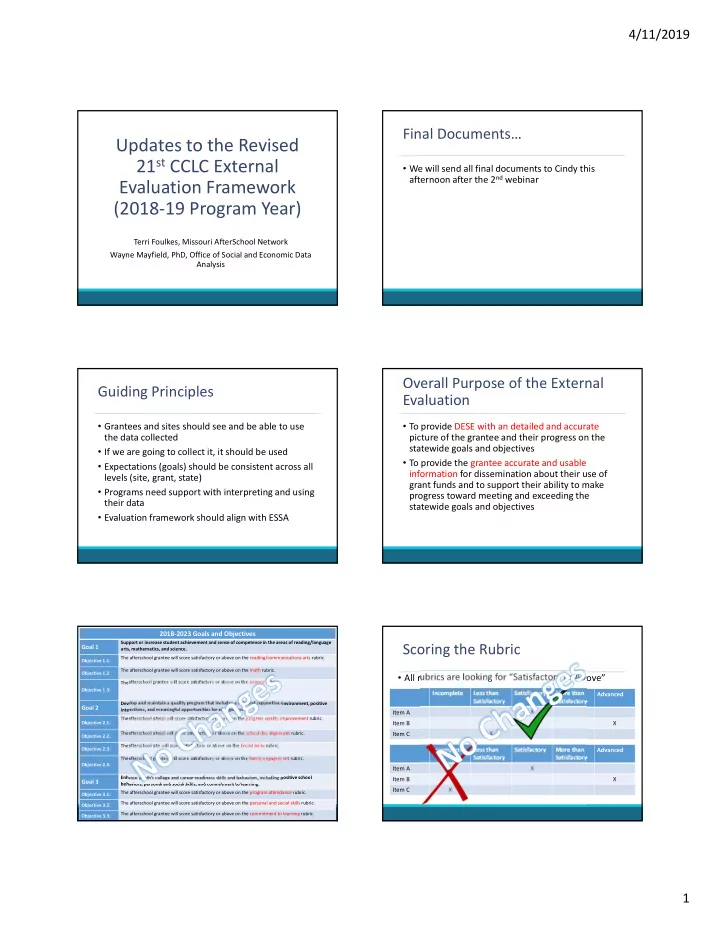
Scoring the Rubric

  • All rubrics are looking for “Satisfactory or Above”

Incomplete Less than Satisfactory Satisfactory More than Satisfactory Advanced Item A X Item B X Item C X Incomplete Less than Satisfactory Satisfactory More than Satisfactory Advanced Item A X Item B X Item C X

slide-2
SLIDE 2

4/11/2019 2

Changes to the Rubrics

  • Highest level is now called Advanced
  • Some items moved up
  • Satisfactory to More than Satisfactory
  • More than Satisfactory to Advanced
  • “Big OR” option on some items
  • Some items now compared to the state or district

data

1.1‐3.C&D ‐ MAP and EOC Scores

Satisfactory More than Satisfactory Advanced The grantee's percentage of students with scores

  • f Proficient or above

is within 10 percentage points of the state's percentage OR the district's percentage. The grantee's percentage of students with scores

  • f Proficient or above

is at or above the state's percentage OR the district’s percentage. The grantee's percentage of students with scores

  • f Proficient or above

is at least 10 percentage points above the state's percentage OR the district’s percentage.

2.2.A ‐ Coordination of Academic Support ‐ Consistency of Curriculum and Content

Satisfactory More than Satisfactory Advanced Written plan documenting how coordination of academic support will take place (see note 2.2.A). Documentation that the written plan is agreed upon by both parties (school day and afterschool ‐ see note 2.2.A). Documentation of the implementation of the agreed upon plan.

2.2.A ‐ The plan should include details about how school day staff and afterschool staff will ensure consistency of curriculum and coordination (but not replication) of content. The plan should include information about what content the afterschool program will cover that is consistent/coordinated, but not replicated, the type of individual student information that will be shared to help determine targeted interventions, and methods of ongoing communication between school and afterschool team members (what will be communicated about students, methods of communication, regularity/timing of communication, etc.). 2.2.A ‐ For more than satisfactory and advanced, documentation that the plan is agreed upon by both parties could be in the form of signatures, e‐mail confirmation, etc.

2.2.B – Documenting State Standards

Satisfactory (If documenting lesson plans, you can go to More than Satisfactory.) More than Satisfactory Advanced

Identify state standards for all activities in the Program Activity Plan of the grant application or continuation report (minimum coding of the standards ‐ see note 2.2.B). Lesson plans for all academic enrichment activities (math, reading, and science) include the state standards (minimum coding of the standard ‐ see note 2.2.B). Lesson plans for all academic enrichment activities (math, reading, and science) include the full description of the state standards OR lesson plans for all activities (except homework help, tutoring, snack, and free time) include the minimum coding of state standards. “…aligns the activities provided by the program with the challenging State academic standards.” ‐ESSA

2.3.A – Academic Strategies Based on Student Needs

“… programs and activities with emphasis on … the academic needs of participating students.” “… align with the regular academic program of the school and the academic needs of participating students …” ‐ ESSA

  • Changed language from “targeted academic strategies” to

“academic strategies based on student academic needs”

  • Fixed error – there is no Incomplete for this item, not having a

plan is Less than Satisfactory

2.3.B – Social and Emotional Learning Activities

Satisfactory More than Satisfactory Advanced

Documentation that at least two SEL activities (individual, small group,

  • r whole group) were

implemented. Documentation of at least three SEL activities OR a summary of the site's approach to supporting SEL that includes at least two of the following: topics covered, frequency of SEL activities, rationale for selection. Documentation of at least four SEL activities with data to document impact OR the SEL summary must include topics covered, frequency of SEL activities, rationale for selection, and data to document impact.

slide-3
SLIDE 3

4/11/2019 3 3.2.A ‐ Personal and Social Skills (and 3.3.A ‐ Commitment to Learning)

Satisfactory More than Satisfactory Advanced

At least 70% of youth indicate a medium to high level of personal and social skills on the Youth Survey OR the site level SEL plan includes information about how the site will address personal and social skills. At least 80% of youth indicate a medium to high level of personal and social skills on the Youth Survey OR the site level SEL plan includes personal and social skills AND documentation of a lesson plan specific to personal and social skills. At least 90% of youth indicate a medium to high level of personal and social skills on the Youth Survey OR the site level SEL plan includes personal and social skills, a lesson plan specific to personal and social skills, and data to document impact.

2.2.B – School Day Discipline

Satisfactory More than Satisfactory Advanced

At least 70% of youth have no in‐building or

  • ut‐of‐school suspensions

OR the grantee's percentage

  • f in‐building or out‐of‐

school suspensions is within 10 percentage points of the district's percent. At least 80% of youth have no in‐building or

  • ut‐of‐school suspensions

OR the grantee's percentage

  • f in‐building or out‐of‐

school suspensions is at

  • r above the district's

percent. At least 90% of youth have no in‐building or

  • ut‐of‐school suspensions

OR the grantee's percentage

  • f in‐building or out‐of‐

school suspensions is at least 10 percentage points above the district's percent.

Changes to the Process

Evaluation Design

  • MASN
  • OSEDA
  • DESE

Data Collection

  • MASN
  • Grantees
  • External Evaluator

Data Report Generation

  • OSEDA

Review of Data Guided Reflection Document

  • External Evaluator
  • Program Director

Grantee Level Action Plans

  • Grantees
  • Coaches
  • External Evaluator

Change to the Documentation Review

  • Originally – External Evaluator
  • Now – MASN
  • Consistency
  • Flexibility
  • Follow‐up

Documentation Review Sheet

  • Will be used by MASN to capture the nuances of the

documentation

  • Details that will help us with TA
  • Passed out to External Evaluators
  • Feedback on how we were going to review the information
  • AREs will use them to develop tools
  • Not meant to be used by program directors
  • Not coded to levels
  • Organized by type of document, not by rubrics
  • Some questions are to help with TA tools
  • Able to score More than Satisfactory and Advanced without

all the questions

Snapshot of the Review Sheet

slide-4
SLIDE 4

4/11/2019 4

But what if I missed something…

  • You will have the option to fill out an “expected

level” sheet.

  • If your reviewed level does not match with the

expected level, we will contact you.

Expected Level Sheet Timeline

  • Now‐5/31/19 – Prepare documentation
  • 5/31/19 postmark deadline for guaranteed post‐review

communication if “expected” and “actual” are different

  • 6/15/19 postmark deadline for all documentation –
  • therwise scored as “less than satisfactory”
  • Now‐6/30/19 – MASN reviews documentation and follows

up when “expected” and “actual” are different

  • 6/30/19 – Data to OSEDA for calculating Satisfactory, More

than Satisfactory, Advanced

  • 7/31/19 – Data from OSEDA to report writer
  • 8/15/19 – Reports sent to External Evaluators and Program

Directors for second part of Guided Reflection

Preparing the Documentation – Grant Level Items

  • Activity Plan with State Standards
  • NA if documenting state standards in lesson plans
  • Family Activity Summary Forms

Preparing the Documentation – Site Level Items

  • Weekly schedule
  • Daily only needed if weekly does not have enough detail
  • Lesson Plans
  • Academic (matching weekly schedule)
  • Broad Array (matching weekly schedule)
  • Social and Emotional Learning (or summary form)

Preparing the Documentation – Site Level Items

  • Age Group Flow and Choice Summary Form
  • Academic Strategies Summary Form
  • SEL Activity Documentation (optional “OR” for

some items)

  • Plan for Academic Support
  • Documentation of implementation (Advanced only)
  • SEL Plan (optional “OR” for some items)