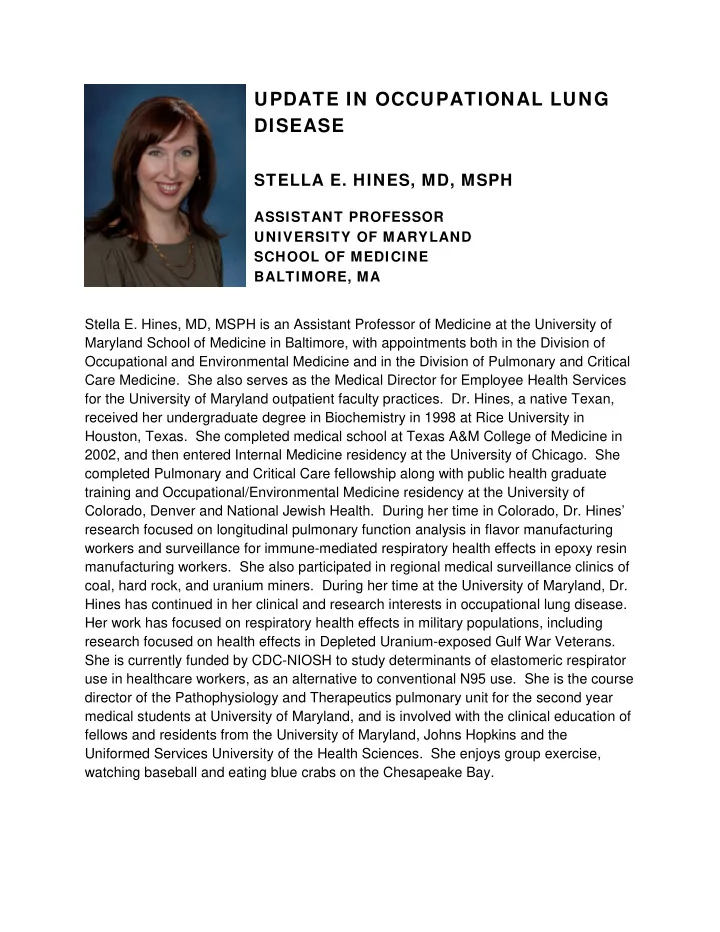
UPDATE IN OCCUPATIONAL LUNG DISEASE STELLA E. HINES, MD, MSPH - - PDF document
UPDATE IN OCCUPATIONAL LUNG DISEASE STELLA E. HINES, MD, MSPH ASSISTANT PROFESSOR UNIVERSITY OF MARYLAND SCHOOL OF MEDICINE BALTIMORE, MA Stella E. Hines, MD, MSPH is an Assistant Professor of Medicine at the University of Maryland School of
OBJECTIVES:
Participants should be better able to:
- 1. The listener will learn about new cases reported in the medical literature of
constrictive bronchiolitis in flavoring-exposed populations.
- 2. The listener will learn about the increasing body of medical literature related to
pulmonary health in military Service members from combat operations in Southwest Asia.
F R I D A Y , M A R C H 4 , 2 0 1 6
1 0 :3 0 A M
3/8/2016 1
Update in Occupational Lung Disease: Constrictive Bronchiolitis in Flavors and War
Stella E. Hines, MD, MSPH Assistant Professor The University of Maryland-Baltimore School of Medicine
- Dr. Hines has declared no
conflicts of interest related to the content of her presentation.
3/8/2016 2
Disclosures
- Dr. Hines has evaluated patients for flavoring-
induced lung disease and provided programmatic advice to flavor manufacturing employee health services within her academic practice at the University of Maryland School
- f Medicine.
Outline
- Review of nomenclature
- Review and Update on Flavoring-induced Lung
Disease
- Review and Update on Deployment-related
Lung Disease
- Summary
3/8/2016 3
Constrictive Bronchiolitis/ Obliterative Bronchiolitis
- Bronchiolar disorder
– Airways < 2 mm – Lack of cartilage
- Concentric narrowing of
the bronchiolar lumen due to fibrotic changes to the airway wall
- Related
terms/conditions
– Cellular bronchiolitis – Follicular bronchiolitis – Proliferative bronchiolitis – BO with
- rganizing
pneumonia
Cummings & Kreiss, Sem in Resp Crit Care Med, 2015. Image: King et al, NEJM, 2011 Image: Burgel et al, ERJ, 2013
Examples of exposures associated with bronchiolar disorders
Exposure Setting
Ammonia Chemical industry, refrigerant Benzalkonium compounds Floor polish spill Chlorine Transportation spill, industrial accident Flock (nylon, rayon) Upholstery Humidifier disinfectant Homes Nitrogen oxides Explosive detonation, silage Sulfur dioxide Sulfur mine fire, paper mill bleaching Sulfur mustard Chemical warfare Styrene Fiberglass-reinforced plastics
Cummings & Kreiss, Sem in Resp Crit Care Med, 2015. = association with constrictive bronchiolitis
3/8/2016 4
Audience Response Question 1
- True/False
– Flavoring-related Constrictive Bronchiolitis was first recognized as an occupational illness among lollipop factory workers?
- A. TRUE
- B. FALSE
Audience Response Question 1 Flavoring-related Constrictive Bronchiolitis was first recognized as an occupational illness among lollipop factory workers?
- A. True
- B. False
A. B.
40% 60%
3/8/2016 5
Original Cases in Microwave Popcorn Workers
- 2000: 9 former workers of a
microwave popcorn plant in rural Missouri dx with Bronchiolitis Obliterans
– Non-smokers – Spirometry: fixed airflow obstruction
- FEV1 ranged 14-67% predicted
– HRCT: mosaic attenuation, air trapping – Surgical lung bx: bronchiolitis obliterans – All had worked in production areas of the plant
Parmet JOEM 2002, Akpinar-Elci ERJ 2004,
(Kreiss, NEJM 2002)
Additional Cases in Flavor Manufacturing Workers - 2007
- 2 cases in California flavor
companies
– 29 yo M; fixed airflow
- bstruction, typical HRCT
– 40 yo W; fixed airflow
- bstruction; bx with
peribronchial inflammation, interstitial fibrosis, granulomas
- Diacetyl Manufacturer in
Netherlands
April 27, 2007: Fixed Obstructive Lung Disease Among Workers in the Flavor- Manufacturing Industry --- California, 2004--2007
Van Rooy et al, AJRCCM, 3007
3/8/2016 6
2007 - Consumer Case brings “Popcorn Lung” to national attention
- 53 y.o. never smoker
c/o shortness of breath & cough
- Spiro: Fixed
- bstruction
- VATS Bx: bronchiolitis
- bliterans (& granulomas)
- SHx: Consumes 2
bags/day microwave popcorn x 10 years
11
Industry Response to Consumer Case
- Change in formulation & advertising
Press Releases AMERICAN POP CORN COMPANY, MAKERS OF JOLLY TIME POP CORN, STATEMENT ON THE BUTTER FLAVORING AGENT DIACETYL September 5, 2007 America’s first brand name of popcorn, JOLLY TIME, will remove all added diacetyl from their microwave popcorn products within the next 90 days.
http://www.jollytime.com/pressroom/press_releases/diacetyl_statement 12
- Change to different
flavoring agents
- Butter starter distillate,
Acetoin, 2,3-pentanedione
3/8/2016 7
Diacetyl substitutes still induce epithelial toxicity in rat & mouse models
- Inhalation of 2,3-pentanedione
– Upper airway epithelial necrosis (Hubbs 2010, Morgan 2010) – Extra & intraluminal airway fibrosis (Morgan 2012)
- Intratracheal administration of 2,3-pentanedione
– Bronchiolar epithelial inflammation & necrosis + intramural fibrosis (Flake 2010)
13
Morgan et al, Tox Path, 2012. Figure: Constricted bronchiolar lumen lined by irregular epithelium.
Audience Response question 2
- TRUE/FALSE
- No additional cases of biopsy-proven
constrictive bronchiolitis have been published among flavor-exposed populations since the report of the consumer case.
– A. TRUE – B. FALSE
3/8/2016 8
Audience Response Question 2 No additional cases of biopsy-proven constrictive bronchiolitis have been published among flavor-exposed populations since the report of the consumer case.
- A. True
- B. False
A. B.
100% 0%
Additional Cases – Consumers
- 47 yo F, non-smoker
– Worked at video store x 4 years, popped 30 bags of popcorn/weekend – Consumed 3-5 bags/day popcorn 1996-2004
- 43 yo F, non-smoker
– Consumed 1-2 bags/day from 1989-2000, and sporadically thereafter – NSIP + bronchiolitis
- bliterans
Egilman & Schilling, Int. J Occ Env Health, 2012.
3/8/2016 9
Additional Cases – Food Production
- Cookie manufacturing in Brazil
– 4 male, non-smokers, exposed to artificial butter flavoring
Cavalcanti et al, J Bras Pneumol. 2012
Additional Cases – Coffee Production
2 Cases
- 34 yo Hispanic F, nonsmoker
- Initially worked in QC, then housekeeping, then flavoring room
- Operated grinding and packing machines for flavored beans for 1 year
- Moved to similar job in unflavored coffee area for another 2.5 years
- Initially diagnosed and treated for asthma, worsened
- 39 yo Hispanic M, nonsmoker
- Initially worked as green coffee bean unloader, then maintenance, then mixer
in flavorings room x 19 months
- Symptoms noted after 18 months at this job
- Initially diagnosed and treated for bronchitis
3/8/2016 10
Cases and Surveillance from Coffee Production (same facility)
- 3 additional cases in
former workers based on non-invasive testing total of 5
- 2.7 x Increased Airflow
Obstruction
- 1.6 x Excess of SOB on
mild exertion among current workers compared to NHANES III
Bailey et al, AJIM. 2015
New Exposure Data – Coffee production
Bailey et al, AJIM. 2015; Gaffney et al, Tox Reports. 2015
- High levels of flavoring compounds not just in
flavoring rooms, but in areas with unflavored beans
– Natural source of diacetyl: roasting of coffee beans emitted during grinding
3/8/2016 11
New Exposure Data – Coffee Shops
- Simulated small coffee shop,
preparation & consumption of unflavored coffee
- Grinding of beans
- Brewing
- Pouring into cups
- Compared levels to NIOSH
proposed REL of 0.005 ppm over 8 hours
Pierce et al, Tox Reports. 2015
New Exposure Data – Cigarette Smoke
- Diacetyl and 2,3-pentanedione measured in
mainstream smoke via standard smoking machine
– Mean diacetyl: 250-361 ppm – Mean 2,3-pentanedione: 32.2-50.1 ppm
- Author Conclusions:
– Exposures from smoking far exceed occupational exposures; – Findings suggest that studies implicating health effects associated with diacetyl exposure have been confounded due to non-occupational exposure to diacetyl from cigarette smoking
Pierce et al. Crit Rev Toxicol, 2014.
3/8/2016 12
New Exposure Data – E-cigarettes
Allen et al. Environ Health Perspect, 2015.
51 types of e-cigs by leading brands, with flavors deemed “appealing” to youth.
- “Cotton candy”
- “Cupcake”
So……..
- We continue to see this disease in flavor-
exposed populations……
- We continue to identify new opportunities for
exposure but
- Is this the same disease being seen in military
deployers?
3/8/2016 13
Constrictive Bronchiolitis in Deployers to Middle East and Southwest Asia
- Fort Campbell soldiers referred to Vanderbilt
for evaluation of exertional dyspnea
– Unable to complete 2 mile run – Most exposed to large sulfur mine fire in Iraq – 80 evaluated
- 49 referred for VATS
– 38 had constrictive bronchiolitis – Remaining 11: 2 with Respiratory Bronchiolitis, 2 RB-ILD, 2 HP, 2 Sarcoidosis, 2 other
King NEJM 2011; Miller, ATS 2011
25
Audience Response question 3
- TRUE/FALSE
Deployers from the 2011 NEJM report with Constrictive Bronchiolitis showed severe pulmonary functional impairment.
- A. True
- B. False
3/8/2016 14
Audience Response Question 3 Deployers from the 2011 NEJM report with Constrictive Bronchiolitis showed severe pulmonary functional impairment.
- A. True
- B. False
A. B.
37% 63%
PFTs & Imaging not that “impressive”
- PFTs
– Totally normal in 13 – 25 with abnormal gas exchange (low diffusion capacity (DLCO))
- FEV1, FVC, FEV1/FVC all
significantly different from controls but still “normal” – FEV1 % Pred: 86.7 – FVC % Pred: 90.3 – FEV1/FVC %: 79.1 – TLC % Pred: 96.1 But… – DLCO % Pred: 73.4
- vs. 90.6% in controls
- High res chest CTs (n=37)
– 25 NORMAL – 6 mild air trapping – 1 single nodule – 2 multiple nodules – 1 basilar scarring – 1 pleural thickening – 1 apical bullae
- Cardiopulmonary Exercise
Tests
– VO2 max & Anaerobic Thresholds significantly lower than controls
28
King NEJM 2011
3/8/2016 15
Constrictive Bronchiolitis, Arteriopathy, and Peribronchial Pigment Deposition.
King MS et al. N Engl J Med 2011;365:222-230
Subepithelial fibrosis Smooth muscle hypertrophy Fibrosis btwn epithelium & muscle layer Smooth muscle hypertrophy + intimal fibrosis + PA medial hypertrophy & peribronchiolar pigment Smooth muscle hypertrophy Polarizable pigment (from E)
So, clinically this is odd. Was it really constrictive bronchiolitis?
King NEJM 2011
29
Exposures of Concern
Photo credit: R. Teichman, WRIISC conference, Aug 2011
3/8/2016 16
Institute of Medicine Report, released 2011
- VA directed IOM to prepare an evaluation of Burn
Pit issues and recommendation back to the VA
- Conclusions
– Mixture of chemicals from regional bkgrd & local sources that contribute to the high PM – Unable to determine whether long-term health effects likely due to burn pit emissions;
- BUT service in Iraq or Afghanistan might be associated with
long-term health effects (mainly b/c of PM from natural & anthropogenic sources)
– Needs more study
31
New Data on Lung Disease in Military Populations
- Review Articles
– Krefft et al. Emerging spectrum of deployment- related respiratory diseases. Curr Opin Pulm
- Med. 2015.
- Recommended diagnostic and management algorithm
for deployment-related sxs
– Falvo et al. Airborne hazards exposure and respiratory health of Iraq and Afghanistan
- Veterans. Epi Rev. 2015
- Table of all published data, from case series through
cohort studies
3/8/2016 17
New Data on Lung Disease in Military Populations
- Case Reports
– Zumbrzuskia et al, ATS 2011
- Pulmonary Fibrosis Presenting At Post-Deployment Health Screening
– Dhoma et al, ATS 2013
- Lung Disease in Deployers Returning from Iraq and Afghanistan
– Sobieszczyk & Holley, ATS 2013
- Lung Function Testing In Soldiers Serving In Iraq And Afghanistan And
Returning With Dyspnea
– Dhoma et al, ATS 2014
- Chest Tomography May Predict Histopathologic Abnormalities In
Symptomatic Deployers Returning From Iraq And Afghanistan
– Lowers et al, ATS 2015
- Lung Biopsies from Symptomatic Military Deployers have Variable
Mineral Particle Types and Higher Abundances of Silicon, Aluminum, Cadmium and Vanadium Compared to Controls
STAMPEDE
Morris et al, AJRCCM, 2014
3/8/2016 18
Asthma and COPD
- Asthma
– 400 active duty Army undergoing Medical Evaluation Board for career-limiting asthma
- No difference in rates of
diagnosis or severity based on deployment to Southwest Asia
- 48% had fixed airflow
- bstruction
- 95% had positive
Methacholine challenge
- COPD
– Database review of all active duty with new dx
- f “emphysema” or
“chronic airway
- bstruction”
- 371 cases
- 52% deployed vs. 48%
– Mean age 40 – Mean pack-years 19 – Only 67% obstructed DelVecchio et al, J Asthma, 2015 Matthews et al, Mil Med, 2014
Exposure and Animal Data
- Compared dust
composition & size
– Camp Victory, Iraq – Kuwait – Silica (+ control) – US Urban Dust (control)
- Similar size fraction
Porter et al, J Toxicol Environ Health A. 2015.
3/8/2016 19
Self-selected Registry Data
VA Airborne Hazards and Open Burn Pit Registry
- 28,426 completed
questionnaires as of Dec 2014
– Most commonly reported provider-diagnosed health conditions:
- Allergies, asthma,
hypertension
– Burn Pit Exposure
- More likely to report asthma,
hypertension, insomnia, chronic multi-symptom illness
– Dust Storm Exposure
- Asthma, COPD associated with
exposure
BurnPits360.org Registry
- Published report of 38
Participants
– 54% nonsmokers – 24% worked at burn pits – 58% reported general respiratory symptoms – 13% have received PFTs – 8% have undergone lung biopsy
- Paper references 309 cases of
Constrictive Bronchiolitis in Iraq-Afghanistan veterans
Szema et al, Am J Men Health, 2015.
Dept of VA. Report on Data from the Airborne Hazards and Open Burn Pit (AH&OMP) Registry. June 2015. Available at: http://www.publichealth.va.gov/docs/exposures/va-ahobp- registry-data-report-june2015.pdf
Current Recommendations: Surgical Biopsy?
- Rose et al, 2012
– “Consider referral for surgical lung biopsy to assess constrictive bronchiolitis on a case-by-case basis.”
- Zacher et al, 2012; Morris et al, 2013
– “Pulmonologists within the DoD or VA healthcare systems do not advocate surgical lung biopsy in the absence of PFT
- r CT findings, or without a comprehensive evaluation to
eliminate other causes of disease.”
- Cummings and Kreiss, 2015
– “Given the variable clinical, functional, and radiographic findings in exposure-related bronchiolar disorders, biopsy is warranted for symptoms that remain unexplained after a complete noninvasive evaluation.”
3/8/2016 20
Audience Response question 4
- Multiple Choice
What histopathologic feature continues to show up on the biopsies of flavor- and deployment- exposed military populations in addition to constrictive bronchiolitis?
– A. intra-lumenal polypoid tissue – B. granulomatous inflammation – C. lymphoid aggregates – D. emphysema
Audience Response question 4 What histopathologic feature continues to show up on the biopsies of flavor- and deployment- exposed military populations in addition to constrictive bronchiolitis?
- A. intra-lumenal polypoid tissue
- B. granulomatous inflammation
- C. lymphoid aggregates
- D. emphysema
A. B. C. D.
2% 2% 7% 88%
3/8/2016 21
Spectrum of Hypersensitivity Pneumonitis?
Porter 2015 Cavalcanti 2013 Krefft 2015
Summary
- Histopathologic nomenclature in occupational
bronchiolar disorders should be precise
- New cases of flavoring-related constrictive
bronchiolitis continue to be reported
- Since King’s 2011 published case series of
constrictive bronchiolitis in deployers, at least 6- 10 cases in published conference abstracts
- Non-invasive methods were helpful in flavoring,